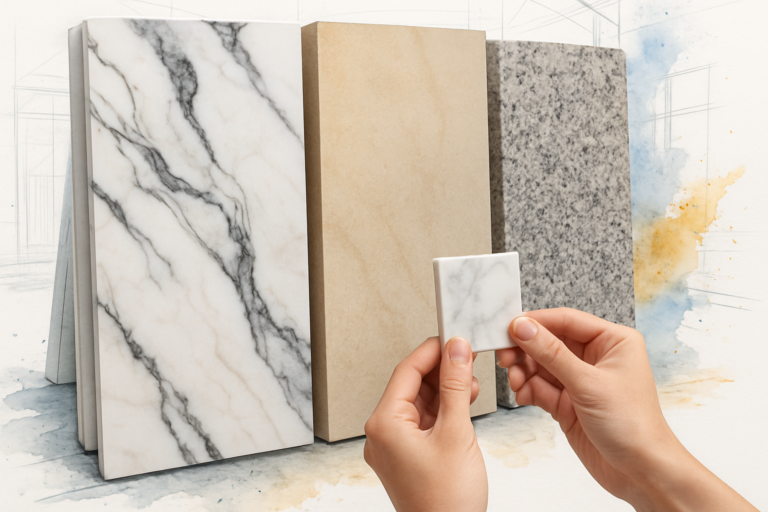
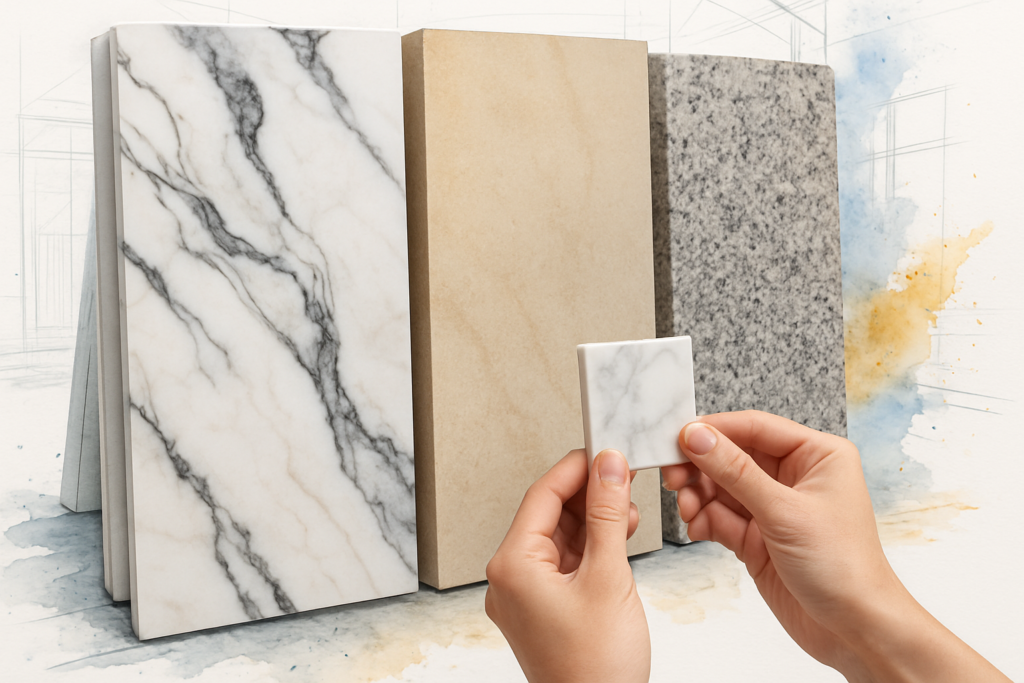
Direct Answer: Natural stone countertops are durable and beautiful, but hardness, porosity, and etch resistance are three different things, and confusing them leads to costly regret. Know all three before you choose.
You’ve done the research. You’ve saved the Instagram photos, read the reviews, maybe even picked out a name, Taj Mahal quartzite, Calacatta marble, something you saw on a design blog. And then a nagging question creeps in: will it actually hold up the way I’m imagining? That gap between how a stone looks in a catalog and how it performs on a real kitchen counter is where most buyers get tripped up.
Callers and form contacts arrive at Carmel Stone Imports almost daily with a material name already in hand, but genuinely unsure whether it will survive daily cooking, coastal humidity, or the habits of their household. The uncertainty is justified. Natural stone countertops are not all the same, and the properties that matter most, hardness, porosity, and etch resistance, are routinely lumped together or glossed over in the places most people do their research.
This article breaks down the three things that determine how a stone actually performs, explains what finish choice has to do with daily maintenance, and covers a simple test you can run at any showroom before you commit to a slab. No jargon, no sales pitch, just the stuff that helps you choose with confidence.
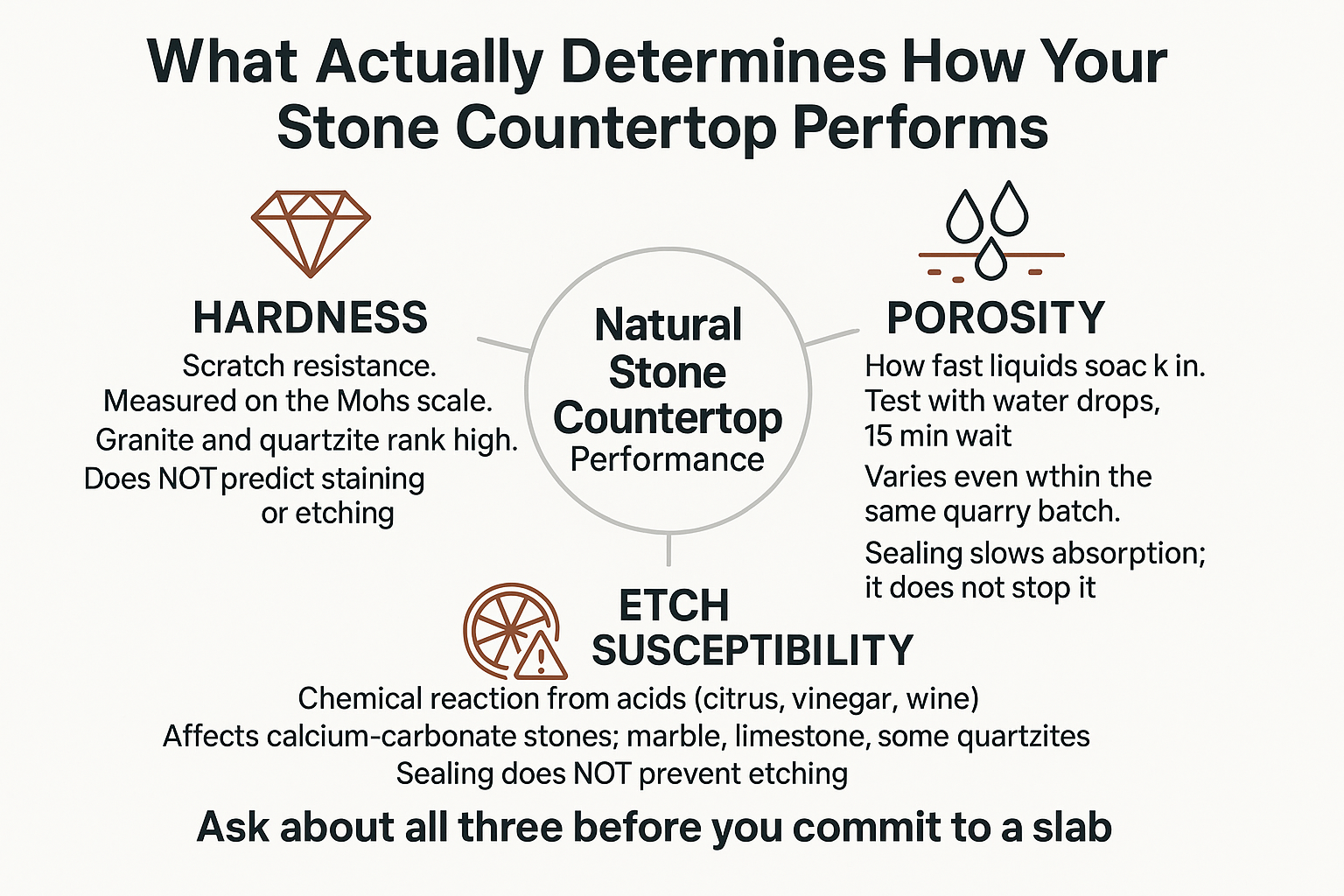
Hardness, Porosity, and Etching Are Three Different Things
This is the single most important thing to understand before choosing natural stone countertops, and it’s almost never explained clearly.
Hardness refers to scratch resistance. It’s measured on the Mohs scale, and stones like quartzite and granite rank high, meaning a key or a knife won’t easily mark them. That sounds like a green light for a kitchen, and in terms of scratching, it is.
But hardness tells you nothing about porosity, how readily the stone absorbs liquids. A highly porous stone will soak up olive oil, red wine, or coffee before you can wipe it up, leaving a stain that has nothing to do with how hard the surface is. And hardness definitely doesn’t tell you about etch susceptibility, the chemical reaction that happens when acids like lemon juice, vinegar, or tomato sauce come into contact with calcium-carbonate-based stones.
Marble is the most common example. It can be polished to a mirror shine, it resists scratching reasonably well, but it will etch from a splash of citrus every single time. Some quartzites marketed as ultra-durable are actually calcite-rich, which means they etch just like marble. Understanding how these properties play out across stone types is the starting point for any honest material comparison.
Before settling on a material, ask these three questions:
– How does this stone rank for scratch resistance?
– What is its typical porosity, and how often does it need sealing?
– Does it contain calcite, and will it etch from household acids?
The answers vary not just by stone type, but sometimes by quarry batch, which is why asking at a showroom with live inventory matters.
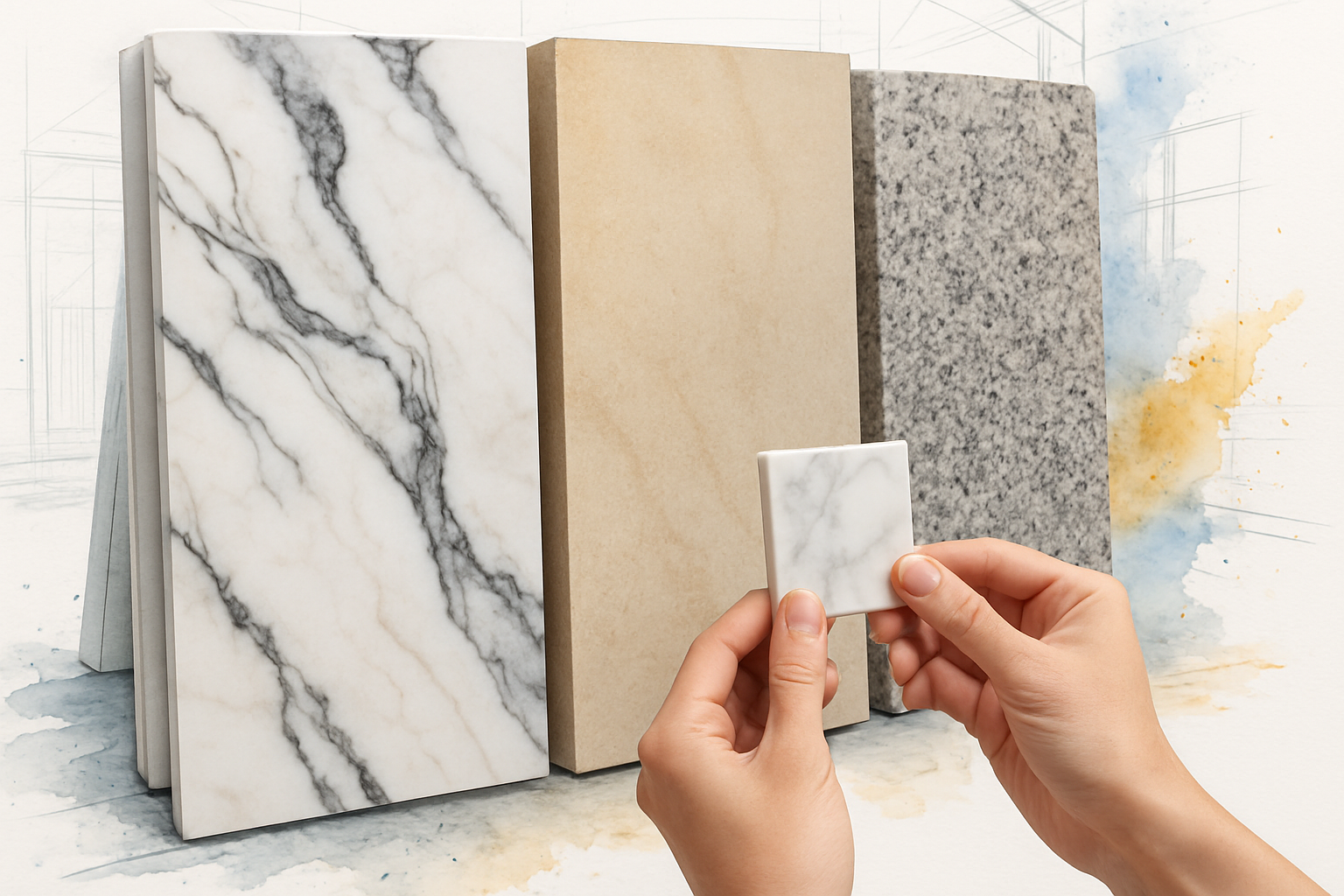
What Sealing Actually Does, and What It Doesn’t
Sealing is widely misunderstood, and that misunderstanding leads to disappointment. Many homeowners assume that a sealed stone is a protected stone, end of story. In practice, sealing reduces the rate at which liquids penetrate the surface. It does not make natural stone immune to staining, and it does nothing to prevent etching.
Think of it like water-resistant versus waterproof. A spill wiped up quickly on a freshly sealed surface might not stain. The same spill left sitting for an hour on the same surface might still soak in, seal or not.
Sealing cadence also varies significantly by material:
– Granite is generally denser and less porous, many granite countertops hold up well with resealing every 1-3 years depending on use
– Marble and limestone are more porous and may need resealing annually, or more often in a busy kitchen
– Quartzite is highly variable, two slabs from the same quarry can have meaningfully different porosity levels
That last point about quartzite is something buyers often don’t hear until after they’ve had a problem. Quartzite porosity variation is real, and it’s one reason why running a simple absorption test before committing to a slab is worth the two minutes it takes.
The test is straightforward: place a few drops of water on the surface and wait 15 minutes. If the water absorbs and darkens the stone, it’s porous and will need reliable sealing, and more frequent attention in use. If the water beads and sits on top, the stone is denser and more forgiving. You can ask to run this test on any slab at a showroom. A knowledgeable supplier will expect the question and welcome it.
For a deeper look at how the Mohs hardness scale applies to common countertop stones, the U.S. Geological Survey has a plain-language explanation worth bookmarking.
Finish Is a Performance Decision, Not Just an Aesthetic One
Most buyers think of finish, polished, honed, leathered, as a style preference. It is that, but it’s also one of the most practical decisions you’ll make about how your countertop holds up day to day.
Polished surfaces are achieved by grinding and buffing the stone to a high-gloss shine. On marble or limestone, that glossy surface shows etching immediately, any acid contact leaves a dull mark that disrupts the shine and is visible in certain light. The stone isn’t damaged in a structural sense, but the surface looks wrong, and refinishing it requires professional work.
Honed surfaces have a matte or satin look with no reflective sheen. On the same marble slab, a honed finish hides etching much better because there’s no high-gloss surface to disrupt. The mark may still be there, but it blends rather than stands out. Honed marble in a kitchen is a fundamentally different daily-use experience than polished marble, even though it’s the same stone.
Leathered finishes, created by running diamond-tipped brushes across the surface, add a slight texture and depth. On granite or quartzite, a leathered finish does something practical: it hides fingerprints and water spots that drive some homeowners genuinely crazy on polished surfaces. In kitchens with professional ranges, like many in larger homes in Palo Alto and Atherton, a leathered quartzite at a prep island handles the daily cooking environment with far less visible wear than a polished surface would.
The decision on finish often gets left to the fabricator, made late in the process, or defaulted to polished because that’s what people are used to seeing. Making it deliberately, based on how the stone will actually be used, is worth slowing down for. Questions to ask before choosing a marble slab covers this in more detail for marble-specific projects.
Natural Stone Countertop Properties at a Glance
This table summarizes how common natural stone types compare across the three properties that matter most in a kitchen or bathroom setting. Use it as a starting point, not a final answer, individual slabs vary.
| Stone Type | Scratch Resistance | Porosity / Stain Risk | Etch Susceptibility | Best Finish for Daily Use |
|---|---|---|---|---|
| Granite | High | Low to moderate, varies by slab | Very low, does not etch | Polished or leathered |
| Quartzite | High | Variable, test each slab | Low to moderate, depends on calcite content | Honed or leathered |
| Marble | Moderate | Moderate to high | High, etches from household acids | Honed (hides marks better) |
| Limestone | Low to moderate | High | High, similar to marble | Honed, polished shows wear quickly |
| Travertine | Moderate | High, porous by nature | Moderate to high | Filled and honed for countertop use |
The Three Properties That Determine Countertop Performance
Before choosing a natural stone countertop, it helps to see how hardness, porosity, and etch susceptibility each work, and what they actually mean for your kitchen.
Why the Slab You See Online Is Not Always the Slab You Get
Several buyers contact showrooms with a specific concern: they’ve found a stone they love on a supplier’s website, but they want to confirm that what they’d receive actually looks like the photo. The honest answer is that it doesn’t always.
Natural stone varies within a single quarry batch. Two slabs carrying the same name and sourced from the same quarry can look meaningfully different in veining density, background tone, and movement across the surface. A small sample chip from a showroom display, or a product photo online, represents one version of a stone, not a guarantee of what your slab will look like.
For a kitchen island or a master bath, this matters more than most people realize. If your project requires two or three slabs that need to visually match, say, a continuous run of countertop around a large kitchen, you need slabs from the same quarry lot. Asking which lot number or batch the slabs come from is a specific, practical question that any serious supplier should be able to answer.
Viewing slabs in person, from live inventory, is a genuinely different experience than choosing from a website. The difference between picking a marble slab in person versus online gets into this in more detail. And if you’re wondering what to expect on a first showroom visit, that’s worth reading before you make the trip.
A customer who found a leathered quartzite for their kitchen island, after searching widely, described the difference simply: seeing the actual slab standing upright in the warehouse, in full light, with the texture visible, was nothing like looking at it on a screen. That’s not a knock on photography. It’s just the nature of the material.
Local Conditions That Change the Conversation: Coastal Humidity and Outdoor Applications
Where a stone will live matters as much as what it is. Two regional conditions specific to the Monterey Peninsula and Bay Area are worth understanding before you fall in love with a material.
Coastal humidity in Carmel-by-the-Sea and Pacific Grove is real and persistent. Stones with high porosity, unsealed limestone, travertine, or certain marbles, absorb moisture from the air over time. In a bathroom with limited ventilation near the coast, that can accelerate surface wear, promote mineral deposits, or create conditions where staining is harder to prevent even with regular sealing. Whether travertine makes sense in a coastal California bathroom is a question worth thinking through for any Monterey Peninsula project.
Outdoor countertop applications are increasingly common on the Monterey Peninsula, covered terraces, outdoor kitchens with built-in grills, and exterior prep surfaces. These applications require stones that can handle UV exposure and temperature cycling without degrading. Not every natural stone is suited for outdoor use:
– Granite generally handles outdoor conditions well, dense, UV-stable, and less prone to freeze-thaw damage
– Quartzite can work outdoors but needs careful vetting for porosity before outdoor installation
– Marble and limestone are typically not recommended for outdoor countertop surfaces exposed to weather, UV exposure dulls polished finishes, and moisture cycling causes deterioration over time
– Porcelain slabs are a common choice for outdoor applications precisely because they are non-porous and UV-stable
For larger homes in Palo Alto or Atherton where professional ranges are common, thermal shock is another variable. Hot pots set directly on a cold stone surface can cause micro-cracking over time in certain materials. Granite and quartzite handle thermal cycling better than marble or limestone. It’s worth raising the question of how a stone handles heat before the fabricator installs it.
Frequently Asked Questions About Natural Stone Countertops
Is quartzite really harder and more durable than marble?
Quartzite is generally harder than marble on the Mohs scale, which means it resists scratching better. But some stones sold as quartzite contain significant amounts of calcite, which means they etch from acids just like marble does. The name alone doesn’t tell the whole story. Ask specifically whether the slab is calcite-rich and whether it passed an acid test before assuming it’s more durable than marble for your kitchen.
How often do I actually need to reseal a natural stone countertop?
It depends on the stone. Granite is typically dense enough that resealing every 1-3 years is sufficient for most kitchens. Marble and limestone are more porous and may need resealing annually, especially in a heavily used kitchen. Quartzite varies, porosity differs even between slabs from the same batch, so the water-drop test (15 minutes on the surface) gives you a real baseline before you commit.
Can I put a sealed marble countertop in my kitchen and not worry about etching?
Sealing does not prevent etching. Etching is a chemical reaction between acids and the calcium carbonate in marble, it happens at the surface level regardless of what sealant is applied. A honed finish hides etch marks far better than a polished finish, because there’s no high-gloss surface to disrupt. If your kitchen sees citrus, vinegar, wine, or tomato regularly, a honed marble or a switch to granite or quartzite is worth considering.
If I need two slabs for a large kitchen, how do I make sure they match?
Ask for slabs from the same quarry lot or batch. Natural stone varies between lots, background tone, veining intensity, and movement can shift noticeably even within the same named material. When visiting a showroom, bring your measurements, view the actual slabs side by side in upright position, and ask specifically which batch they’re from. Never rely on online photos or small sample chips to confirm a match across multiple slabs.
What natural stones work for outdoor countertops on the Monterey Peninsula?
Granite is the most reliable natural stone for outdoor countertop use, it’s dense, UV-stable, and handles temperature cycling well. Some quartzites work outdoors but should be tested for porosity first. Marble and limestone are generally not good candidates for outdoor countertop surfaces exposed to weather and UV. Porcelain slabs are a practical alternative for outdoor kitchens specifically because they are non-porous and highly UV-resistant.
What should I do at the showroom before committing to a slab?
Three things worth doing in person: run the water-drop test (a few drops left on the surface for 15 minutes) to check porosity, view the slab upright in full light rather than flat on a cart, and ask which quarry lot it’s from, especially if you need more than one slab. Also ask about finish options. The decision between polished, honed, and leathered is a performance decision as much as an aesthetic one, and it’s easier to make standing in front of the actual stone.
Ready to See the Actual Slabs Before You Decide?
Carmel Stone Imports keeps live inventory across its Carmel-by-the-Sea and Palo Alto showrooms, so you can view and select the real slab, not a catalog photo, before anything gets ordered or fabricated. If you have a material in mind and want to run a porosity test, compare finishes in person, or ask the kind of questions this article raised, a showroom visit is the most practical next step. Call (650) 800-7840 or email info@carmelimports.com to check current availability or set up a slab selection appointment.