Direct Answer: Online photos can’t show you true color, movement, or scale. Marble slabs vary dramatically even within the same batch — selecting in person is the only way to know exactly what you’re getting.
You found a marble slab online that looks perfect. The photo shows clean white stone with dramatic grey veining, and the price seems reasonable. Then the slab arrives — or you visit the yard — and it looks almost nothing like what you expected.
This happens constantly. Marble is a natural material quarried from the earth, and no two slabs from the same block are identical. A camera compresses color, flattens texture, and can’t capture how a 10-foot slab actually reads in a room. For homeowners on the Monterey Peninsula investing in a kitchen or bathroom remodel, that gap between screen and reality is where expensive mistakes get made.
This article walks through exactly what you can and can’t assess online, what changes when you select a slab in person, and which details actually determine whether you’ll love the stone five years from now.
What a Photo Actually Can’t Tell You About a Marble Slab
The biggest problem with online slab shopping isn’t the catalog — it’s the confidence it creates. A well-lit photo of a Calacatta Oro slab looks convincing. But there are at least four things a photo structurally cannot communicate:
- Color accuracy: Stone photography is typically shot under controlled lighting that warms cool tones and brightens dull backgrounds. The same slab under the overcast natural light common along the Carmel coast can read 15-20% cooler or greyer than the photo suggests.
- Movement and scale: Veining in marble is not a repeating pattern. The veining you see in a cropped photo occupies a specific 18-inch zone of a slab that may be 120 inches long. You can’t predict the full picture from a detail shot.
- Surface finish: Polished, honed, and leathered finishes interact with light completely differently. A polished Carrara reads almost silver-white in bright light and dark charcoal in shadow. A photo collapses that range into a single moment.
- Thickness and edge profile: Most online listings show face-on images. You can’t gauge the actual slab thickness — 2cm vs. 3cm is not a minor difference when you’re pricing fabrication and edge treatment.
None of these are flaws in the photography. They’re limitations of the medium. Stone is three-dimensional, light-reactive, and alive in a way that a flat image simply cannot carry.
What Actually Changes When You Select a Slab in Person
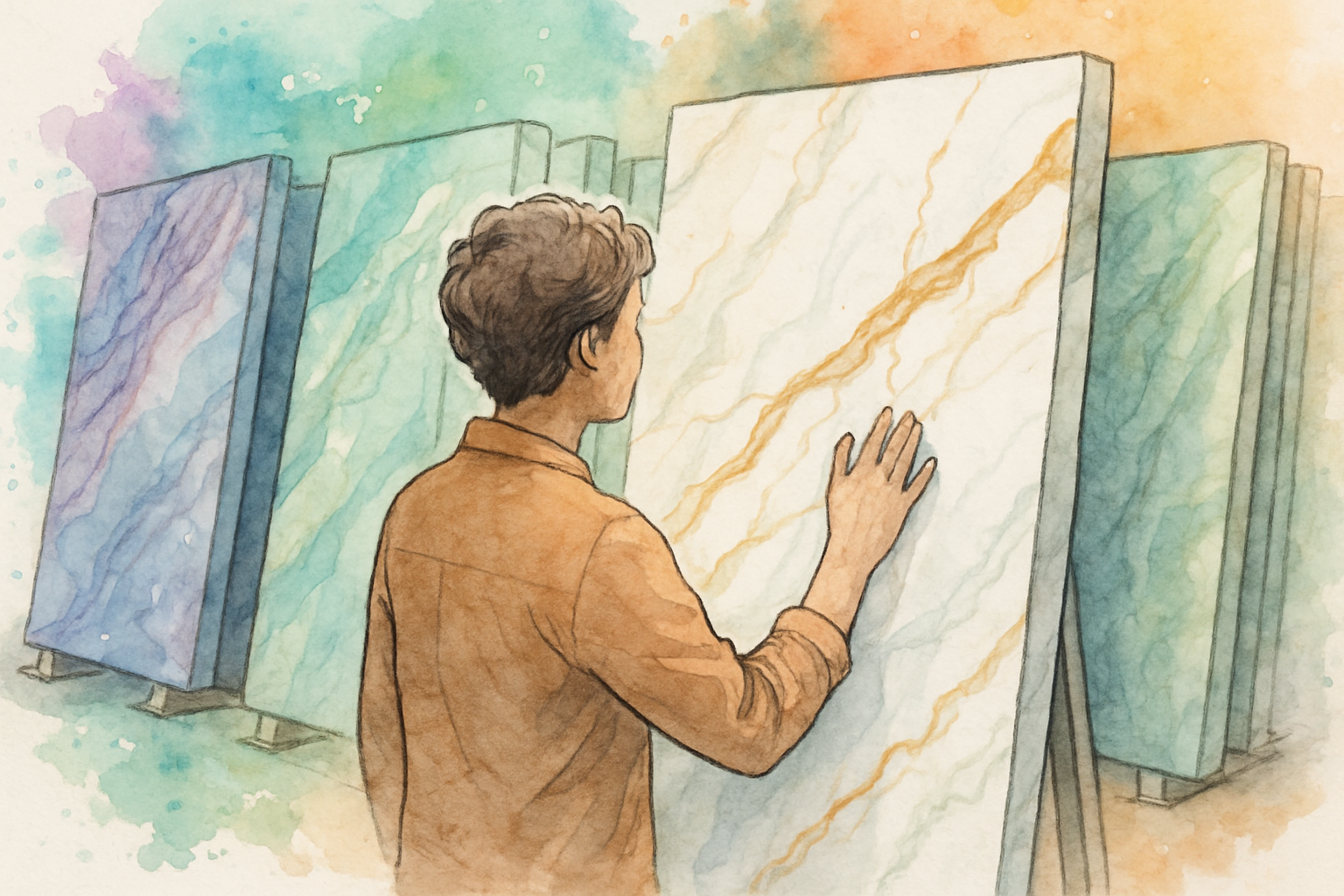
Standing in front of a full-size slab changes the decision entirely. Here’s what becomes visible — and solvable — in a showroom that simply isn’t on a screen.
You can see the full slab movement. Marble like Paonazzetto, Statuario, or Nero Marquina has veining that travels the entire length of the stone. When you’re standing 8 feet back from a vertical slab rack, you can read that movement the way it will actually read across a kitchen island. You can ask to see two book-matched slabs opened side by side.
You can compare material under real lighting conditions. The Carmel showroom has both controlled indoor lighting and areas where natural light enters the space. Running your shortlist of slabs through both conditions takes about 15 minutes and eliminates a category of regret that no online return policy can fix.
You can hold material samples against your cabinet door. Many homeowners arrive with a cabinet door sample, tile sample, or paint chip. Seeing a marble slab next to your actual finish — not a photo of both — tells you immediately whether the undertones work together. Warm cream veining in a Botticino marble next to a cool-toned white cabinet can look jarring in a way no mood board predicts.
If you haven’t visited a stone showroom before, what happens when you visit a stone showroom for the first time walks through exactly what to expect — including how slab selection appointments work and what to bring.
You can assess the actual inventory lot. Stone sold by the same supplier under the same name can vary significantly between shipments. Seeing the specific slabs currently in stock — not the catalog reference image — is the only way to know what you’re actually committing to.
In Person vs. Online: What You Can Actually Assess
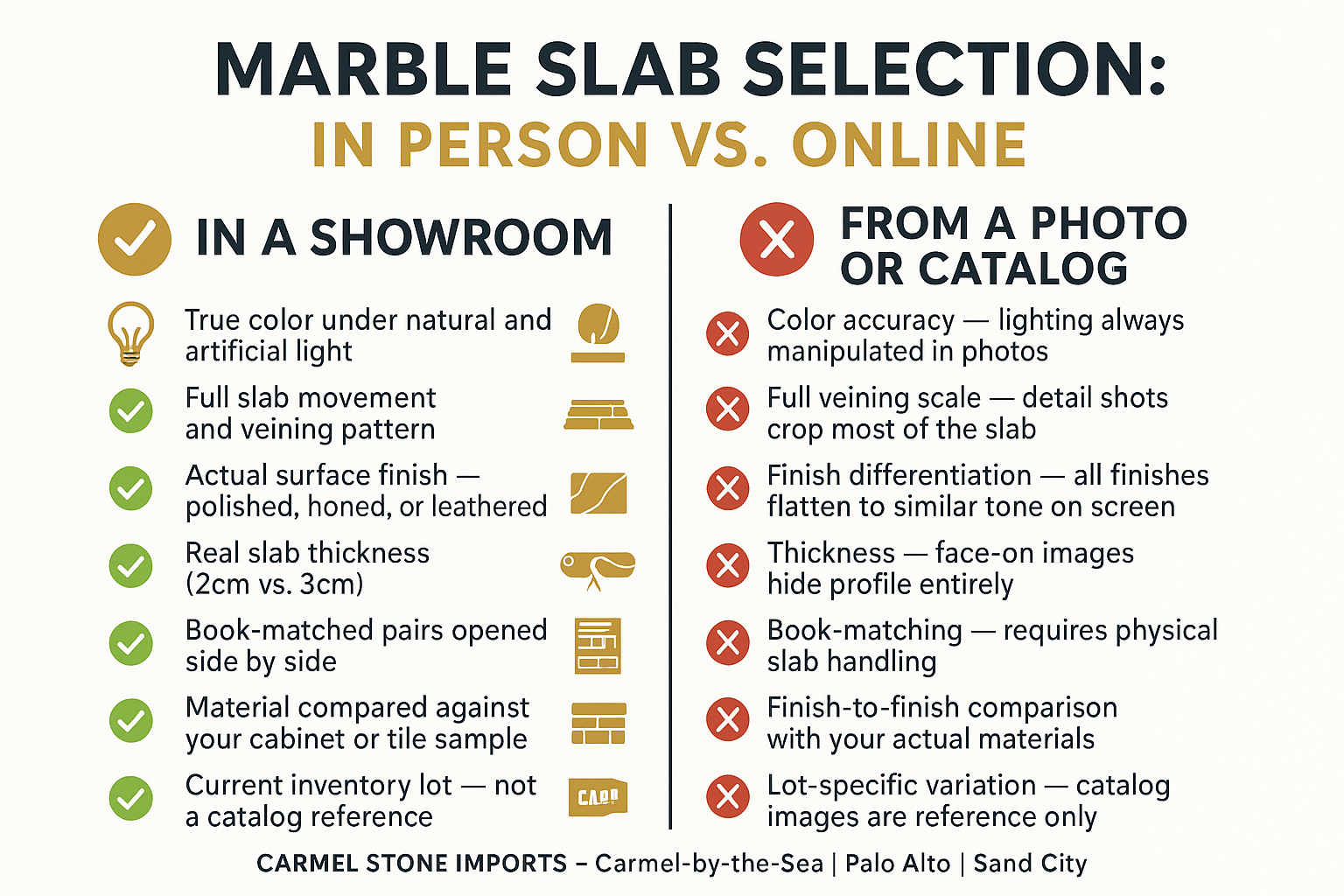
This comparison shows what a slab selection process reveals in person versus what remains hidden when shopping from photos alone.
The Risk That’s Hardest to Recover From
The worst outcome in a marble slab purchase isn’t hating the stone — it’s realizing the problem after fabrication has started. Once a slab is cut, the options for recourse are extremely limited.
Fabricators on the Monterey Peninsula typically charge between $65 and $120 per square foot for marble fabrication, depending on edge profile complexity and finish. That’s money spent before a single piece of stone is installed. If the slab turns out to be a different tone than expected, or if the veining runs in a direction that doesn’t work with the layout, there’s no practical fix.
This is especially true with marble varieties that have strong directional movement — Arabescato, Calacatta Vagli, or any slab with bold diagonal veining. How you orient the stone relative to the sink, the island seam, or the shower niche changes the entire visual weight of the installation. That orientation decision needs to happen in front of the actual slab, ideally with a simple layout sketch in hand.
Designers working on Pacific Heights or Pebble Beach projects — where countertop budgets often run $8,000 to $20,000 for a primary kitchen — treat in-person slab selection as non-negotiable precisely because the cost of getting it wrong is so high. For homeowners, the logic is the same even at smaller scale.
Common Marble Varieties: What Online Photos Consistently Misrepresent
These are among the most frequently selected marble types — and the ones where the gap between catalog image and physical slab is most pronounced.
| Marble Variety | What Photos Overstate | What You Need to See in Person |
|---|---|---|
| Calacatta Oro | Gold veining appears bolder and warmer than most lots deliver | Actual gold intensity and vein frequency across full slab length |
| Statuario | Background white reads brighter under studio lighting than in natural light | True background tone under daylight — often cooler and more grey |
| Paonazzetto | Purple-red tones photograph dramatically; real slabs vary widely | Color saturation and whether the veining is tight or open across the field |
| Arabescato | Cropped detail shots hide how dominant the grey field becomes at scale | Full movement direction and whether grey or white dominates your square footage |
| Nero Marquina | Black reads flat in photos; real slabs show depth and white vein variation | Vein density and background depth under both natural and artificial light |
| Emperador Dark | Brown tones shift significantly between warm and cool light sources | Undertone under the specific lighting conditions of your project space |
When Online Research Is Actually Useful
Online research isn’t useless — it just serves a different purpose in the process. Before you visit a showroom, looking at catalog images and supplier galleries is a good way to build a working shortlist.
Use online research to:
- Identify material categories — do you want dramatic movement or quiet, consistent pattern?
- Learn basic terminology — understanding the difference between Calacatta and Carrara before you arrive saves time and prevents confusion
- Understand performance expectations — knowing that marble is softer than quartzite and will show etching from acidic liquids is information that shapes the right decision, not just the aesthetic one
- Build a rough budget range — marble slabs in the Bay Area and Central Coast markets typically range from $40 to $180 per square foot for the material alone, depending on origin and rarity; online research can help you understand where a specific stone sits in that range
For homeowners who are also weighing other materials, the real difference between these three stone surfaces is a useful read before your appointment. And if you’re genuinely undecided between marble and a harder alternative, granite, quartz, or porcelain — how do you actually decide? covers the durability and maintenance trade-offs without the sales angle.
The point is that online research builds vocabulary and a shortlist. In-person selection is where that list gets narrowed to one — the specific slab that actually works.
Frequently Asked Questions About Selecting Marble Slabs
Can I order a marble slab online and return it if it doesn’t match the photo?
Most stone suppliers do not accept returns on slabs once they’ve been released for pickup or delivery — especially if any cutting has occurred. Natural stone is sold as-is by lot, and variation from reference images is considered standard in the trade. A few online retailers offer credits but apply restocking fees that can run 15-25% of the slab cost. The cleaner path is simply selecting in person before committing.
How much does it actually matter which specific slab I pick if they all come from the same quarry?
It matters a lot. Even slabs from the same block pulled the same week can vary in background tone, vein density, and color saturation. Two Calacatta slabs listed under the same product name at the same supplier can read noticeably different side by side. Quarry origin sets the general character of the stone, but each individual slab is unique. Picking your specific slab — not just a material name — is the actual decision.
What should I bring to a slab selection appointment?
Bring your cabinet door sample if you have one, a photo of your flooring, your rough square footage measurements, and any tile or fixture samples that will live in the same space. If you’re working with a designer, they’ll typically bring their own reference materials. The more physical samples you can hold against the stone in the showroom, the more accurate your final read will be.
Is it worth driving from San Jose or San Francisco to see slabs in person?
For a marble selection that affects the primary kitchen or master bath, yes — consistently. Homeowners in Atherton, Menlo Park, and Pacific Heights regularly make the drive to the Palo Alto location specifically to see live inventory before committing to material for projects in the $15,000–$40,000 range. The drive is a few hours. A wrong slab choice can cost several thousand dollars in fabrication and replacement costs, plus weeks of project delay.
Can I take samples home before making a final decision?
Yes. Most stone showrooms offer material samples for take-home review so you can see how the stone reads in your actual space under your specific lighting conditions. This is particularly useful for marble because residential lighting varies dramatically — a slab that looks warm and creamy under showroom lighting may read cooler in a north-facing kitchen with no direct sun.
How do I know if the marble I’m looking at will hold up in my kitchen?
Marble is a calcite-based stone, which means it will etch from acidic liquids — citrus juice, vinegar, wine — regardless of how well it’s sealed. Sealing slows water absorption but does not prevent etching. In a heavily used kitchen, expect to see light surface etching within 12-18 months on most polished marble finishes. Honed finishes tend to hide etching better than polished ones. If acid sensitivity is a concern for your household, quartzite or porcelain may be a better fit — here’s how porcelain slabs compare for countertop use.
Ready to See the Actual Slabs?
Carmel Stone Imports maintains live inventory across its showroom and warehouse locations in Carmel-by-the-Sea, Palo Alto, and Sand City — so every slab you’re considering can be viewed in person before any commitment is made. To schedule a slab selection appointment or ask about current marble inventory, call (650) 800-7840 or email info@carmelimports.com.