Direct Answer: Some quartzite is more porous than buyers expect — and some slabs sold as quartzite are actually marble or dolomite. The right pre-purchase tests and proper sealing can prevent most staining problems before they start.
You paid for quartzite. You had it installed. And within a few weeks, there’s a dark ring near the edge where someone set a wine glass — or a faint stain running along one of the veins. This is one of the most common frustrations we hear about from homeowners across the Monterey Peninsula and the Bay Area, and it almost always traces back to something that could have been caught before the slab was ever purchased.
The problem isn’t always what people think. Sometimes the stone itself is more porous than expected. Sometimes what was sold as quartzite isn’t true quartzite at all. And sometimes the sealing step was done correctly — but on a stone that sealing alone can’t fully protect.
This article covers the three things that matter most: how to tell what you’re actually buying, how to test a specific slab before any money changes hands, and what sealing genuinely does — and where it stops.
Not Everything Labeled Quartzite Is Actually Quartzite
This is where most staining problems start — at the point of purchase, before a single tile is cut.
True quartzite is a metamorphic rock, formed when sandstone is subjected to extreme heat and pressure. That process fuses the quartz grains so tightly that the resulting stone is genuinely dense and hard. A true quartzite slab typically scores 6 to 7 on the Mohs hardness scale and absorbs very little liquid under normal conditions.
But the word “quartzite” gets applied loosely in the stone industry. Marble-like stones — particularly soft, calcite-rich materials from Brazil — are routinely labeled as quartzite at the quarry level or by importers who aren’t careful with their sourcing. By the time a slab reaches a showroom floor, it may carry a beautiful quartzite-sounding name and look the part, while behaving much more like marble or dolomite.
If you’ve read our piece on how dolomite stone looks like marble but behaves differently, this pattern will feel familiar. The same labeling confusion that affects dolomite affects soft quartzite — and the stakes are identical.
Signs you may not have true quartzite:
– The slab has a soft, chalky feel when you drag a key across an inconspicuous edge
– The veining looks almost identical to Calacatta or Statuario marble
– The price is unusually low for an imported natural stone
– The country of origin is Brazil and the supplier can’t name the quarry or provide a mineralogy sheet
Asking your supplier where the stone came from and whether they can verify it as true quartzite isn’t unreasonable. A supplier who knows their inventory should be able to answer.
The Three Tests That Reveal How a Slab Will Actually Behave
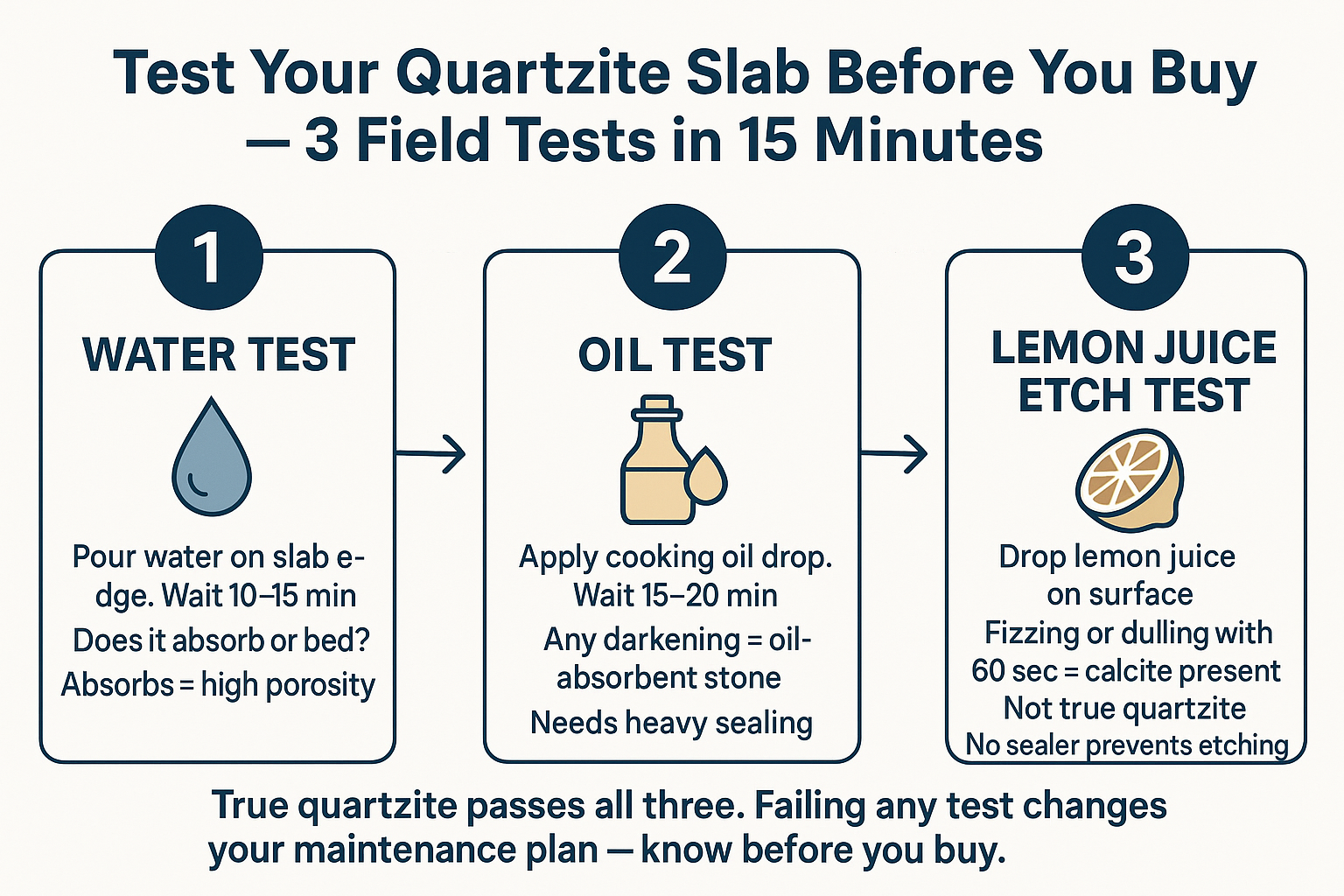
Before you commit to a slab, you can run three simple tests that will tell you more than any product description ever will. These aren’t lab procedures — they take about ten minutes and require nothing more than water, cooking oil, and a drop of lemon juice.
Test 1: The Water Test
Pour a small amount of water on an inconspicuous area of the slab — ideally near an edge or corner — and wait 10 to 15 minutes. On dense, low-porosity stone, the water will bead up and sit on the surface. If it darkens the stone or absorbs quickly, that slab is porous and will require diligent sealing and ongoing maintenance.
Test 2: The Oil Test
Apply a small drop of cooking oil the same way. Oil molecules are larger than water molecules, so a stone can pass the water test and still absorb oil slowly. Watch for any darkening over 15 to 20 minutes. This matters especially for kitchen countertops, where cooking oils are a daily reality.
Test 3: The Lemon Juice Etch Test
This one specifically identifies whether you’re dealing with a calcite-bearing stone — marble, soft dolomite, or a mislabeled “quartzite” — rather than true quartzite. Put a small drop of lemon juice on the surface. If the stone fizzes, dulls, or etches within 30 to 60 seconds, it contains calcite. True quartzite will not react at all. Etching is a chemical reaction, not a staining issue — and no sealer on the market prevents it.
Some showrooms are comfortable letting you run these tests on slab samples or on back edges of display slabs. If you’re viewing actual slabs — not catalog images — you can evaluate the material for real before any purchase decision is made. That’s one of the core reasons seeing a slab in person matters so much.
The Pre-Purchase Slab Test Sequence
These three field tests take about 15 minutes and can save you years of maintenance frustration. Here’s how to run them in order.
What Sealing Actually Does — and Where It Stops
Sealing is not a shield. This is probably the most important clarification in this entire article.
A penetrating sealer works by filling the microscopic pores in stone with a water- and oil-repelling compound. It slows absorption — giving you more time to wipe up a spill before it soaks in. On a properly sealed, genuinely dense quartzite, that window might be 30 minutes to an hour. On a soft, porous stone, even a freshly applied sealer may give you only a few minutes.
Sealing does not prevent etching from acids (citrus juice, wine, vinegar, some cleaning products). It does not close open veins or natural fissures — which is why staining so often appears along veining first, as multiple callers and homeowners have described. And it does not last forever. Most penetrating sealers on natural stone need to be reapplied every one to three years, depending on use and the specific stone.
One more wrinkle worth understanding: some slabs arrive from the quarry with a resin coating already applied to the surface. Resin fills micro-fissures and improves the visual consistency of the slab. But it also means the stone can behave very differently during installation than it will six months later, once the resin wears in high-traffic areas. Ask your supplier directly whether a slab has been resin-treated — and factor that into your maintenance expectations from day one.
For more on how material choices compare on the durability front, the real difference between these three stone surfaces is worth a read before finalizing any countertop decision.
How Common Quartzite Scenarios Compare on Stain Risk
This table gives a quick reference for how the main quartzite situations differ when it comes to staining, etching, and sealing needs.
| Stone Type | Stain Risk | Etch Risk | Sealing Frequency |
|---|---|---|---|
| True dense quartzite | Low | None | Every 2–3 years |
| Porous quartzite | Moderate to high | None | Every 1–2 years; reapply if water absorbs |
| Mislabeled quartzite (calcite-bearing) | Moderate to high | High — acids will dull the surface | Sealing slows stains; does not prevent etching |
| Resin-coated quartzite slab | Low initially, rises as resin wears | Depends on underlying stone | Re-evaluate after 12–18 months of use |
If Staining Happens After Install — Here’s the Escalation Path
Even when a buyer does everything right, problems can still surface after installation. The key is knowing who handles what — because calling the wrong party first wastes time and rarely gets you to a resolution.
Start with the material supplier. If the staining appears within weeks of install and you have questions about whether the stone itself performed as described, that conversation belongs with whoever sold you the slab. A good supplier can tell you what that specific stone’s porosity profile should look like, whether resin-coating was applied, and what the expected maintenance requirements were at time of sale. That’s the first call.
For workmanship concerns, go to the fabricator. If the staining is concentrated along cut edges or joints — places the fabricator touched — that points to a finishing issue, not a material issue. Unsealed cut edges are a known failure point. Your fabricator should stand behind their work.
For surface repair and restoration, bring in a stone restoration professional. Stains that have already set, etches that have dulled the surface, or honing damage from improper cleaning products all fall into this category. These specialists have the right chemicals and abrasives to address the stone without causing further damage. This is different from routine sealing — it’s a remediation step, and it requires someone who works on stone surfaces professionally.
If you’re already troubleshooting an existing issue, safe quartzite countertop stain removal methods covers the cleaning side in more detail.
Frequently Asked Questions About Quartzite Staining
Why is the staining worst along the veins and edges of my quartzite?
Veins in natural stone are often softer, more porous, or differently composed than the surrounding matrix. They absorb liquids faster. Edges are especially vulnerable because cut stone surfaces — if not sealed properly by the fabricator after cutting — are essentially open to whatever they contact. Both patterns are common and both are addressable with the right sealer applied thoroughly across the entire surface, including edges.
Can I test a slab before I buy it at a showroom?
At many showrooms that carry live inventory — actual slabs rather than catalog samples — you can request to run simple field tests on a slab edge or a sample piece. The water test and lemon juice etch test in particular take only a few minutes. It’s worth asking before you commit.
My quartzite etched when I spilled lemon juice on it. Is that a defect?
If the stone reacts to acid, it contains calcite — which means it’s not true quartzite, regardless of what it was labeled. This is a labeling issue, not a manufacturing defect in the traditional sense. Etching cannot be sealed away. A stone restoration professional can re-hone or re-polish etched areas, but the stone will continue to etch from acid exposure going forward. Understanding this before purchase is the cleanest solution.
How often do I actually need to reseal quartzite?
It depends on the specific stone’s porosity — not the category label. The simplest test: pour water on the surface and watch. If it absorbs within a few minutes, reseal. If it still beads after 15 minutes, the sealer is holding. Dense quartzite may only need sealing every two to three years. More porous stones may need it annually or even more frequently in high-use kitchen environments.
Does a resin-coated slab need different care?
Yes, at least initially. Resin-treated slabs can behave as though they’re more resistant than the underlying stone actually is. As the resin wears — particularly in high-traffic zones — the real porosity of the stone starts to show. Ask your supplier whether the slab was resin-treated and plan to reassess your sealing routine after the first year of use.
What’s the difference between a stain and an etch on quartzite?
A stain is a discoloration caused by a substance absorbing into the stone — oil, wine, coffee. It sits beneath the surface. A stain can often be drawn out with a poultice if caught early. An etch is a chemical reaction that physically changes the surface of the stone — acids dissolve the calcite, leaving a dull spot. Etches are not removable by cleaning; they require mechanical restoration. Knowing which problem you have determines how you address it.
Want to See How a Specific Slab Actually Tests Before You Commit?
The showrooms at Carmel Stone Imports — in Carmel-by-the-Sea and Palo Alto — carry live inventory, which means you can view and evaluate actual slabs, not photographs. Staff can walk you through the material characteristics of any slab you’re considering and help you understand what the maintenance expectations really are before any purchase decision is made. To schedule a slab selection appointment or ask about current quartzite inventory, call (650) 800-7840 or email info@carmelimports.com.