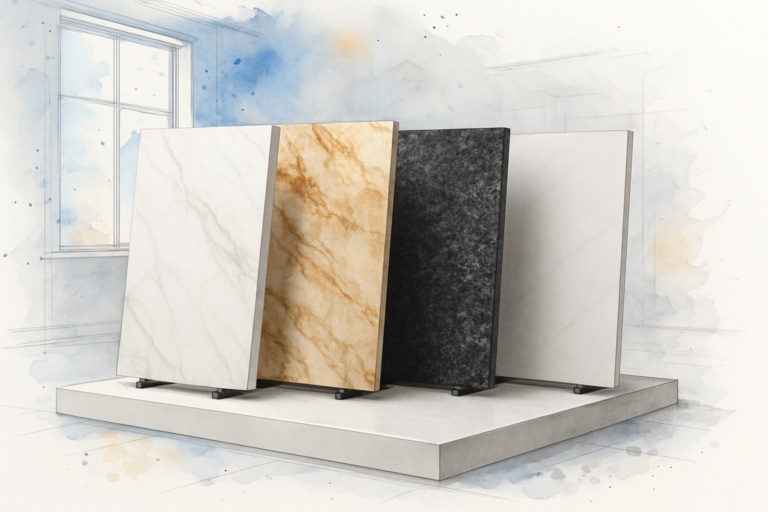
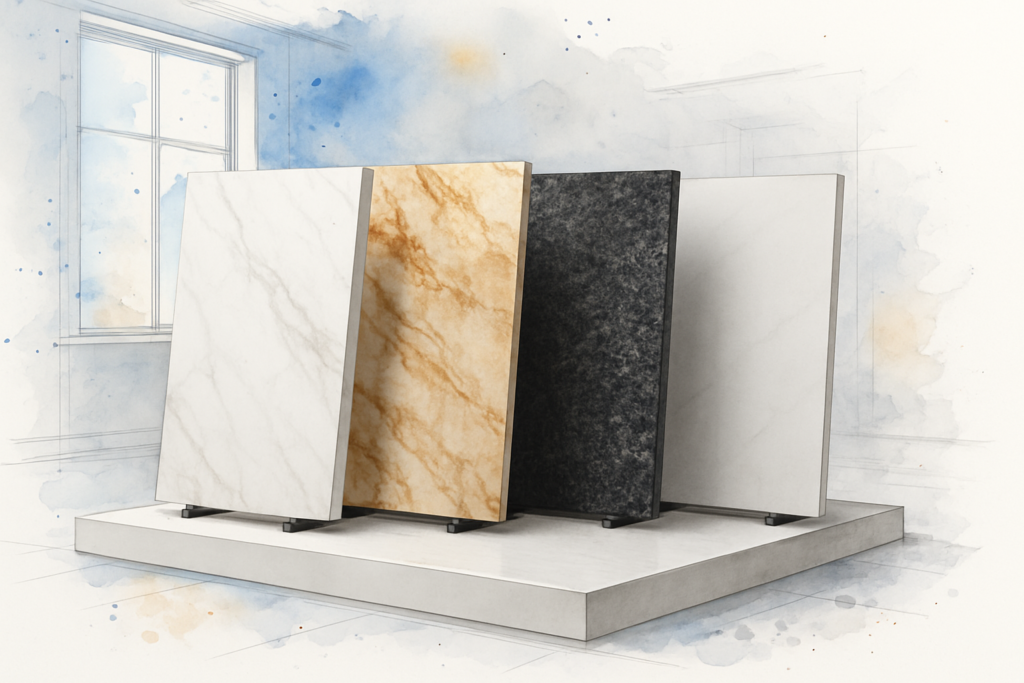
Direct Answer: The right countertop material depends on how your kitchen or bath actually gets used — not just how it looks. Marble etches, true quartzite doesn’t, granite is tougher than most people think, and porcelain punishes bad fabrication.
Most people walk into a stone showroom knowing roughly what they want — something white and dramatic, or whatever holds up in a busy kitchen. What they don’t know yet is that ‘white stone’ covers a dozen different materials with completely different maintenance requirements, porosity levels, and price tiers. That gap between what you imagine and what the materials actually do is where most countertop regrets are born.
The good news is that the decision gets a lot clearer once you understand what you’re actually choosing between — not just aesthetically, but physically. Marble, quartzite, granite, and porcelain slab are four genuinely different things. They look similar in photos. They do not behave similarly in a kitchen near Carmel-by-the-Sea, where a morning squeeze of lemon or a glass of Central Coast wine can tell you everything about which material you actually bought.
This guide is built around performance first. Once you understand how each material behaves day to day, the aesthetic decision gets easier — and you stop second-guessing yourself six months after installation.
Marble: Beautiful, But Only If You’re Honest With Yourself
Marble is the most requested material in almost any stone showroom, and also the most misunderstood. Homeowners frequently assume that because it’s expensive and looks refined, it must be durable. The reality is more complicated.
Marble is calcium carbonate. That means it reacts chemically with acids — lemon juice, vinegar, wine, tomato sauce — and etches on contact. An etch is not a stain. A stain is a discoloration from something absorbed into the stone. An etch is a dull mark where the acid has actually altered the surface of the stone itself. You can’t seal your way out of etching.
The finish matters enormously here. Polished marble shows etch marks sharply — every dull ring from a citrus glass will be visible against the reflective surface. Honed marble (a matte finish) hides those same marks far better, because there’s no shine to contrast against. If you love marble and want it in a kitchen that sees real cooking, honed is almost always the smarter choice.
Using marble in a hard-use kitchen isn’t a mistake — it’s an informed choice that requires genuine maintenance acceptance. Some of the most beautiful kitchens in Pebble Beach and Carmel-by-the-Sea have honed Calacatta countertops that have developed a natural patina over years of use. The owners knew what they were getting. That’s the difference between a good decision and a frustrating one.
If you want to go deeper on what happens when marble or marble-look materials hit everyday wear, the real difference between these three stone surfaces covers that in detail.
Quartzite: The Most Misrepresented Stone on the Market Right Now
True quartzite is one of the best natural stone countertop options available — genuinely hard, silica-based, and resistant to etching in a way marble simply isn’t. The problem is that a significant number of stones being sold as quartzite are not actually quartzite. They are soft marble, transitional dolomite, or calcite-bearing material that will etch and stain just like marble.
This isn’t a small problem. Callers arrive at showrooms across the Monterey Peninsula after spending several hundred dollars per slab on a stone they were told was ‘basically bulletproof’ — only to watch it etch within weeks of installation. The misrepresentation often isn’t intentional, but the result for the buyer is the same either way.
Here’s how to check before you buy: Leave a few drops of lemon juice or white vinegar on the surface of the slab for 10 minutes, then wipe it off. True quartzite will show no change. Calcite-bearing stone — marble, dolomite, or mislabeled ‘quartzite’ — will show a dull etch mark where the acid touched it. This test costs nothing and takes ten minutes. It can save you thousands.
This is one reason why why brand-new quartzite sometimes stains — and how to prevent it is worth reading before you finalize any quartzite purchase. The line between true quartzite and transitional materials is blurry in the market right now, and knowing what to ask matters.
One customer who visited the Sand City location described it well: she arrived with a specific leathered quartzite in mind after searching for months, and the difference between seeing the actual slab in person — and confirming its behavior — versus trusting a catalog image was the thing that gave her confidence to commit.
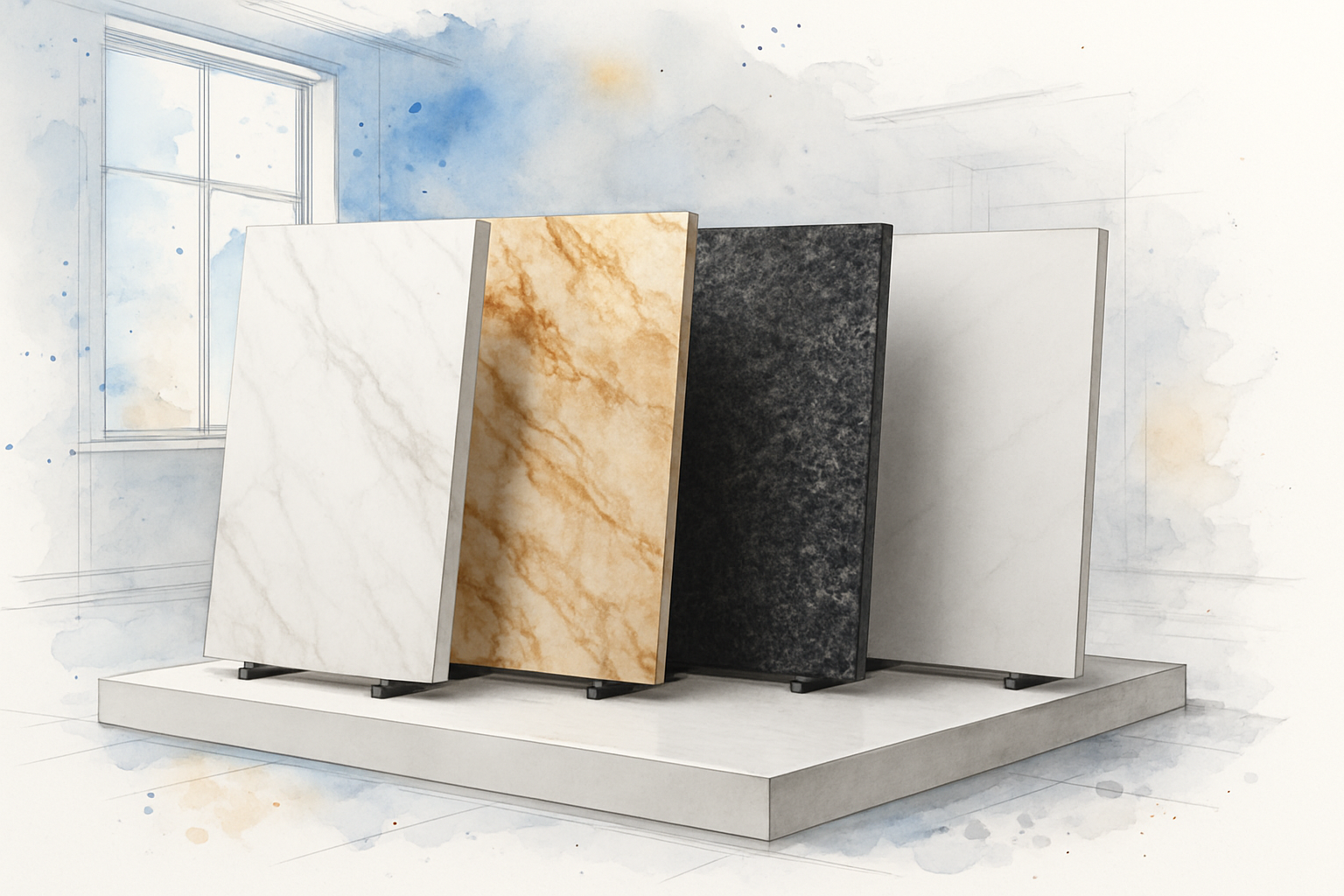
Granite: The Durable Natural Stone That Deserves a Second Look
Granite fell out of fashion during the quartz countertop surge of the 2010s, and it’s been underestimated ever since. But among buyers who want a natural stone that genuinely performs without constant maintenance anxiety, granite is staging a real comeback — and for good reason.
True granite is silica-based, which means it does not etch the way marble or softer quartzites do. Spill wine on granite and wipe it up — no chemical reaction, no dull mark. Most granite only needs sealing once a year, and denser granites may go longer between sealings depending on the stone. This is a fundamentally different maintenance conversation than marble.
The other thing that surprises people when they see live slabs: granite’s range. Most homeowners picture the speckled beige countertops from early-2000s kitchens. Current granite inventory — particularly material sourced from Brazil, India, and Norway — includes stones with dramatic movement, deep blacks, rich blues, and warm golds that read as design-forward in any kitchen.
For a practical guide on picking the right slab without second-guessing the decision later, how to pick a granite slab without second-guessing yourself walks through the selection process in detail. If you haven’t looked at granite seriously in five years, the current options may change your mind.
How These Four Materials Compare at a Glance
This side-by-side comparison covers the factors that actually matter in a countertop decision — etching risk, sealing frequency, repairability, and fabrication sensitivity.
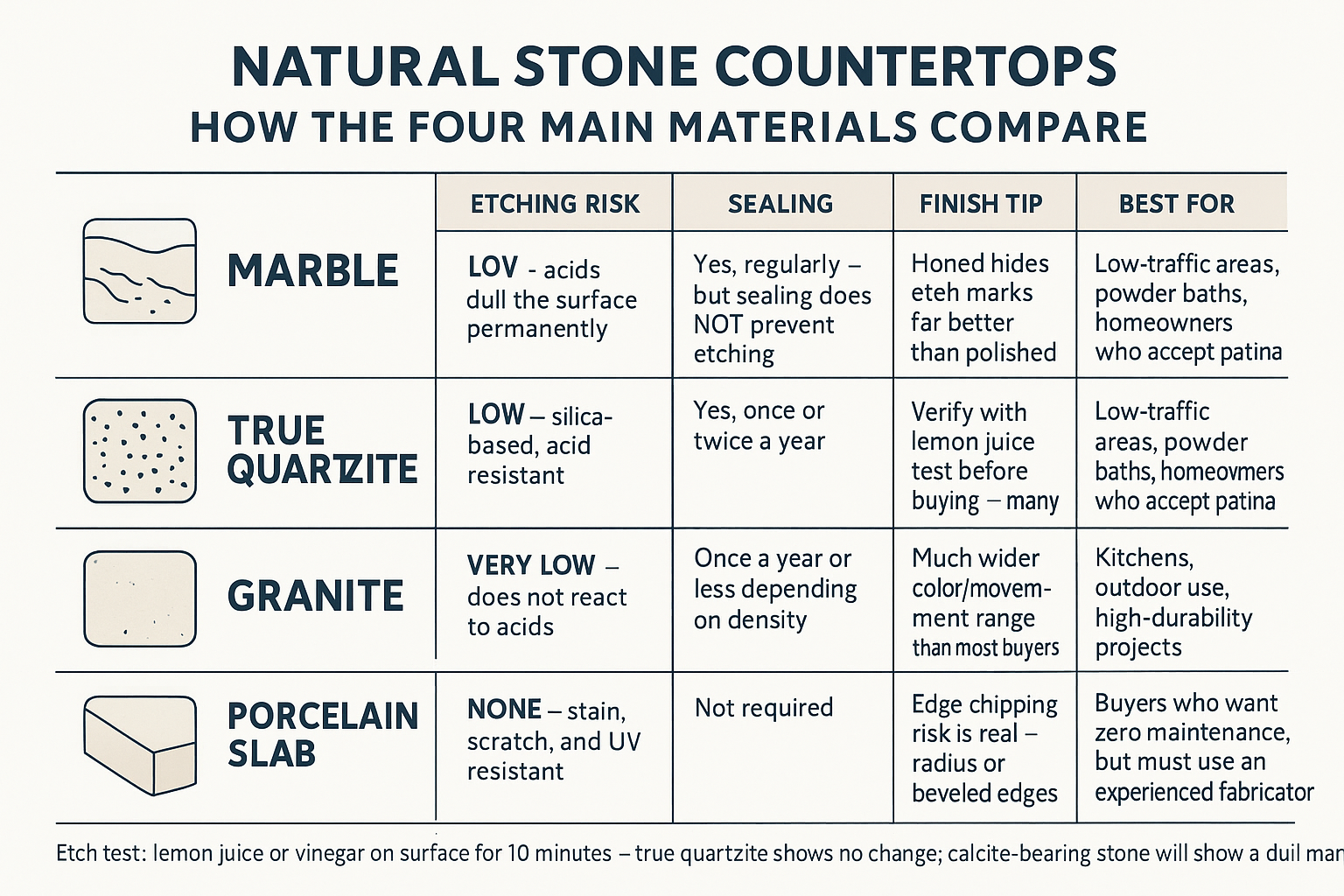
Quick Reference: Material Behavior at a Glance
The table below summarizes how each material handles the most common day-to-day situations in a kitchen or bathroom.
| Material | Etches with Acid? | Needs Sealing? | Repairable if Chipped? | Fabrication Sensitivity |
|---|---|---|---|---|
| Marble | Yes — polished finish shows it clearly | Yes — but sealing prevents stains, not etching | Yes — can be honed or repolished | Moderate |
| True Quartzite | No — if it’s genuinely quartzite | Yes — once or twice a year | Yes — professionals can address chips | Moderate |
| Granite | No — silica-based, acid-resistant | Yes — once a year or less | Yes — chips can often be filled | Low to moderate |
| Porcelain Slab | No — fully stain and acid resistant | No sealing needed | No — chips cannot be repaired | High — requires experienced fabricator |
Porcelain Slab: The Promises That Hold Up and the One That Doesn’t
Porcelain slab is the newest category most homeowners are actively researching, and the marketing around it tends to oversell certain things while staying quiet about others. Some of those durability claims are genuinely true. Others deserve more context.
What holds up: Porcelain slab is scratch-resistant, stain-resistant, and UV-stable in ways that natural stone simply isn’t. If you want a countertop or outdoor surface that requires zero sealing and laughs at coffee, wine, and sunlight, porcelain is a legitimate choice. For outdoor kitchen applications on the Central Coast — where UV exposure and salt air are real factors — which stone surfaces hold up to California weather outdoors covers porcelain alongside natural stone options.
What doesn’t hold up: Porcelain chips. And when it chips, it cannot be repaired the way natural stone can. A chip in granite or marble can often be filled and polished to a near-invisible result. A chip in porcelain leaves a permanent white or gray wound in the surface that reveals the raw material underneath.
Edge chipping during fabrication and transport is a recurring issue that shows up in buyer discussions and trade forums. The edge profile you choose matters: a radius or beveled edge is significantly less vulnerable to chipping than a sharp square edge. This is not a minor detail — it’s a practical decision that affects the slab’s long-term appearance.
The bigger picture with porcelain is this: the material’s durability claims are accurate in everyday use, but the slab is only as good as the team cutting and installing it. Porcelain punishes inexperienced fabrication in ways that granite and quartzite simply don’t. For a full breakdown of what buyers should know before committing, porcelain slab countertops: what nobody tells you before you buy is a good place to start.
Why Seeing Slabs in Person Changes the Decision
Stone photographs unpredictably. Two slabs of the same material — same quarry, same lot — can look dramatically different in person because of how veining, depth, and finish variation interact with light. A slab that looks cold and flat in a catalog photo can be warm and full of movement when you see it pulled vertically in natural light.
One homeowner described submitting a form inquiry with six specific slab SKUs before her visit — she arrived prepared, saw the slabs in person, and made a confident same-day decision. That’s the difference between catalog shopping and live slab selection. The preparation helped. But the actual slabs told her things the photos couldn’t.
The guidance available during an in-person visit makes that difference even more concrete. Christina F., a customer who had visited multiple showrooms before arriving at Carmel Stone Imports, described it this way:
‘I had been to too many showrooms and had a vague idea about what I envisioned when I showed him my cabinet door and some photos he guided me instantly to the Dolce Vita leathered Quartzite. The color, texture and design was exactly what I had been searching for, and I didn’t know it until he showed it to me.’
That outcome — finding the right material you didn’t know you were looking for — is what happens when the selection process is guided by someone who understands both aesthetics and performance. For anyone unsure what to expect from a first showroom visit, what happens when you visit a stone showroom for the first time walks through the process clearly.
Frequently Asked Questions About Natural Stone Countertops
How do I know if the quartzite I’m looking at is actually quartzite?
Do the lemon juice test. Put a few drops of lemon juice or white vinegar on the surface and leave it for 10 minutes. True quartzite will show zero change. Calcite-bearing stone — including marble and many stones labeled as quartzite — will show a dull etch mark where the acid touched. This is the single most useful thing a buyer can do before committing to any quartzite purchase.
Can I put marble in my kitchen if I’m a good about wiping up spills?
Yes — but understand what you’re signing up for. Spill response time helps with staining, but etching happens on contact. A drop of lemon juice wiped up in ten seconds can still leave a dull mark on polished marble. If you want marble in a working kitchen, choose a honed finish, which hides etch marks far better. And accept that over time, the surface will develop a patina. Some homeowners love that. Others don’t.
Is granite really coming back, or is that just a trend?
It’s a real shift, not a trend. Granite never stopped being one of the most durable natural surfaces available — it just got pushed out of the conversation by quartz marketing in the 2010s. Buyers who want natural stone without the maintenance anxiety of marble are rediscovering it. And the current range of material available — from Brazil, India, and other quarrying regions — is dramatically wider than what most people picture when they hear ‘granite.’
What’s the biggest risk with porcelain slab that nobody mentions upfront?
Chipping — specifically, edge chipping during fabrication and transport. The material itself is incredibly durable in use, but it’s unforgiving when cut or handled by someone without experience. Unlike natural stone, a chip in porcelain cannot be repaired. Choosing a radius or beveled edge profile instead of a sharp square edge meaningfully reduces this risk. And working with a fabricator who has real porcelain experience is non-negotiable.
Do I need to seal all natural stone countertops?
Most natural stone benefits from sealing, but the frequency varies a lot by material. Granite typically needs sealing once a year or less depending on its density — some very tight-grained granites need it even less. Quartzite usually needs sealing once or twice a year. Marble should be sealed regularly, but keep in mind that sealing prevents liquid absorption and staining — it does not prevent etching from acid contact. Porcelain requires no sealing.
Can I use any of these materials outdoors?
Granite and porcelain are generally the strongest outdoor performers on the Central Coast. Granite resists UV fading and handles temperature variation well. Porcelain is UV-stable and non-porous, which makes it popular for outdoor kitchens. Marble and softer quartzites are better kept indoors — exposure to moisture, UV, and temperature swings accelerates weathering in ways that are hard to reverse.
Ready to See These Materials in Person?
Carmel Stone Imports maintains live slab inventory across showroom and warehouse locations in Carmel-by-the-Sea, Sand City, and Palo Alto — which means you can pull slabs, run your own tests, and make a decision based on what you actually see, not what a photo suggests. If you have a project in progress or a material question you haven’t been able to answer online, the team is reachable at (650) 800-7840 or info@carmelimports.com to help you find the right starting point before your visit.