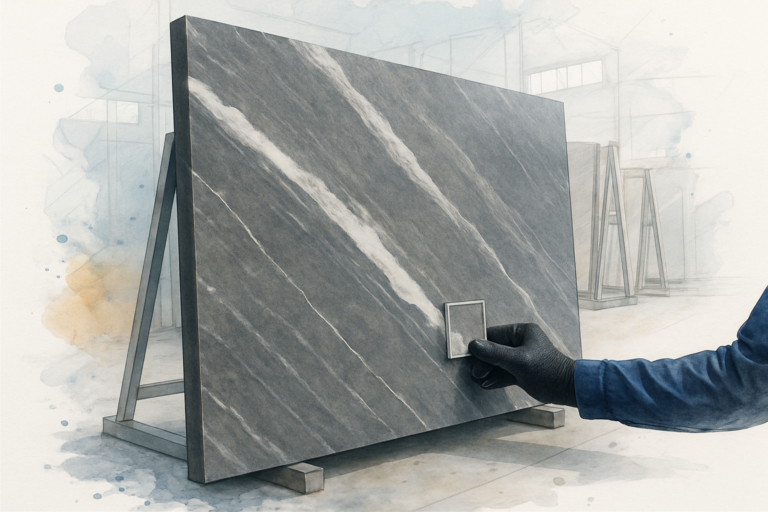
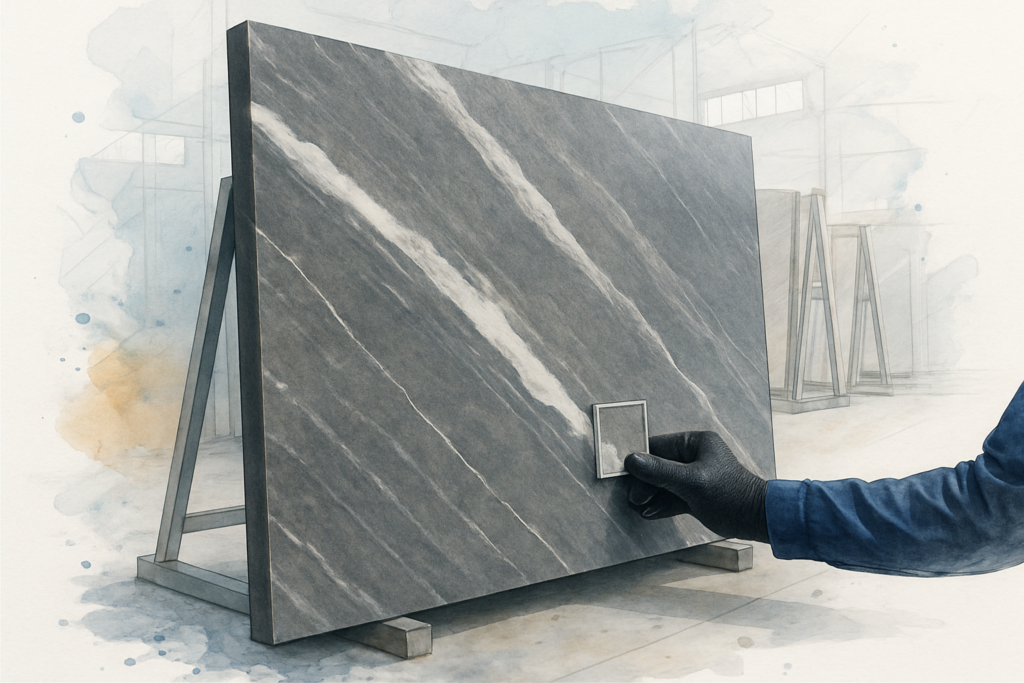
Direct Answer: Naica quartzite is a hard natural stone with sweeping diagonal veining in white, silver and gray. It resists etching and works best on large surfaces like kitchen islands and feature walls.
You saw a photo of Naica quartzite, and now every other stone in your folder looks flat. That happens with this material. The veining does something dramatic, and once you have seen it, a quiet slab feels like a compromise.
But bold stone carries risk. Buyers on the Monterey Peninsula call about quartzite every week with the same worry: will it stain, will it scratch, and will the slab actually look like the picture? Those are the right questions to ask before anything gets ordered.
This is a plain look at what Naica quartzite is, how to check that a slab labeled quartzite really is one, and which projects give the movement room to read. No sales angle, just the parts that change your decision.
What Makes Naica Quartzite Look Different
Naica is named for the Naica region, and it is known for one thing above all: movement. The veining sweeps across the slab on a diagonal in whites, silvers and grays, with lines that feel fast rather than soft.
That is what sets it apart from other pale quartzites you may be comparing:
- Naica: strong diagonal veins, high contrast, clear direction across the slab
- Perla Venata: warmer, quieter, with gentle gold and gray drifting through a cream field
- Mont Blanc: cloud-like and diffuse, closer to a soft marble look
If you are weighing those side by side, our breakdown of Perla Venata quartzite is a useful comparison point.
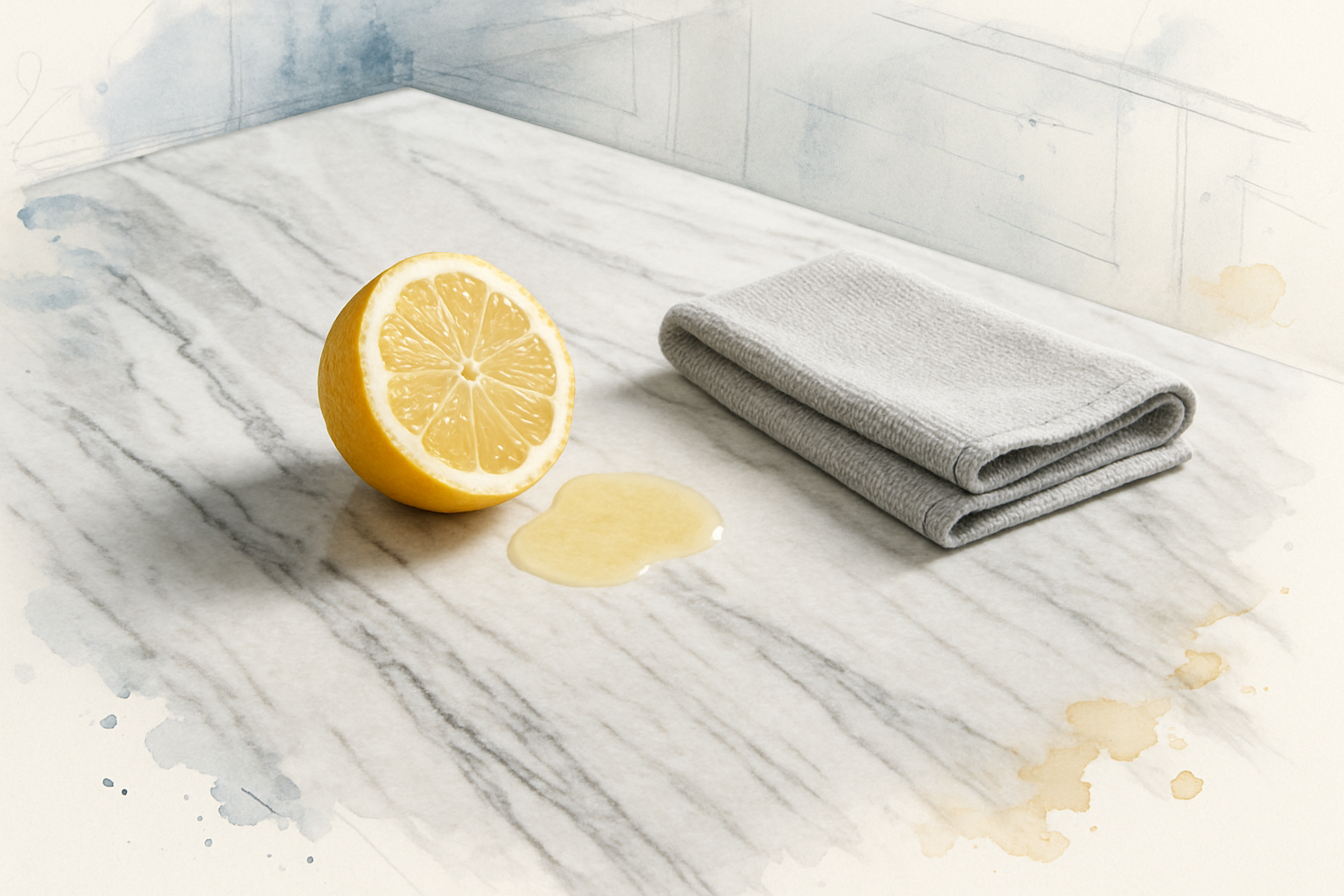
Naica is also a true quartzite in the geological sense. That means it sits high on the Mohs hardness scale and shrugs off the acidic foods that etch marble. Lemon juice, wine and vinegar do not dull the surface the way they do on Italian marble.
That matters in a real kitchen. In Carmel and Pebble Beach homes where the kitchen island doubles as the prep zone and the wine counter, etching is usually the complaint that shows up first.
How to Confirm a Slab Labeled Quartzite Really Is One
Here is the part most buyers never hear. “Quartzite” gets applied loosely in the trade. Some slabs sold under quartzite names are dolomite or a marble, and those behave very differently in a kitchen.
Two simple field checks tell you most of what you need:
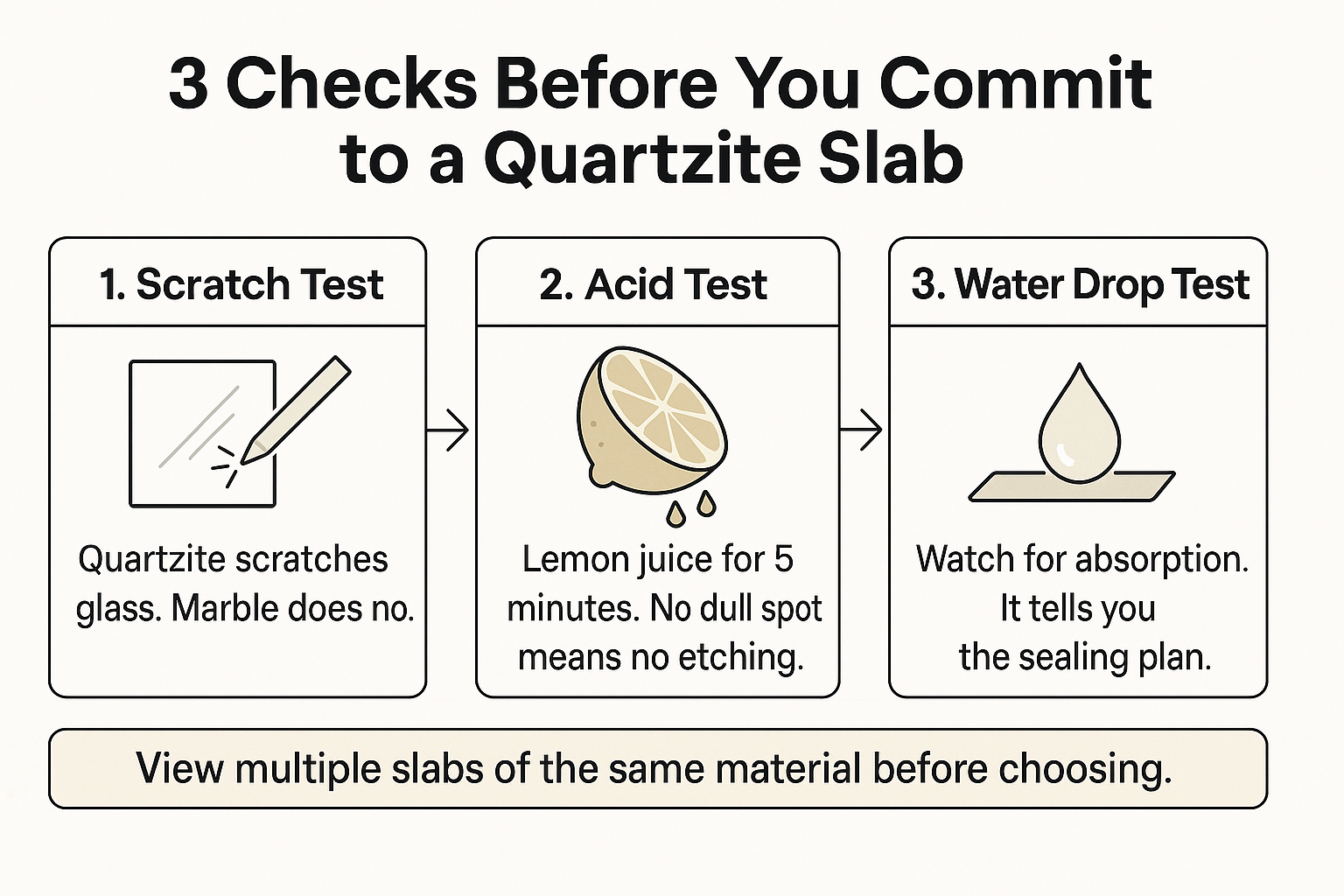
- Scratch test against glass: real quartzite is harder than glass. Draw a hidden corner of the stone across a scrap of glass. Quartzite scratches the glass. Marble and dolomite usually do not.
- Acid test with lemon juice or vinegar: put a few drops on an unpolished offcut or a sample, wait several minutes, then wipe. A dull spot means calcite in the stone, so it will etch in use.
Ask to run these on a sample rather than a finished slab face. Any supplier who understands the material will not blink at the request.
The Natural Stone Institute publishes material standards and testing guidance if you want to go deeper on how stone types are classified.
This is also why two slabs with the same name can price very differently. Density, source block and thickness all move the number, which we cover in quartzite countertop pricing.
Where Naica Quartzite Works, and Where It Fights You
Strong veining needs space. Give it a large uninterrupted surface and it reads as a designed statement. Chop it into small pieces and it reads as noise.
Applications where it works well:
- A large kitchen island, where the diagonal veining becomes the focal point of the room
- A feature wall behind a freestanding tub, especially in a primary bath with simple fixtures
- A bookmatched slab installation, where two mirrored slabs create a symmetrical pattern
- Full-height backsplash on a single wall, paired with plain cabinetry
Applications where it gets harder:
- Small countertops broken up by sink and cooktop cutouts
- Runs with many corners, where veins stop and restart at odd angles
- Rooms that already have a patterned tile floor or heavily figured cabinet fronts
One local pattern worth noting: in Carmel-by-the-Sea kitchens, where footprints are often modest and the fog keeps interior light soft, a bold slab on the island with quiet perimeter counters usually holds up better than bold everywhere.
Seam placement and vein direction are fabrication decisions, so bring your fabricator into the conversation before the slab is committed. A showroom visit with your layout in hand makes that conversation far more productive.
Naica Quartzite by Application
A quick reference for how the material behaves across common project types.
| Application | Fit | What to Watch |
|---|---|---|
| Large kitchen island | Strong | Plan vein direction before the slab is cut |
| Perimeter kitchen counters | Fair | Cutouts break up the veining pattern |
| Bath feature wall or bookmatch | Strong | Needs two slabs from the same block |
| Full-height backsplash | Good | Keep cabinetry and hardware simple |
| Powder room vanity | Fair | Small top can look busy |
| Outdoor kitchen counter | Case by case | Ask about UV and sealer performance for the specific slab |
Three Checks Before You Commit to a Slab
These are the three things worth doing in person, in order, before a statement slab gets reserved.
Never Choose a Statement Slab From One Sample
With a material this active, slab-to-slab variation is not a small detail. Vein direction, vein density and the gray-to-silver balance shift noticeably between slabs pulled from different blocks.
A buyer who picks from a single 4-inch sample often gets a surprise on delivery day. The stone is correct. It just is not the piece they pictured.
So ask to see at least three slabs of the same material, standing up, under the same light. Then ask which ones came from the same block if you are planning a bookmatch.
One homeowner who called recently about a different quartzite described herself as picky about all of the colors and veining. That is the correct instinct. Being picky in the warehouse in Sand City costs you an hour. Being surprised after fabrication costs a great deal more.
A review from a Monterey area homeowner put the payoff simply: she called her slab “still my favorite thing about our house.” That comes from choosing the actual piece, not a photo of it.
Sealing and Maintenance: The Honest Version
Quartzite is hard, but hardness and porosity are two different properties. Some quartzites absorb nothing. Others take in a water drop within a few minutes.
So the maintenance plan depends on the specific slab in front of you, not on the category name. Here is a routine that holds up:
- Ask the supplier for the sealing recommendation for that exact material, not for quartzite in general
- Have your fabricator apply an impregnating sealer before installation
- Run a water drop test once a year: if the stone darkens within 10 minutes, reseal
- Wipe oil, wine and citrus promptly, even on a sealed surface
Skipping the sealer is what produces the complaint you sometimes hear about edge staining along veining. The veins are often slightly more open than the surrounding field, so they take on oil first.
If that concern is on your mind, our piece on why brand-new quartzite sometimes stains walks through the causes and the fix. And if you are still deciding between material families entirely, marble, quartzite, granite or porcelain lays out the tradeoffs.
Frequently Asked Questions About Naica Quartzite
Does Naica quartzite scratch or etch?
A true quartzite resists both. It is harder than glass and harder than a steel knife blade, and it does not etch from acidic foods the way marble does. Cutting directly on the surface still dulls your knives, so keep using a board.
How much does Naica quartzite cost per square foot?
Pricing moves with block quality, thickness, finish and current inventory, so any single number online is unreliable. Exotic quartzites generally sit in the premium tier above common granites. Call (650) 800-7840 for pricing on the slabs actually in stock.
Can I get two slabs that match for a bookmatched wall?
Only if they come from the same block, cut in sequence. Ask about this early, because sequential slabs sell as a pair and are not always available in the material you want. Live inventory changes as containers arrive through the Port of Oakland.
Is it a good choice for an outdoor kitchen in Carmel?
Sometimes. Quartzite handles coastal weather well, but salt air, UV exposure and the specific stone’s density all matter. Ask about that individual slab rather than assuming, and consider a honed or leathered finish to hide water spotting.
Do I need an appointment to view slabs?
Walk-ins are welcome at the showrooms. That said, if you want to compare several slabs of one material side by side, calling ahead means the pieces can be pulled and staged before you arrive.
Want to See How Naica Reads in Person?
Bold veining is nearly impossible to judge from a photo or a small sample. Slabs are viewable in person at the Carmel and Palo Alto showrooms, with additional inventory staged at the Sand City warehouse for Central Coast projects. If you would like specific slabs pulled before you stop by, Carmel Stone Imports can be reached at (650) 800-7840 or info@carmelimports.com.