
Direct Answer: Large-format tile in a shower needs a substrate flat within about 1/8 inch over 10 feet, real grout joints for movement, and confirmed floor framing capacity for the added weight.
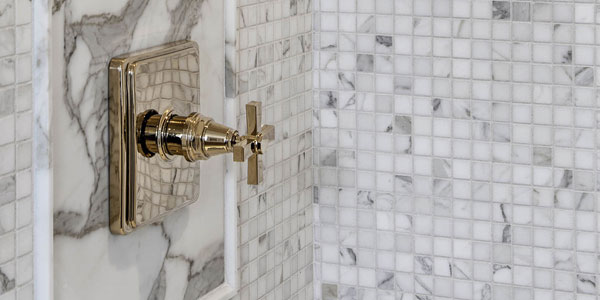
You saw a shower with two enormous slabs of stone-look tile on the wall, almost no grout lines, and it looked like a spa in Big Sur. So you started shopping 24×48 tile and bigger.
That format is one of the most requested things walking through showrooms on the Monterey Peninsula right now. But a shower is a wet, moving, temperature-swinging box, and large format porcelain tile asks more of the wall behind it than standard 12×24 ever did.
This is not a reason to avoid the format. It is a reason to understand three things before you buy: how flat the substrate has to be, why grout joints still matter, and how much the material actually weighs. Get those settled and the format performs beautifully.
What Counts as Large Format, and Why Showers Change the Math
In the tile trade, large format generally means any tile with at least one side 15 inches or longer. Once you get to 24×48, 32×64, or full slab-size panels, you are in a different install category.
The appeal is obvious. Fewer grout lines means fewer places for soap film and mildew to collect, and a wall that reads as one continuous piece of stone.
What changes in a shower:
- Moisture and heat cycles move the wall and floor assembly slightly, every single day
- A big tile cannot flex to follow a wall that is out of plane, so stress collects at the edges
- Fewer joints means fewer places for that movement to go
- Handling a 40 lb panel in a 3 x 4 foot shower is a two-person job with limited room to work
A standard 12×24 tile forgives a wall that is a little wavy. A 24×48 does not. That single difference drives almost everything else on this list, and it is worth knowing before you pick a material, not after your installer is on site.
The Substrate Is the Real Job
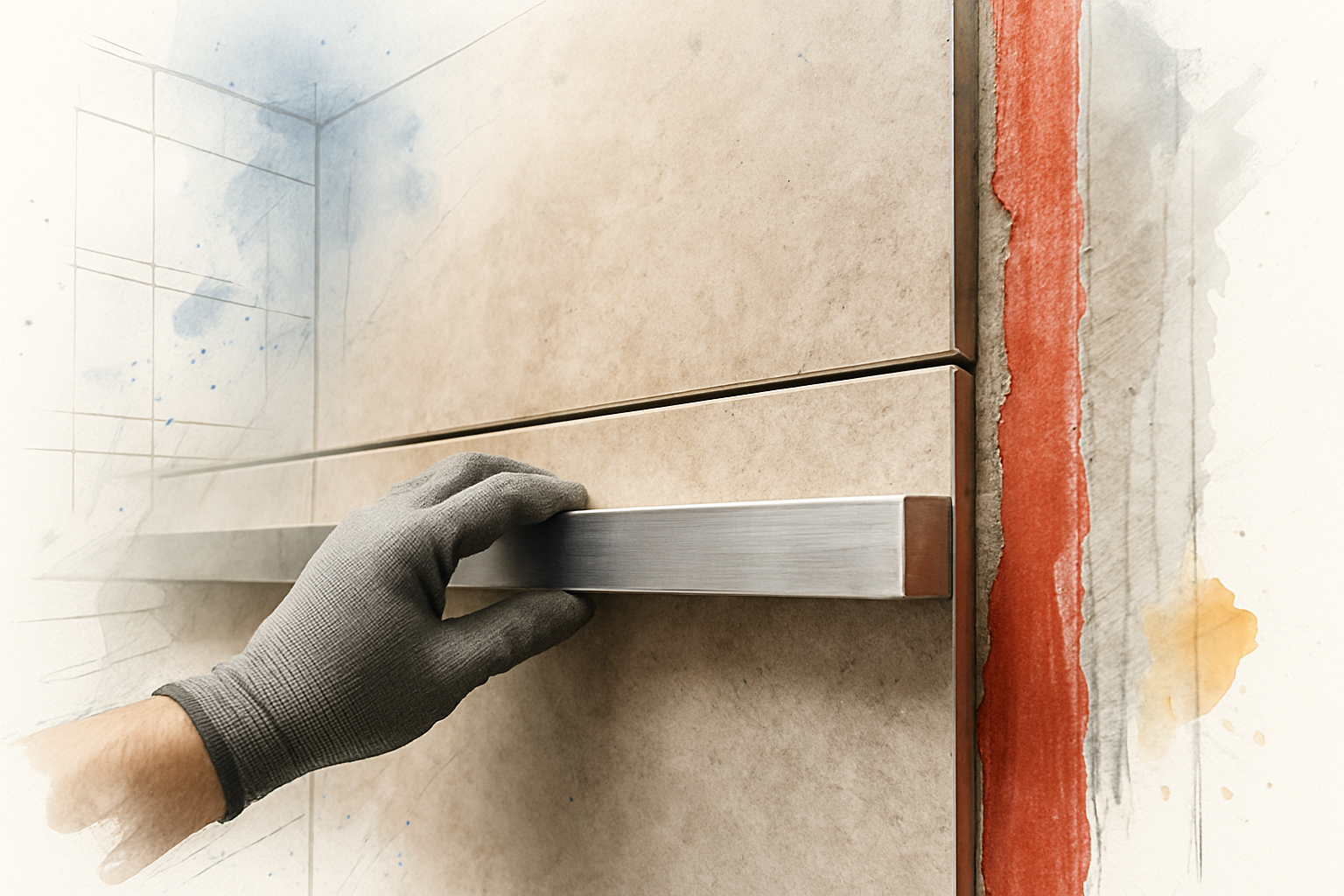
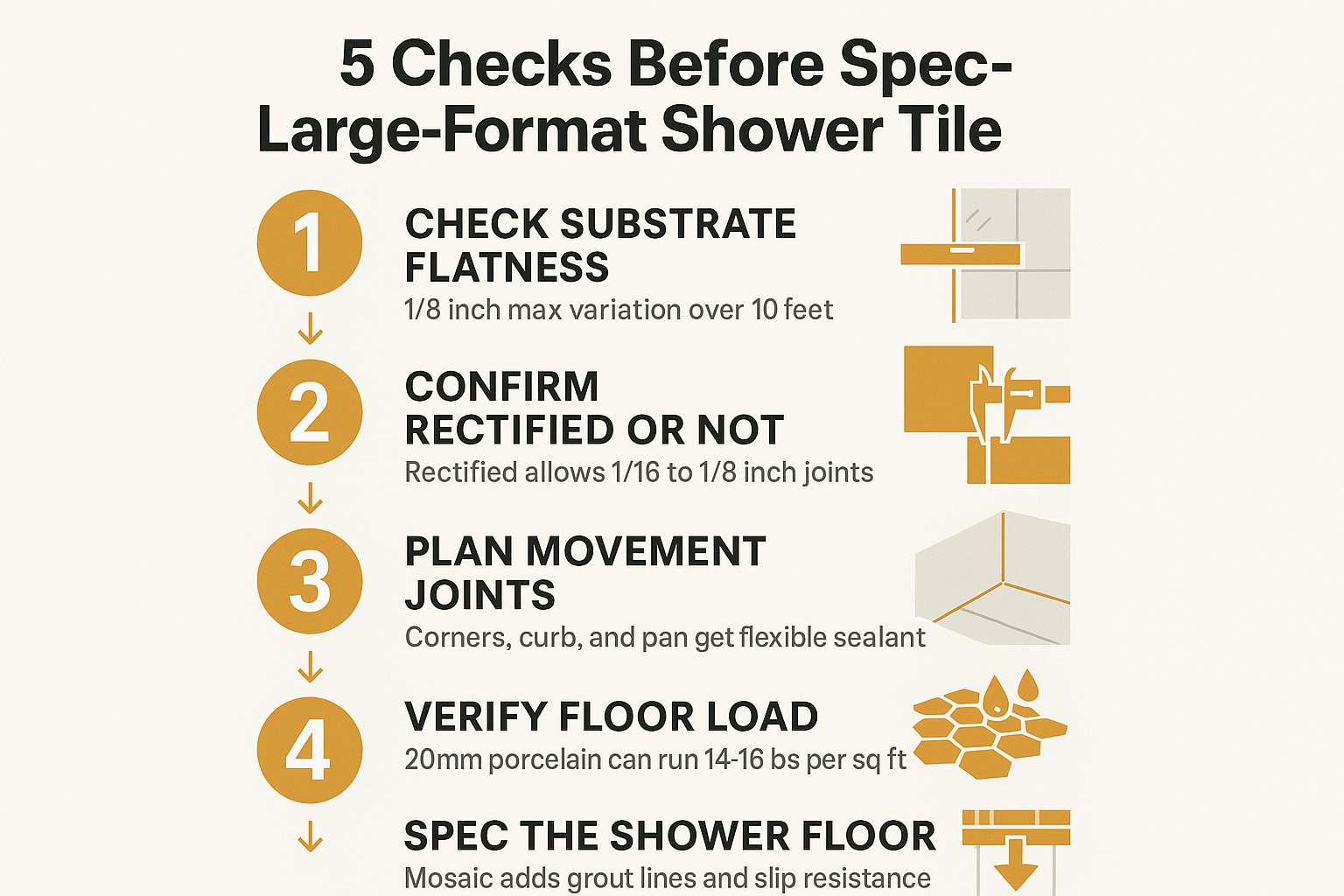
Industry standards call for substrate flatness of no more than 1/8 inch variation across a 10-foot span for tile with any side longer than 15 inches. Tighter tolerances apply over shorter spans.
That is a demanding number in a real bathroom. Framing in many older homes around Carmel-by-the-Sea, Pacific Grove, and the pre-1960s pockets of Palo Alto was never built to it, and neither was the mortar bed some of those showers still have behind the tile.
When the wall is not flat enough, one of two things happens. Either you get visible lippage, where one tile edge sits proud of the next and catches the light, or you get hairline cracks and hollow spots at the joints a year or two in.
An improperly prepared substrate is the most commonly cited cause of large-format tile failure. The fix is not exotic, it is just work: flattening compound, a fresh backer assembly, or shimmed and re-planed framing before any waterproofing goes on.
Questions worth asking your installer before demo starts:
- How will you check and correct wall flatness before setting?
- What setting material are you using, and is it rated for large format?
- Are you using a medium-bed mortar rather than standard thinset?
- How do you plan to get full mortar coverage behind each tile in a wet area?
The Tile Council of North America publishes the handbook most Bay Area installers reference for these assemblies. A contractor who cites it by name is a good sign.
Rectified Tile, Grout Joints, and Why You Can’t Skip Them
Rectified means the tile was cut or ground to an exact dimension after firing, so every piece is the same size with crisp square edges. Most large-format porcelain sold for showers is rectified.
That precision is what allows the tight 1/16 to 1/8 inch grout joints designers want. It is also why the look only works when the wall behind it cooperates.
Natural stone tile is a different story. Cut limestone, travertine, and marble tiles that are not rectified carry small dimensional variation from piece to piece, and they need a wider joint to absorb it. Forcing a hairline joint on unrectified stone produces uneven lines and chipped edges.
And in a wet area, grout joints do more than look tidy. They give the assembly somewhere to move. Eliminate them entirely across a large-format installation and the pressure has nowhere to go except into the tile or the grout.
Separate from grout joints, tile assemblies also need movement joints: soft, flexible joints at inside corners, at the curb, and where the wall meets the pan. Those get caulk or sealant, not grout. Skipping them is one of the quietest ways a beautiful shower fails.
If you are weighing stone against porcelain for a bath, our breakdown of whether porcelain slabs are really as durable as they sound covers the performance side in more detail.
Standard Tile vs. Large Format: What Actually Changes
The same shower, three material choices, three different sets of demands on the install.
| Consideration | 12×24 Tile | Large-Format Porcelain (24×48+) | Large-Format Natural Stone |
|---|---|---|---|
| Substrate flatness | More forgiving | 1/8 in. over 10 ft or tighter | 1/8 in. over 10 ft, plus thickness variation |
| Typical grout joint | 1/8 in. | 1/16 to 1/8 in. if rectified | Wider if unrectified, varies by lot |
| Weight per sq ft | Modest | Higher, climbs sharply at 20mm | Varies by stone and thickness |
| Handling in a small shower | One person | Two people, suction cups | Two people, edges chip easily |
| Sealing needed | Porcelain: no | No | Yes, and reapplied over time |
Five Checks Before You Spec Large-Format Tile for a Shower
Run through these five items with your contractor while the material selection is still open.
Weight: The Question Buyers Rarely Hear from a Tile Supplier
A 24×48 porcelain slab at 20mm thickness can run roughly 14-16 lbs per square foot before you add setting mortar, backer board, and mud bed. Thinner wall-rated panels weigh far less, but 20mm shows up regularly on floors and outdoor applications.
Stack that across a bathroom floor and it adds up. Plenty of homes in Pebble Beach, Monterey, and the older Palo Alto neighborhoods have second-story baths framed decades before anyone imagined 20mm stone panels.
Before large-format tile gets specified for an upper-floor bathroom, have your contractor or a structural engineer confirm the framing can carry the load. It is a short conversation and a cheap one compared to the alternative.
While you are at it, factor in the practical stuff: getting a 5 x 10 foot panel up a narrow Carmel cottage stairway is a genuine logistics question, and so is where it stages before install.
Shower Floors and Transitions: Where Mosaic Earns Its Place
When most of the wall is one large tile, every small piece becomes more visible. The niche interior, the curb, the floor border, the transition at the door: these read as deliberate choices, because they are.
The shower floor is the one spot where small tile usually wins outright. Mosaic increases grout lines per square foot, and more grout lines means more texture underfoot when the floor is wet. It also conforms to the slope toward the drain in a way a single large tile cannot.
Think of the selection as a system, not a field tile plus leftovers:
- Field tile for walls, the large-format piece doing the visual work
- Mosaic or small-format for the shower pan, chosen for texture as much as looks
- Niche interior, either matched to the field or shifted for contrast on purpose
- Curb and threshold, often a small stone slab piece cut by your fabricator
- Grout color, which changes how much the joints read at a distance
This is exactly the kind of decision that goes faster in person with samples in hand. Natural stone varies slab to slab and lot to lot, which is why what live inventory at a slab supplier actually means matters more than a catalog image. If travertine is on your list for a bath, the filled versus unfilled question changes both look and maintenance.
Frequently Asked Questions About Large-Format Tile in Showers
Does large-format tile cost more to install than standard tile?
Usually yes, and the material is only part of it. Labor tends to run higher because of substrate prep, medium-bed mortar, two-person handling, and specialty cutting equipment. Install pricing varies widely across the Monterey Peninsula and the Bay Area, so get quotes from your own contractor or fabricator. For material pricing and lead times, ask a supplier directly.
Can large-format tile go over my existing shower tile?
Rarely a good idea in a wet area. You are stacking a heavy, unforgiving material on top of an assembly whose flatness and waterproofing you cannot verify. Most installers will want to take the shower back to framing and build the substrate fresh.
What does rectified mean and do I need it?
Rectified tile is ground to an exact size after firing, so every piece matches. If you want the tight 1/16 to 1/8 inch grout joints that make large format look continuous, you want rectified. Unrectified natural stone tile needs a wider joint to absorb its natural size variation.
Is porcelain or natural stone better for a large-format shower?
Both work. Porcelain does not need sealing and comes in very consistent, precisely sized pieces. Natural stone gives you depth and movement that porcelain approximates but does not match, and it can be honed or refinished later if it gets etched. Stone asks for sealing and a little ongoing care, which our guide on cleaning porcelain tile contrasts on the maintenance side.
Who checks whether my floor can hold the weight?
Your contractor, and for anything questionable, a structural engineer. A tile supplier can tell you the weight per square foot of a given material and thickness, but the framing evaluation belongs to the trades working on your house.
Seeing the Format in Person Before You Commit
Large-format tile is one of those materials that reads completely differently at full size than it does on a screen, which is why so many homeowners say they want to see it in person first. Carmel Stone Imports keeps live inventory of porcelain and natural stone tile at its Carmel, CA and Palo Alto showrooms, with take-home samples for most materials and design consultants available to talk through field tile, mosaic, and transitions together. Slab selection appointments can be arranged at (650) 800-7840 or info@carmelimports.com, and walk-ins are welcome if you happen to be nearby on Carmel Rancho Lane.