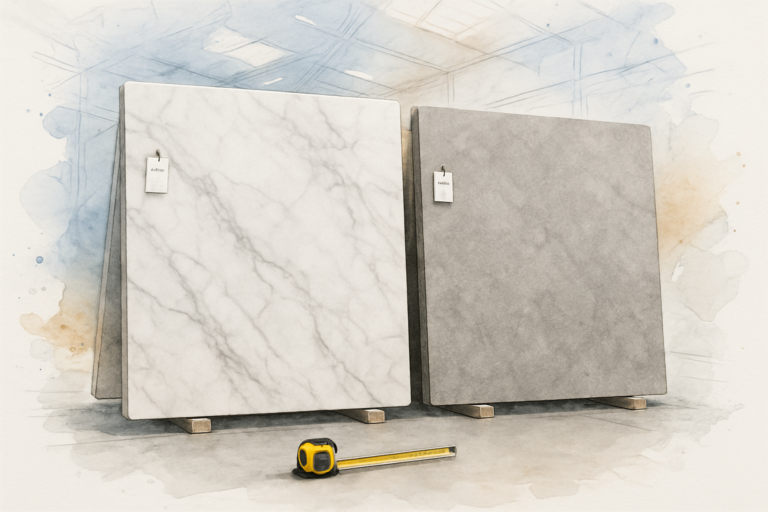
Direct Answer: Quartzite countertop prices vary based on quarry origin, slab rarity, finish type, and thickness, not just material name. Two slabs called the same thing can cost very different amounts per square foot.
One of the most common questions that comes in from homeowners across the Monterey Peninsula and Bay Area goes something like this: ‘I saw quartzite online for $X a square foot, why is your price different?’ It is a fair question, and it does not have a simple answer. The cost of quartzite countertops can swing dramatically from one slab to the next, even when the material carries the same name.
About 23% of tracked calls to stone showrooms are pricing questions, and quartzite comes up more than almost any other material. Several callers in recent months specifically asked about Taj Mahal quartzite by name, surprised that prices varied between suppliers. Others found that a leathered finish changed the number they were quoted.
This article focuses on the three things that actually explain that variation: quarry origin and rarity, finish type, and slab thickness. Understanding those three factors will help you read a quote accurately and know what you are actually comparing.
Why Quarry Origin Is the Biggest Price Driver
When someone quotes you a price per square foot for quartzite, the first question worth asking is where it came from. Not all quartzite is quarried from the same places, and location matters a lot.
Taj Mahal quartzite, sourced from Brazil, is one of the most requested materials in the market right now. Its consistent soft ivory background and dramatic veining make it visually reliable across a kitchen layout, which is rare in natural stone. That consistency comes from a specific quarry producing a specific aesthetic, and because demand is high relative to available supply, the price reflects it.
Compare that to a quartzite pulled from a high-production block or a more commonly available domestic source. The material may be beautiful and equally durable, but the scarcity factor is different. When a quarry produces limited yardage or ships primarily to premium importers, the cost at the supplier level is higher before anyone adds a margin.
This is worth understanding because price is a real signal in the stone market. A higher cost on a named quartzite is usually not an arbitrary markup. It reflects:
- Quarry scarcity, lower annual yield from a specific extraction site
- Import logistics, shipping from Italy, Brazil, or Turkey adds freight and handling cost
- Slab consistency, more uniform veining and background color commands a premium
- Demand pressure, materials trending in design media get bid up across the supply chain
For a deeper look at how to read slab-to-slab variation before you buy, reading marble slabs and what veining and batch numbers tell you applies directly to quartzite selection as well.
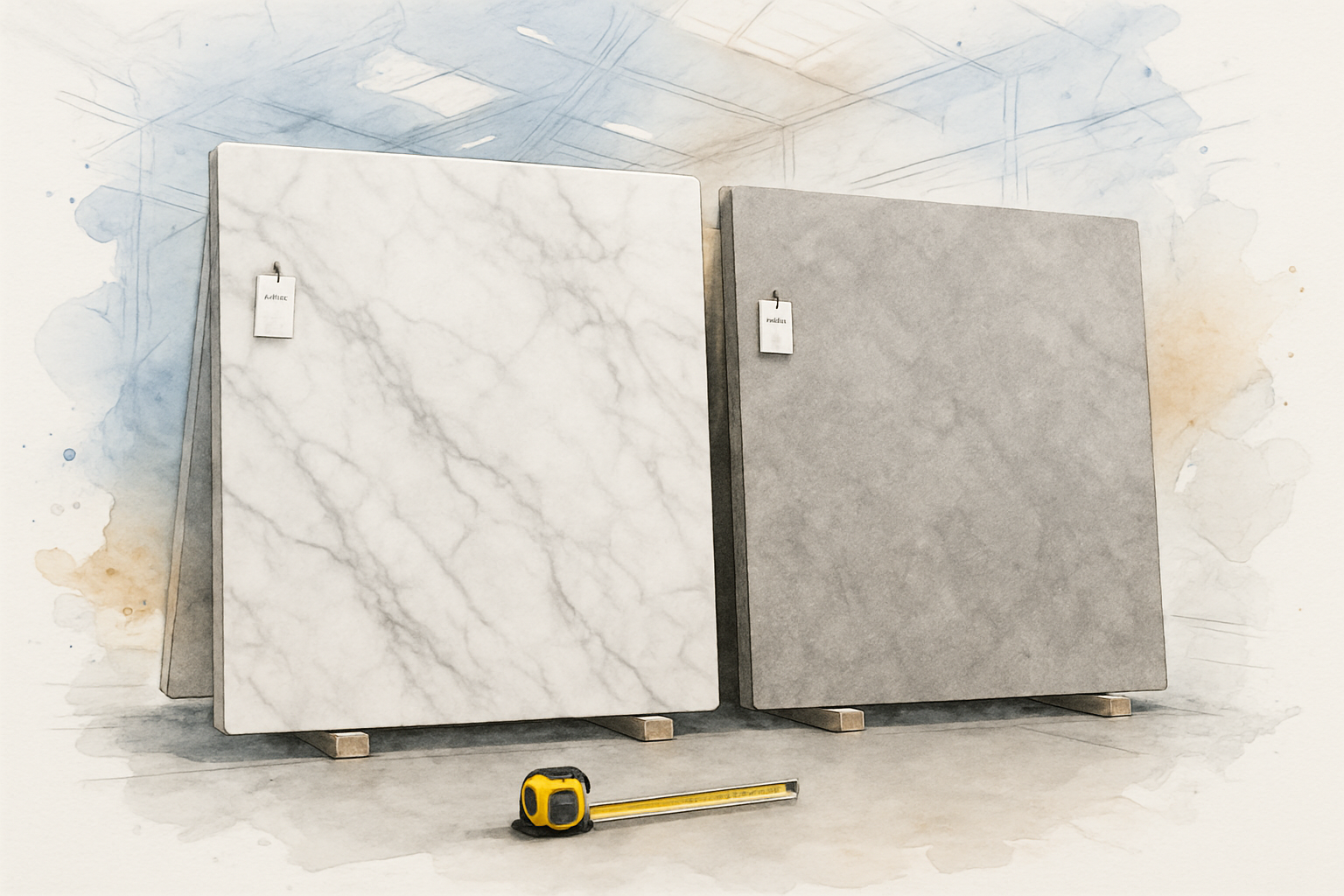
How Finish Type Changes the Price, and the Maintenance
The finish on a quartzite slab is not just an aesthetic choice. It affects price at the material level and it changes what you will deal with in everyday use.
Polished quartzite has the most reflectivity. The surface is smooth, bright, and shows the veining at its most vivid. It also requires the most care around acidic substances, coffee, lemon juice, and vinegar can leave marks over time if the stone is not properly sealed. Polished slabs typically cost more per square foot than honed equivalents because the processing is more involved.
Honed quartzite has a flat, matte finish. It hides minor surface scratches better than polished, which matters in a busy kitchen. The tradeoff is that honed surfaces absorb oils more readily, so a proper sealing schedule matters even more.
Leathered quartzite is the finish designers most often specify for kitchen islands. The texture disguises fingerprints, feels less formal underhand, and sits between polished and honed in terms of sheen. Several homeowners who found their ideal slab described it specifically as a leathered quartzite for the island, and it is easy to see why. The texture adds dimension that flat finishes do not.
Each finish involves additional processing steps, which is why the same slab in three different finishes will carry three slightly different price points. And each finish carries different maintenance expectations going forward, so the choice at the showroom has a long tail.
If you are comparing quartzite to other materials before committing, marble, quartzite, granite, or porcelain, how to actually decide is a useful framework.
Quartzite Finish Types at a Glance
These are the three finishes most commonly specified for residential countertops, each has a different look, feel, and maintenance profile.
| Finish | Surface Feel | Best For | Maintenance Note |
|---|---|---|---|
| Polished | Smooth, reflective | Formal kitchens, low-traffic baths | Most vigilance around acids; seal regularly |
| Honed | Flat, matte | Bathrooms, secondary kitchens | Hides scratches; absorbs oils more readily |
| Leathered | Textured, low sheen | Kitchen islands, high-touch surfaces | Disguises fingerprints; easier daily upkeep |
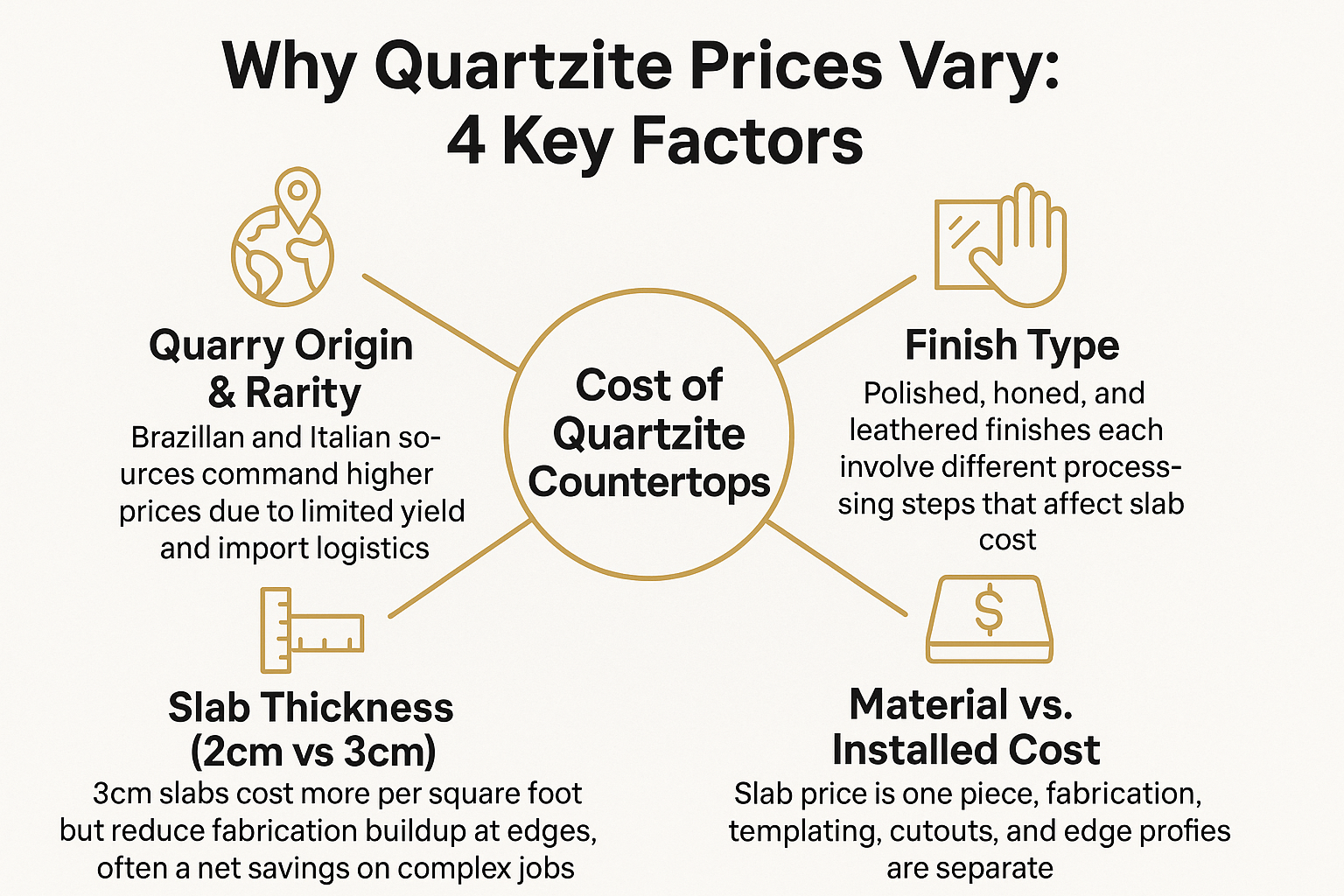
What Actually Drives the Cost of Quartzite Countertops
These are the four variables that explain most of the price variation you will encounter when shopping quartzite slabs.
Thickness, Waterfall Edges, and the Math Homeowners Miss
Slab thickness is one of the least discussed variables in quartzite pricing, until someone gets a fabrication quote that surprises them.
Most countertop slabs come in 2cm or 3cm thickness. A 3cm slab costs more per square foot at the supplier level. But on certain projects, that difference pays for itself.
For a Bay Area kitchen island with waterfall sides, a 3cm slab is almost always the right specification. A waterfall edge drops the countertop material vertically down the side of the island, which means the slab face is visible. With a 3cm slab, that edge reads as a single solid piece. With a 2cm slab, your fabricator needs to laminate an additional strip to build up the edge thickness, and that seam shows.
The fabrication labor for laminating adds cost that partially offsets the price savings on the thinner slab. For simpler layouts with standard edges, 2cm can be a reasonable choice. But for anything with exposed vertical faces, upgrading to 3cm at the supplier is usually the cleaner solution.
According to the Marble Institute of America, slab thickness selection is one of the most consequential decisions a buyer makes before fabrication, and it is almost impossible to change after the slab is cut.
The broader takeaway: do not evaluate quartzite pricing only on cost per square foot at the material level. The installed cost includes fabrication, templating, sink and cooktop cutouts, and edge profile work, all separate line items. The slab price is the starting point, not the total. For more on how to think about this, natural stone countertops: what nobody tells you before you choose covers the full picture honestly.
Reading a Quartzite Quote Correctly
When a caller recently asked about Portoro quartzite in a leathered finish, the quoted price reflected several stacked variables: the premium origin, the additional processing for the leathered finish, and the slab dimensions. A 20% trade discount applied in that case made a meaningful difference to the final number. That kind of context is why asking ‘how much does quartzite cost’ produces such a wide range of answers.
A useful habit is to ask the supplier to break out what the price reflects:
- What is the quarry origin of this specific slab?
- Is this price for polished, honed, or leathered finish?
- Is this 2cm or 3cm?
- Is this the price per square foot of slab, or per finished square foot installed?
Those four questions will tell you whether two quotes are actually comparing the same thing. They usually are not.
If you want to understand why some quartzite stains even after sealing, which affects which tier of material makes sense for your project, why does brand-new quartzite sometimes stain and how do you prevent it is worth reading before you finalize your selection.
Frequently Asked Questions About Quartzite Countertop Pricing
Why does Taj Mahal quartzite cost more than other quartzites?
Taj Mahal comes from a specific quarry in Brazil that produces a consistent soft ivory background with dramatic veining, a combination that is hard to find in natural stone. That consistency is rare, demand is high across the design market, and import logistics from Brazil add freight cost. All of that is reflected in the price per square foot compared to more commonly available quartzites.
Does the finish type really change what I pay for the slab?
Yes. Polished, honed, and leathered finishes each involve different processing steps, and the more involved the finishing work, the higher the slab price. Leathered finish, for example, is a multi-step mechanical process that adds time and equipment use. The price difference between finishes on the same slab can be meaningful, so it is worth asking the supplier to quote all three if you are undecided.
Should I buy 2cm or 3cm quartzite for a kitchen island with waterfall sides?
For a waterfall edge, 3cm is almost always the right choice. It allows the vertical face to read as a single solid piece without a laminated seam showing. The higher material cost often offsets some of the fabrication labor that would be needed to build up a 2cm slab to the same appearance.
Is the price per square foot I see online the full cost of my countertop project?
No, not even close. The slab price at the supplier is one piece of a larger project cost. Fabrication, templating, sink and cooktop cutouts, edge profile work, and delivery are all separate. General Bay Area market data puts installed stone countertop projects across a wide range depending on complexity, layout size, and material tier. Always think in terms of total project budget, not just material cost per square foot.
Can I get a trade discount on quartzite if I am working with a designer or contractor?
Trade discounts are common in the stone supply industry and can make a real difference on larger orders. Ask about trade account pricing when you call, many suppliers apply a meaningful discount for designers, fabricators, and contractors, and it is worth asking before any pricing conversation goes further.
How do I know if two quartzite slabs with the same name are actually the same material?
They often are not. Natural stone varies slab to slab, even from the same quarry block. Two slabs labeled ‘Calacatta quartzite’ can have different veining density, background tone, and surface variation. This is why viewing actual slabs in person, not catalog photos, matters so much. A sample in your hand looks different from a small image on a screen, and a full slab looks different from a sample.
Want to See What These Differences Actually Look Like in Person?
Pricing makes a lot more sense when you are standing in front of the slabs. The showrooms in Carmel-by-the-Sea and Palo Alto carry live inventory, actual slabs, not catalog images, so you can see finish differences, thickness, and veining variation side by side. Reach the team at (650) 800-7840 or email info@carmelimports.com to check what is currently in stock or to schedule a slab selection appointment.