

Direct Answer: Bring measurements, inspiration images, and cabinet or flooring samples. Call ahead to confirm slab availability. A prepared visit becomes a decision; an unprepared one becomes a second trip.
Most people arrive at a stone showroom the same way they’d browse a furniture store — with a general idea and an open afternoon. Then they walk out two hours later with nothing decided, because they didn’t have their measurements, couldn’t remember their cabinet color, and weren’t sure whether the slab they liked would actually be available when their fabricator was ready.
This is the single most common pattern in the Bay Area and Monterey Peninsula market right now. Project timelines are tight, contractor schedules are tighter, and a second showroom trip costs time nobody has in the middle of a kitchen or bath remodel.
The good news is that one well-prepared visit is usually all it takes to make a confident, final material decision. This guide explains what to bring, what to confirm before you leave home, and how the whole process actually works — whether you’re a homeowner doing this for the first time or a designer sourcing for a client project.
What to Bring Before You Walk In
The difference between a productive showroom visit and a reconnaissance trip almost always comes down to preparation. When a homeowner shows up with a cabinet door sample, a flooring tile, and a written list of dimensions, a good showroom consultant can narrow a field of dozens of slabs down to three or four candidates in under an hour.
Without those things, every conversation starts over from scratch — and the selections you fall in love with may not work once you’re back home looking at your actual kitchen light.
Here’s what to bring:
- Accurate measurements — total square footage needed for countertops, backsplash, or flooring, plus the dimensions of each individual surface
- Cabinet door or paint chip — even a photo on your phone helps; the actual sample is far better
- Flooring or tile samples — anything the new stone needs to coordinate with
- Inspiration images — screenshots, saved photos, a folder on your phone; show what you’re drawn to, not just what you think you should pick
- Your fabricator’s contact information — if you’re working with one already, your showroom consultant may want to coordinate directly on slab holds and delivery logistics
As one reviewer noted after working with a consultant at the Palo Alto location: the staff was able to guide her immediately to the right material the moment she showed a cabinet door and a few photos. That’s the version of this visit worth having.

Why You Can’t Judge a Slab From a Sample Chip
Choosing stone is not like choosing paint. A 4-inch sample chip tells you almost nothing about how a material will read across a 10-foot kitchen island.
The veining in marble and quartzite moves across the full slab in ways that only become clear when you’re standing in front of the whole thing. A slab that looks calm and subtle in a small sample can be dramatically bold at full scale — or the reverse. Lighting plays a role too: showroom lighting reads differently from the natural light in a Carmel-by-the-Sea kitchen or the cool north-facing windows common in Pacific Heights homes in San Francisco.
This is exactly why picking a marble slab in person vs. online produces better outcomes. The full-slab view isn’t a luxury — it’s the only way to know what you’re actually buying.
A few things to do while you’re viewing slabs in person:
- Step back at least 8–10 feet to see how the veining reads at distance, not just up close
- Hold your cabinet sample against the stone rather than just eyeballing them separately
- Ask to see the slab in a different light position if the showroom can move or angle it — the shift in depth and reflection can be significant
- Look at both faces of the slab when possible; stone is not uniform, and the two faces of the same slab can look meaningfully different
If you’re still uncertain between two or three materials, most showrooms can provide take-home samples. But that’s a starting point, not a substitute for the in-person slab view.
Your Stone Showroom Visit — What Happens at Each Stage
This shows the four stages of a well-prepared showroom visit, from your call ahead to your slab hold confirmation.
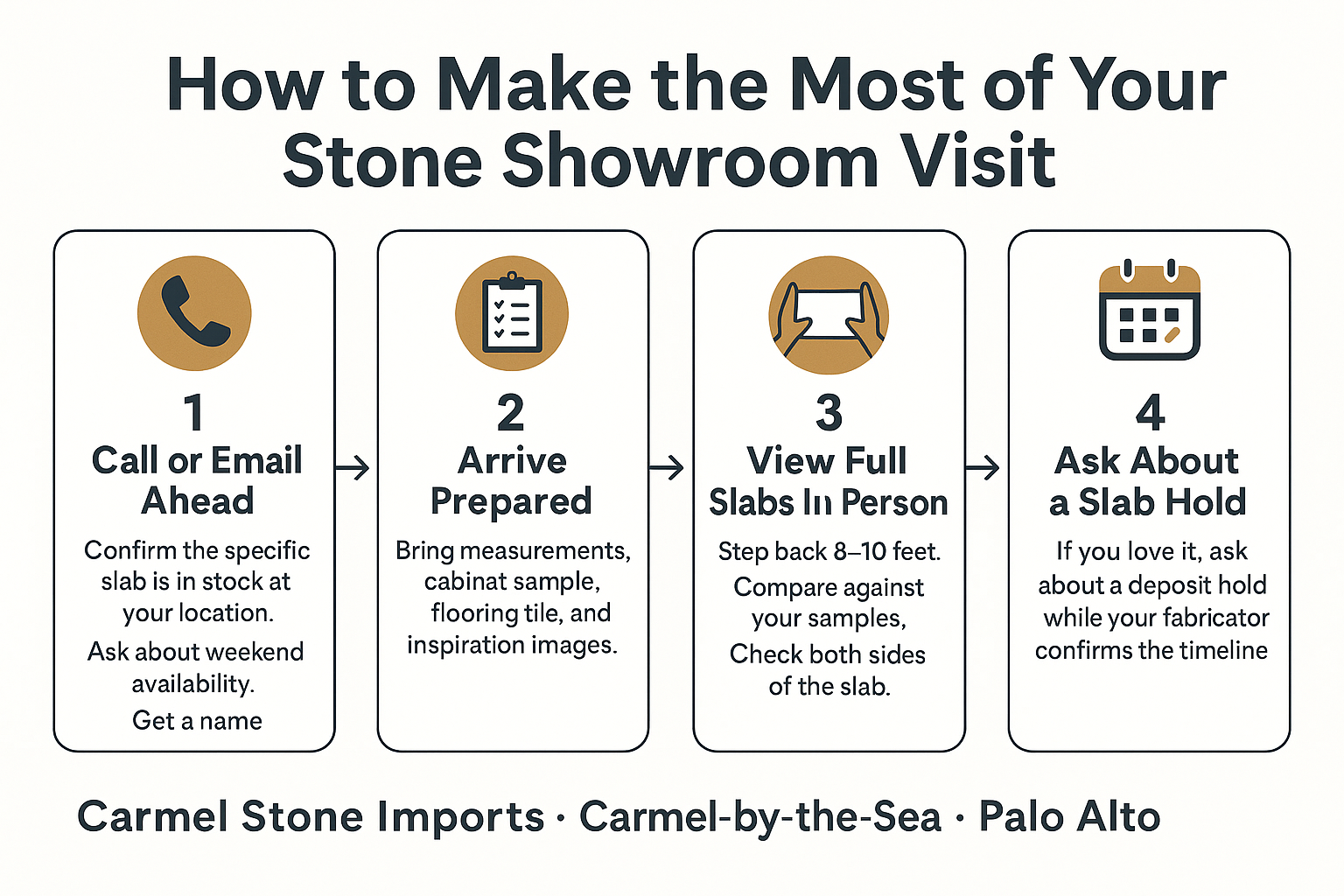
Call Ahead — and Ask the Right Questions
One of the most repeated frustrations in the Bay Area stone market is making the drive to a showroom only to find that the specific slab you had in mind is either sold, at a different location, or never actually in stock. This is avoidable with a two-minute phone call.
Before you visit, call or email the showroom location you plan to go to and ask specifically:
- Is [material name or SKU] currently in stock at this location? Not at the other location — at the one you’re driving to.
- How many slabs are available? For a kitchen with an island plus perimeter counters, you may need two or three slabs. A single slab won’t always be enough.
- Are there any slabs currently on hold? Available inventory and available-for-purchase inventory are not always the same thing.
- Is there a good time to come in this week? Some showrooms are quieter mid-week, which means more time with a consultant.
Multiple callers in recent months have specifically mentioned driving to a location based on what the website showed, only to discover the inventory had changed. Calling ahead turns your visit from a reconnaissance trip into a decision trip.
For the Palo Alto showroom, reach the team at (650) 800-7840 or info@carmelimports.com. For the Carmel-by-the-Sea location, the same contact routes to the right team.
How Slab Holds Work — and Why They Matter for Summer Projects
Summer is the busiest season for kitchen and bath remodels across the Bay Area and Central Coast. Contractor schedules book out weeks in advance, and the gap between selecting a slab and getting a fabricator on-site to template the countertops can easily run two to four weeks.
That’s a problem if you find the perfect Mont Blanc quartzite or Taj Mahal slab and then lose it to another buyer while you’re waiting for your fabricator’s schedule to open up.
Slab holds — sometimes called reservations — exist for exactly this reason. Generally, a hold requires a deposit to secure specific slabs in your name while the project timeline gets confirmed. The standard model is that slabs are not held indefinitely without payment, which is correct policy: it protects inventory for buyers who are genuinely committed.
When you find a slab you want during your visit, ask your consultant directly:
- What does a slab hold cost and how long does it last?
- Can I place a deposit today to secure these specific slabs?
- What happens to my deposit if the project timeline shifts?
As one caller noted after finding a slab they loved: the concern was losing it before the fabricator was ready. Getting a clear answer on deposit terms at the showroom — not later over email — is what keeps a project on track.
For context on how materials move from supplier to fabricator to finished surface, this breakdown on how porcelain slabs actually get to your kitchen counter covers the logistics chain clearly, even if your material is stone rather than porcelain.
Homeowner vs. Trade Professional — How Showroom Visits Differ
Homeowners and designers use a stone showroom differently. Understanding which mode fits your situation helps you get more out of the visit.
| Factor | Homeowner Visit | Designer / Architect Visit |
|---|---|---|
| Primary goal | Find the right material for one project | Source and confirm materials for a client project on a bid timeline |
| What to bring | Measurements, cabinet sample, inspiration images | Project specs, client brief, slab count per surface, fabricator contact |
| Decision timeline | May take 1–2 visits to finalize | Often finalizes in one visit — client direction is already set |
| Pricing conversation | Retail pricing; ask about any available discounts | Trade account pricing — mention your license or firm early in the visit |
| Slab hold priority | Deposit hold while fabricator confirms schedule | Deposit hold while client approves selection — often same day |
| Coordination needed | Consultant to homeowner and fabricator | Consultant to designer, client, fabricator — sometimes all three |
How Trade Professionals Use the Showroom Differently
Interior designers and architects who visit showrooms regularly move through the selection process faster — and with notably higher confidence in the final outcome. This isn’t because they know more about stone than a prepared homeowner. It’s because they arrive with a defined brief, a client aesthetic already established, and the ability to approve materials on the spot.
If you’re a homeowner working with a designer or architect, bringing them to the showroom with you changes the experience significantly. They’ll ask different questions, push back on options that won’t age well in your specific space, and often flag practical concerns — like how a highly polished marble reads in a kitchen with heavy natural light — before you fall in love with a material that will frustrate you later.
If you’re a trade professional visiting on behalf of a client, a few things will make your time more productive:
- Identify yourself as a designer or contractor at the start of the visit — trade pricing and trade account terms are worth knowing about early
- Bring your fabricator’s name and contact so the consultant can coordinate slab delivery logistics directly
- Have your client’s approval threshold clear — knowing whether the client needs to see the slab in person or trusts your selection saves a second trip
Several contractors on the Monterey Peninsula send clients directly to the Sand City location for this kind of guided material selection, describing it as an integral part of their process — not an extra step. That’s a useful model for any project team.
For a deeper look at what separates a reliable stone supplier from a frustrating one, this article covers the core differences in plain terms.
A Note on Material Decisions Before You Visit
If you haven’t narrowed down your material category yet — still deciding between marble, quartzite, granite, or porcelain — spending 20 minutes on that question before your visit makes the showroom conversation far more focused.
Each material performs differently, especially in real-world use. Quartzite is frequently confused with marble or quartz, and the distinction matters for maintenance expectations. This guide on marble, quartzite, granite, or porcelain walks through how to actually decide based on your project type and tolerance for care.
The Natural Stone Institute also publishes care and performance guidance by stone type — a useful reference if you want to understand sealing requirements or slip resistance for a specific material before walking into a showroom conversation.
Arriving with even a general preference — “I want something that reads white and soft” or “I need something that can take a coastal outdoor environment” — gives your consultant a starting point. It’s not about knowing all the answers. It’s about knowing enough to have a productive conversation.
Frequently Asked Questions About Visiting a Stone Showroom
Do I need an appointment or can I walk in?
Walk-ins are generally welcome, but calling ahead is always worth it — especially for summer visits when showroom traffic is higher. Calling ahead also lets you confirm that the specific slabs you’re interested in are actually at the location you’re driving to, which saves a wasted trip.
How much stone do I actually need to buy for a kitchen countertop?
This depends entirely on your layout. A standard kitchen island plus perimeter counters can require two to three full slabs, depending on slab dimensions and the layout your fabricator templates. Your measurements matter here — bring them. Without square footage numbers, no supplier can give you a reliable slab count.
Can I take samples home before I decide?
Yes, most showrooms provide take-home samples so you can check how a material reads in your actual space under your actual lighting. That said, samples are small — they won’t show you how the full veining pattern reads across a countertop. Use the sample to confirm the general color and tone, but make your final decision based on viewing the full slab.
What if the slab I want is at a different location than the one I visited?
This comes up regularly, especially between the Palo Alto and Sand City/Carmel locations. Call ahead and ask specifically which location holds the material you want. The team can also advise on delivery coordination between locations, so you’re not necessarily limited to what’s physically at one showroom on the day you visit.
Does Carmel Stone Imports cut or fabricate the stone?
No. Carmel Stone Imports is a supplier and importer — the company provides the slab or tile, not the cutting, templating, or installation. Your fabricator handles that. If you don’t have a fabricator yet, the showroom team can often point you toward reliable trade partners in the Bay Area or on the Monterey Peninsula.
What’s a realistic price range for natural stone slabs in the Bay Area right now?
Pricing varies significantly by material, origin, and slab dimensions. In the Bay Area market, natural stone slab pricing generally runs from roughly $15–$20 per square foot on the low end for more common granite, up to $80–$150 or more per square foot for premium imported marble, rare quartzite, or exotic materials. These are rough market ranges, not quoted prices — contact the showroom directly for current pricing on any specific material.
Ready to Make Your Showroom Visit Count?
Carmel Stone Imports has showrooms in Carmel-by-the-Sea and Palo Alto, with live slab inventory across both locations and the Sand City warehouse — so what you see is what’s actually available. Call (650) 800-7840 or email info@carmelimports.com to confirm availability before you make the drive, or to schedule a slab selection appointment with a consultant who can work from your measurements and project brief from the first conversation.