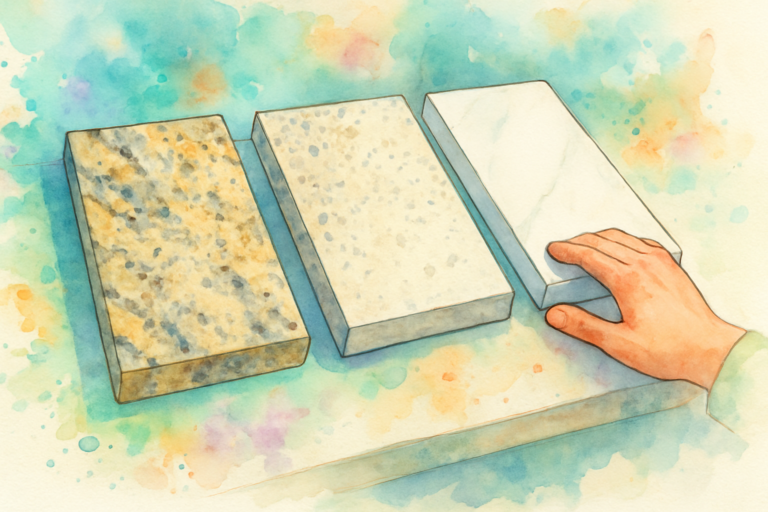
Direct Answer: Granite is natural and durable but porous. Quartz is engineered and low-maintenance but heat-sensitive. Porcelain is the hardest of the three but unforgiving to fabricate.
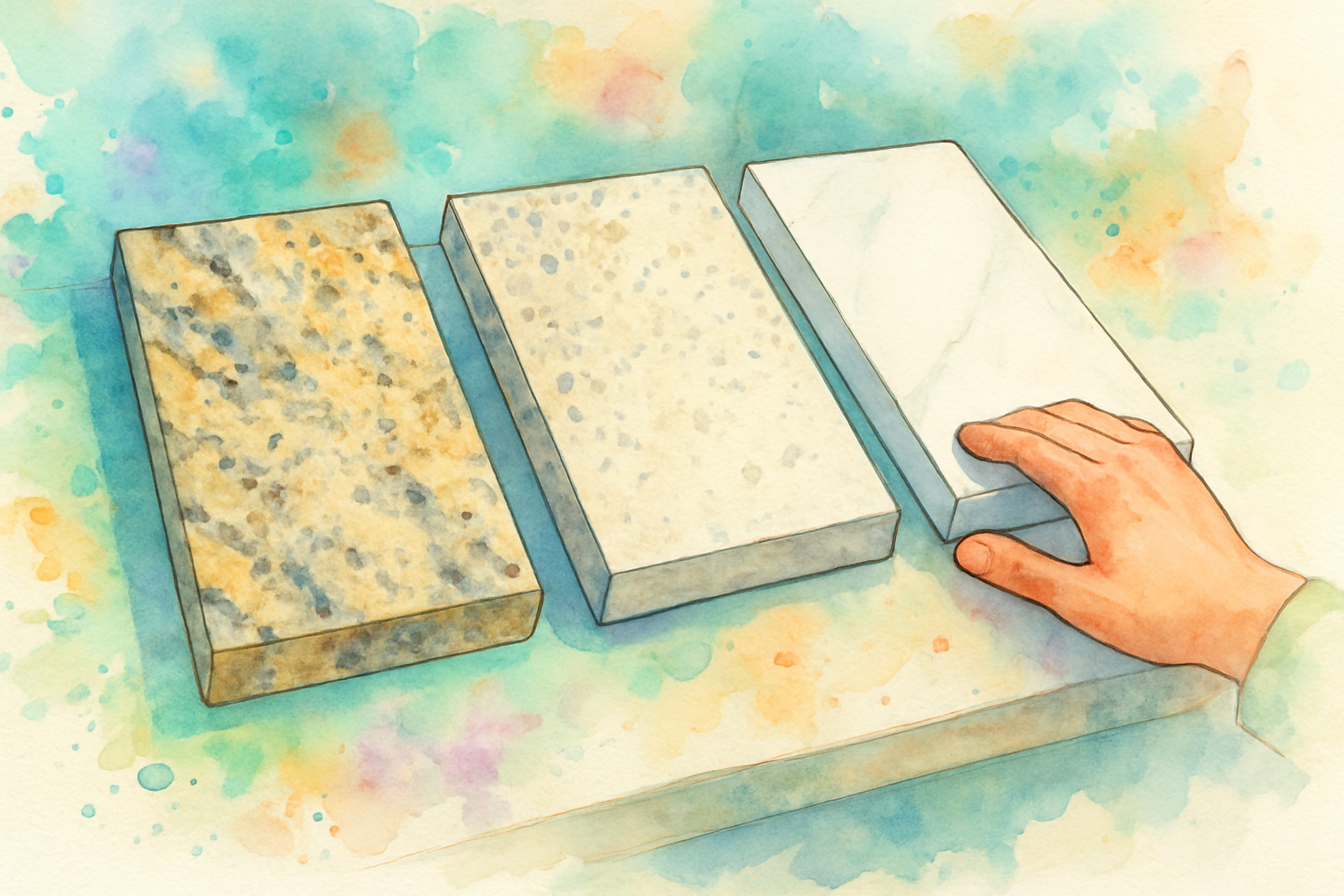
Most homeowners walk into a stone showroom thinking they already know what they want. Then they see three slabs that look almost identical and the question shifts from ‘which color?’ to ‘wait — what actually is this material?’
Granite, quartz, and porcelain each have a legitimate place in kitchen and bathroom design. But they perform differently, require different care, and carry different risks if you choose the wrong one for how you actually live. Getting this decision wrong at the selection stage can create real problems later — problems that are expensive to fix and impossible to ignore.
This guide focuses on what the differences actually mean for your project — not marketing claims, but material behavior, maintenance reality, and where each surface holds up and where it doesn’t. We’re drawing from what clients across the Monterey Peninsula and Bay Area consistently get surprised by when they start asking the right questions.
What Each Material Actually Is
Before comparing performance, it helps to understand what you’re actually buying.
Granite is a natural igneous rock quarried from the earth in massive blocks. Every slab is unique — no two are identical. The colors and patterns come from the specific mineral composition of each quarry region, which is why granite from Brazil looks nothing like granite from Italy or India.
Quartz (also called engineered stone) is a manufactured product. It’s made from roughly 90-95% crushed natural quartz bound together with polymer resins and pigments. The consistency you see across slabs is intentional — that’s the point. It’s designed to replicate the look of natural stone with tighter quality control.
Porcelain is fired clay — technically a ceramic, but kiln-fired at much higher temperatures than standard tile. Large-format porcelain slabs can run 5 feet by 10 feet or larger and are thin enough (as slim as 6mm) to work as countertops, wall cladding, or even flooring. They’re fully non-porous from the start. If you want to understand how porcelain slabs move from production to your kitchen, this breakdown of how porcelain slabs actually get to your counter explains the full supply chain.
Where Each Surface Holds Up — and Where It Doesn’t
This is the part most showrooms gloss over. Every material has a real weakness, and knowing yours before you select saves a lot of frustration.
Granite is one of the hardest natural stones you can buy. It resists scratching well and handles heat better than any engineered alternative — you can set a hot pan on polished granite without damaging it. The trade-off is porosity. Granite is a natural material with microscopic pores, and without regular sealing (typically once a year for kitchen surfaces in heavy use), it can absorb oils, wine, and acidic liquids. This doesn’t mean granite stains easily — sealed granite performs very well — but it does mean maintenance is part of the deal.
Quartz is where people expect low-maintenance and largely get it. The resin binders close off the surface completely, so there’s no sealing required. But quartz has one vulnerability that surprises homeowners: heat sensitivity. Those same resins can discolor or warp under direct, sustained heat above around 300°F. A hot pan set directly on quartz — even briefly — can leave a permanent mark. This is a real concern in working kitchens, not a theoretical one.
Porcelain is the hardest of the three. It’s scratch-resistant, fully non-porous, and won’t react to acids, oils, or UV exposure. Those properties make it an excellent choice for outdoor kitchens, coastal properties near Pebble Beach or Carmel-by-the-Sea where salt air is a factor, and applications where the surface is exposed to sun. The limitation is fabrication risk — porcelain slabs are brittle and unforgiving to cut. A fabricator without direct experience with large-format porcelain can crack a slab during cutting or edge work. That’s a cost and delay problem worth understanding before you commit. For a candid look at what can go wrong, this article on what nobody tells you before buying porcelain slabs covers the fabrication risks specifically.
Quick summary of real-world weaknesses:
– Granite — requires annual sealing; can stain if neglected
– Quartz — heat-sensitive; resin can discolor or warp
– Porcelain — brittle; fabrication errors are costly and not always recoverable
Side-by-Side: How These Three Surfaces Actually Compare
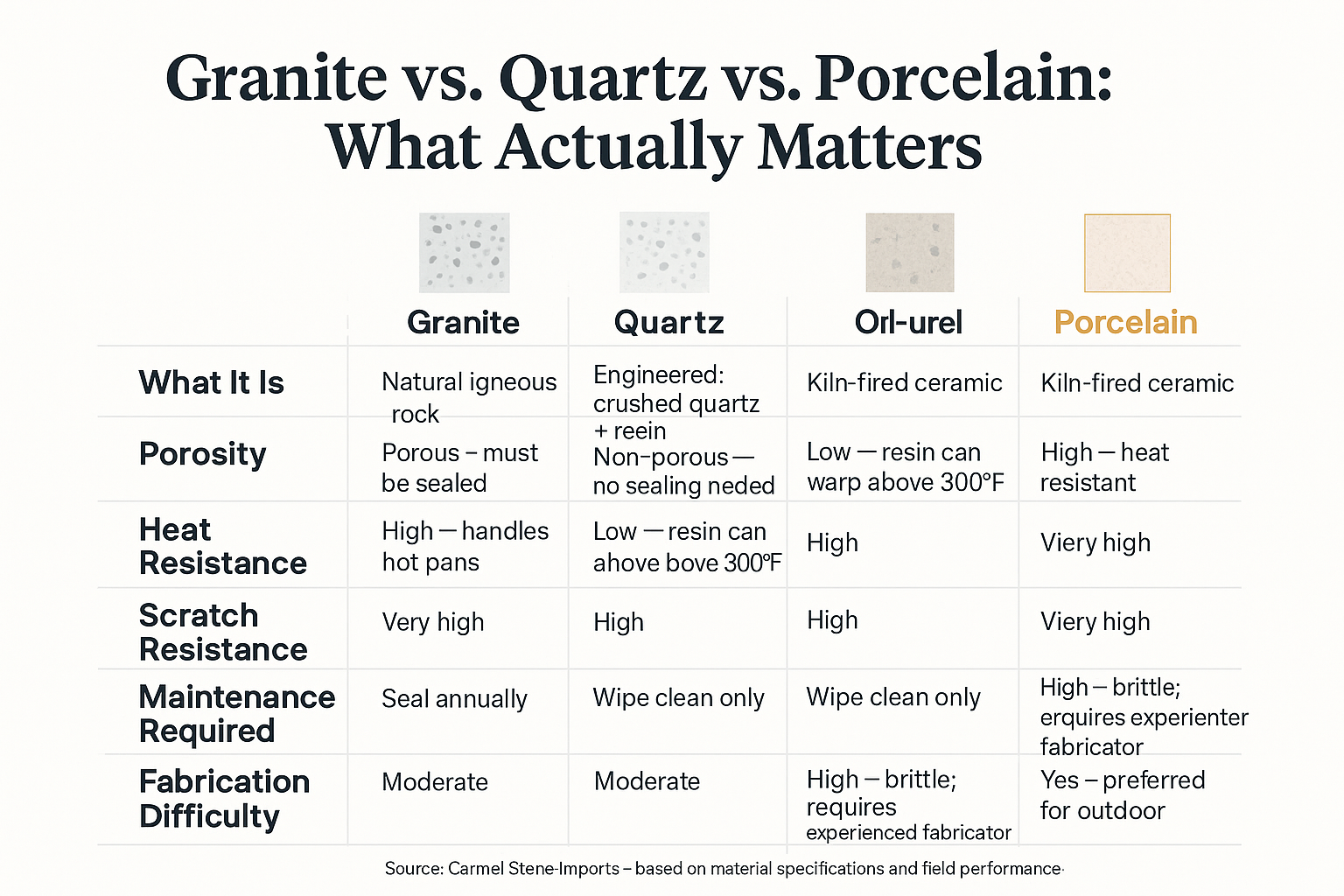
This comparison covers the properties that matter most at the point of selection — not brand claims, but material behavior.
Material Performance at a Glance
Use this as a quick reference when you’re narrowing down your options at the slab selection stage.
| Property | Granite | Quartz | Porcelain |
|---|---|---|---|
| Porosity | Porous — seal annually | Non-porous | Non-porous |
| Heat resistance | High | Low (resin warps ~300°F) | High |
| Scratch resistance | Very high | High | Very high |
| UV / outdoor use | Yes, with sealing | Not recommended | Yes — preferred |
| Maintenance | Annual sealing | Wipe clean | Wipe clean |
| Fabrication risk | Moderate | Moderate | High — brittle material |
| Each slab unique? | Yes — every slab varies | No — consistent by design | No — consistent by design |
| Typical slab cost (supply only) | $60–$120/sq ft | $55–$110/sq ft | $70–$150/sq ft |
The Question Nobody Asks at the Showroom — But Should
Most people walk in asking ‘which one looks better?’ The more useful question is: how does this kitchen or bathroom actually get used?
A working kitchen in Pacific Grove or Menlo Park where someone cooks daily and sets pots directly on the counter is not the same project as a showpiece kitchen in Atherton that gets used twice a week. One of those surfaces needs to handle real punishment. The other can prioritize appearance.
If heat is a regular factor, granite is the more forgiving choice. If the household has kids and the surface will see juice, oils, and a lot of wiping down without much thought about maintenance schedules, quartz handles that well. If the application is outdoors — a barbecue area, a pool deck counter, anything exposed to the Central Coast’s coastal air and sun — porcelain is the clear answer.
For homeowners who want the look of natural stone without the maintenance commitment, understanding where granite, quartz, and porcelain actually land against each other is the right place to start before walking into any showroom. And if you’re working on a bathroom vanity specifically, the decisions involved are a bit different — this guide on mistakes homeowners make with stone vanity tops addresses that specific context.
Cost Reality for Central Coast and Bay Area Projects
Supply costs for all three materials sit in a similar range when you’re buying through a premium importer rather than a big-box retailer. But ‘supply cost’ is only part of the picture.
Expect slab material costs (supply only, before fabrication and installation) to fall roughly in these ranges:
– Granite — $60–$120 per square foot depending on origin and rarity
– Quartz — $55–$110 per square foot for most mid-to-premium engineered options
– Porcelain — $70–$150 per square foot for large-format slabs, with higher-end imported panels toward the top
Where the total project cost diverges is fabrication. Porcelain’s brittleness means fabricators often charge a premium of $20–$40 per square foot over granite or quartz for the added care and tooling required. Some fabricators in the Monterey Peninsula or Bay Area will decline porcelain work entirely if they don’t specialize in it. That’s a logistics reality worth sorting out before you commit to the material. For context on what premium porcelain pricing looks like in the Bay Area market, this breakdown of whether $140 per square foot is too much for a porcelain countertop is a useful reference.
Quartz falls in the middle — fabrication is straightforward, pricing is predictable, and lead times are generally shorter than natural stone because inventory is more consistent.
Frequently Asked Questions About Granite, Quartz, and Porcelain
Is quartz really maintenance-free, or is that a marketing claim?
Mostly true, but with one important exception: heat. Quartz doesn’t need sealing and cleans up easily. But the resin binders that make it non-porous also make it vulnerable to sustained heat above roughly 300°F. A trivet or hot pad near the stove is a real recommendation, not a precaution for cautious people.
Can I use any of these surfaces outside?
Porcelain is the best choice for outdoor applications — it’s fully non-porous, UV stable, and unaffected by the kind of coastal air you get near Carmel or Pebble Beach. Granite works outdoors with proper sealing. Quartz is not recommended outdoors because UV exposure can cause the resin to discolor or break down over time.
Why do some people say quartzite and quartz are the same thing?
They’re not — and this confusion causes real selection mistakes. Quartzite is a natural metamorphic rock, formed from sandstone under heat and pressure. It’s mined from the earth like granite. Quartz (engineered stone) is a manufactured slab product. The names sound similar but the materials, performance characteristics, and maintenance requirements are completely different.
Will the slabs I see at the showroom match what gets delivered to my project?
For quartz and porcelain, consistency is very close — these are manufactured products, so batch variation is minor. For granite, what you see in the showroom is what you need to select from — natural stone varies slab to slab from the same quarry. That’s exactly why viewing actual slabs in person matters so much. Catalog images and online photos don’t capture the full movement, depth, or color shift in real lighting.
Is porcelain harder to fabricate and does that affect my project timeline?
Yes, and it’s worth asking your fabricator directly about their experience with large-format porcelain before you commit to the material. Porcelain slabs are thin and brittle — cutting curves, sink cutouts, and detailed edge profiles carries more risk than the same work on granite or quartz. An experienced fabricator handles it well. One who doesn’t work with porcelain regularly can crack a slab during production, which means a replacement order and weeks of delay. Budget an extra 2–4 weeks of lead time as a conservative assumption.
Ready to See These Materials in Person?
Photos and spec sheets only go so far. Seeing actual slabs under real light — and being able to ask someone who knows the material what to watch for — is what changes a stressful decision into a confident one. Carmel Stone Imports carries live inventory across showrooms in Carmel-by-the-Sea and Palo Alto, with staff who can walk you through exactly what each surface will and won’t do in your specific application. Call (650) 800-7840 or email info@carmelimports.com to schedule a slab selection appointment before your project timeline gets tight.