

Direct Answer: A good slab supplier gives you straight pricing, tells you the truth about what’s actually in stock, and guides you toward the right material — not just the one that looks good in photos.
If you’ve ever called a stone yard and been told ‘someone will get back to you with pricing,’ you already know the frustration. You’re mid-remodel, your fabricator is waiting on dimensions, and the person on the phone can’t tell you what a slab costs or whether it’s actually available.
This happens more than it should — especially during busy remodel season on the Monterey Peninsula and Bay Area, when good material moves fast and buyers are racing against project timelines. The difference between a supplier that moves your project forward and one that stalls it usually comes down to a few specific things.
This article breaks down the three areas where slab suppliers either earn your trust or lose it: pricing transparency, inventory and holds, and material guidance. If you’re buying stone for a kitchen or bath project, these are the questions worth asking before you commit to anyone.
Pricing Transparency: Why Some Suppliers Won’t Give You a Number
Pricing opacity is one of the most common frustrations buyers describe. In call after call, customers ask for a per-square-foot price and get routed to a callback that never comes — or get a vague range that doesn’t help them budget anything.
The reasons pricing varies on natural stone are real and worth understanding:
- Material origin — a quartzite sourced from Brazil and a similarly patterned one from Turkey can sit at very different price points depending on quarry exclusivity, shipping costs, and import volume
- Slab size and yield — larger, bookmatched slabs from a single quarry block command a premium because the material is rarer and the logistics more complex
- Finish type — a leathered or honed finish on the same stone as a polished version often costs more due to additional processing
- Current inventory levels — when a material is running low or comes from a discontinued quarry lot, price reflects scarcity
A transparent supplier doesn’t hide behind these factors — they explain them. When one homeowner called asking about a specific Taj Mahal slab, the right answer isn’t ‘I’ll have someone call you back.’ It’s a direct quote, tied to what’s actually on the floor that day.
For planning purposes, natural stone slab pricing across the Bay Area and Central Coast can range considerably — many buyers in the Carmel and Palo Alto markets see rough estimates anywhere from a few hundred dollars per slab for more common granites to well over a thousand for premium imported quartzites or rare marbles, before fabrication. But those numbers shift with the material, the lot, and the supplier. Always ask for a quote tied to the actual slab you’re looking at — not a ballpark for the category.

Slab Holds and Inventory: What ‘In Stock’ Actually Means
This is the part of the slab-buying process that surprises first-time buyers most. A slab can be listed as available today and sold to someone else before noon tomorrow — especially during peak remodel season, which on the Central Coast tends to run hard from April through October.
Several callers described the same situation: they saw a slab they loved, took a photo, went home to think about it, called back two days later, and were told it was gone. One caller specifically asked about a Mont Blanc quartzite — it was available when they called Friday, gone by Monday.
How a reputable supplier handles this:
- Holds require a deposit. A supplier that holds inventory indefinitely without commitment isn’t protecting you — they’re just delaying the problem. A standard approach is a deposit (often in the range of a few hundred dollars) that takes the slab off the floor while you confirm with your fabricator.
- The deposit is applied to your purchase. It’s not a fee — it comes off the final invoice.
- Hold windows are real deadlines. Most suppliers set a hold period of a few days to a couple of weeks. After that, the slab goes back to available inventory.
If you’re working with a fabricator and haven’t yet confirmed your final square footage, that’s fine — but communicate that clearly when you call. A good supplier can work with your timeline if they know what it is.
Also worth knowing: inventory can differ between locations. A slab at the Sand City warehouse isn’t automatically available at the Palo Alto showroom. Always confirm which location holds the material before making a trip. For more on what the in-person selection process actually looks like, What Happens When You Visit a Stone Showroom for the First Time walks through it step by step.
How the Supplier-to-Fabricator Workflow Actually Works
Many buyers don’t realize a slab supplier and a fabricator are separate businesses with separate roles. This visual shows exactly how the process flows from selection to installed countertop.
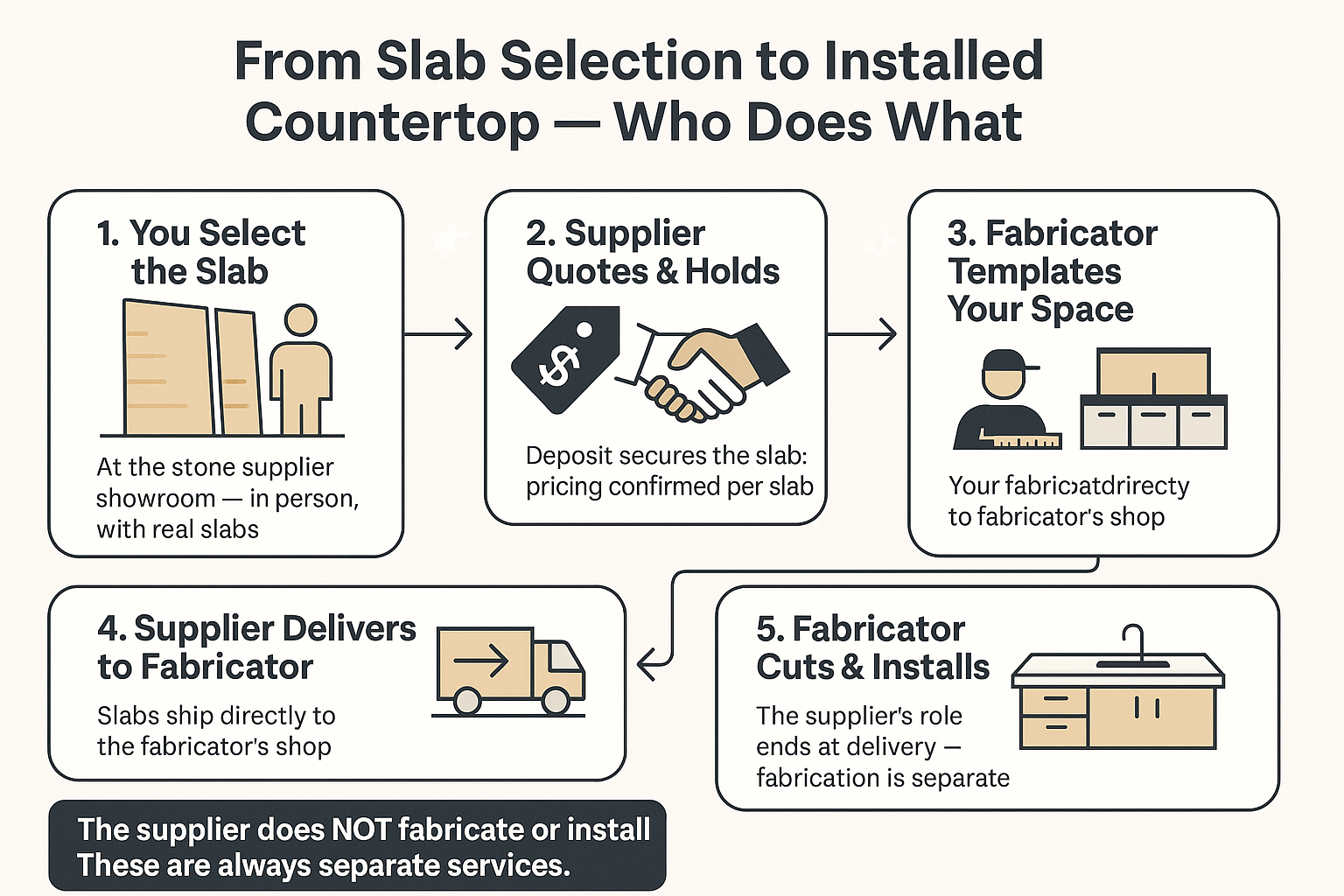
The Supplier-to-Fabricator Workflow: Who Does What
A question that comes up constantly — especially from homeowners early in a remodel — is whether they can just walk in and buy a slab directly, or whether they need a contractor or fabricator involved.
The short answer: you can select and purchase a slab directly from a stone supplier. You don’t need a contractor present to choose your material or place an order. But fabrication — the cutting, edging, and installation of the stone — is always a separate service performed by a separate company.
Here’s how the workflow typically runs:
1. You visit the showroom, select your slab, and purchase it (sometimes with a deposit to hold).
2. Your fabricator templates your space — meaning they measure the countertop area precisely.
3. The supplier coordinates delivery of your slabs directly to the fabricator’s shop.
4. The fabricator cuts, finishes, and installs the stone.
The supplier’s job ends at delivery. No stone showroom handles the cutting or installation — those are trade contractor services that require separate licensing, equipment, and scheduling.
For trade professionals — designers, architects, and contractors — the supplier relationship goes a step further. A reliable supplier coordinates directly with your fabricator so you’re not playing telephone between two vendors. One contractor reviewer described sending clients directly to the showroom, knowing they’d come back with material chosen confidently and delivery already coordinated. That kind of supplier-contractor collaboration is what keeps Monterey Peninsula remodel timelines intact.
If you work in the trade, it’s worth asking any supplier about their contractor or designer program early. Some suppliers offer meaningful pricing advantages for trade accounts — advantages that make a real difference on multi-project volume. How to Pick a Granite Slab Without Second-Guessing Yourself Later covers what the selection side of that conversation looks like.
Material Guidance: Suitability Matters as Much as Looks
A supplier who just points you toward what’s popular isn’t doing their job. The best stone consultants ask where the material is going, how the surface will be used, and what kind of maintenance the homeowner is actually willing to do.
This matters because not every beautiful stone performs the same way in every application. A few examples:
- Calcatta marble looks stunning in a kitchen but is soft and porous — it etches from acidic foods and requires sealing. In a busy cooking kitchen, that’s a real daily maintenance consideration.
- Quartzite is often confused with quartz (an engineered product), but it’s a natural stone — and porosity varies significantly by type. Some quartzites are dense and highly resistant; others need regular sealing just like marble.
- Leathered finishes on granite or quartzite hide fingerprints and water spots better than polished surfaces, which matters in a kitchen used by a family with kids.
- Travertine is beautiful in a bathroom or as exterior pavers, but its natural pits and voids require either filling or ongoing maintenance depending on the finish.
A good supplier walks through these tradeoffs before you fall in love with a slab. One customer described coming in with a vague idea of what they wanted — and leaving with a leathered quartzite they hadn’t considered, because the consultant asked the right questions first. That’s guidance, not just sales.
For materials that often get misread on looks alone, Dolomite Stone Looks Like Marble — But It Behaves Differently and Are Porcelain Slabs Really as Durable as They Sound? are worth reading before your showroom visit.
Quick Reference: What a Good Supplier Does vs. What a Frustrating One Does
These aren’t small differences — they’re the gap between a project that moves smoothly and one that stalls at the material stage.
| Situation | Frustrating Supplier | Good Supplier |
|---|---|---|
| You ask for pricing | Promises a callback that may not come | Gives a direct quote tied to the actual slab |
| You want to hold a slab | Vague about policy; slab sells before you return | Clear deposit terms, confirmed hold window |
| Inventory differs by location | Transfers you without confirming which location has it | Checks the specific location before answering |
| You ask about maintenance | Says ‘it’s easy to care for’ without specifics | Explains porosity, sealing schedule, and finish behavior |
| You need fabricator coordination | Leaves logistics to you | Coordinates slab delivery directly with your fabricator |
| You’re a trade professional | Treats you like a retail buyer | Discusses trade pricing and project coordination upfront |
Frequently Asked Questions About Choosing a Slab Supplier
Can I buy a slab directly from a stone supplier without a contractor?
Yes — you can select and purchase a slab directly. You don’t need a contractor present to choose your material. That said, fabrication and installation are always separate services handled by a licensed trade contractor. The supplier’s role ends when the slab is delivered to your fabricator’s shop.
How do slab holds work, and how long can I hold a slab?
Most reputable suppliers require a deposit to hold a slab — typically applied toward your final purchase price. Hold windows vary, but a few days to two weeks is common. Without a deposit, the slab stays available to anyone who walks in. If you’ve seen something you love, ask about a hold the same day — especially during peak remodel season when inventory moves fast.
Why does pricing vary so much on the same type of stone?
Several factors drive the range: country of origin, quarry exclusivity, slab size, finish type (leathered vs. polished), and current inventory levels. A material from a discontinued quarry lot can cost significantly more than a similar-looking stone that’s widely available. The best way to get an accurate number is to ask for a quote on the specific slab you’re considering — not a category estimate.
What should I ask a supplier before selecting a material?
Ask about porosity and sealing requirements for the specific stone, not the category. Ask how the finish behaves in daily use — polished marble and honed marble look different, age differently, and require different care. Ask whether the material is suitable for your specific application: a bathroom wall, a kitchen countertop, and an outdoor patio have very different performance demands. A good supplier answers these questions before you ask.
Do suppliers offer different pricing for designers and contractors?
Many do. If you’re a trade professional, ask about a designer or contractor account early in the conversation. Trade pricing programs can make a meaningful difference on multi-project volume — and the best suppliers mention it proactively rather than waiting for you to bring it up.
I saw a slab at one location — is it available at another?
Not automatically. Inventory is location-specific. A slab at a Sand City warehouse isn’t guaranteed to be at a Palo Alto showroom. Always confirm which location holds the material before making the drive — and ask whether it can be transferred if needed.
Ready to Work With a Supplier Who Gives You Straight Answers?
Carmel Stone Imports has showrooms in Carmel-by-the-Sea and Palo Alto, with live inventory you can view in person before committing to anything. If you have a project in progress and want to check availability, get a real quote, or schedule a slab selection appointment, call (650) 800-7840 or email info@carmelimports.com — and someone who knows the inventory will get back to you with specifics.