Direct Answer: The right countertop material depends on how your kitchen or bath actually gets used. Marble is beautiful but reacts to acids. True quartzite and granite are far more durable. Porcelain is tough but unforgiving to cut.
Most people walk into a stone showroom with a feeling, not a decision. Something white and dramatic. Something that won’t show every water mark. Whatever holds up in a kitchen with three kids. That’s a perfectly reasonable place to start — but it’s not enough to choose a material, because ‘white stone’ alone covers a dozen different surfaces that behave completely differently once they’re in your home.
What most homeowners discover at the showroom is that the decision they thought was aesthetic is actually a performance decision first. Marble etches. Some quartzites are actually soft stone sold under the wrong name. Granite fell out of fashion but quietly outperforms most surfaces in daily use. Porcelain is genuinely scratch-resistant but punishes any fabricator who doesn’t know it well.
This guide works through the real differences between these four materials — not the marketing version, the actual one. If you’re planning a kitchen or bath remodel on the Monterey Peninsula or in the Bay Area, getting this decision right before you spend thousands on slabs is worth the time.
Marble: The Most Requested, Most Misunderstood Natural Stone Countertop
Marble is calcium carbonate. That’s not a chemistry lesson — it’s the single most important fact about how it performs in a kitchen. Acids etch calcium carbonate on contact, and acids are everywhere in a kitchen: lemon juice, vinegar, tomato sauce, wine, even some cleaning sprays.
Etching is not the same as staining. A stain is a discoloration that soaks into porous stone and can often be treated or drawn out. An etch mark is a physical change to the surface — the acid dissolves a thin layer of the stone, leaving a dull spot on polished marble that no amount of cleaning will fix. This is the distinction that catches homeowners off guard, and it’s why marble in a hard-use kitchen is a commitment, not just a choice.
That said, marble is not the wrong choice — it’s a choice that requires honesty about maintenance. A few things that genuinely help:
- Honed finish over polished — a matte surface hides etch marks far better than a mirror-polished one, because the contrast between an etch and the surrounding surface is much less visible
- Prompt cleanup — acids that sit for minutes etch; acids wiped up immediately cause far less damage
- Sealing — protects against staining, not etching; the two protections are separate and both matter
For bathrooms, powder rooms, or low-traffic kitchen surfaces, marble can be a stunning and practical choice. For a primary cooking surface where lemons get squeezed and wine gets poured, go in with clear eyes. Picking a marble slab in person versus online covers what that selection process actually looks like when you’re standing in front of real slabs.
Quartzite: The Most Misrepresented Stone in Any Showroom Right Now
True quartzite is a metamorphic rock formed when sandstone is subjected to intense heat and pressure. It is silica-based, which means it doesn’t etch from acids the way marble does, and it’s genuinely hard — one of the most durable natural stone countertop options available. The problem is that a significant number of stones currently sold as quartzite are actually soft marble or transitional dolomite, and they etch and stain exactly like marble does.
This isn’t a minor labeling issue. Several callers who’ve reached out before visiting the showroom described being burned by a previous purchase — a stone sold to them as ‘basically bulletproof quartzite’ that started showing acid damage within weeks. The mislabeling happens at multiple points in the supply chain, and it’s common enough that any buyer should verify before committing.
The simplest field test you can do: put a few drops of lemon juice or white vinegar on the surface and leave it for 10 minutes. Wipe it off and look closely at the spot in raking light. If the surface looks dull or has a faint ring, the stone contains calcite — it’s not true quartzite, regardless of what the label says. True silica-based quartzite will be completely unaffected.
Do this test before you spend several hundred dollars per slab. If a supplier won’t let you test in the showroom, that’s information too.
For more on why even properly labeled quartzite can behave unexpectedly, this guide on why new quartzite sometimes stains is worth reading before your selection appointment.
How These Four Materials Actually Compare
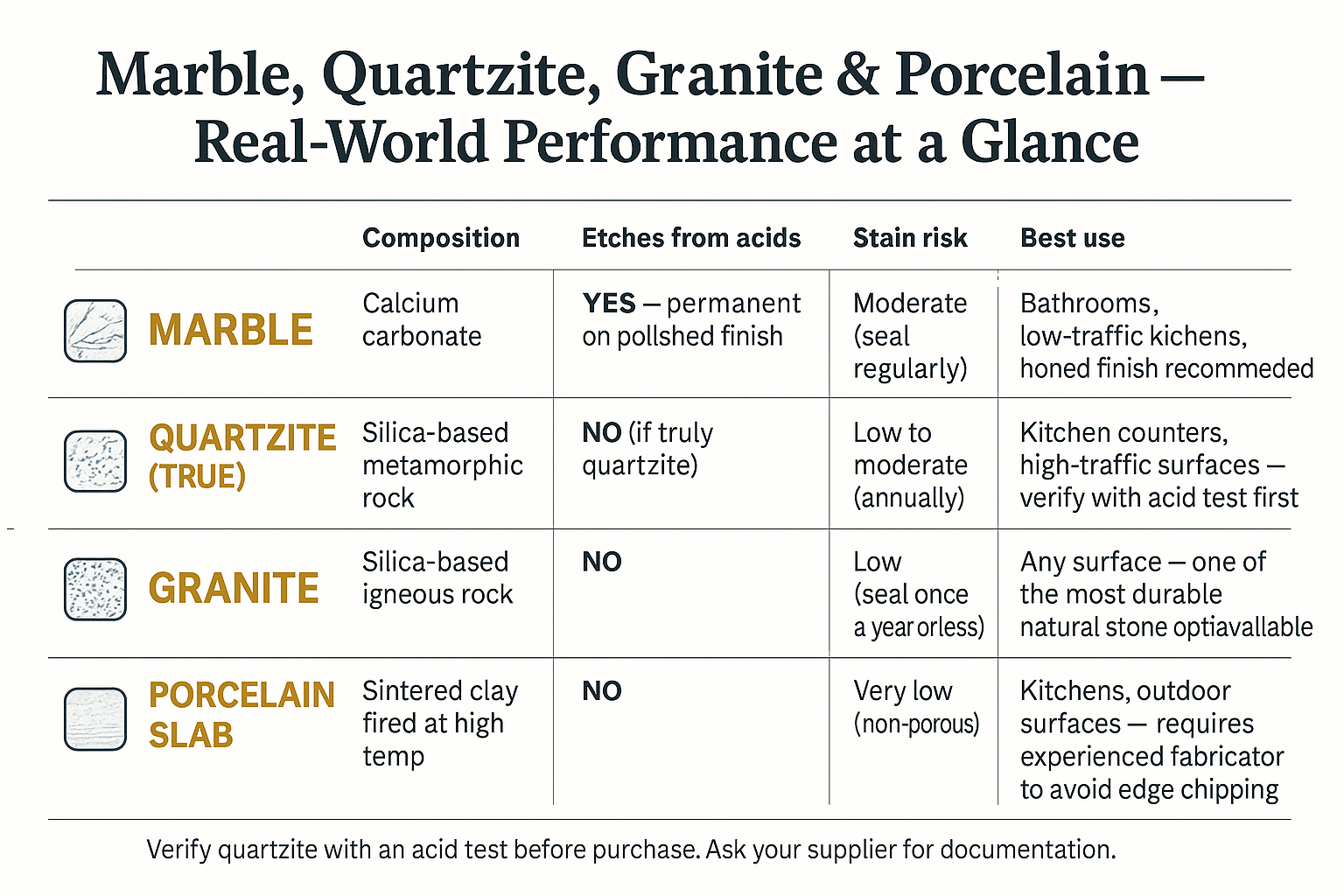
Here’s a side-by-side look at the four main categories — what makes each one distinct in real daily use, not in a catalog.
Granite: The Durable Natural Stone Countertop That Deserves a Second Look
Granite went out of style during the quartz countertop boom of the 2010s, and a lot of homeowners still carry a mental image of heavy, dark slabs with busy black-and-gold patterns. That picture is about 15 years out of date.
True granite is a silica-based igneous rock, which means it doesn’t etch from acids — full stop. Lemon juice, tomato sauce, vinegar: none of them chemically attack granite the way they attack marble or soft quartzite. Most granite also needs sealing only once a year or less, depending on the density of the individual slab. Denser granites may barely need sealing at all.
What most buyers don’t realize until they see live slabs in a showroom is how wide the range actually is. Granite comes in soft whites and creams, deep navy blues, warm earthy tones, and dramatic movement that rivals the best quartzite. The material that fell out of fashion wasn’t granite itself — it was a specific subset of it that was overused.
For a kitchen that gets hard daily use and for homeowners who genuinely don’t want to think much about maintenance, granite is one of the strongest cases in the natural stone category. How to pick a granite slab without second-guessing yourself later walks through the selection process in detail.
Quick Reference: Acid Etching and Maintenance by Material
These are the maintenance realities that matter most for a kitchen or bath countertop. Use this as a starting point — every individual slab will vary.
| Material | Etches from Acids? | Sealing Frequency | Repair if Damaged? |
|---|---|---|---|
| Marble (polished) | Yes — permanently on polished finish | Every 6–12 months | Honing can reduce visible damage; etches cannot be reversed |
| Marble (honed) | Yes — but far less visible | Every 6–12 months | Better starting point for kitchens; still etches |
| True Quartzite | No (verify with acid test) | Once a year or less | Minor scratches can often be polished out |
| Soft Quartzite / Dolomite | Yes — behaves like marble | Every 6–12 months | Same limitations as marble |
| Granite | No | Once a year or less for most | Chips and cracks can be repaired by a fabricator |
| Porcelain Slab | No | None required | Edge chips cannot be repaired — prevention is the only solution |
Porcelain Slab: What the Marketing Gets Right — and What It Leaves Out
Porcelain slab is the category most homeowners are actively researching right now, and the performance claims you’ll see are largely accurate. Sintered porcelain is scratch-resistant, stain-resistant, UV-stable, and heat-tolerant. It’s non-porous, so it never needs sealing. For outdoor kitchens — a real consideration for California homeowners — it handles weather exposure better than most natural stone.
What the marketing doesn’t mention is what happens during fabrication. Porcelain slabs are harder and more brittle than natural stone, and they chip at the edges during cutting and transport in ways that can’t be repaired after the fact. Once a chip happens, you’re looking at replacement, not refinishing.
Two things reduce that risk meaningfully:
- Edge profile selection — a radius or beveled edge is significantly less prone to chipping than a sharp square edge, because there’s less exposed material at the corner
- Fabricator experience — porcelain punishes an inexperienced team. The slab is only as good as the people cutting and handling it
This is not a reason to avoid porcelain — it’s a reason to ask the right questions before the material leaves the showroom. Are porcelain slabs really as durable as they sound? covers this in more depth, and what nobody tells you before you buy a porcelain slab countertop addresses the fabrication side specifically.
Why Seeing the Actual Slab Changes Everything
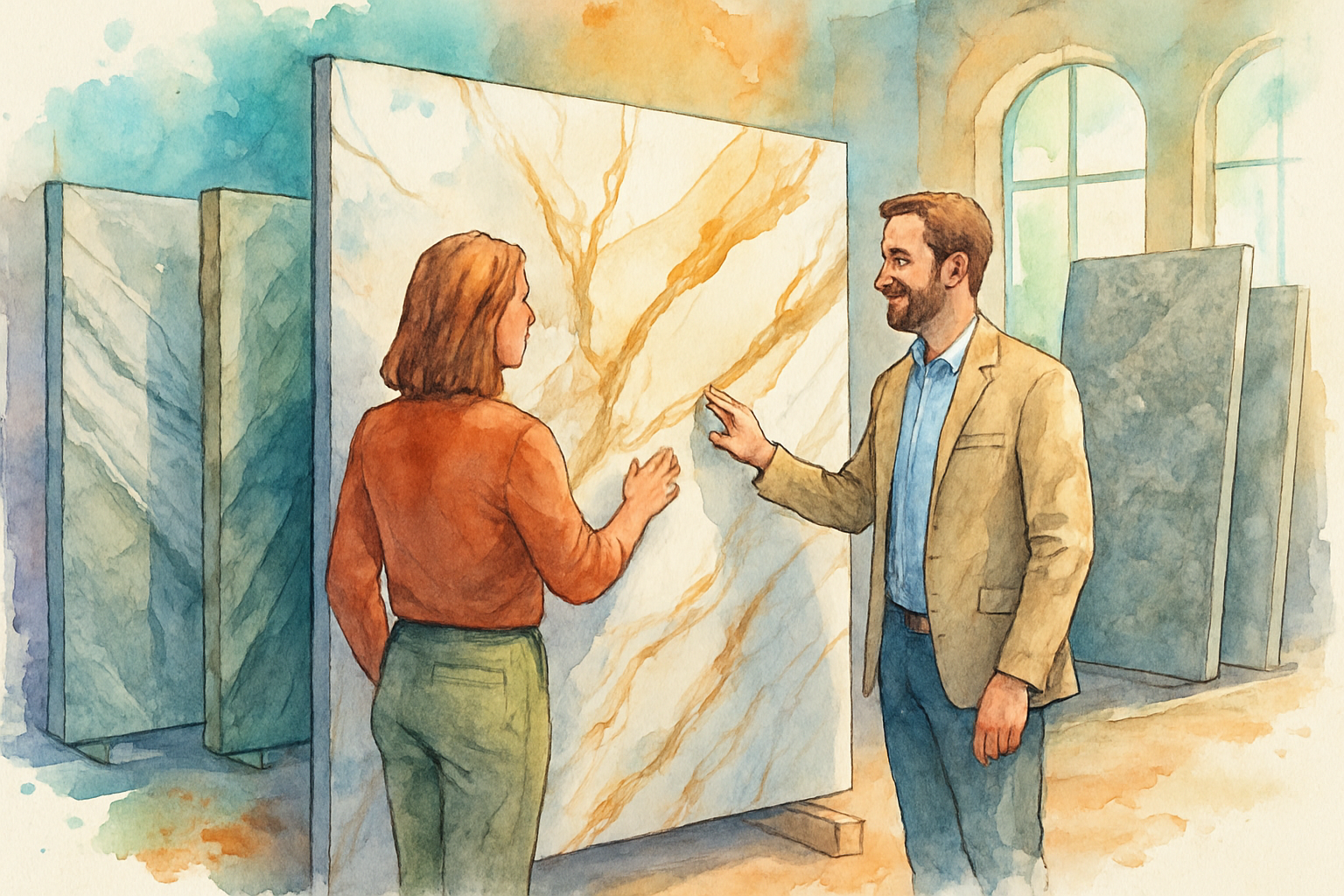
Stone photographs unpredictably. The veining depth, the background tone, the way a finish catches light — none of it translates reliably to a screen or a small sample chip. Two slabs of the same material, from the same quarry batch, can look dramatically different when pulled into natural light side by side.
One homeowner described submitting a detailed form inquiry before her showroom visit — she arrived with six specific slab SKUs she wanted pulled and ready. She saw them in person, made a same-day decision, and left confident. That’s the contrast between catalog shopping and standing in front of a real slab: the material tells you things a photo simply can’t.
The experience Christina F. described captures it well: “I had been to too many showrooms and had a vague idea about what I envisioned when I showed him my cabinet door and some photos he guided me instantly to the Dolce Vita leathered Quartzite. The color, texture and design was exactly what I had been searching for, and I didn’t know it until he showed it to me.”
That outcome — not knowing what you wanted until you saw it — is more common than most buyers expect. It’s also why the performance framework in this article matters: when you know what a material actually does, you can walk into a showroom with confidence and let the aesthetics guide the final call, rather than working backward from a photo and hoping it translates.
What happens when you visit a stone showroom for the first time walks through exactly what to expect if you haven’t done a slab selection appointment before.
Frequently Asked Questions About Natural Stone Countertops
How do I know if the quartzite I’m looking at is actually quartzite?
Do the acid test before you buy. Put a few drops of lemon juice or white vinegar on the surface, leave it 10 minutes, then wipe it off and look at the spot in raking light. If the surface is dull or has a faint ring, the stone contains calcite — it’s marble or dolomite, not true quartzite. True silica-based quartzite will show no change at all. Any reputable supplier should let you do this in the showroom.
Is marble a reasonable choice for a kitchen countertop?
It can be — with realistic expectations. Marble will etch from acids, and those marks are permanent on a polished finish. If you want marble in a hard-use kitchen, choose a honed finish, which hides etching far better, and accept that the surface will develop patina over time. For many homeowners, that’s part of the appeal. For others, it’s a dealbreaker. Both answers are valid — the problem is going in without knowing.
Does granite still look dated? I thought quartz replaced it.
That reputation is outdated. Quartz countertops dominated the market through the 2010s, but granite never stopped being one of the most durable natural stone countertop options available. The range of colors, movement, and finishes in granite is much wider than most homeowners realize — seeing live slabs in person usually changes the picture completely.
Can porcelain be repaired if it chips?
No. That’s the honest answer. Edge chips on porcelain slab cannot be repaired the way natural stone can be touched up or re-polished. Prevention is the only solution — choose a radius or beveled edge profile, and make sure your fabricator has real experience cutting large-format porcelain.
How often does natural stone actually need to be sealed?
It depends on the material and the specific slab’s density. As a general starting point: marble and softer quartzites typically need sealing every 6 to 12 months, most granite once a year or less, and denser granites may need it even less frequently. Porcelain never needs sealing — it’s non-porous by nature. Ask at the showroom about the specific slab you’re considering, because density varies even within the same material category.
Do I need an appointment to view slabs at the showroom?
Walk-ins are welcome, but calling ahead lets the team pull specific slabs you’re interested in so they’re accessible when you arrive. For a major purchase decision, a scheduled appointment means someone can focus on your project from the start — which makes a real difference when you’re comparing multiple materials side by side.
Ready to See the Actual Slabs in Person?
Carmel Stone Imports keeps live inventory across its showroom and warehouse locations in Carmel-by-the-Sea, Sand City, and Palo Alto — so you can view and select real slabs, not catalog images. If you’re working through a kitchen or bath project on the Monterey Peninsula or anywhere in the Bay Area and want to compare materials side by side with someone who can explain the performance differences honestly, you can reach the team by phone at (650) 800-7840 or by email at info@carmelimports.com to plan your visit.