

Direct Answer: A good natural stone tile supplier should know material performance, wet-area requirements, dye lot risk, and fabrication realities — not just what’s in stock.
A lot of tile suppliers will hand you a catalog and tell you the price per square foot. That’s about where their help ends. For a kitchen remodel in Carmel-by-the-Sea or a master bath in Palo Alto, that’s not nearly enough.
The questions that actually matter — how this tile holds up in a steam shower, whether the dye lot from Phase 1 will match Phase 2, what your installer needs to know before they set a large-format slab on a floor — those questions require someone who knows the material, not just the SKU.
This article covers what a genuinely knowledgeable stone tile supplier should be able to tell you, and why the gap between a well-informed supplier and an uninformed one can mean the difference between a beautiful finished project and a costly repair.
Wet-Area Tile Selection Is More Than Picking a Look
This is where a lot of buyers get tripped up. A tile that photographs beautifully in a showroom can perform poorly in a shower or steam room if the wrong finish or porosity rating ends up in a wet environment.
A supplier who understands wet-area applications should be walking you through at least three things:
- Finish: Polished marble and honed limestone can become dangerously slippery when wet. In a shower floor application, a textured or matte finish — or a mosaic format that adds more grout joints — dramatically improves grip.
- Porosity: Natural stone is not uniformly dense. A porous travertine or unsealed limestone will absorb moisture repeatedly in a shower wall application, which eventually leads to efflorescence, staining, or mortar bond failure. Understanding which stones need sealing and how often is part of what the supplier should be explaining to you. The article on travertine in coastal California bathrooms covers this in more depth.
- Minimum mortar coverage: This one rarely comes up in a casual showroom visit, but it matters. Large-format stone tile requires a higher percentage of mortar coverage on the back face — often 95% or more in wet areas — compared to standard ceramic tile installations. If your installer doesn’t know this and the substrate isn’t prepared correctly, tiles can crack or delaminate over time.
The supplier’s job isn’t to do the installation. But a supplier who understands fabrication and installation requirements helps you ask better questions of the contractor who will.

Dye Lot Risk: The Problem Nobody Explains Until It’s Too Late
Natural stone tile comes from quarries. Every block cut from that quarry produces a slightly different batch — in color, veining, and tone. That batch is called a dye lot (sometimes called a shade lot or run), and once it sells through, there is no guarantee the next shipment will match.
For most single-room projects where all material is ordered at once, this isn’t a problem. But it becomes a real issue in a few specific situations:
- Phased remodels where a kitchen is tiled in Phase 1 and an adjacent hallway in Phase 2, months later
- Commercial or larger residential projects where material is specified early and ordered in stages
- Repairs and replacements — if a tile cracks two years after installation and the dye lot is long gone, finding a visual match can be extremely difficult
A knowledgeable supplier will flag this risk before you finalize your quantity. They’ll typically recommend ordering 10–15% overage beyond your measured square footage specifically to account for cuts, breakage, and future repairs from the same lot.
Several designers and contractors working along the Monterey Peninsula have mentioned exactly this situation in real project conversations — specifying a tile for an initial phase, then discovering the follow-on order comes from a different lot with a noticeably different tone. The supplier who mentions dye lot risk upfront is doing their job. The one who doesn’t is leaving you to find out the hard way.
For a broader look at how supplier reliability affects the full project experience, this article on what separates a good slab supplier from a frustrating one is worth reading.
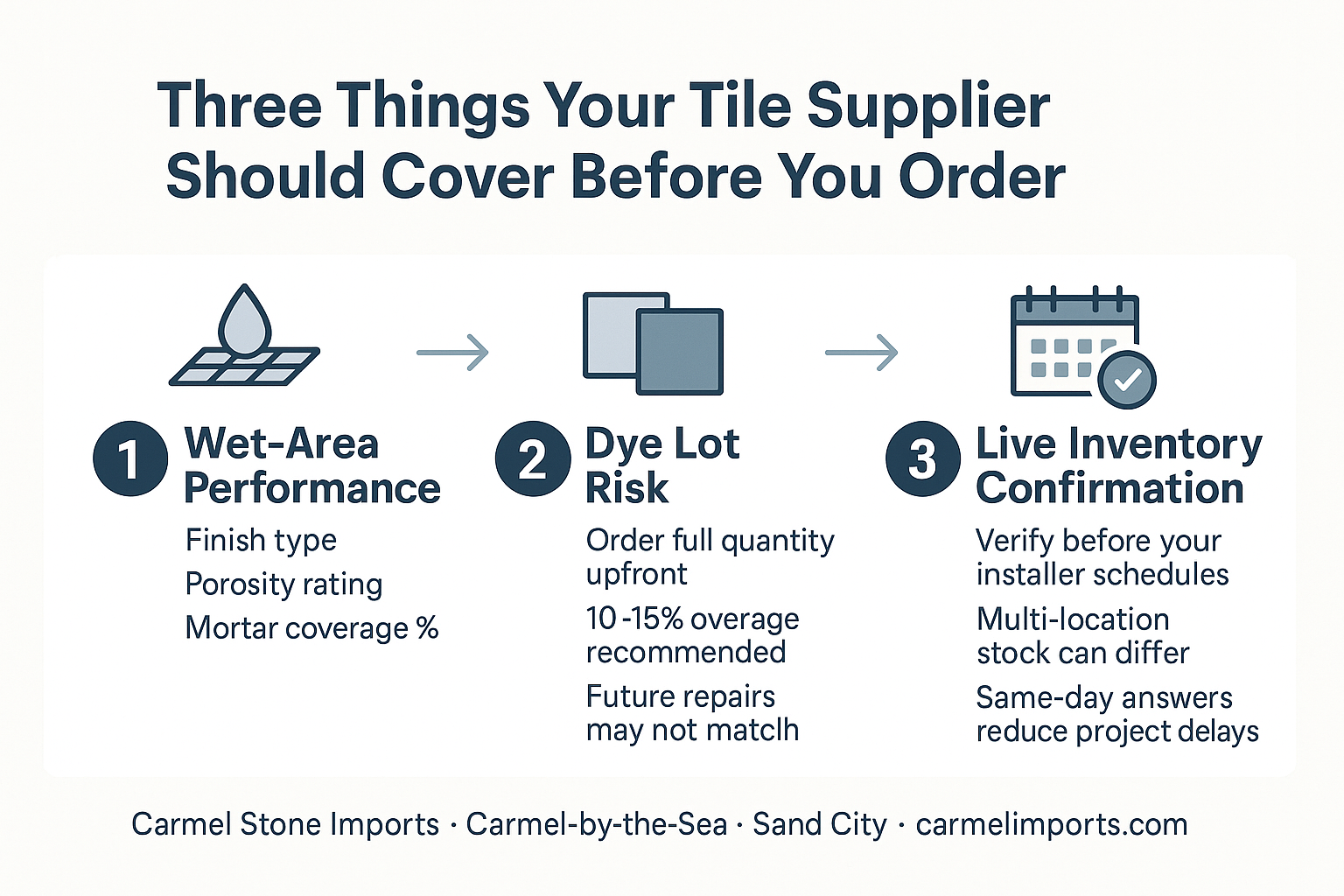
Three Things a Tile Supplier Should Cover Before You Order
These three topics come up repeatedly in projects that go wrong — and almost never get addressed by suppliers who are just moving inventory.
Fast Inventory Answers Aren’t a Courtesy — They’re Part of the Service
Designers and contractors working on active projects don’t have time for a callback queue. When a tile installer has a crew scheduled to start on Monday and the supplier can’t confirm stock until Wednesday, that’s a project risk — not just an inconvenience.
A supplier with live inventory visibility across their locations removes that uncertainty. When a contractor in Monterey can call and get a real answer in the same conversation — yes, we have it, here’s how many square feet, it’s at Sand City — they can make decisions and keep their schedule.
This matters particularly for projects across multiple locations. Several callers have mentioned calling to confirm stock they saw at one location, only to find it wasn’t available at another — and no one flagged that difference up front. A supplier whose staff can see inventory across locations in real time, and communicates that proactively, is worth more to a working professional than one with a wider selection but slower answers.
For homeowners, this plays out differently but the stakes are similar. One common pattern from real project conversations: a homeowner drives from Pacific Heights or Pebble Beach to view a specific tile, only to find it’s already sold through. Getting that confirmation before the visit — and getting it fast — is what turns a supplier into a reliable partner rather than a gamble.
The broader question of how to find a reliable stone source in the Bay Area is covered in more detail in this guide for countertop slab buyers near San Francisco.
Natural Stone Tile in Wet Areas: A Quick Reference
Different stone types behave very differently in showers and high-moisture environments. This table summarizes the key considerations a supplier should be discussing with you.
| Stone Type | Wet-Area Suitability | Key Considerations |
|---|---|---|
| Marble | Moderate — surface dependent | Polished finish is slippery when wet; honed is better for floors; requires regular sealing |
| Travertine | Use with caution | Highly porous; unfilled travertine traps moisture; needs sealing and proper substrate prep |
| Limestone | Moderate — species dependent | Varies widely by density; softer limestones absorb water readily; always ask about absorption rate |
| Quartzite | Good — when properly sealed | Dense and durable; less porous than marble; finish selection still matters for slip resistance |
| Porcelain Tile | Excellent | Non-porous; low maintenance; large-format versions require skilled installation and full mortar coverage |
| Granite | Good | Dense and durable; honed finish recommended for shower floors; sealing extends performance |
Large-Format Tile: Why the Supplier’s Knowledge of Installation Matters
Large-format stone tile — think 24×48 inch or even 24×24 inch porcelain slabs used as floor or wall tile — is one of the more unforgiving products in the stone category. The tile itself can be beautiful. But if the substrate isn’t perfectly flat, or the mortar coverage is insufficient, or the installer doesn’t have experience with heavy, thin-format material, the results can include cracked tiles, hollow spots, or lippage between panels.
A supplier who only knows the product code isn’t helping you here. The useful conversation goes further:
- What substrate preparation does this format require? (Large-format tile is far less forgiving of floor deflection than smaller tile.)
- Does this tile need a specific mortar type — a large-format, polymer-modified thinset as opposed to standard thinset?
- What’s the minimum slab thickness available, and how does that affect handling and cutting?
- Are there special tools required for installation that your contractor needs to have on hand?
A good supplier doesn’t need to be your installer. But knowing enough to prepare you for the right conversation with your installer is exactly what separates useful expertise from a catalog hand-off.
For buyers researching porcelain specifically, this article on porcelain slab countertops covers several related points on fabrication risk that apply equally to large-format tile installations.
What Good Supplier Guidance Actually Looks Like
Customer feedback from real projects tells a consistent story. The experiences people describe as exceptional almost never start with product selection. They start with being asked the right questions.
One homeowner working through a master bath remodel described it this way: the person helping her asked about the scope, the timeline, and the style — not just the square footage. By the time they’d had that conversation, the material selection felt obvious rather than overwhelming.
Another pattern that comes up repeatedly: people mention never being left wondering about lead times or availability. That’s not a small thing when you’re managing multiple contractors and a project that’s already been delayed by supply chain issues.
The qualities that define a genuinely useful stone tile supplier:
- Asks before recommending — understanding the end use and the design context before pulling samples
- Flags limitations honestly — telling you when a material isn’t the right fit for your application, even if it’s a beautiful one
- Knows the numbers — lead times, available quantities, dye lot status, and mortar coverage requirements
- Bridges to the rest of the process — connecting you with reliable fabricators and flagging installer requirements you need to pass along
For buyers still in the material comparison phase, this guide on choosing between marble, quartzite, granite, and porcelain is a practical starting point.
Frequently Asked Questions About Natural Stone Tile Suppliers
How do I know if a supplier actually has a tile in stock, or if they’re just showing me a catalog?
Ask directly: ‘Is this item in your warehouse right now, and can I see the actual lot you have available?’ A supplier with live inventory should be able to confirm stock on hand, show you the physical material, and tell you how many square feet are available from the same dye lot. If the answer is ‘we can order it,’ that’s fine — but it’s a different situation with different lead times and no guarantee of a match to any previously shipped material.
Do I really need to order extra tile, or is that just a sales tactic?
It’s a legitimate risk management practice. Standard guidance for natural stone tile is a 10–15% overage above your measured square footage. That covers cuts and breakage during installation, and — critically — it preserves tiles from the same dye lot for future repairs. If a tile cracks a year from now and that lot is sold through, matching it can be very difficult.
What’s the difference between a tile supplier and a tile fabricator?
A supplier sources, imports, and sells the tile. A fabricator cuts it to size, makes specialty cuts around outlets or fixtures, and handles installation. These are separate businesses with separate expertise. When you’re at a showroom, you’re working with the supplier — they can often recommend fabricators in the area, but they don’t do the cutting or installation work themselves.
How do I know if a specific tile is safe to use in a shower or on a wet floor?
Your supplier should be able to tell you the tile’s slip resistance rating (look for a COF — coefficient of friction — of 0.42 or higher for wet floors under most standards), its water absorption rate, and whether the finish is appropriate for the application. For shower floors in particular, polished finishes on marble or limestone are generally not recommended. A honed or textured finish, or a mosaic format with more grout lines, gives better grip.
Does the showroom location matter if I’m having tile delivered to a job site?
It can, depending on where your project is located. Carmel Stone Imports operates showrooms in Carmel-by-the-Sea and Palo Alto, plus a warehouse hub in Sand City. Not all inventory is identical across locations — so if you’re working on a project in Pebble Beach versus one in Menlo Park, it’s worth confirming which location is carrying the specific material you’re interested in and coordinating delivery from there.
Ready to Talk Through Your Tile Selection With Someone Who Knows the Material?
Carmel Stone Imports carries live inventory across three locations — Carmel-by-the-Sea, Sand City, and Palo Alto — with staff who can walk you through finish selection, dye lot availability, and wet-area requirements before you finalize anything. You can call to check availability or schedule a slab selection appointment at (650) 800-7840, or send a note to info@carmelimports.com with your project details and someone will follow up with specifics.