Direct Answer: Porcelain slabs are genuinely hard and heat-resistant, but chipping at edges and during fabrication is a real risk most buyers aren’t warned about before they commit.
Porcelain slabs have been positioned as the low-maintenance answer to every surface problem — scratch-proof, stain-proof, and nearly indestructible. That’s the pitch, anyway. But in Carmel and across the Monterey Peninsula, designers and homeowners who’ve gone through full kitchen remodels are telling a more complicated story.
The material itself is genuinely hard. That’s not hype. Porcelain rates 7–8 on the Mohs hardness scale, which puts it above most natural stones. But hardness and durability aren’t the same thing — and the gap between those two words is where most of the problems live.
This article focuses on two things that actually determine whether a porcelain slab holds up: edge profiles and fabricator experience. If you’re comparing porcelain against granite or quartzite for a countertop project, understanding both of these will save you from an expensive disappointment.
Where Porcelain Slabs Actually Fail in Real Kitchens
The marketing around porcelain slabs focuses almost entirely on the flat surface — and that surface really does perform well. It won’t etch from lemon juice the way marble does. It handles heat better than engineered quartz. And it won’t absorb red wine or olive oil.
But edges are a completely different story. Porcelain is dense and brittle, which means impact force doesn’t spread — it concentrates. Bump a sharp-edged porcelain countertop with a cast-iron pan and you may chip it. Drag a heavy pot across the edge near an undermount sink and the result can be a clean, irreversible fracture.
This is the part nobody mentions in the showroom: unlike natural stone, porcelain chips are extremely difficult to repair invisibly. With granite, an experienced fabricator can often color-match an epoxy fill and polish it down to near-invisible. With porcelain, the fired surface is what it is — there’s no matching it after the fact. Prevention is the only real strategy here, which means getting the edge profile right before fabrication begins.
The most common failure points on installed porcelain slabs:
- Undermount sink cutouts — the tightest, most vulnerable geometry on any countertop
- Outside corners — especially in L-shaped kitchens or island corners
- Waterfall edges — beautiful but require precision miters that punish inexperienced fabricators
- Areas near heavy-use appliances — where pots, pans, and cutting boards create repeated impact
For a deeper look at what happens before a slab even reaches your counter, this breakdown of how porcelain slabs actually get to your kitchen is worth reading.
Why Edge Profile Choice Changes Everything
Most buyers pick an edge profile based on how it looks. That’s understandable — you want the countertop to match the kitchen’s design direction. But with porcelain, edge profile is a durability decision first.
A sharp square edge (also called an eased square) concentrates stress at the very tip of the slab. Even a glancing impact can fracture it. In high-use kitchens — anywhere on the Monterey Peninsula where entertaining is part of the lifestyle — that edge will be bumped, scraped, and knocked against regularly.
A slight radius edge (also called a softened or eased radius) rounds the corner by just 1–2mm. That small change redistributes impact force across a wider surface area instead of concentrating it at a single point. The visual difference is subtle. The durability difference is significant.
Edge profiles that work with porcelain:
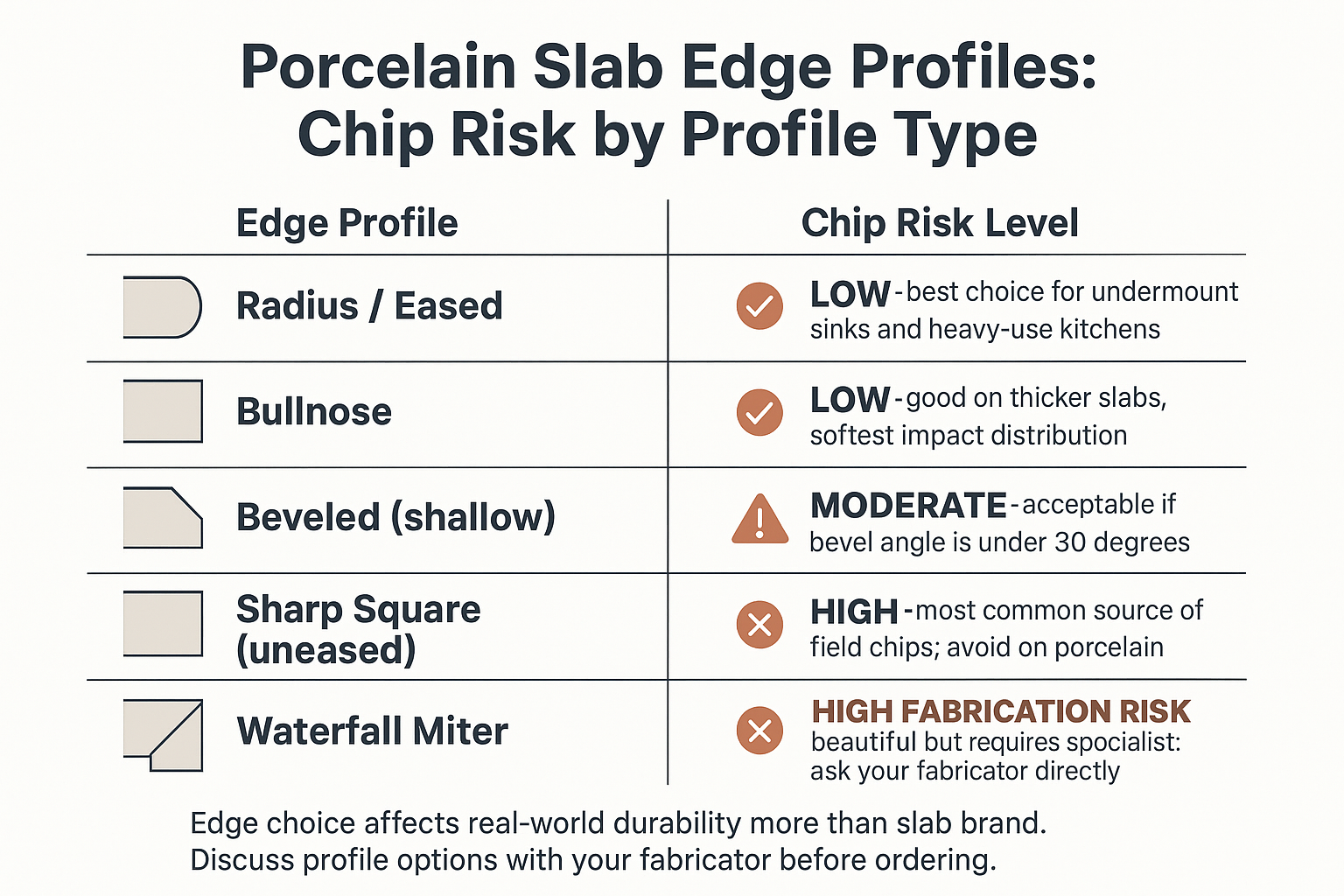
- Radius/Eased — low chip risk, clean modern look, works on most slab thicknesses
- Beveled — acceptable if the bevel is shallow; steep bevels create new fragile corners
- Bullnose — more rounded, reduces risk further, works well on thicker slabs
- Mitered waterfall — highest visual impact, highest fabrication risk; requires an experienced fabricator specifically
Edge profiles to avoid or approach carefully:
- Sharp square (uneased) — the most common source of field chips
- Ogee or complex profiles — multiple transitions mean multiple stress points
If you’re still deciding between porcelain, granite, and quartzite, this comparison of granite, quartz, and porcelain lays out how these materials behave differently under the same real-world conditions.
Porcelain Slab Edge Risk at a Glance
This reference shows which edge profiles carry the lowest and highest chip risk on large-format porcelain slabs.
The Questions You Should Ask Your Fabricator Before You Commit
Here’s the part most buyers skip: the slab brand matters less than the fabricator’s experience with porcelain. A less expensive slab cut by someone who works with large-format porcelain regularly will outperform a premium slab cut by someone who doesn’t.
Large-format porcelain — we’re talking 120″ x 60″ slabs at 6mm or 12mm thickness — cuts, handles, and behaves completely differently from granite or quartz. The tooling is different. The blade speed is different. The support requirements during handling are different. A fabricator who does primarily granite work and occasionally takes a porcelain job is a real risk.
Before you confirm a fabricator, ask these questions directly:
- “How many porcelain slab projects have you completed in the last six months?” — You want a number, not a general answer about experience.
- “What blade and cutting method do you use for porcelain?” — Wet diamond blades rated for sintered porcelain is the correct answer. Generic granite blades cause edge fractures.
- “How do you support a 6mm slab during transport from your shop to the job site?” — Thin porcelain requires full-length support frames. If they’re vague, that’s a warning sign.
- “Can you show me a completed undermount sink cutout you’ve done in porcelain?” — Photos or a reference are reasonable to ask for.
- “What edge profile do you recommend for this application?” — Their answer will tell you a lot about whether they understand porcelain’s failure points.
A good fabricator will welcome these questions. Anyone who gets defensive about them is telling you something.
For more on what to look out for before buying, Porcelain Slab Countertops: What Nobody Tells You Before You Buy covers the gaps between the marketing and the reality.
Porcelain vs. Quartzite vs. Granite: Durability Compared
If you’re still deciding on material, here’s how porcelain stacks up against quartzite and granite on the factors that matter most in a working kitchen.
| Factor | Porcelain Slab | Quartzite | Granite |
|---|---|---|---|
| Surface hardness | 7–8 Mohs — very hard flat surface | 7–8 Mohs — hard and dense | 6–7 Mohs — durable, slight porosity |
| Edge chip risk | HIGH — brittle under impact | LOW to MODERATE — tougher at edges | LOW — absorbs impact well |
| Stain resistance | Excellent — non-porous | Good with sealing — some etching risk | Good with sealing — porous without it |
| Heat resistance | Excellent — handles direct heat | Good — some quartzites can stress-crack | Excellent — handles direct heat |
| Repair if damaged | Very limited — chips rarely invisible | Good — epoxy fills blend well | Good — color-match fills work well |
| Fabrication complexity | High — requires specialist | Moderate — standard stone fabrication | Standard — widely experienced fabricators |
When Porcelain Is Actually the Right Call
None of this means porcelain is the wrong choice — it means it’s the right choice in specific situations, with the right team executing it.
Porcelain slabs make strong sense for:
- Outdoor kitchens along the Central Coast, where UV exposure and coastal salt air degrade some natural stones over time — porcelain holds color and surface integrity outdoors better than most alternatives
- Bathroom vanities where the surface sees light use and the priority is a clean, low-maintenance look
- Fireplace surrounds and feature walls where large-format slabs with dramatic veining can be installed without the weight concerns of a 3cm natural stone slab
- Kitchens with consistent, careful use — not households with young kids and cast iron flying around
For applications involving heavy daily use, high-impact cooking, or any undermount sink in a primary kitchen, quartzite and granite both offer more forgiveness if something goes wrong. And if a chip does happen with natural stone, the repair options are far better.
If you’re comparing materials for an outdoor application specifically, this guide to stone surfaces that hold up to California weather walks through how different materials perform in Monterey Peninsula conditions.
Frequently Asked Questions About Porcelain Slab Durability
Is porcelain actually harder than granite?
On the Mohs scale, yes — porcelain rates 7–8 while granite typically comes in at 6–7. But hardness measures scratch resistance on a flat surface, not impact resistance at edges. Granite handles edge impacts far better because it’s not brittle the way fired porcelain is.
Can a porcelain slab chip be repaired?
Rarely to a standard that looks invisible. The fired surface of porcelain can’t be color-matched and re-polished the way natural stone can. Small chips near edges can sometimes be stabilized with a clear resin, but the chip will likely still be visible. Prevention through proper edge profile selection and experienced fabrication is the only reliable strategy.
How thick should a porcelain slab be for a kitchen countertop?
12mm (about 1/2 inch) is the standard for countertop applications. Some buyers choose 6mm slabs for cost or weight reasons, but 6mm requires very careful handling and has less tolerance for any fabrication error. For a primary kitchen with an undermount sink, 12mm is the safer choice.
Does porcelain need to be sealed like natural stone?
No. Porcelain is non-porous, so sealing isn’t required and doesn’t add any benefit. This is one of the genuine advantages it holds over granite and many quartzites, which need periodic sealing to maintain stain resistance.
Is porcelain a good choice for an outdoor kitchen near the coast?
Yes — for outdoor applications, porcelain is one of the stronger options. It won’t absorb moisture, won’t fade under UV, and handles the salt air along Carmel and Pebble Beach properties better than many natural stones. The same edge and fabrication considerations still apply, but outdoor use removes most of the daily impact risks you’d see in a working kitchen.
Can I look at actual porcelain slabs before deciding?
Yes, and you should. Catalog images and online photos of porcelain slabs look very different from the actual material in person — especially for large-format slabs where veining and tone shift across the length of the piece. Viewing live inventory before committing is always worth the trip.
Seeing the Slabs in Person Changes the Decision
If you’re weighing porcelain against quartzite or granite for a kitchen or bath project in Carmel, Monterey, or anywhere on the Peninsula, the team at Carmel Stone Imports can walk you through live inventory across all three material categories — including the full porcelain slab selection — and help you think through which material actually fits your application and your fabricator’s capabilities. Stop by the showroom in Carmel-by-the-Sea, call (650) 800-7840, or email info@carmelimports.com to set up a slab selection appointment.