Direct Answer: Granite, quartzite, and large-format porcelain are the most reliable choices for California outdoor surfaces. Marble and limestone can work in protected settings but require more maintenance and careful placement.
Outdoor stone projects on the Central Coast come with a specific set of pressures that interior remodels don’t. Salt air off Monterey Bay, intense summer UV, and occasional freezing nights in the Santa Lucia foothills can degrade the wrong material fast — and once it’s installed, you own the problem.
Most of the questions homeowners and designers bring into a showroom are about countertops or bathroom floors. But the outdoor selection conversation is where material choice actually has the biggest consequences. A poor call on a patio or pool deck is expensive to fix and impossible to ignore.
This article focuses on the materials that perform well in California outdoor conditions, what makes each one appropriate or risky for specific applications, and what you should be asking before anything gets installed.
Why California Outdoor Conditions Are Harder on Stone Than They Look
California weather feels mild — and compared to Minnesota winters, it is. But stone that lives outdoors here faces a combination of stressors that most people underestimate.
UV exposure is the first. The Central Coast gets significant sun from April through October, and UV degrades certain sealers and softens the surface appearance of some stones over time. Polished finishes tend to dull outdoors within a few years regardless of material.
Salt air is the second. Properties within a mile or two of the water — anywhere from Pacific Grove to Pebble Beach to Carmel-by-the-Sea — see accelerated mineral attack on porous stone. Limestone and some travertines absorb salt moisture through their pores, which eventually causes spalling and surface pitting.
Thermal cycling is the third and most underestimated. Even without a true freeze, coastal California temperatures swing enough between morning and afternoon to stress stone that isn’t dense enough. Porous materials with absorbed moisture expand and contract at the seam between wet and dry layers — that’s how surface flaking starts.
Understanding these three factors is more useful than any material ranking list, because the right stone for a shaded courtyard in Carmel Valley differs from what belongs on a sun-facing pool deck in Pebble Beach.
Granite and Quartzite: The Workhorses for California Outdoor Use
If there’s a single category that earns its reputation outdoors in California, it’s dense igneous and metamorphic stone — granites and quartzites in particular.
Granite has low porosity, high surface hardness, and handles UV without significant color shift over time. It takes a flamed or brushed finish well, which matters outdoors because polished granite becomes dangerously slick when wet. A flamed finish also adds visual texture that suits exterior applications better aesthetically. For pool decks, outdoor kitchen counters, or high-traffic patios in the Pebble Beach or Atherton corridor, granite is a default workhorse for good reason.
Quartzite is worth separating from granite in this conversation because it’s often confused with quartz (engineered) — and that confusion leads to outdoor installation failures. True quartzite — metamorphosed sandstone — is extremely dense and performs well outdoors. But the label “quartzite” gets applied loosely in the industry, and some stones sold as quartzite are actually softer dolomitic marble that won’t survive outdoor exposure without heavy sealing. Knowing what to look for when sourcing quartzite matters as much as the material itself.
For outdoor use, key questions to ask about any quartzite:
– What’s the absorption rate? Under 0.4% is good for outdoor use.
– Has it been tested for frost resistance? Relevant for interior mountain properties above 2,500 feet.
– What finish is available? Brushed or leathered handles outdoor conditions better than polished.
Both granite and quartzite are available in slab form for outdoor counters or feature walls, and in paver cuts for flooring applications.
Large-Format Porcelain: The Case for Going Engineered Outside
Natural stone has a clear aesthetic advantage outdoors — but large-format porcelain has made a serious case for itself in California exterior projects over the past five years, and it deserves an honest look.
Modern porcelain is fired at very high temperatures, producing a tile with water absorption under 0.5% — effectively impervious to moisture. That matters enormously for coastal properties where salt air and marine humidity are constants. It doesn’t need sealing, it won’t stain from organic debris like leaves or bird droppings, and the color and texture run through the body of the tile rather than just sitting on the surface.
For pool surrounds and outdoor kitchen areas in Carmel and Pacific Grove, 20mm-thick porcelain pavers have become a popular choice. The added thickness allows for pedestal or sand-set installation without mortar in some applications, which makes future repairs far easier. Standard indoor porcelain (typically 8–10mm) is not appropriate for outdoor paver use — thickness matters.
The tradeoff is installation complexity. Large-format porcelain — especially 60″x120″ slabs — requires experienced fabricators with the right cutting equipment, and any mistake during cutting is permanent. How porcelain slabs move from manufacturer to finished surface involves more steps than most homeowners realize, and that’s true outdoors too.
For designs where the natural variation of stone matters — an organic-looking garden path or a terrace meant to age gracefully — porcelain won’t replicate what granite or quartzite does over time. But for low-maintenance, high-performance exterior surfaces in a contemporary home, it’s a legitimate choice.
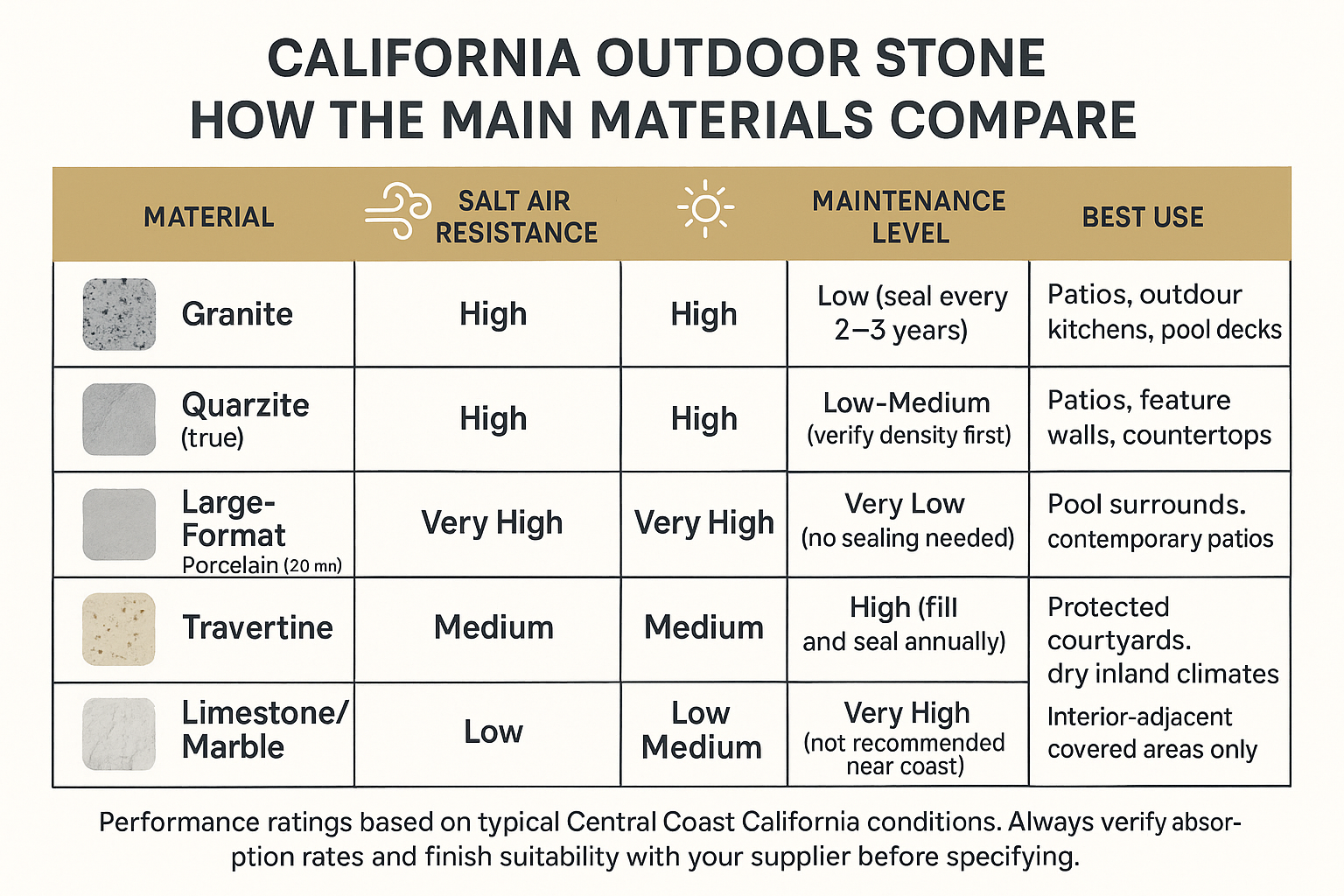
Outdoor Stone Performance at a Glance
This comparison covers the five most commonly considered stone types for California outdoor projects, rated across the factors that actually matter in coastal and Bay Area conditions.
Outdoor Stone Selection by Application
The right material shifts depending on where it’s going and what it needs to do. Use this as a starting framework — not a final spec.
| Application | Best Material Options | Finish to Request | Key Watch-Out |
|---|---|---|---|
| Pool deck / surround | Porcelain 20mm, Granite | Flamed, Brushed, or Textured | Slip resistance — test wet COF rating |
| Outdoor kitchen counter | Granite, Quartzite | Leathered or Honed | Avoid polished — shows every water mark outdoors |
| Patio / terrace flooring | Granite, Quartzite, Porcelain 20mm | Brushed or Flamed | Check absorption rate before specifying |
| Covered courtyard | Travertine, Limestone, Granite | Honed or Brushed | Still needs sealing — ‘covered’ ≠ ‘protected from humidity’ |
| Exterior steps / stairs | Granite, Quartzite, Porcelain 20mm | Flamed or Brushed | Thickness and edge profile matter for safety |
| Vertical / cladding | Quartzite, Granite, Limestone | Natural Cleft or Brushed | Weight load — confirm structural support with contractor |
What Marble, Travertine, and Limestone Actually Do Outside
These three materials come up constantly in outdoor design conversations — and they deserve a straight answer rather than a reflexive “avoid them outdoors.”
Marble is soft and porous relative to granite or quartzite. On the Monterey Peninsula, where marine layer moisture is nearly year-round, marble outdoors means committing to a real maintenance schedule. Acid from rain (even mild rain), leaf tannins, and salt air all attack the calcium carbonate in marble. A polished marble patio will show etching within one season. Some designers use honed marble in covered, protected exterior spaces — loggia floors, for example — where direct weather exposure is minimal. But it’s a considered choice with eyes open, not a casual one. Understanding how marble slabs differ in person versus in a catalog is part of why slab selection matters so much for these calls.
Travertine is more forgiving than marble outdoors, but it has a structural issue: the natural voids in travertine hold water. Unfilled travertine outdoors in a wet climate traps moisture in those voids, which eventually causes cracking. Filled travertine performs better, but the fill material degrades over time and needs maintenance. In drier microclimates — Carmel Valley, Salinas Valley, or shaded inland courtyards — travertine can be a beautiful choice if sealed annually.
Limestone behaves similarly to marble chemically and is equally vulnerable to acid and salt. The main exception is very dense, hard limestone — some French and Israeli stones fall into this category — which can handle moderate outdoor exposure better than typical soft limestone. Density testing and sourcing transparency matter here. The real differences between these surface categories are worth understanding before any material gets specified for exterior use.
Frequently Asked Questions About Outdoor Stone in California
Do I need to seal granite or quartzite before it goes outside?
Yes — even dense granite benefits from a penetrating sealer before outdoor installation. For most granites, resealing every 2–3 years is appropriate in coastal California conditions. Quartzite varies more by stone, so ask your supplier for the absorption rate and let that guide the sealing schedule. A simple water-bead test tells you when it’s time to reseal: if water stops beading and starts absorbing within a few minutes, the sealer is spent.
Is engineered quartz (like Silestone or Caesarstone) okay for outdoor counters?
No. Engineered quartz uses a resin binder that degrades under prolonged UV exposure. The color shifts, the surface can chalk, and the warranty on most engineered quartz products explicitly excludes outdoor use. Stick with natural granite, quartzite, or 20mm porcelain for any outdoor counter application.
What finish should outdoor stone have to prevent slipping around a pool?
A flamed or brushed finish is standard for outdoor and pool applications. Polished stone — regardless of material — becomes dangerously slick when wet. When reviewing material samples, ask your supplier specifically about the COF (coefficient of friction) rating for wet conditions. The Americans with Disabilities Act threshold for wet areas is 0.60 COF; pool decks should meet or exceed that.
Can I use indoor tile samples to pick an outdoor paver?
Not reliably. Outdoor pavers need to meet thickness, absorption, and frost-resistance specs that indoor tile doesn’t. A 10mm porcelain tile that looks identical to a 20mm outdoor paver is a completely different product under real conditions. Always confirm you’re looking at the correct outdoor-rated specification before making a final selection.
How do I know if a quartzite is actually quartzite and not soft marble?
Ask for the absorption rate and Mohs hardness from the supplier. True quartzite rates 7 or higher on the Mohs scale and has very low absorption. If a supplier can’t provide those specs, treat that as a red flag. Seeing the actual slab — rather than a catalog image — also helps; selecting stone in person gives you information a photo never will.
Does it matter that my property is close to the ocean?
Yes, significantly. Properties within roughly one mile of the water — Carmel-by-the-Sea, Pacific Grove, parts of Monterey — see much higher salt air exposure than properties a few miles inland. That pushes the material choice toward denser, lower-porosity options and makes the sealing schedule more aggressive for any natural stone you do use.
Ready to Choose the Right Stone for Your Outdoor Project?
Carmel Stone Imports keeps live inventory of granite, quartzite, and large-format porcelain across its Carmel-by-the-Sea and Palo Alto showrooms, where you can view actual slabs and pavers under real light — not catalog photos. If you’re planning an outdoor project on the Monterey Peninsula or in the Bay Area, a slab selection appointment is the fastest way to make a confident, informed decision. Call (650) 800-7840 or email info@carmelimports.com to schedule a visit.