Direct Answer: Porcelain slabs are fired under extreme heat and pressure in a factory, then shipped internationally to importers, where you select a physical slab before it goes to a fabricator for cutting and installation.
Most homeowners planning a kitchen remodel on the Monterey Peninsula think of porcelain slabs as something that just arrives at their house one day. But there are actually five to seven major steps between raw materials in a factory and a finished countertop in your kitchen — and what happens at each stage directly affects what you end up with.
If you skip over the early steps, or don’t understand them, you’re making a $3,000–$8,000 decision based on a catalog image instead of an actual slab. That’s where most costly mistakes happen.
This guide walks through the full journey — from raw clay and minerals to the showroom floor to your kitchen — so you can make that decision with real information.
What Porcelain Slabs Are Made Of
Porcelain isn’t quarried like granite or marble. It’s manufactured from a mixture of fine clay, feldspar, silica, and mineral pigments. Those materials are compressed under 10,000+ tons of pressure, then fired in a kiln at temperatures around 2,200°F.
The result is an extremely dense, non-porous tile or slab that’s harder than most natural stone. That process also means every slab is consistent in thickness — typically 6mm, 12mm, or 20mm — and can be produced in very large formats, some exceeding 5 feet by 10 feet.
Because the pattern is printed digitally before firing, manufacturers can replicate the look of Carrara marble, Calacatta Gold, concrete, or even wood grain. But those patterns are surface-level — they don’t run through the body of the material the way veining does in natural stone. That distinction matters when you’re choosing between porcelain and natural stone for a countertop.
Key raw material inputs include:
– Fine-grain kaolin clay for density
– Feldspar for hardness and low water absorption
– Silica for structural stability
– Mineral oxides for color and pattern
– Digital inkjet printing applied before the final firing
Where Porcelain Slabs Are Produced
The majority of large-format porcelain slabs imported into California come from Italy and Spain, with a smaller share from Turkey and Brazil. Italian producers — particularly those based in the Emilia-Romagna and Veneto regions — dominate the high-end market because of the investment those factories have made in digital printing precision and kiln technology.
Spanish manufacturers produce strong material as well, often at a slightly lower price point. The difference shows up in surface detail: Italian slabs tend to have finer veining gradients and more realistic stone patterns, while Spanish slabs often lean toward bolder, more graphic looks.
Each factory produces slabs in batches called lots. Slabs within the same lot will match in color and pattern. Slabs from different lots may vary — sometimes noticeably. This is why lot matching matters when you’re ordering for a large kitchen with multiple slab runs.
Porcelain slab production hubs by country:
– Italy — Marazzi, Iris Ceramica, Florim, Rex, and others in the Sassuolo district
– Spain — Porcelanosa, Vives, Aparici
– Turkey — Kale, Ege Seramik
– Brazil — Portobello, Eliane
How Slabs Get from the Factory to California
Once slabs are produced and quality-checked at the factory, they’re crated in wooden A-frames — essentially angled wooden racks that hold the slabs upright and protect them during shipping. These crates are then loaded into 20-foot or 40-foot ocean freight containers.
A standard 40-foot container can hold roughly 400–600 square feet of large-format porcelain slabs, depending on thickness and slab size. Transit time from Italian or Spanish ports to the Port of Oakland or the Port of Los Angeles typically runs 4 to 8 weeks, depending on routing and customs processing.
Import duties, freight costs, customs brokerage fees, and inland trucking from the port all add to the landed cost of the slab before anyone sells it. This is why a porcelain slab that retails for $18–$35 per square foot at the showroom level represents real supply chain cost — not just markup.
After clearing customs, slabs are trucked to the importer’s warehouse. For projects on the Central Coast or Monterey Peninsula, that last-mile delivery often originates from a warehouse location like Sand City, just north of Monterey — which keeps lead times shorter for local contractors and designers than ordering from a Bay Area-only supplier.
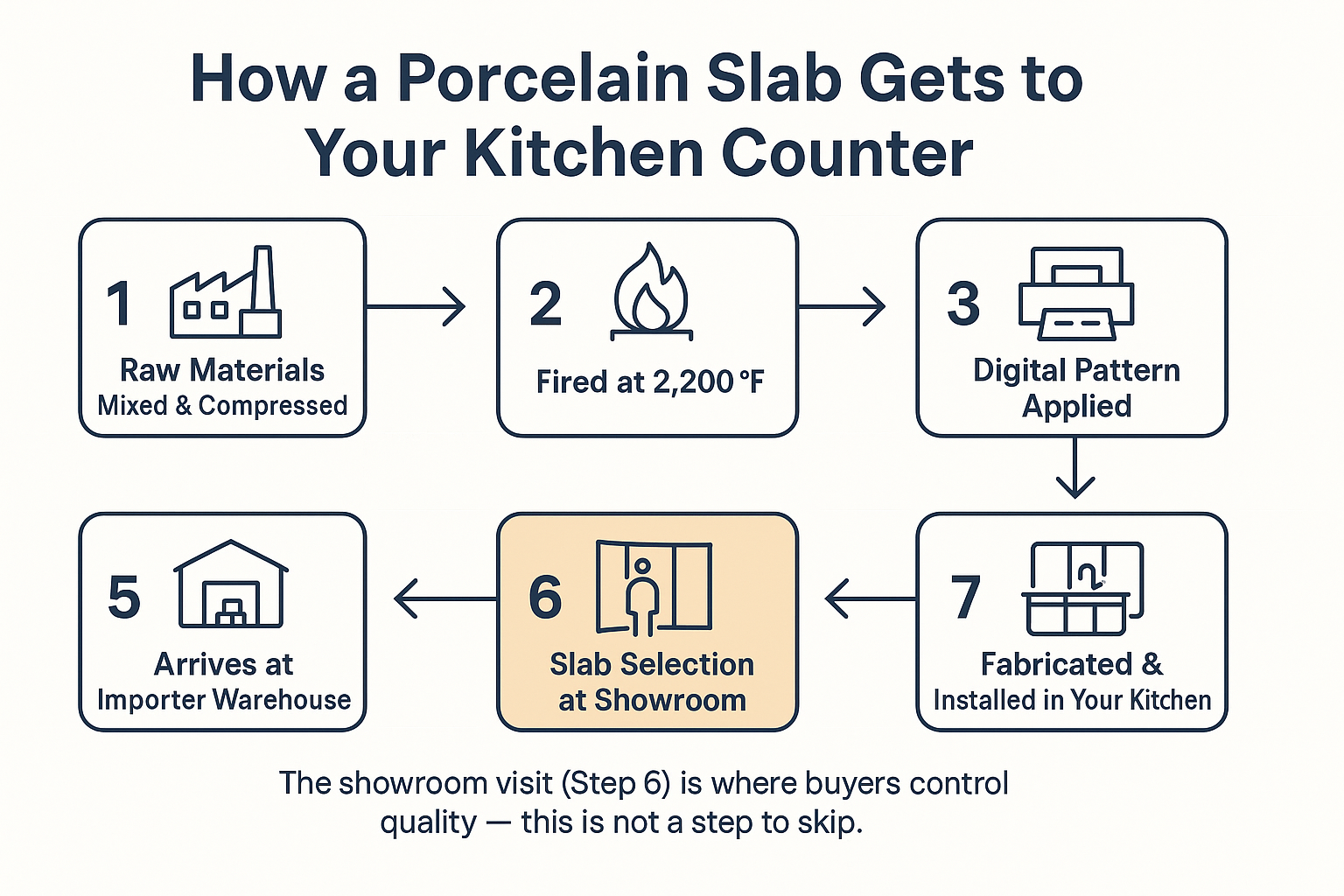
The Porcelain Slab Journey: Factory to Kitchen Counter
This step-by-step flow shows every stage a porcelain slab passes through before it reaches a finished kitchen countertop.
What Happens at the Showroom — and Why It Matters
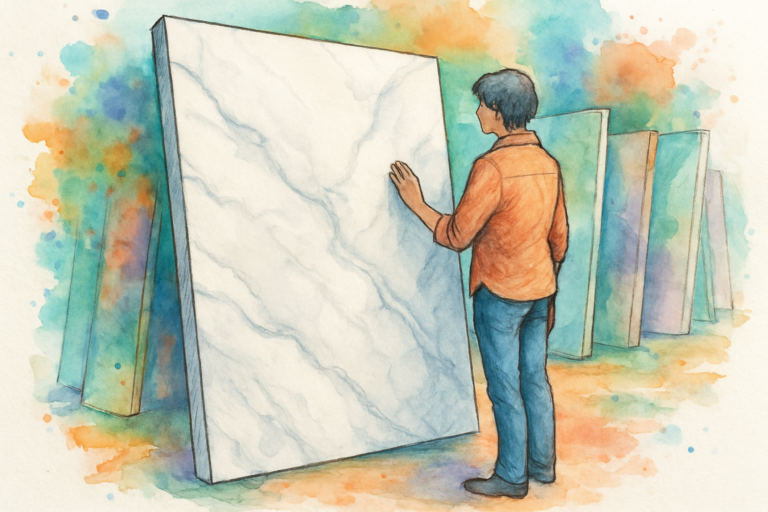
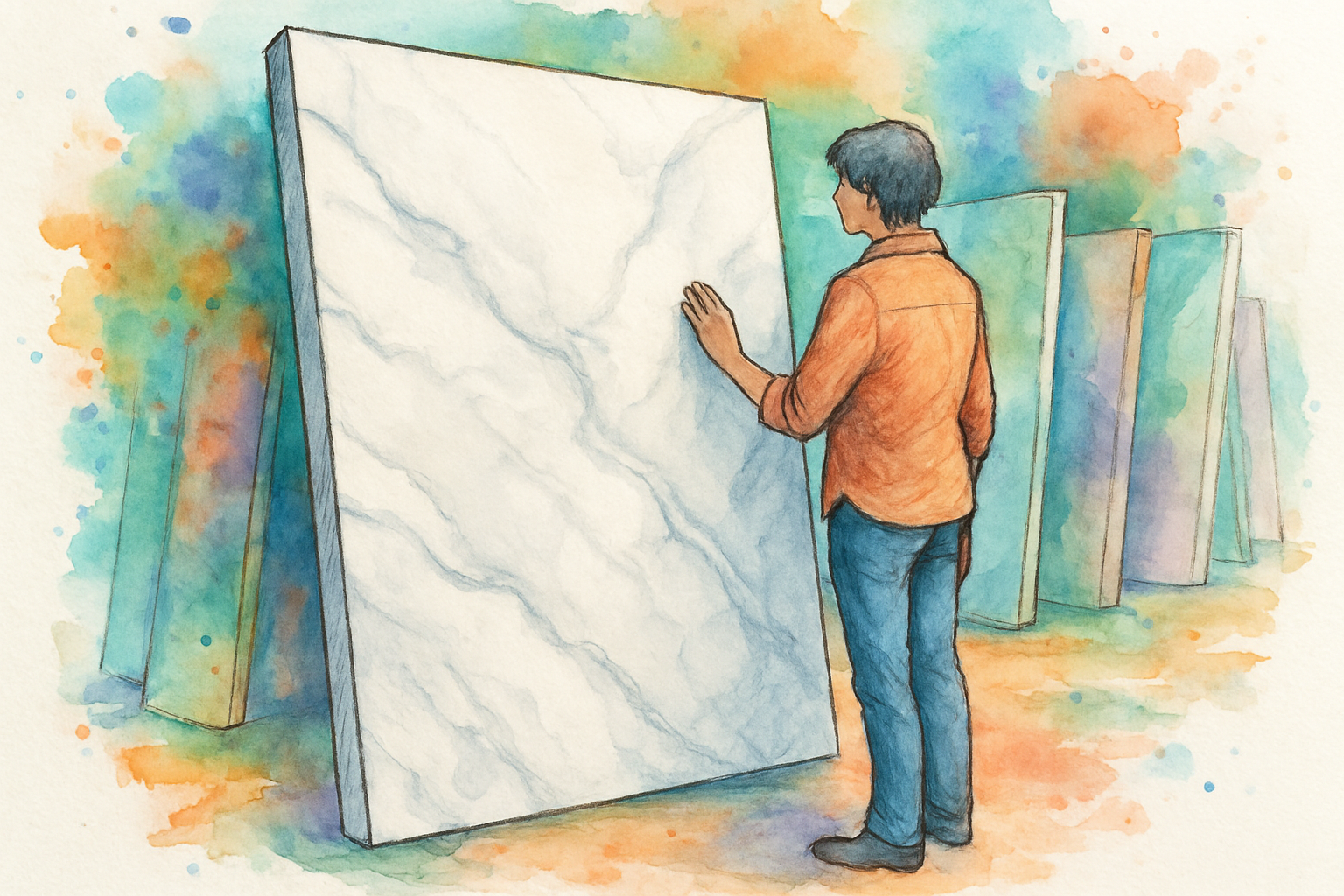
The showroom visit is the most consequential stop in the whole process for a homeowner or designer. This is the only point in the chain where you can see the actual slab your kitchen will be cut from — not a sample card, not a rendering, not a catalog photo.
Large-format porcelain slabs can run 4 feet wide by 10 feet long. A 4-inch sample tells you about color. It doesn’t tell you how the full veining pattern will read across a 9-foot island, or whether the movement in the slab feels balanced or chaotic at scale. That’s information you only get by seeing the full slab in person.
Showrooms that carry live inventory — meaning actual slabs on the floor rather than order-on-demand catalogs — give you the ability to pull slabs, stand them up in natural light, and make a real decision. If you’re planning a kitchen in Carmel-by-the-Sea or Pacific Grove, it’s worth understanding whether you can buy porcelain slabs directly without a contractor — because in many cases, you can walk in and select your own slab.
What to evaluate when viewing slabs in the showroom:
– Pattern scale — does the veining feel proportional to your countertop dimensions?
– Color in natural light — showroom lighting can hide undertones
– Surface finish — polished vs. matte vs. textured, and how each performs with daily use
– Lot number — confirm all slabs for your project come from the same production lot
– Slab dimensions — verify the slab is large enough for your layout without a seam in a bad location
Porcelain Slab Specs: What to Know Before You Buy
These are the common spec ranges you’ll encounter when comparing porcelain slabs at the showroom level. Ask your supplier for the exact spec sheet for any slab you’re seriously considering.
| Spec | Typical Range | Why It Matters |
|---|---|---|
| Thickness | 6mm, 12mm, 20mm | Thicker slabs are heavier but more forgiving in fabrication |
| Slab Size | Up to 63″ x 126″ | Larger slabs mean fewer seams in a big kitchen |
| Water Absorption | Less than 0.5% | Low absorption = stain and freeze-thaw resistant |
| Surface Hardness (Mohs) | 6–7 | Harder than most natural stone; difficult to scratch |
| Weight (12mm) | ~7–8 lbs per sq ft | Affects cabinet support requirements |
| Price Range (supply only) | $18–$45 per sq ft | Varies by origin, finish, and format size |
| Lot Matching Window | Varies by manufacturer | Order all slabs at once to guarantee a match |
From Showroom to Fabricator: What the Supplier Hands Off
Once you’ve selected your slab, the supplier’s job shifts to logistics and documentation. A good supplier will provide your fabricator with the exact slab dimensions, lot number, finish type, and any handling notes relevant to that material.
Porcelain requires different handling than natural stone during fabrication. It’s brittle at the edges and can crack under improper blade pressure. Experienced fabricators use wet-cutting diamond blades specifically designed for porcelain, and they work more slowly than they would with granite. If a fabricator tells you they cut porcelain the same way they cut granite, that’s a sign to ask more questions.
This handoff — from supplier to fabricator — is where the slab’s condition at delivery matters. Slabs should arrive at the fabrication shop uncracked and fully intact. Inspect them before accepting delivery, or ask your fabricator to document the condition when the slabs arrive. Damage from freight that isn’t caught at delivery can become a costly dispute later.
For homeowners researching this process, understanding what the $140-per-square-foot porcelain countertop price actually includes helps clarify why total installed costs are much higher than slab-only pricing.
Common Points Where Things Go Wrong
Most porcelain countertop problems trace back to decisions made early in the supply chain — not at installation. Knowing the failure points helps you avoid them.
Ordering without seeing the slab. Buying from a catalog or a small sample and assuming the full slab will look the same is the most common mistake. Pattern scale, color depth, and veining movement all change dramatically at full size.
Lot number mismatches. If your project gets delayed and your fabricator orders a second slab from a different production lot, the color may not match. Lock in your lot at the time of purchase and ask about hold policies.
Wrong fabricator for the material. Not every stone fabricator has experience with large-format porcelain. Chipping at the sink cutout or edge cracking during transport from shop to site usually points to inexperience with the material — not a defect in the slab itself.
Skipping the showroom entirely. Online purchasing of porcelain slabs is convenient, but it removes your ability to catch problems before fabrication. Once a slab is cut, returns are generally not possible.
Other common issues to watch for:
– Inadequate cabinet support for 20mm slabs (heavier than standard stone)
– Surface finish mismatch — ordering polished when matte would have hidden fingerprints better in daily use
– Seam placement agreed to verbally but not marked on a shop drawing before cutting begins
Frequently Asked Questions About Porcelain Slab Supply and Selection
Can I go to a showroom and pick my own porcelain slab without a contractor?
Yes, in most cases. Suppliers with live slab inventory — meaning actual slabs on the floor — allow homeowners to come in, view slabs, and make a selection. You’ll still need a licensed fabricator and installer to do the cutting and countertop work, but the slab selection itself is open to you directly.
How long does it take to get a porcelain slab once I choose it?
If the showroom carries the slab in live inventory, you can often have it ready for your fabricator within a few days to two weeks, depending on delivery scheduling. If the slab needs to be imported, 4 to 8 weeks is a realistic lead time for ocean freight from Europe.
Is porcelain harder to fabricate than granite or marble?
Yes. Porcelain is more brittle at the edges than most natural stone, and requires specialized wet-cutting diamond blades and experienced operators. Sink cutouts, mitered edges, and waterfall profiles all carry more risk in porcelain than in granite. Choosing a fabricator who regularly works with large-format porcelain matters.
What does ‘lot matching’ mean and why does it matter?
Porcelain slabs are produced in batches called lots. Slabs from the same lot are color-matched. Slabs from different lots — even the same style — can vary in tone or pattern. If your project needs more than one slab, or if you’re phasing a remodel, ordering all slabs from the same lot at the start protects against visible color mismatches.
Does porcelain need to be sealed the way natural stone does?
No. Porcelain is non-porous with a water absorption rate below 0.5%, so it does not require sealing. This is one of the practical advantages over marble or travertine in a kitchen setting. You can learn more about how to clean and maintain porcelain tile using the same basic principles that apply to porcelain slab surfaces.
Ready to See Actual Slabs Before You Commit?
Carmel Stone Imports carries live porcelain slab inventory at showroom locations in Carmel-by-the-Sea and Palo Alto — so you can see the full slab, not a sample, before any decisions are made. If you’re planning a kitchen remodel on the Monterey Peninsula or in the Bay Area and want to walk through your options in person, call (650) 800-7840 or email info@carmelimports.com to schedule a slab selection appointment.