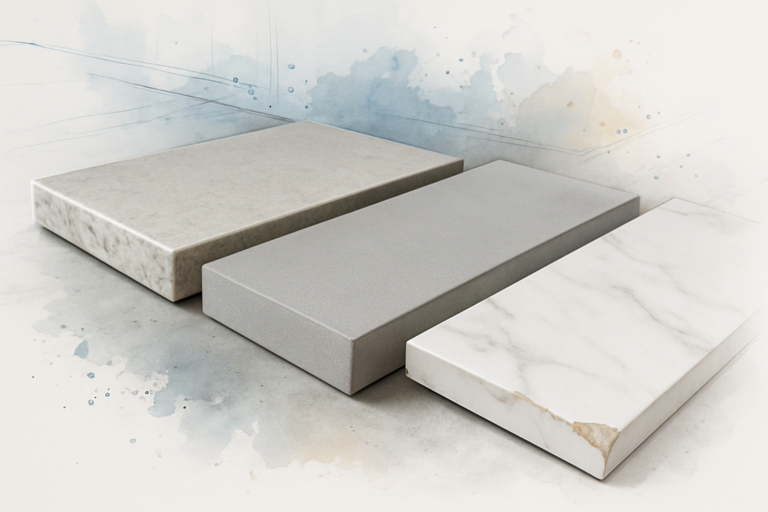
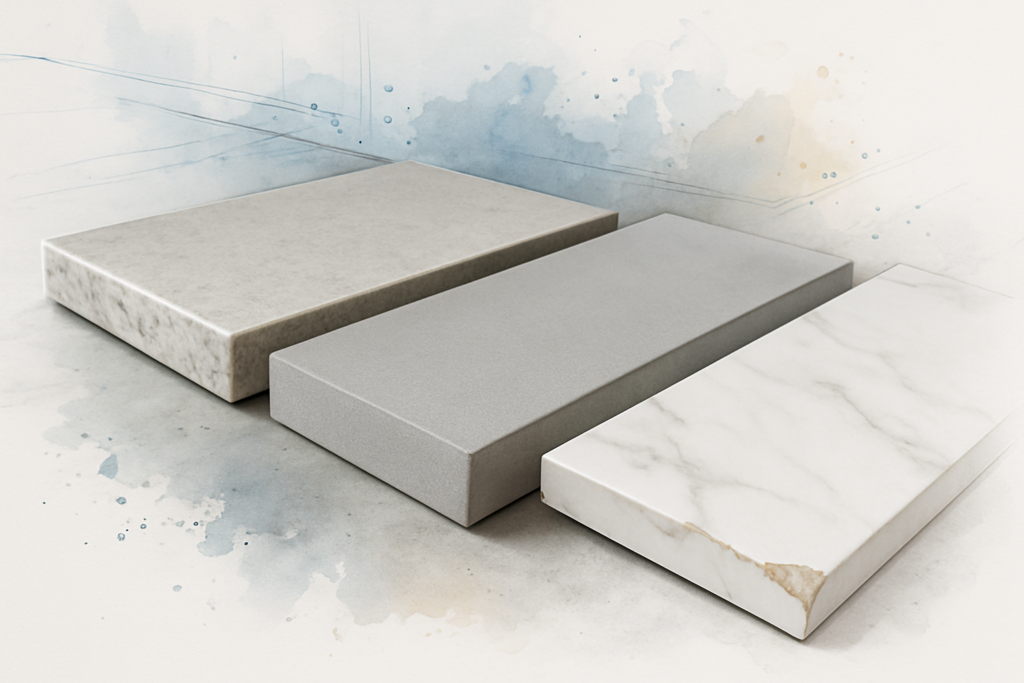
Direct Answer: Engineered stone is a broad category covering quartz, porcelain slabs, and sintered stone, materials that look similar in a showroom but behave very differently in a real kitchen.
A lot of homeowners on the Monterey Peninsula walk into a showroom having already decided on engineered stone countertops. They’ve read that it’s low-maintenance, consistent in appearance, and tougher than marble. Most of that is true. But the category is broad enough that ‘engineered stone’ covers materials with very different compositions, edge characteristics, and real-world limitations, and the marketing almost never explains those differences.
The three main types, standard quartz, sintered stone (brands like Dekton and Neolith), and large-format porcelain slabs, are all engineered. But they behave quite differently when a hot pan lands on them, when a pot chips an edge, or when something goes wrong and you need a repair. Knowing which is which before you select changes the conversation.
This article focuses on the two material properties that matter most and get talked about least: heat sensitivity in quartz, and repairability across the full engineered stone category. If you’re also trying to sort out the difference between quartz and quartzite, there’s a plain-language answer for that below, it’s one of the most common points of confusion we see, and it’s worth clearing up.
The Heat Problem with Quartz, and Why It Surprises So Many Buyers
Standard quartz countertops are made of roughly 90 to 95% ground quartz bound together with a resin binder. That resin is what gives quartz its consistent color, its non-porous surface, and its easy-clean reputation. It’s also the reason you cannot set a hot pan directly on it.
The resin binder can discolor or crack under sustained heat, from a cast iron skillet pulled off the stove, a hot baking sheet, or even a slow cooker left running on the surface. This surprises a lot of homeowners who chose quartz specifically because they wanted something tougher than marble. And it matters more than a minor caveat on a product sheet: it changes how the kitchen actually gets used every day.
Trivets are non-negotiable with quartz. That’s not a precaution, it’s a material property. For a household that cooks heavily, entertains often, or has kids who drop things and forget about them, that’s worth thinking through before the slabs are ordered.
Sintered stone and porcelain slabs don’t share this limitation. Both are fired at extremely high temperatures during manufacturing, which means they’re genuinely heat-resistant and won’t discolor from a hot pan. They’re also impervious to etching from acids, something quartz handles well too, but natural stone often doesn’t. If heat resistance is a primary concern, sintered stone and porcelain are the more forgiving category.
For a deeper look at how porcelain slabs hold up in practice, Are Porcelain Slabs Really as Durable as They Sound? covers the real-world performance picture in detail.
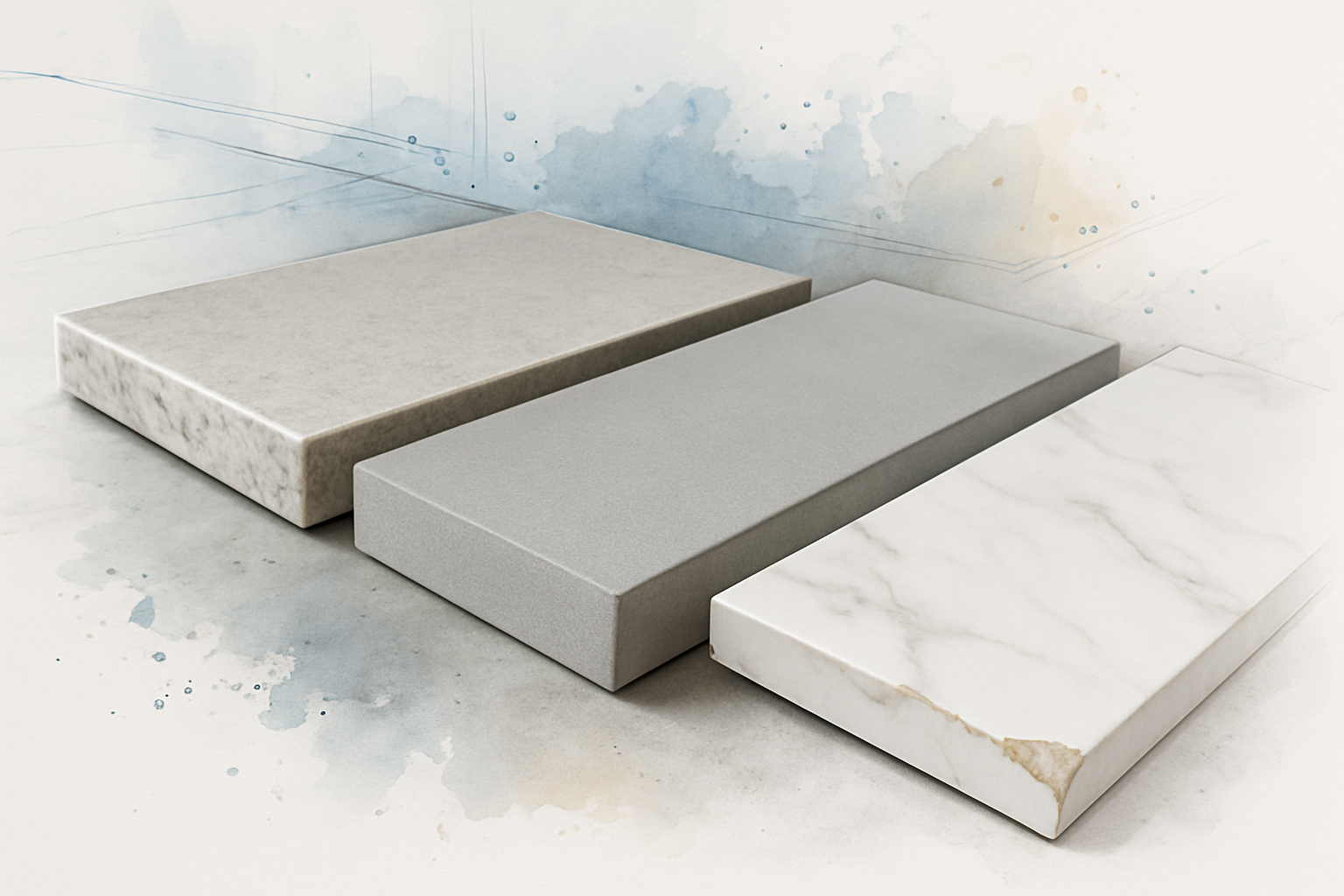
Porcelain Slabs and Sintered Stone: Real Strengths, One Major Catch
Porcelain and sintered stone are gaining traction fast among designers and architects working on projects across the Monterey Peninsula and Bay Area, particularly in kitchens and baths where the ultra-thin, large-format look is in demand. These materials offer genuine advantages: heat resistance, stain resistance, no etching, and a clean aesthetic that works well in contemporary spaces.
But there’s one limitation that doesn’t apply to granite or standard quartz, and it’s worth understanding before you specify: edge chipping.
Porcelain is dense but brittle at the edge. A sharp impact, a dropped pot, an aggressive installation move, even a heavy item sliding off a countertop edge, can chip the corner or profile in a way that is very difficult to repair invisibly. The same density that makes porcelain so resistant to surface damage makes a chipped edge nearly impossible to touch up without it being noticeable.
This is why the fabricator’s experience level matters more with porcelain than it does with granite or quartz. A fabricator who hasn’t cut and handled large-format porcelain panels regularly is more likely to chip edges during the process, and once it’s chipped, there’s no clean fix. Asking your fabricator directly about their experience with large-format porcelain is a reasonable question before work starts.
For more context on what fabrication risk actually looks like with porcelain, Porcelain Slab Countertops: What Nobody Tells You Before You Buy goes into specifics that don’t usually show up in product descriptions.
How the Three Types of Engineered Stone Actually Compare
This table summarizes the key practical differences across standard quartz, sintered stone, and porcelain slabs, the properties that affect daily use and long-term durability.
| Property | Standard Quartz | Sintered Stone (Dekton, Neolith) | Large-Format Porcelain |
|---|---|---|---|
| Heat resistance | Low, resin binder discolors under direct heat | High, fired at extreme temperatures | High, fired at extreme temperatures |
| Etch resistance | Good, non-porous surface | Excellent | Excellent |
| Edge chip risk | Low to moderate | Moderate | Higher, brittle at edges |
| Repairability | Polishing or patching possible; results vary | Very difficult to repair invisibly | Very difficult to repair invisibly |
| Fabricator skill required | Standard | Above average | High, especially for edge profiles |
| Appearance consistency | Very consistent, engineered color | Very consistent | Very consistent |
| Silica exposure (fabrication) | High, resin-bound quartz dust is a known concern | Lower than standard quartz | Lower than standard quartz |
Repairability: The Question Most People Don’t Think to Ask
When something goes wrong with a countertop, a chip, a crack, a deep scratch, the question of whether it can be fixed matters a lot. And engineered stone materials are not equal on this point.
Standard quartz can sometimes be polished or patched at a chip site, though the results depend on color, finish, and how significant the damage is. Lighter colors and busier patterns tend to hide repairs better than solid or minimalist slabs.
Porcelain and sintered stone are much harder to repair in a way that looks seamless. The material’s density makes invisible touch-up nearly impossible. A chip is usually visible, and permanent.
Natural stone, by contrast, offers more options. Depending on the material and damage type, honing, re-polishing, or professional filling can often address a problem without it being obvious. It’s one of the reasons experienced designers sometimes favor natural stone for high-traffic kitchens.
For buyers in Palo Alto, Atherton, or elsewhere in the Bay Area running a busy household with kids and regular entertaining, repairability should be part of the selection conversation from the beginning, not something you learn about after a pot hits the floor.
If you’re weighing engineered stone against natural options for that kind of project, Marble, Quartzite, Granite, or Porcelain, How to Actually Decide lays out the comparison in practical terms.
Quartz vs. Quartzite: A Plain-Language Comparison
These two materials get confused constantly, mostly because of the name. Here’s the clearest way to tell them apart.
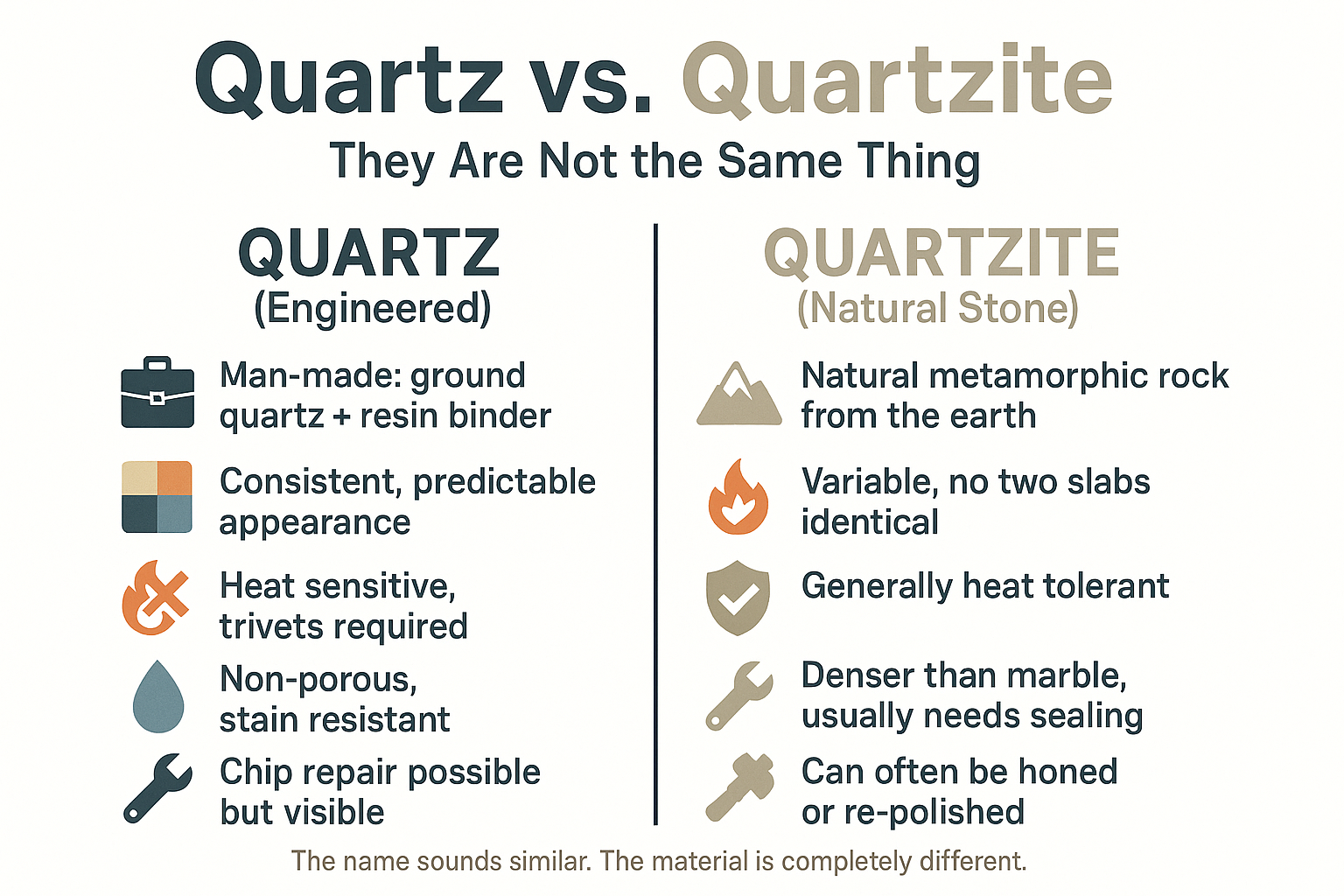
Quartz and Quartzite Are Not the Same Thing
This one comes up constantly. Several callers every month ask to compare quartz and quartzite, and the confusion is completely understandable, because the names differ by only a few letters.
Here’s the clearest way to understand the difference:
- Quartz is engineered. It’s manufactured from ground quartz mineral, mixed with resins and pigments, and pressed into slabs. The appearance is consistent and predictable. The resin binder is what creates heat sensitivity.
- Quartzite is a natural stone. It’s a metamorphic rock formed when sandstone is compressed and recrystallized over geologic time. No resin. No engineered consistency, every slab is different, which is part of what makes it appealing. It’s generally harder and denser than marble.
The performance profiles are quite different too. Quartzite is generally more heat-tolerant and behaves more like granite in daily use, though it often benefits from sealing depending on the specific stone. Quartz is more consistent across slabs and easier to match if you need extra material.
If you’ve been searching for a specific quartzite slab, like a leathered Perla Venata or a Mont Blanc, Why Does Brand-New Quartzite Sometimes Stain, and How Do You Prevent It? and Perla Venata Quartzite: How to Know If It’s Right for Your Project are both worth reading before you finalize a selection.
A Note on Silica and Fabrication Safety
If you’ve been following design industry news over the past year or two, you may have seen coverage of silica dust exposure linked to fabricating artificial quartz countertops. California saw significant public health attention on this topic in 2024 and 2025, and it’s something informed homeowners and design professionals are asking about.
The key context for a buyer: this is a fabrication-side concern, not a finished-surface concern. Once a quartz countertop is installed and sealed, it poses no exposure risk in your home. The issue relates to the fine silica dust generated when quartz slabs are cut, shaped, and polished, a process that happens in a fabrication shop, not your kitchen.
What this does mean, practically, is that choosing a fabricator who follows current safety protocols is a meaningful consideration. Shops with proper wet cutting equipment, dust control systems, and worker safety practices are not just doing right by their employees, they’re also operating in compliance with California’s increasingly strict OSHA enforcement on this front. It’s a fair question to ask a fabricator before you hire them.
Frequently Asked Questions About Engineered Stone Countertops
Can I set a hot pan on a quartz countertop?
No, not directly. The resin binder in standard quartz can discolor or crack under sustained heat. Trivets are required, and this applies to cast iron, baking sheets, slow cookers, and anything pulled straight from the oven or stove. It’s not a minor precaution, it’s how the material behaves. If you cook heavily and don’t want to think about this every time, sintered stone or porcelain slabs are more forgiving choices.
What’s the difference between quartz and quartzite? I keep seeing both.
They’re completely different materials. Quartz is engineered, manufactured from ground quartz mineral and resin, with a consistent, predictable appearance. Quartzite is natural stone, a metamorphic rock formed in the earth, with no resin and no two slabs alike. The name similarity causes a lot of confusion, but once you see both in person at a showroom, they’re easy to tell apart.
If a porcelain countertop chips, can it be repaired?
Only with difficulty, and usually not invisibly. Porcelain and sintered stone are dense enough that seamless touch-up is nearly impossible. A chip at an edge or corner is typically permanent and visible. This is why edge impact risk matters more with porcelain than with quartz or natural stone, and why your fabricator’s experience with large-format panels matters so much.
Is engineered stone better than natural stone for a busy kitchen?
It depends on which engineered stone and what ‘busy’ means for your household. Standard quartz is non-porous and easy to clean, but heat-sensitive. Porcelain and sintered stone are heat-resistant and impervious to etching, but difficult to repair. Natural stone like granite or quartzite requires sealing but is often more repairable when damaged. For kitchens with heavy cooking, young children, or frequent entertaining, repairability should be part of the conversation, not an afterthought.
Is silica dust from quartz countertops dangerous in my home?
No, the silica exposure concern is specific to fabrication shops where slabs are cut and shaped, not to finished surfaces in homes. Once installed, a quartz countertop poses no exposure risk. The issue is a worker safety and fabrication practice concern, which is why asking your fabricator about their dust control and wet-cutting protocols is reasonable.
Do I need to see engineered stone slabs in person, or is ordering from photos fine?
Seeing slabs in person makes a real difference, especially with natural-look quartz patterns and large-format porcelain panels where the scale of the veining matters. Several customers have noted that online photos don’t accurately reflect color or texture, and batch variation means two slabs with the same SKU can look noticeably different. Visiting a showroom where live inventory is on hand gives you a much clearer picture of what will actually end up in your kitchen.
Ready to See the Difference in Person?
Engineered stone looks one way in a catalog and another way when you’re standing in front of an actual slab. Carmel Stone Imports carries live inventory across showroom and warehouse locations in Carmel-by-the-Sea, Sand City, and Palo Alto, so you can compare quartz, porcelain panels, and natural stone side by side before any decision is made. To schedule a slab selection appointment or ask about current availability, call (650) 800-7840 or email info@carmelimports.com.