Direct Answer: Choose granite or quartzite if you want natural stone character and can commit to occasional sealing. Choose quartz for low maintenance. Choose porcelain if heat resistance and stain-proof performance matter most.
Most homeowners walk into a countertop decision already overwhelmed. They’ve done enough research to know there are options, but not enough to feel confident choosing between them. Granite, quartz, and porcelain each get marketed hard — and the claims from every direction tend to contradict each other.
On the Monterey Peninsula, where kitchen and bathroom remodels often involve Spanish-style homes, mid-century ranches, or coastal modern builds, the material choice carries real design weight. A countertop that photographs well on a showroom floor can look completely different in your kitchen under Pacific Coast light.
This article covers the three things that actually separate these materials in real use: how they perform under daily wear, how they hold up to the Central Coast lifestyle, and what the selection process actually looks like so you can walk into a slab yard knowing what you’re looking at.
What Each Material Actually Is — Before You Compare Anything
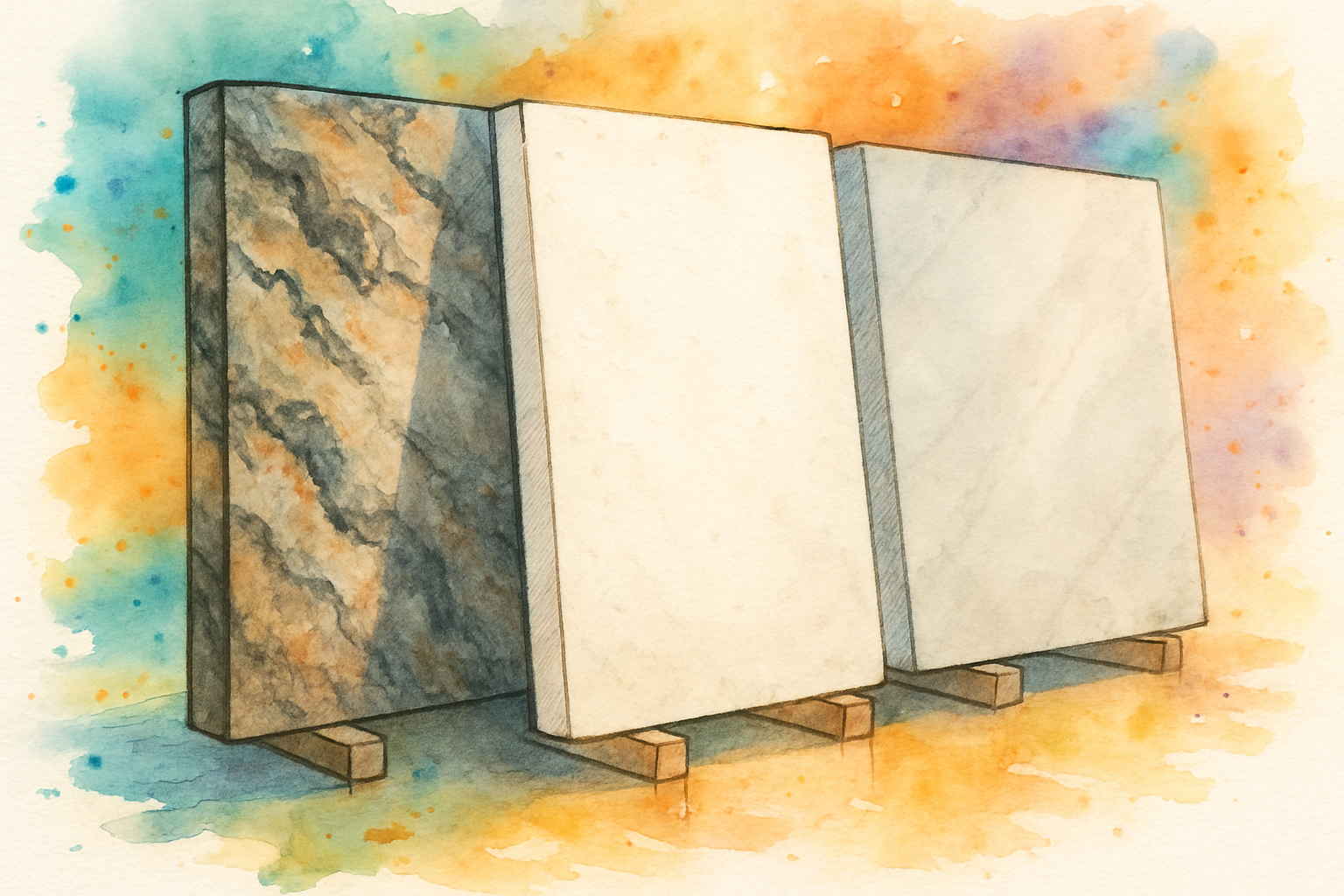
People often compare granite, quartz, and porcelain as if they’re three versions of the same thing. They aren’t. Understanding what each one is made of changes how you think about every comparison.
Granite is a natural igneous stone quarried in large blocks, then cut into slabs. No two slabs are identical. The mineral composition — feldspar, quartz, mica, and others — determines the color, pattern, and density. Higher-density granites are extremely hard and require less frequent sealing. You can learn more about what separates granite suppliers before committing to a source.
Quartz countertops (sometimes called engineered stone) are manufactured products — roughly 90–94% crushed natural quartz bound with polymer resins and pigments. The result is a consistent, non-porous surface. The pattern is set at the factory, so every slab of a given product looks nearly the same.
Porcelain slabs are fired clay ceramic products pressed at very high pressure and baked at temperatures above 2,200°F. Modern large-format porcelain can be as thin as 6mm or as thick as 20mm for outdoor use. They’re non-porous by nature and printed with high-resolution patterns — including marble and stone looks — that go through the surface layer but don’t penetrate the full thickness. There’s a lot more to understand about porcelain before buying, and what nobody tells you before purchasing porcelain slab countertops is worth reading if you’re seriously considering it.
The Performance Differences That Matter in a Real Kitchen
Marketing materials will tell you every material is durable. That’s true in a narrow sense — none of these materials will fall apart on you. But they fail in different ways, and those differences matter depending on how your kitchen actually gets used.
Scratch resistance: Porcelain sits at a Mohs hardness of 7–8, making it the hardest surface of the three. Granite typically ranges from 6–7. Quartz is similar to granite but the resin binders are softer than the quartz crystals themselves, so deep scratches from knives can leave visible marks. In practical terms, none of these materials should be used as a cutting surface — but porcelain is the most forgiving if someone forgets.
Heat tolerance: Porcelain handles direct heat without damage. Granite handles it well too. Quartz is the weak link here — the polymer resins can discolor or crack from a hot pan placed directly on the surface. If you cook frequently at high heat, that matters.
Stain and acid resistance: Quartz and porcelain are both non-porous and resist wine, coffee, and citrus without any sealing. Natural granite varies — denser granites like Absolute Black or Blue Bahia resist staining well, while lighter granites with higher porosity need sealing every 1–3 years. Unsealed granite left with red wine or lemon juice for an hour can etch or stain.
Etching: This is different from staining, and it’s a word that trips up a lot of buyers. Etching is a chemical reaction where acids dull the polished surface. Marble is famous for it. Granite and quartz don’t etch. Porcelain doesn’t etch. If you’re considering a material with a marble-look finish, understanding the difference between real marble and a porcelain lookalike matters — this designer’s guide to porcelain marble-look tile walks through exactly that.
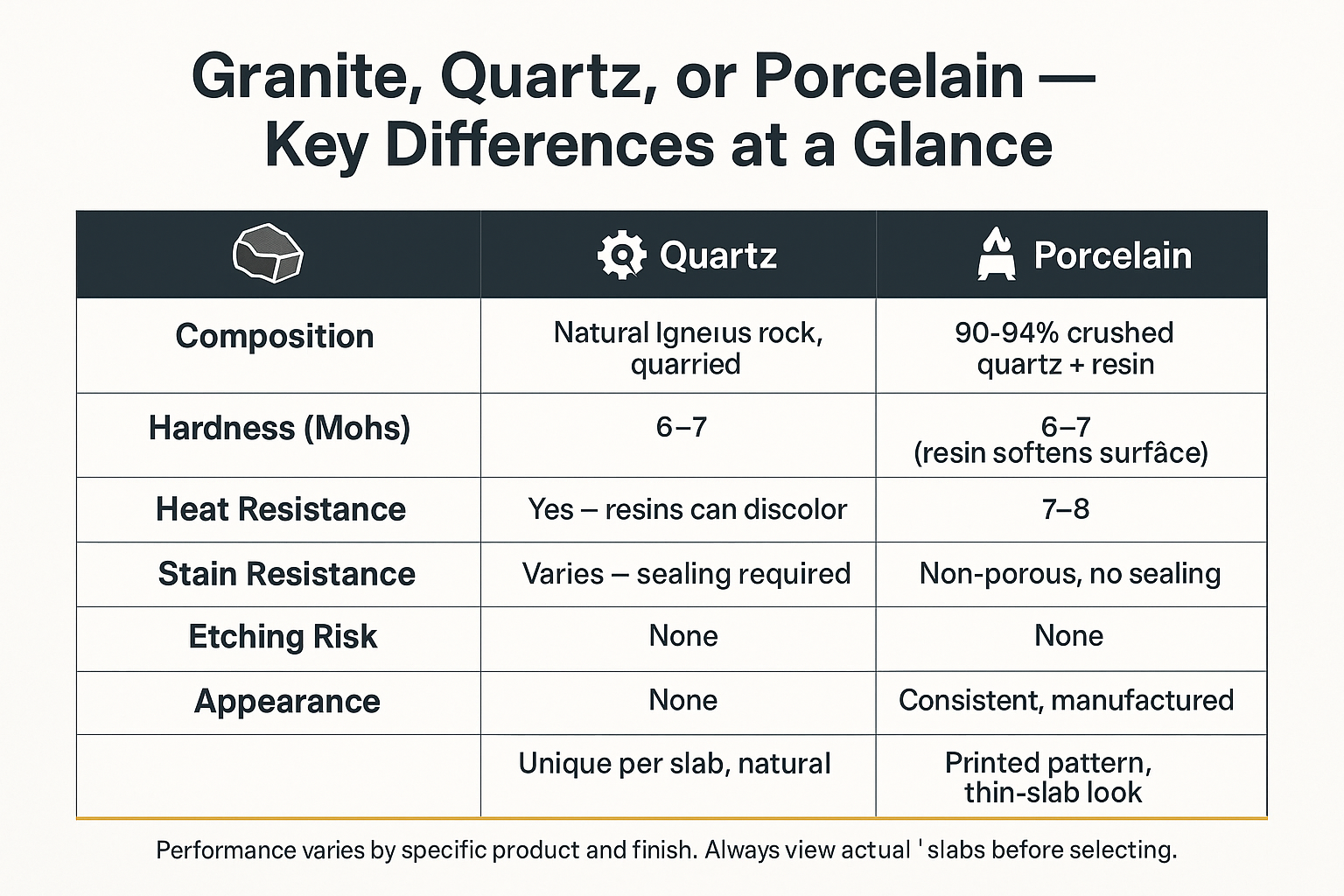
Granite vs. Quartz vs. Porcelain at a Glance
This comparison covers the key decision factors across all three materials in one place.
Typical Material Costs on the Central Coast (2026)
These are realistic slab material price ranges for the Monterey Peninsula and Bay Area markets — fabrication and installation are separate costs not reflected here.
| Material | Slab Cost Range (per sq ft) | Sealing Required |
|---|---|---|
| Granite (domestic) | $40 – $80 | Yes, every 1–3 years |
| Granite (imported / exotic) | $80 – $180 | Yes, every 1–3 years |
| Quartz (engineered) | $70 – $130 | No |
| Porcelain Slab (standard) | $55 – $110 | No |
| Porcelain Slab (large format / premium) | $100 – $180+ | No |
The Question Nobody Asks But Should: What Does Selection Actually Look Like?
Most buyers focus so hard on which material to choose that they skip thinking about how the selection process itself works — and that’s where projects often go sideways.
With quartz, selection is straightforward. You’re choosing a product SKU. The slab you get will look like the sample, consistently. There’s less decision risk in the selection step, but also less opportunity to find something genuinely unique.
With granite and natural stone, every slab is different. Two slabs from the same quarry batch can have meaningfully different veining, color intensity, and pattern movement. If your project requires matched slabs — say, a large island with a book-matched surface — you need to physically view and approve the actual slabs, not a catalog photo. This is exactly why visiting a stone slab yard in person matters so much for natural stone projects.
With porcelain, the selection challenge is different. The material performs consistently, but large-format porcelain slabs are more fragile during transport and fabrication than most buyers expect. Seams, cuts around sinks, and edge profiles all require a fabricator who has worked with thin porcelain specifically. How porcelain slabs actually get from the warehouse to your counter is a process worth understanding before you order.
A few questions worth asking yourself before you walk into any showroom:
- Do I want every countertop surface to match exactly, or am I open to natural variation?
- How often am I realistically going to seal and maintain this surface?
- Is my fabricator experienced with the specific material I’m considering?
- What lighting will this surface live under — north-facing kitchen, bright coastal windows, or low recessed light?
How the Central Coast Context Changes the Decision
Homes in Carmel-by-the-Sea, Pebble Beach, and Pacific Grove have specific conditions that affect material performance in ways that buyers in inland markets don’t deal with as often.
Salt air is a real factor for outdoor stone applications and for homes with frequently opened windows. Porcelain pavers and exterior stone hold up well in coastal conditions. Some softer natural stones — certain limestones and lower-density granites — can show surface weathering faster in a high-moisture, salt-air environment when used outdoors.
Interior humidity also matters in older Carmel cottages and Spanish-style homes that weren’t built with modern vapor barriers. Stone that’s installed over a subfloor with moisture variation can experience more movement stress. This doesn’t disqualify natural stone — but it reinforces the value of working with a supplier who understands the local conditions rather than a big-box retailer sourcing from a national catalog.
Design style is the other Central Coast-specific factor. The stone vernacular of the Peninsula leans toward materials with warmth and character — travertine, honed limestone, aged granite, quartzite with movement. A bright white engineered quartz can look clinical in a stone cottage that needs texture and depth. That’s not a rule; it’s a consideration. The right material depends on the specific space.
Frequently Asked Questions About Choosing Between Granite, Quartz, and Porcelain
Is quartz always lower maintenance than granite?
Generally, yes. Quartz is non-porous and never needs sealing. But ‘lower maintenance’ doesn’t mean indestructible — quartz can discolor from heat and scratch from abrasive cleaners. Dense granites like Absolute Black or similar dark stones are nearly as low-maintenance as quartz and outperform it in heat resistance.
Can I buy granite or quartz slabs directly without a contractor?
Yes. You don’t need a contractor to visit a showroom and select slabs. You’ll still need a licensed fabricator to cut and install the material, but sourcing the stone yourself is common — especially for homeowners who want control over exactly which slab goes in their kitchen. Buying direct from a granite slab dealer without a contractor is a normal part of the process.
Does porcelain look fake compared to natural stone?
It depends on the product and the viewer. High-end large-format porcelain printed with genuine stone photography can be difficult to distinguish from natural stone in a photograph. In person, most designers and experienced buyers can tell the difference — the depth and variation of natural stone is hard to replicate. Whether that matters is a personal call, not a quality judgment.
How do I know if a quartzite will actually resist staining before I buy it?
Ask for a water absorption test on a sample — you can do this yourself by putting a few drops of water on the surface and watching how quickly it absorbs. A more definitive test involves a small amount of lemon juice left for 10 minutes. Quartzite that’s being misrepresented as a low-porosity stone will show absorption quickly. You can read more about what to know before a quartzite stains on you before you select.
Is porcelain really worth $140 per square foot?
It depends on which product you’re looking at and what it’s being compared against. Premium large-format porcelain from Italian or Spanish manufacturers, in oversized slab format, genuinely commands that price range. Whether it’s worth it for your specific project is a different question. A full breakdown of what drives porcelain countertop pricing can help you evaluate the number.
What material works best for a bathroom vanity top?
For bathroom vanities, quartzite and dense granite are strong choices because they handle moisture well and look appropriate in a stone-forward bath. Quartz is also practical in bathrooms. The bigger risk is selecting a material based on appearance alone without accounting for how it performs around standing water and soap residue. Common mistakes in selecting a stone vanity top covers what to watch for.
Ready to See the Actual Slabs Before You Decide?
Carmel Stone Imports carries live inventory across its Carmel-by-the-Sea and Palo Alto showrooms — granite, quartzite, quartz, and large-format porcelain you can stand next to, compare side by side, and take samples home from. If you’re working through this decision and want to talk it through with someone who knows the materials and the local market, call (650) 800-7840 or email info@carmelimports.com to schedule a slab selection appointment.