Choosing the right quartz slab for your home remodel shouldn't feel like a gamble. This guide removes the guesswork, giving you the knowledge to select materials with confidence. We'll go beyond looks, diving into slab grades, origin, and quality—details that directly impact your budget and project success.
End Guesswork When Buying Quartz Slabs
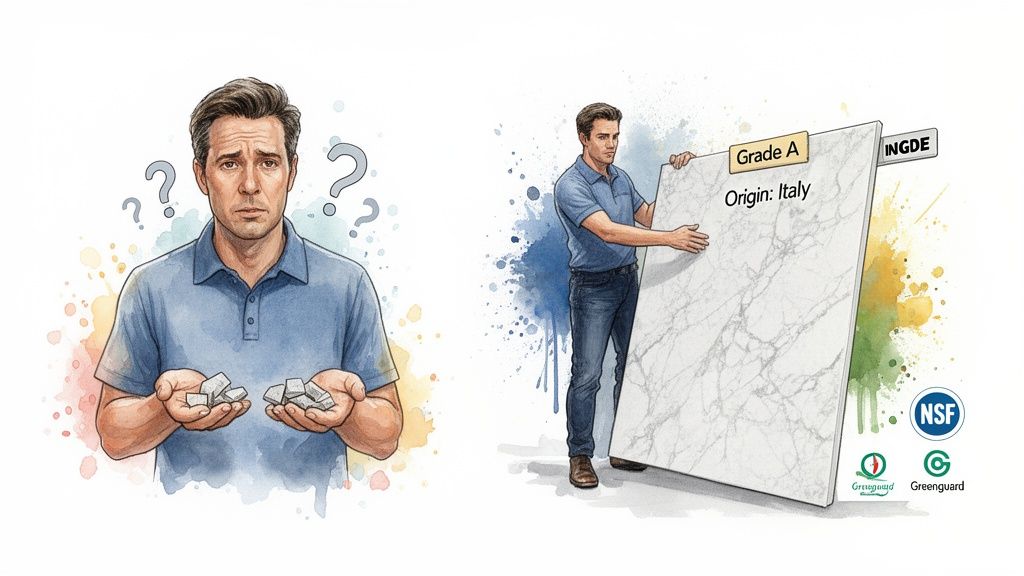
If you've started shopping for quartz, you’ve probably noticed a frustrating pattern. Suppliers show stunning samples and talk up the benefits—durability and low maintenance—but go quiet on pricing. Usually, you won't get a straight answer on cost.
This standard practice leaves you in the dark, making it impossible to budget. It creates an information gap that leads to confusion and stress, which is the last thing you need when investing in your home.
According to design forums like Houzz, quartz is the top countertop material for U.S. kitchen remodels due to its toughness. However, vague pricing remains one of the biggest frustrations homeowners face.
The Shift From Guesswork to Confidence
At Carmel Stone Imports, we believe in empowering our clients. We break this cycle by giving you upfront, transparent information on how quartz slab pricing actually works. When you understand the factors that drive cost, you take back control of your project.
This guide flips the typical process. Instead of waiting for someone else to explain the costs, you’ll learn how to assess value for yourself. This knowledge is crucial for anyone planning a remodel in discerning markets like Monterey or the Bay Area, where quality and ROI are everything.
Ready to dive deeper? Check out our tips on where to compare the best stone slabs near San Francisco.
Two Paths to Buying Quartz Slabs
The journey to new countertops can go one of two ways. This table shows the difference between the typical experience and the informed approach you're about to learn.
Uninformed Guesswork vs Informed Decision-Making
| Buying Stage | The Guesswork Approach (Common Pitfalls) | The Informed Approach (Your New Strategy) |
|---|---|---|
| Initial Research | Browses inspiration photos with no context on cost or quality tiers. | Identifies styles while learning about the factors that influence price and performance. |
| Showroom Visit | Feels overwhelmed and relies solely on the supplier's limited guidance. | Asks targeted questions about slab origin, resin content, and certifications. |
| Budgeting | Creates a budget based on vague estimates, leading to "sticker shock" later. | Budgets confidently, knowing the price range of different quartz grades and brands. |
| Final Selection | Chooses a slab based only on its color, unaware of potential quality issues. | Selects a slab that balances aesthetics, budget, and long-term performance. |
The path you take makes all the difference. An uninformed buyer focuses only on color, often falling for a material without knowing its grade or origin.
In contrast, an informed buyer walks into a showroom with knowledge. You'll know which questions to ask about slab quality and can compare options based on real value. This strategic approach helps you sidestep costly mistakes.
How to Speak the Language of Quartz
Stepping into a stone showroom without knowing the lingo can be confusing. To move past the guesswork, you need to speak the language. It’s the only way to compare apples to apples and understand what drives quality and price.
Getting a handle on a few key terms will instantly transform you into a knowledgeable buyer. This is the most crucial step to confidently buying quartz slabs on your own. You can then ask the right questions and spot a superior product.
Beyond the Surface Aesthetics
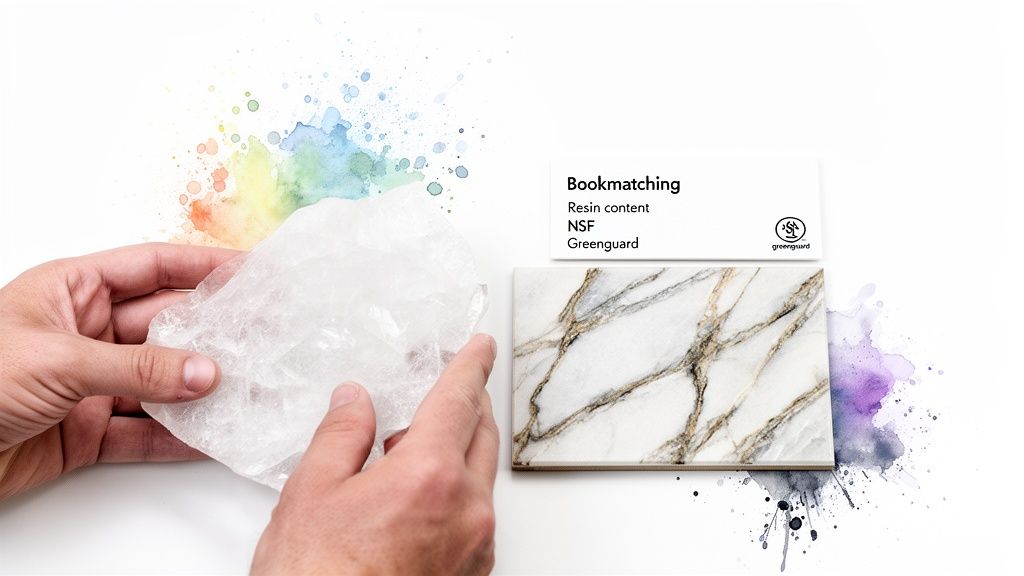
Sure, the color and pattern are what you fall in love with, but the technical details are what you’ll live with. These specs dictate how your countertop performs and how long it lasts. The two biggest concepts to grasp are bookmatching and resin content.
-
Bookmatching: This is pure artistry. Two adjoining slabs from the same block are polished on opposite sides. When placed side-by-side, they create a perfect mirror image, like an open book. It’s a jaw-dropping effect for kitchen islands and accent walls in modern Bay Area homes.
-
Resin content: Think of resin as the glue holding the quartz crystals together. The sweet spot is a slab with 6-7% resin, which gives you the best durability and stain resistance. If a slab has a resin content over 10%, be wary—it can be more vulnerable to heat and scratches.
Grasping these ideas helps you appreciate the skill in a top-tier slab. For a broader view, it's helpful to spend some time understanding the most important aspects of interior design.
Decoding Quality with Certifications
Those logos on the back of a slab are your guarantee of safety and quality. For anyone building a home in an eco-aware community from Monterey to Palo Alto, these credentials are non-negotiable. They are proof that a product meets tough standards.
Here are the two most important certifications to look for:
-
NSF (National Sanitation Foundation): This is a must-have for any kitchen. It certifies that the surface is non-porous and safe for direct food contact. No harmful chemicals will leach into your family's meals.
-
Greenguard: This certification is all about indoor air quality. It measures a product’s emissions of volatile organic compounds (VOCs). A Greenguard Gold certified slab won't off-gas harmful chemicals, which is a huge plus for a healthy home.
Understanding Quartz as an Engineered Product
It's a mistake to think all engineered quartz is created equal. The manufacturing process, raw materials, and technology vary wildly between brands. These differences affect how the final slab looks, performs, and how safe it is.
The percentage of natural quartz and the quality of the polymer resins matter. If you're curious about what separates the best from the rest, our article explains if all quartz is engineered and what premium brands do differently.
This is the knowledge that empowers you to look past marketing and assess your options confidently. You can choose a surface that’s not just beautiful, but built to last.
Understanding How Quartz Slab Pricing Really Works
One of the first questions on anyone's mind is, "What does this actually cost?" It's also one of the most frustrating parts of the process. Too often, suppliers are vague, leaving you in the dark.
This lack of transparency makes budgeting a guessing game, but it doesn't have to be. The price of a quartz slab reflects its design complexity, brand, origin, and dimensions. Once you understand these components, you're back in control.
Breaking Down the Tiers: It's All About the Design
You’ll hear people in showrooms talk about quartz "grades" or "tiers." This is industry shorthand for pricing categories. Most of the time, it boils down to the complexity of the visual design.
Think of it like buying a car. A standard, solid color is the base price, while a custom color is a premium feature. Quartz works the same way.
-
Entry-Level Tiers: These are clean and simple designs with fine, consistent grains. They’re perfect for a uniform look and are the most wallet-friendly.
-
Mid-Range Tiers: Here, you'll start to see more visual depth and subtle veining. These slabs offer a great balance of aesthetic flair and value.
-
Premium Tiers: This is where engineered quartz truly rivals exotic marble. Slabs showcase bold veining, complex color blending, and incredible depth. The technology needed to create these designs places them at the top of the price scale.
Beyond the Pattern: Other Key Cost Drivers
While design is the biggest piece of the puzzle, a few other factors influence the final slab cost. Keeping these in mind will help you make smarter comparisons.
Brand Reputation and Origin
Just like in fashion, brand names matter in quartz. Well-known brands like Cambria or Caesarstone often command higher prices due to their reputations for quality and design.
The slab's country of origin also plays a significant role. Manufacturing standards, labor costs, and shipping logistics all impact the final price tag.
Slab Thickness
Quartz slabs typically come in two standard thicknesses: 2cm (about 3/4 inch) and 3cm (about 1 1/4 inch).
The thicker 3cm slab is heavier, more robust, and generally costs more. For high-end homes from Palo Alto to Monterey, it's a popular choice for large kitchen islands. A 2cm slab is a more economical choice.
At Carmel Stone Imports, our philosophy is built on demystifying these factors. By offering clear guidance, we help our clients avoid sticker shock and scope creep. The result is smoother projects and a better return on your investment.
Creating a Realistic Budget
Now that you understand these variables, you can build a realistic budget. Knowing the price tiers helps you walk into a showroom with confidence.
To give you a clearer starting point, we've broken down the typical price tiers. This table should help you align your aesthetic goals with a practical budget.
| Price Tier | Common Characteristics | Estimated Price Range (Slab Only) |
|---|---|---|
| Entry-Level | Simple, solid colors or fine, speckled patterns. Uniform appearance. | $45 – $65 per sq. ft. |
| Mid-Range | Subtle veining, more color depth, gentle movement. | $65 – $85 per sq. ft. |
| Premium | Bold, dramatic marble-like veining, intricate patterns, translucence. | $85 – $120+ per sq. ft. |
This knowledge is critical for any project in the competitive Bay Area market. For a deeper dive, check out our guide on what goes into the cost of engineered stone countertops.
By understanding how the system works, you transform a confusing ordeal into a transparent process. You can ask the right questions and confidently choose the perfect material.
A Practical Guide to Visiting a Showroom
A stone showroom can feel both inspiring and intimidating. Surrounded by towering slabs, it’s easy to get lost. But a little prep work can transform an overwhelming trip into a productive experience.
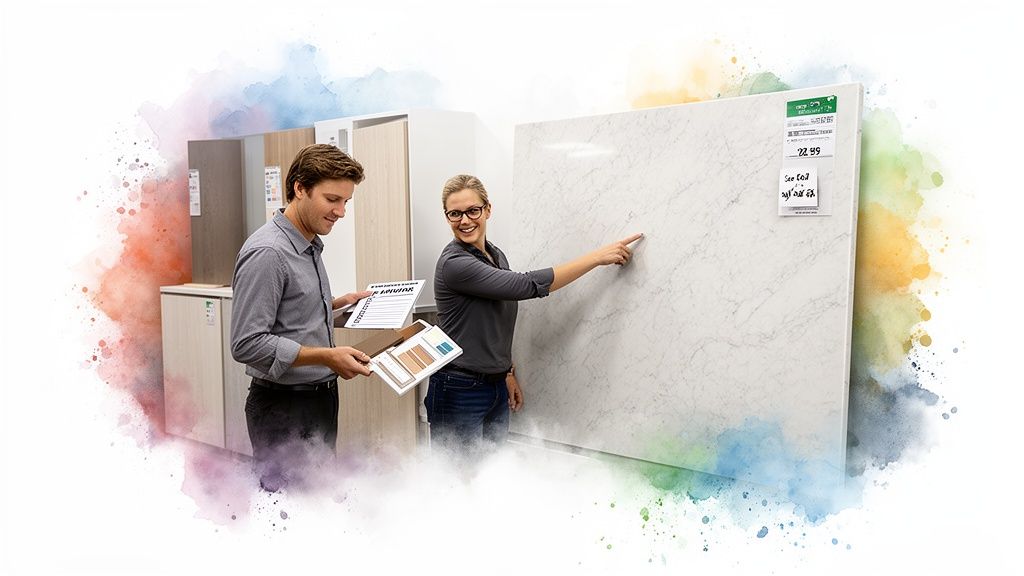
Walking in with a plan is the final piece of the puzzle. By arming yourself with the right tools and questions, you ensure that you lead the conversation and make confident decisions.
Preparing for a Productive Visit
Success in the showroom begins before you leave the house. Gathering a few key items will help you and the consultants visualize your project accurately. It allows you to compare slabs against your actual design elements.
Think of it like bringing a fabric swatch when shopping for furniture—it eliminates guesswork.
Here’s a simple checklist of what to bring:
- Cabinet Samples: A cabinet door or a large finish sample is a must.
- Paint Swatches: Wall colors can dramatically shift how a countertop looks.
- Flooring and Backsplash Samples: Seeing all materials together confirms a harmonious palette.
- Rough Layout Dimensions: A simple sketch with measurements helps consultants grasp the scale of your project.
Key Questions to Ask in the Showroom
Once you’re surrounded by options, your knowledge of quartz terminology will pay off. Now is the time to ask targeted questions that go beyond, "How much is this?" These questions reveal details about quality and consistency.
For more details, you might be interested in our guide to visiting a stone showroom for extra tips.
This is where you put your research into action.
The most important rule of the showroom: Always ask to see the full slab. A small 4×4-inch sample cannot represent the veining and color of a 120×60-inch slab.
Here are the essential questions to ask your consultant:
- "Can I see the full slab(s) I would be purchasing?" This is non-negotiable for any quartz with veining.
- "What is the 'lot' or 'batch number' for this slab?" If your project needs more than one slab, they must come from the same production run to guarantee a match.
- "Do you have other slabs from this same lot available?" This confirms there is enough matching stock for your project.
- "Can you point out any unique characteristics in this slab?" A good consultant will be transparent about any subtle variations.
The Carmel Stone Imports Experience
We get it. A significant investment in your home requires clarity and confidence. If you're planning a remodel in Monterey, Palo Alto, or the Bay Area, we invite you to visit one of our showrooms. Get clear guidance on price ranges—no guesswork, just answers.
Our teams are trained to be your partners. We’ll walk you through the nuances of each option, helping you find that perfect balance of beauty, performance, and value.
How to Measure and Order Slabs Like a Pro
Figuring out how much quartz you need can cause anxiety. Getting it wrong means budget overruns or running out of material. Taking the time to measure your space yourself is a crucial step that puts you in control.
This simple act of planning transforms the process. It's the difference between hoping for the best and ensuring a successful outcome. With a solid estimate, you can build a more accurate budget. These are essential skills for any major home purchase, from quartz to furniture. Learn more about how to measure your space and assess construction for other large home furnishings like sofas and see how these principles apply.
Calculating Your Project's Square Footage
Before ordering, you need a good handle on your total surface area. This doesn’t have to be perfect—your fabricator will handle professional templating. But a close approximation is key for budgeting.
Here’s a simple way to get it done:
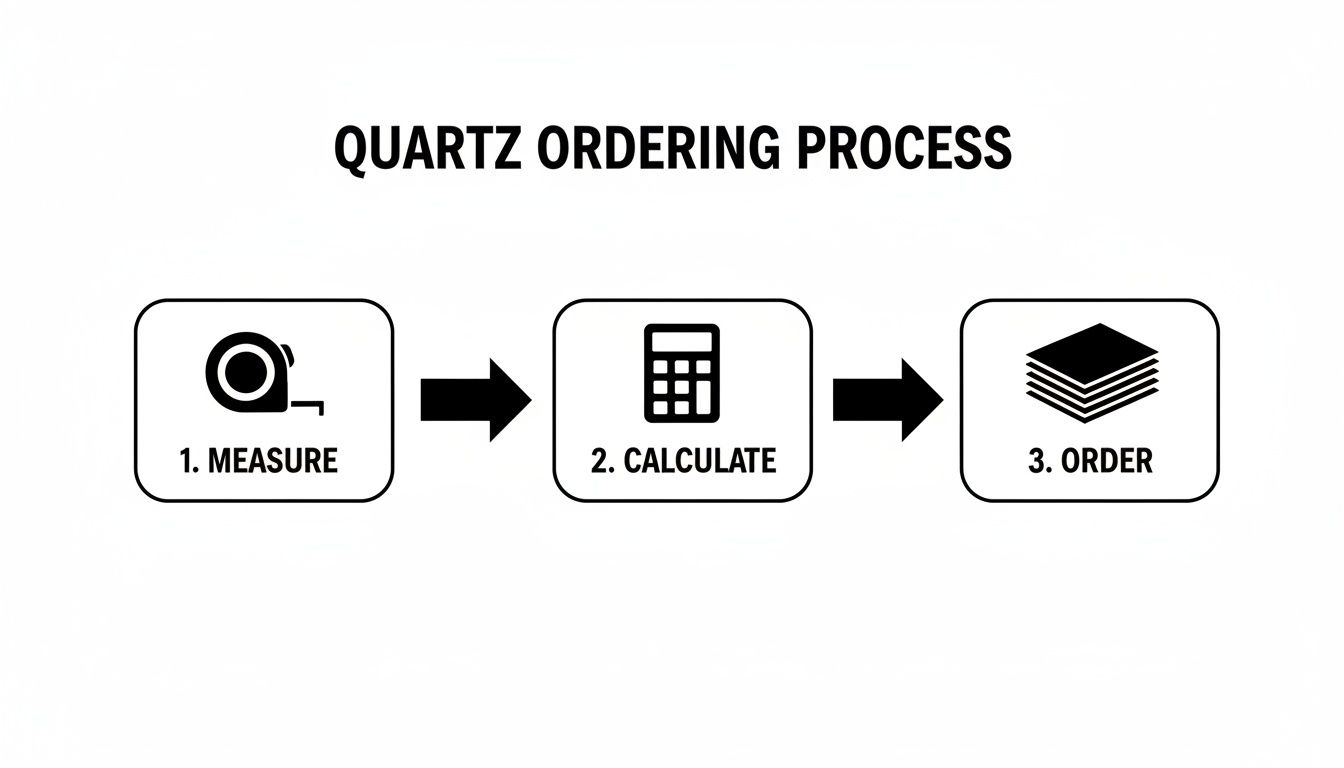
- Measure the Countertops: Break each countertop run into a rectangle. Measure the length and width of each piece in inches.
- Calculate Area: For each section, multiply the length by the width. This gives you the area in square inches.
- Sum It All Up: Add the areas of all sections together.
- Convert to Square Feet: Divide your total square inches by 144 to get your estimated square footage.
Don't forget other surfaces! Be sure to include your kitchen island, any full-height backsplash, or waterfall edges. For a more detailed walkthrough, check out our guide on how to properly template countertops.
Understanding Slab Yield and Overage
You have your total square footage. Now, you can't just order that exact amount. You must account for material lost during the cutting process. This is where the concept of slab yield comes in.
A standard jumbo quartz slab is about 130" x 65", or 59 square feet. In reality, you should only expect a usable yield of 45-50 square feet. As a rule of thumb, always add 15-20% to your calculation for overage. This buffer is your safety net.
This planning is also smart from a sustainability perspective. Since 2020, 93% of premium quartz now uses recycled materials, a practice we support at Carmel Stone Imports. By thinking in terms of full slabs, a buyer can maximize yield and cut waste.
By calculating your needs upfront, you ensure you can purchase all slabs from the same lot. This is the only way to guarantee perfect color and pattern consistency. This homework eliminates a big variable and gets you closer to a flawless finish.
Frequently Asked Questions
Finalizing a big decision like your quartz slab comes with last-minute questions. It's completely normal. Let's tackle some of the most common ones we hear in our showrooms.
What's the biggest mistake people make when buying quartz?
Falling in love with a small sample. A tiny square can't capture the flow and variation of a full slab. We always insist clients view the exact slabs they plan to purchase in one of our Bay Area showrooms to avoid surprises.
Is a more expensive slab always better quality?
Not necessarily. A higher price often reflects a complex design or brand recognition, not just raw durability. A simple slab from a top-tier manufacturer can be just as tough as a designer piece that costs twice as much.
Why is it important to buy slabs from the same batch?
Even though quartz is engineered, tiny shifts in color and pattern can happen between production runs. Buying all your slabs from the same "lot" or batch is the only way to guarantee a perfectly consistent look across your project.
How can I spot a low-quality quartz slab?
Look closely at the surface for dull spots, blotches, or tiny pits. Also, a lack of certifications like NSF (food safety) and Greenguard (low chemical emissions) is a major red flag.
What’s the real difference between 2cm and 3cm slabs?
It comes down to strength and style. A 3cm (about 1 ¼ inch) slab is the industry standard for durability. A 2cm (about ¾ inch) slab is lighter and more budget-friendly but may require a supportive sub-top.
Ready to find the perfect quartz for your home without the guesswork? The expert team at Carmel Stone Imports is here to bring clarity and confidence to your project. Visit us in Palo Alto, Carmel, or Sand City to explore our curated collection and get straightforward answers.