Direct Answer: Soapstone needs no sealer and resists acid and heat, but it is soft and marks easily. Owners either oil it to a deep charcoal or let it darken on its own.
You saw soapstone in a magazine or in a friend’s kitchen in Pacific Grove, and now you cannot tell from a photo whether you will still love it in five years. That is a fair worry. Soapstone changes more over time than almost any other counter material, and photos never show you the middle of that story.
It also varies a lot block to block. One slab reads soft gray-green, the next reads nearly black, and the veining can be a whisper or a bold diagonal. A two-inch sample chip tells you far less here than it would with a consistent engineered product.
This guide covers the three things that actually decide whether soapstone works for you: how patina develops, how the softness behaves in a real kitchen, and what buying one changes about slab size and seams. Everything else is detail.
Why a Sample Chip Is Not Enough With Soapstone
About a third of calls that come into a stone showroom start with the same question before anything else: is the material in stock, and in what size. With soapstone, that question matters more than usual, because you cannot substitute one slab for another and expect the same look.
Here is what changes from block to block:
- Undertone, which can run cool gray, gray-green, or close to charcoal straight out of the quarry
- Vein weight and direction, from faint hairlines to wide white ribbons that run diagonally across the face
- How much it darkens once oil or daily use starts pulling color forward
- Slab dimensions, which tend to run smaller than granite or quartzite
One line comes up over and over from callers planning a kitchen: they want to come in and see it in person before they commit. With soapstone that is not caution, it is good practice.
A sample chip cut from a corner will not show you the vein pattern that lands over your sink or across your island. Standing in front of the full slab does. It is the same reason the finish on a stone slab is easier to judge in person than on a screen.
Patina: The Two Paths Every Soapstone Owner Picks
Soapstone is a talc-based metamorphic stone. It is dense and effectively non-porous, which drives most of what makes it easy to live with:
- It takes no chemical sealer. There is nothing to reapply every year.
- It does not etch. Lemon juice, wine, and vinegar leave the surface alone.
- It handles heat. A hot pan straight off the burner will not mark it.
So the counter does not need protection. It just changes color. And you get two ways to handle that.
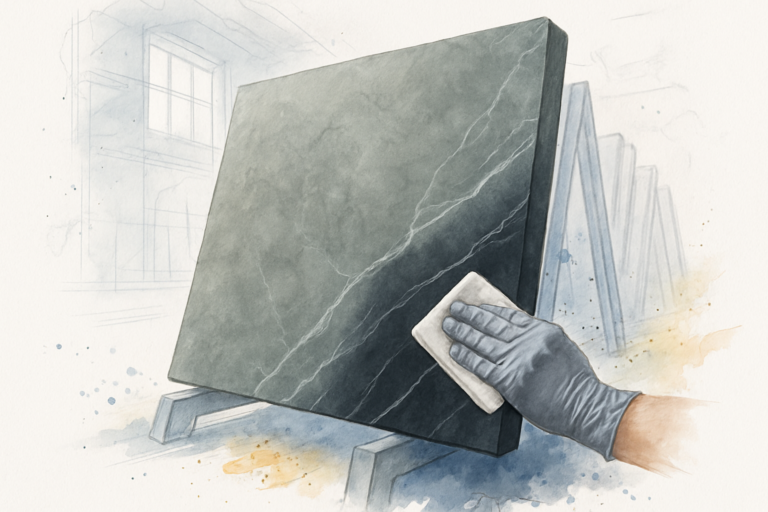
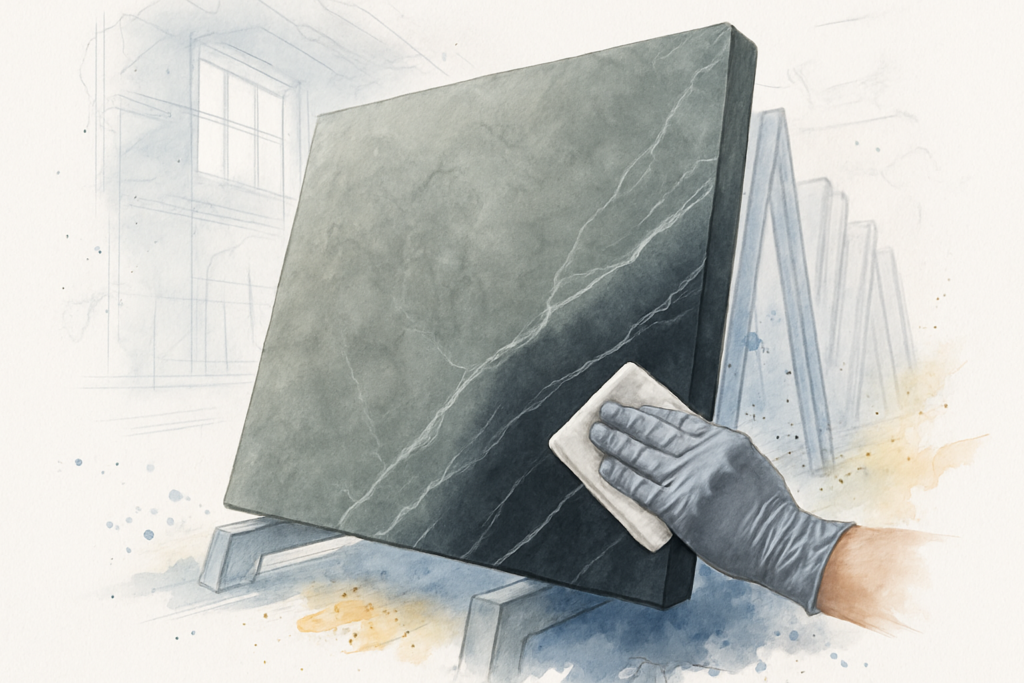
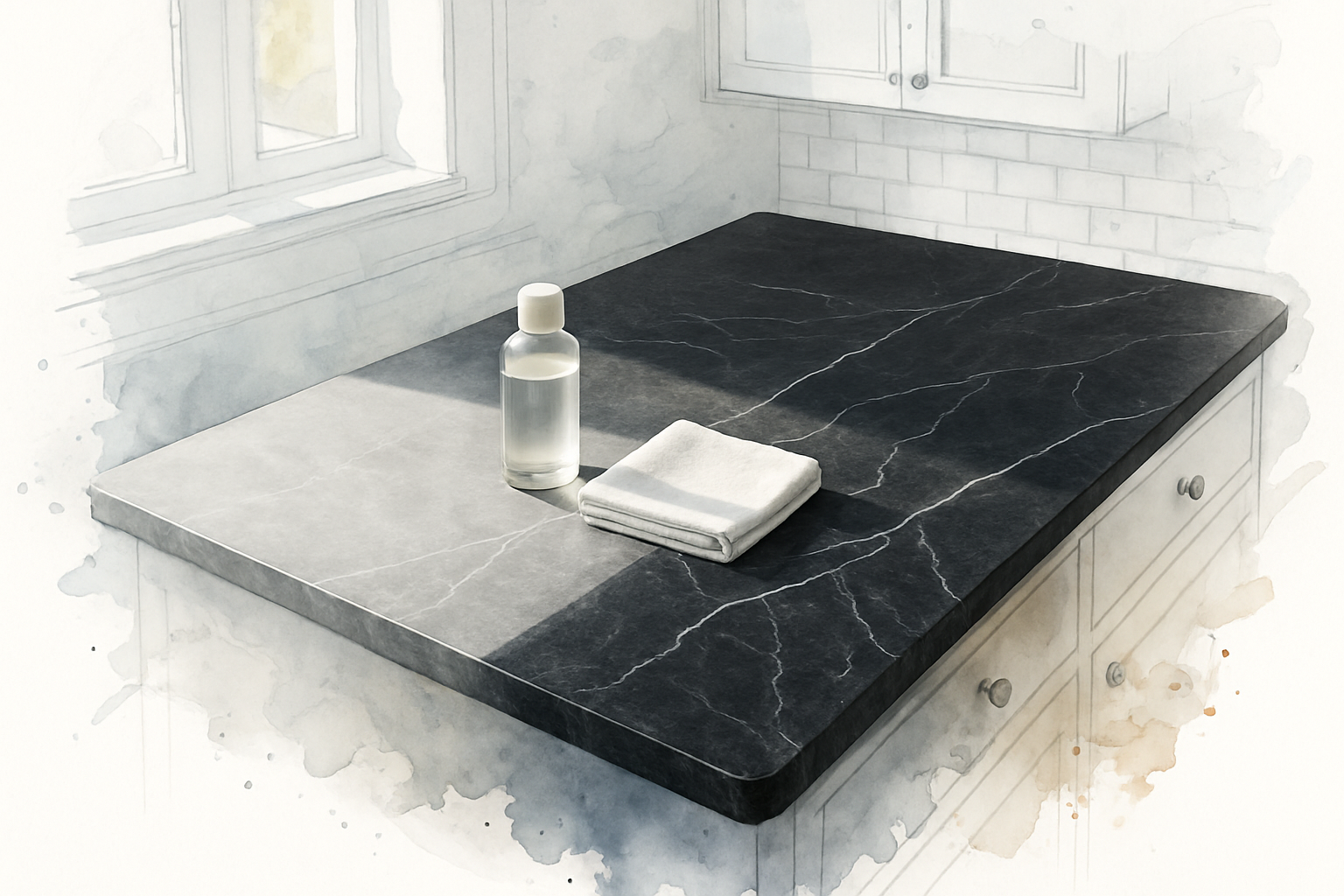
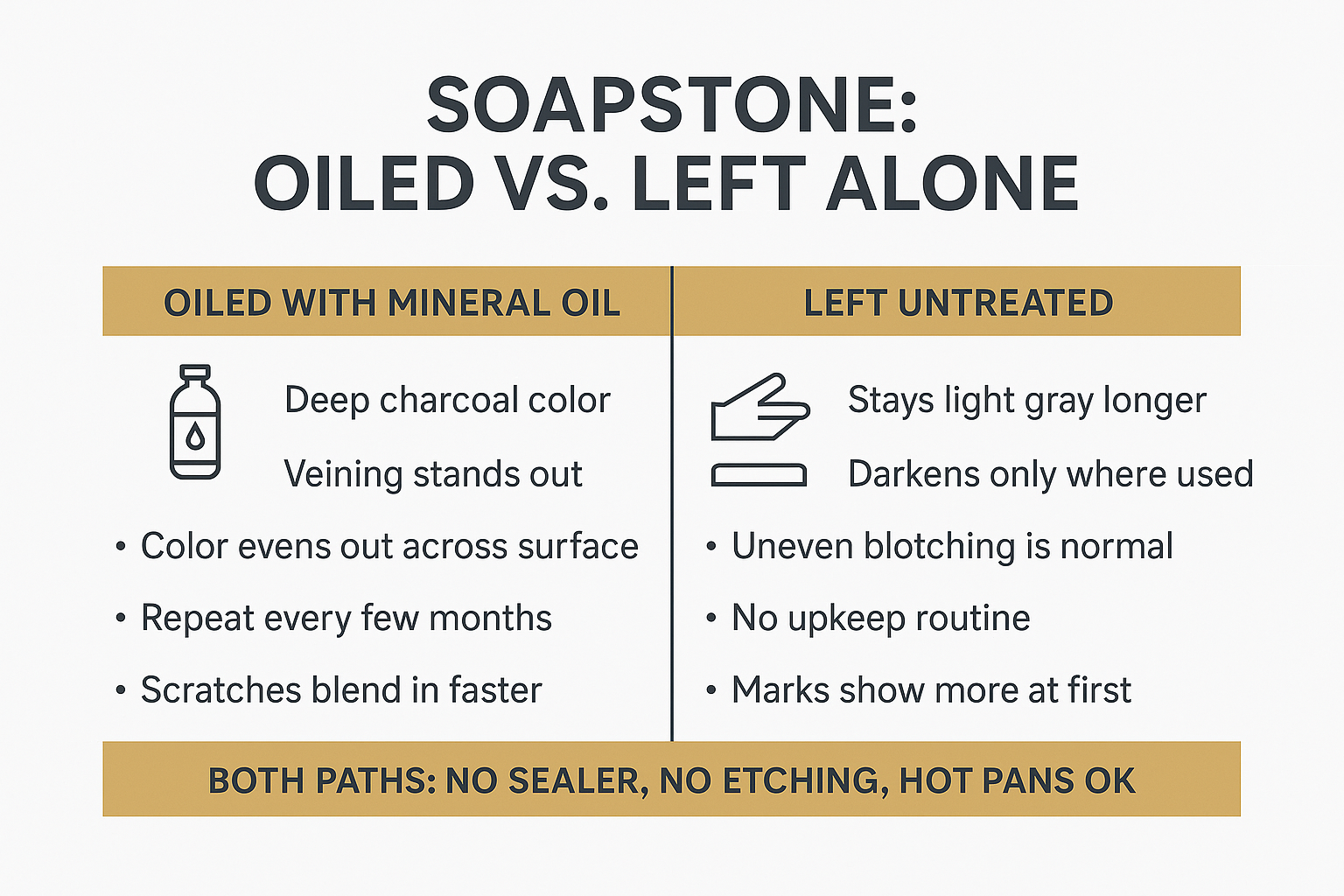
Path one: mineral oil. You wipe food-grade mineral oil across the surface, let it sit, and buff off the excess. The stone jumps from light gray to deep charcoal and the veining pops. Oiling also evens things out, so the area beside the sink does not race ahead of the rest.
This is a habit, not a treatment. Most owners oil often in the first several months, then taper to every few months, then whenever it looks thirsty. If that sounds like a chore, be honest with yourself now.
Path two: leave it alone. The stone still darkens, just unevenly and slowly, wherever hands and water touch it. Some people love that map of how their kitchen gets used. Others look at a blotchy counter at month four and wish they had picked something else.
Neither path is wrong. But there is no third path where it stays exactly the color it was on delivery day.
Oiled or Not: What Actually Changes
A quick side by side of how the same soapstone slab behaves depending on which path you choose.
The Softness Question, Answered Straight
This is where soapstone loses buyers, so let us not dance around it. Soapstone marks more readily than granite or quartzite. Drop a heavy pan lid on it and you can dent an edge. Drag a knife across it and you will see a line.
The counterpoint is real: those marks come out. Fine abrasive paper, a little patience, then re-oil the spot, and the repair blends in. Deeper dings take a fabricator, but the path exists.
That is a repair option manufactured surfaces do not give you. A chipped engineered slab gets filled or replaced, and the fill is usually visible. This is a point the founder of the company has been making to homeowners for years: damage to natural stone is fixable in ways damage to manufactured surfaces is not.
So treat it as a temperament question, not a durability score:
- Want the counter to look identical in year ten? Look at quartzite or granite instead.
- Like a kitchen that shows it has been cooked in? Soapstone will suit you.
- Somewhere in between? Oil regularly. It hides small marks much faster.
If you are weighing this against other natural options, our guide to natural stone countertops walks through the same honest tradeoffs across marble, granite, and quartzite.
How Soapstone Compares on Daily Behavior
A quick reference for the four things homeowners ask about most. Performance still varies slab to slab, so treat this as a starting frame.
| Material | Needs Sealer | Etches From Acid | Scratch Resistance | Repairable On Site |
|---|---|---|---|---|
| Soapstone | No | No | Low | Yes, sand and re-oil |
| Quartzite | Usually | Rarely | High | Limited |
| Granite | Usually | Rarely | High | Limited |
| Marble | Yes | Yes | Medium | Yes, honing and polishing |
| Engineered quartz | No | Yes, some resins | Medium to high | No, fills stay visible |
Where the Silica Conversation Fits
Soapstone keeps coming up in California kitchens for a reason beyond looks. In May 2026, California’s Occupational Safety and Health Standards Board voted unanimously to begin emergency rulemaking that would prohibit fabrication and installation of artificial stone containing more than 1 percent crystalline silica. California search interest in engineered stone counters has dropped sharply since late 2025 as buyers look around.
Get the distinction right, because it is widely garbled. The hazard falls on the workers cutting, grinding, and polishing the material, not on a homeowner living with a finished counter. A sealed, installed slab is not releasing dust into your kitchen.
Soapstone reads differently on a materials safety sheet because its silica is chemically bound inside the talc mineral structure rather than sitting there as free crystalline quartz. Federal OSHA’s countertop silica publication tabulates crystalline silica content by material and shows how far apart these surfaces sit.
If the rulemaking is part of why you are shopping, it is worth reading what California’s engineered stone ruling means for your countertop choice alongside what the engineered stone marketing leaves out.
How Soapstone Behaves in Monterey Peninsula and Bay Area Homes
The no-sealer part is worth something specific here. In a Carmel-by-the-Sea or Pacific Grove kitchen, marine layer moisture and salt air shorten sealer intervals on more porous stone, and homeowners get tired of resealing. Soapstone sidesteps that whole maintenance loop, which is also why it works well around a wet bar or a butler’s pantry sink.
Light is the other local variable. In a Palo Alto or Los Altos remodel of 1960s-era housing, where the kitchen is being opened up with more glass and a wider footprint, a dark oiled patina reads calm and grounded. Put that same slab in a smaller, warmer Peninsula kitchen with limited north light and it can close the room down fast.
So look at the room before the slab:
- Big glass, high ceilings, pale cabinets: dark oiled soapstone holds its own.
- Small kitchen, warm wood tones, one window: consider leaving it unoiled longer, or reconsider the material.
- Wet bar, pantry, laundry: strong fit either way, since acid and heat are non-issues.
Timing matters too. October and November are when material decisions usually land for Central Coast and Bay Area projects that broke ground in late summer, and soapstone supply is not deep enough to assume a slab will still be there in three weeks.
What Changes About Buying and Fabricating It
Soapstone quarry supply is narrower than quartzite or marble, and slab dimensions tend to run smaller. That changes your plan before anything gets cut.
Things to sort out early:
- Seam placement on a long island. A 10-foot island may need a seam where granite would not.
- Full-height backsplash math. Smaller slabs mean more pieces and more visible joints.
- Edge detail. Because the stone is soft, a delicate edge profile chips more easily. Simpler profiles hold up better.
- Sink cutouts. An undermount cutout in soft stone needs a fabricator who has done it before.
Be clear on who does what. A stone supplier stocks and sells the slab. Your own fabricator templates, cuts, edges, and installs it. A showroom can point you toward fabricators who work with soapstone regularly, which matters more here than with harder materials, the same way fabricator choice matters more with porcelain than with standard stone.
And bring your fabricator into the conversation before you commit to a slab, not after. Seam count is a design decision, not a construction detail.
Frequently Asked Questions About Soapstone Countertops
How often do I really have to oil soapstone?
Often at first, then much less. Many owners oil every couple of weeks for the first few months while the stone drinks it in, then move to every few months, then simply when the color looks flat. It is a habit, not a one-time treatment, and skipping it is a legitimate choice, not neglect.
Will scratches ruin my counter?
They will show, and they will come out. Light marks sand out with fine abrasive and a wipe of mineral oil. Deeper dents from a dropped cast iron pan may need a fabricator, but soapstone is one of the few surfaces where an on-site fix actually disappears instead of looking like a patch.
Is soapstone safe around the crystalline silica issue in California?
The California rulemaking targets fabrication and installation of artificial stone, so the exposure risk belongs to workers cutting and polishing material, not to homeowners with finished counters. Soapstone’s silica is bound inside the talc mineral structure rather than present as free crystalline quartz, which is why it lands differently on safety documentation than engineered quartz.
What does soapstone cost compared to granite or quartzite?
Pricing swings a lot with the block, the vein pattern, thickness, and how many slabs the project needs. Soapstone typically sits in a mid to upper range because supply is narrower, but the honest answer is that two slabs with the same name can price very differently, just like quartzite pricing. Ask a showroom for a quote on the actual slab you are looking at.
Can I see it wet before I buy?
Yes, and you should. Ask staff to wipe mineral oil onto a corner so you can see the dry color and the oiled color on the same slab, then take a sample home and set it on your counter for a week under your own kitchen light.
See a Soapstone Slab Before You Decide
Soapstone is a material you judge standing in front of it, dry on one side and wet with oil on the other, then again at home on your own counter for a week. Live inventory across the Carmel, Palo Alto, and Sand City locations means you are looking at the actual slab, not a catalog image, and staff are used to taking their time with this comparison. One reviewer put it simply: “She was extremely patient and non-pushy, offering important insights into the stone selection process.” – Gary D.
Carmel Stone Imports keeps slab selection appointments open for homeowners, designers, and contractors across the Monterey Peninsula and Bay Area, and walk-ins are welcome. Reach the team at (650) 800-7840 or info@carmelimports.com when you are ready to look.