
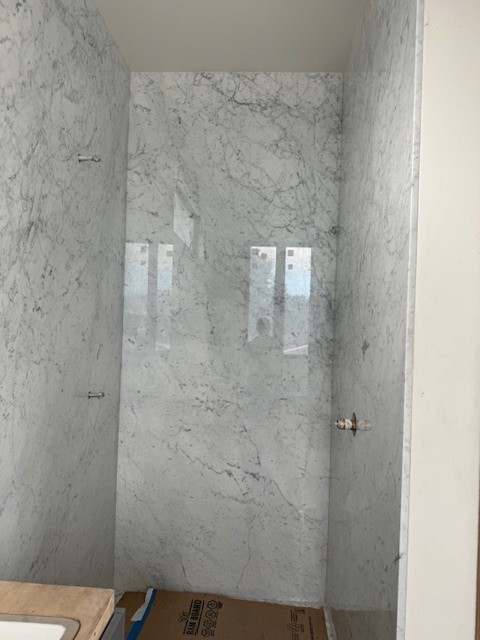
Direct Answer: Porcelain is very durable once installed, but brittle during cutting, routing, and transport. A chipped porcelain edge cannot be repaired to match, so fabricator experience matters more than with natural stone.
Porcelain slabs have a reputation for being close to indestructible, and most of that reputation is earned. Hot pans, red wine, salt air off Carmel Beach, direct sun on a patio counter. Porcelain handles all of it better than almost anything else on the market.
So homeowners are surprised when the problem shows up before the material ever gets used. A chip at the sink cutout, a nicked corner on the island, a hairline break discovered when the slab comes off the truck.
That is the part nobody explains at the sale. Durability in use and fragility during fabrication are two completely different things, and the second one is entirely in your fabricator’s hands. Here is what to understand before you pick a material, an edge profile, or a shop.
The Real Porcelain Slab Fabrication Risk Is Not Daily Use
Porcelain slabs are fired at extreme temperature until they become dense and nearly non-absorbent. Industry standards set through groups like the Tile Council of North America classify porcelain by very low water absorption, which is why it resists staining, etching, and UV fading so well.
But density is not the same as forgiveness. A porcelain slab is a rigid, brittle sheet, and stress concentrates wherever material is removed or unsupported.
The high-risk moments all happen before the counter is ever used:
- Cutting and sizing, where blade speed, water volume, and feed rate all matter
- Routing the undermount sink cutout, the single most reported failure point
- Profiling the edge, especially thin or sharp profiles
- Handling and transport, including the drive from a Sand City warehouse over Highway 68 to a fabrication shop in Salinas or Seaside
- Install day, when the slab is lifted, tilted, and set into place
Here is the part that separates porcelain from natural stone. If a marble or quartzite edge chips, a skilled restoration hand can fill, hone, and repolish it until you stop seeing it. Modern sealers and cleaners have gotten good enough that natural stone damage is usually fixable.
A chipped porcelain edge cannot be repaired in a way that matches the original material. The color and pattern in many porcelain slabs do not run uniformly through the body, so a filled chip reads as a patch. That is why so much of the conversation around porcelain edge chipping centers on prevention rather than repair.
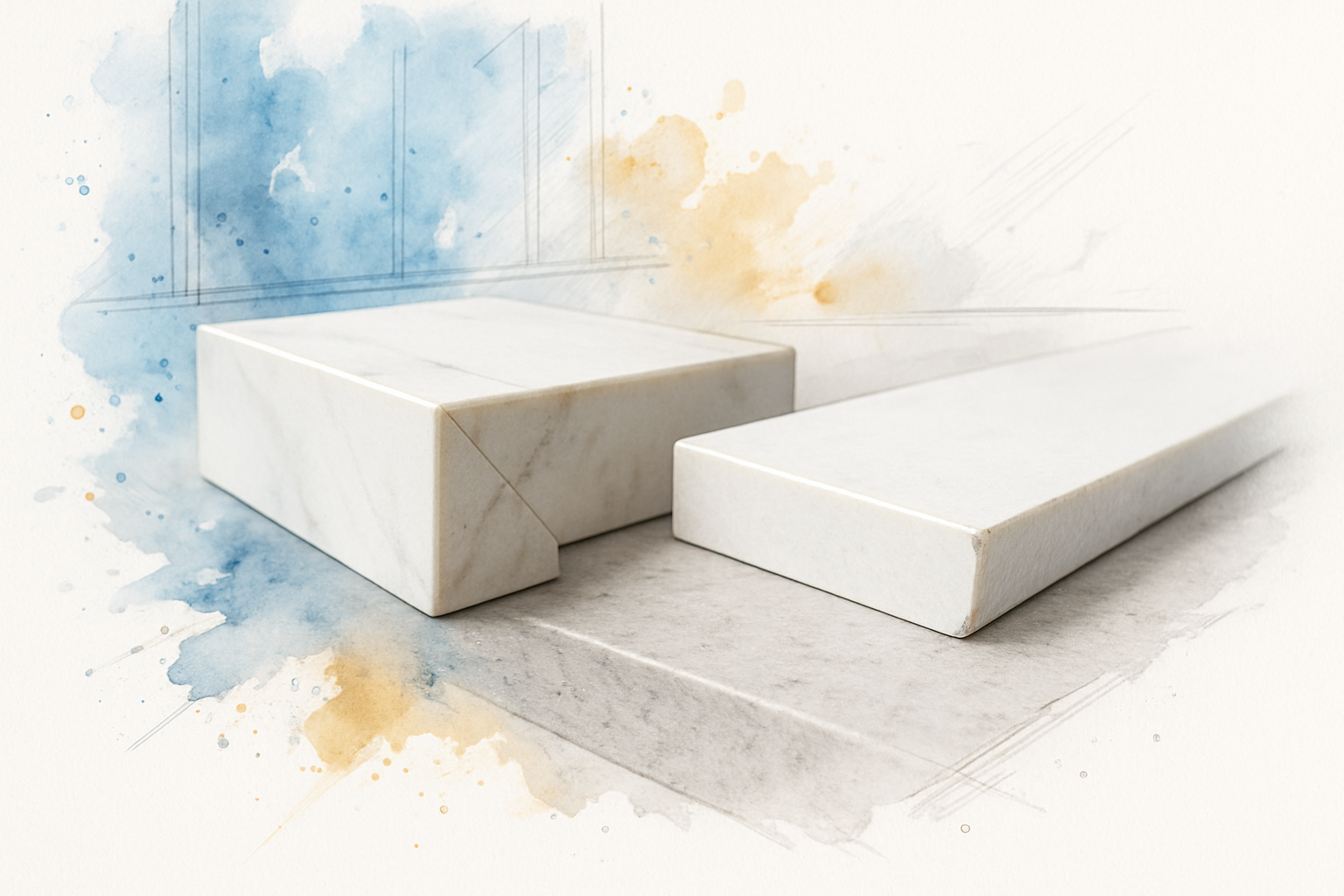
The Edge Profile You Choose Sets the Chip Risk
Most buyers treat edge profile as a styling decision. With porcelain it is also a structural one, and it gets locked in at the design stage, long before anyone picks up a saw.
A thin, sharp, perfectly square edge looks crisp in a photo. In practice it leaves a fragile cross-section exposed at exactly the places people bump into: the corner nearest the range, the front lip at the dishwasher, the inside curve of an undermount sink.
How the common approaches compare:
- Mitered or laminated edge: two pieces joined at an angle to create visual thickness, usually 1.5 to 3 inches or more. Popular on the waterfall islands showing up in Carmel Point and Pebble Beach remodels. It hides the thin body of the slab and gives the edge more material to absorb a knock. It also demands precise seam work, so shop skill shows immediately.
- Eased or small radius edge: a slight softening of the corner. On most porcelain formulations this holds up noticeably better than a hard square profile, because there is no knife-thin arris to break away.
- Square edge: the cleanest look and the least tolerant. Workable, but it puts more pressure on both fabrication and everyday habits.
- Ornate profiles like ogee: generally a poor fit for porcelain. Deep profiling in a 12mm sheet removes too much material and thins the section where it needs strength.
The undermount sink cutout deserves its own thought. It combines an inside radius, an unsupported span, and heat at the blade. Ask your fabricator directly how they intend to handle it, and whether a rodded or reinforced approach makes sense for your layout.
Porcelain Slab Thickness and Where Each One Fits
Thickness is a pre-design decision, not something to sort out after cabinets are ordered. Here is how the three common thicknesses typically get used on Central Coast projects.
| Slab thickness | Where it usually works | What to keep in mind |
|---|---|---|
| 6mm | Wall cladding, shower panels, fireplace surrounds, cabinet faces | Generally too thin for a countertop unless it is laminated to a substrate. Lightest to handle, least forgiving on the saw. |
| 12mm | Kitchen countertops, islands, backsplashes, vanity tops | The most common countertop choice. Looks clean with a mitered or eased edge. Most porcelain fabrication experience in the region is built on this thickness. |
| 20mm | Outdoor kitchens, pool surrounds, commercial and high-traffic surfaces | Heavier and more forgiving in cross-section. A sensible pick for Carmel Valley outdoor kitchens that see real summer heat. Freight and handling cost more. |
Four Questions That Tell You Everything About a Porcelain Fabricator
Bring these four questions to every fabricator interview. The answers, and how quickly they come, tell you what you need to know.
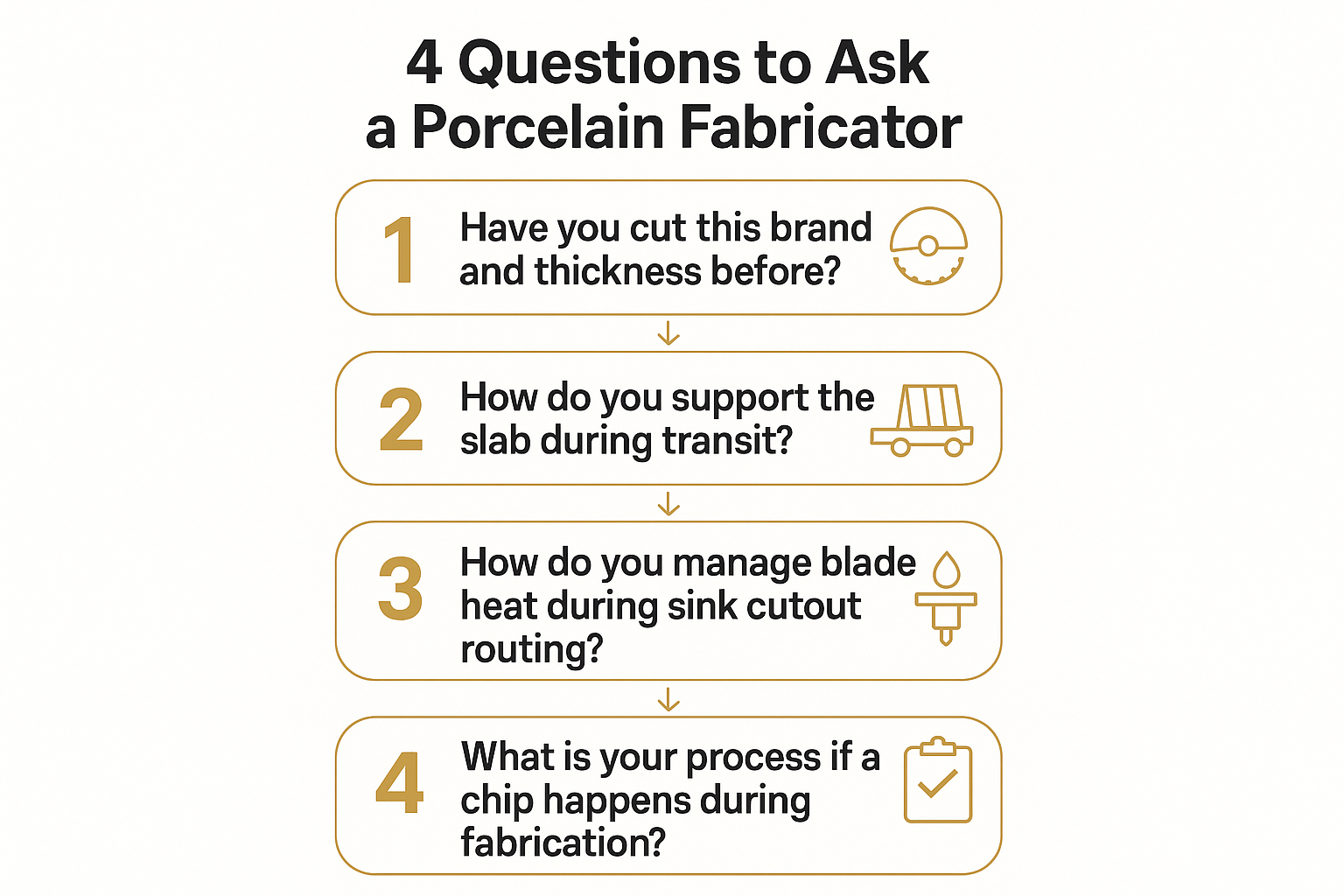
How to Interview a Fabricator About Porcelain
Fabrication shops around Salinas, Seaside, and the greater Monterey Peninsula vary widely in porcelain experience. Some have been cutting large-format porcelain for years and have the tooling and the rails for it. Others do excellent granite work and have handled a handful of porcelain jobs.
Both can be good shops. You just need to know which one you are hiring.
Ask these four things and listen to how the answers come out:
- “Have you cut this brand and this thickness before?” Porcelain formulations differ. Experience with one brand does not automatically transfer.
- “How do you support the slab in transit?” You want to hear about A-frames, full support, and strapping. Vague answers here are a real signal.
- “How do you manage heat at the blade during sink cutout routing?” Water volume and feed rate should come up naturally.
- “What happens if a chip occurs during fabrication?” A shop that has done this work has a policy and will state it plainly.
A fabricator who has done it before answers all four without pausing. One who hesitates or changes the subject is telling you something worth hearing.
One more practical note on cost. Porcelain fabrication labor on the Central Coast often runs above comparable granite work because of the tooling, slower cutting, and added handling, though the spread depends heavily on your layout, edge profile, and cutout count. Get the number in writing from the shop, not as a rough verbal estimate.
And honestly, a beautiful porcelain slab in inexperienced hands often finishes worse than a simpler material in experienced hands. If the shop you trust does not do porcelain, that is useful information for choosing between granite, quartz, and porcelain in the first place.
The Supplier and the Fabricator Are Two Separate Businesses
This trips up a lot of buyers. Several callers each month ask whether the showroom that sells the slab will also cut and install it, and the answer is no. Carmel Stone Imports supplies material and provides referrals to trusted fabricator partners, and the fabricator you hire is a separate business with its own scope and its own quality.
That separation is actually good for you, because you get to evaluate each one independently. But it means the sequence matters:
1. See the actual slab in person and confirm it is what you want. Natural stone and porcelain both vary lot to lot, which is why live inventory beats catalog images.
2. Ask about a time-bound hold while you confirm with your fabricator. Buyers say some version of “can you hold it while I check with my fabricator” constantly, and it is a normal request.
3. Interview the fabricator with the four questions above, and share the exact brand, thickness, and edge profile.
4. Lock in thickness and edge before templating, not after.
5. Coordinate delivery from the Carmel, Palo Alto, or Sand City location to the shop.
One Monterey Peninsula homeowner wrote that the showroom staff “coordinated directly with our stone fabricator so I did not need to.” That coordination is where a lot of the handling risk gets managed, well before install day. For the wider picture, it helps to understand how porcelain slabs actually get to your kitchen counter.
Frequently Asked Questions About Porcelain Slab Fabrication Risk
Can a chipped porcelain countertop edge be fixed?
It can be filled, but it will not match. Color-matched epoxy fills the void and prevents further damage, yet the repair usually reads as a patch because the pattern does not continue through the body of the slab the way it does in natural stone. Prevention is the whole game with porcelain.
Is porcelain a bad choice for a kitchen then?
Not at all. Once it is installed correctly, porcelain is one of the toughest surfaces you can put in a kitchen or on a covered patio. The risk sits in the shop and the truck, not in your daily life. Handle the fabrication decision carefully and porcelain performs beautifully for decades.
What thickness should I pick for a kitchen island in Carmel?
12mm is the most common countertop thickness, usually finished with a mitered edge to give it visual weight. If the island is a waterfall design or takes heavy daily use, talk through the miter plan with your fabricator before templating. Outdoor counters often justify 20mm.
Should I choose the fabricator before or after I pick the slab?
Have a fabricator identified before you commit to porcelain. If your preferred shop has not worked with the brand and thickness you like, that changes your material conversation, not just your labor conversation. Many buyers put a short hold on a slab while they sort this out.
Does porcelain hold up to Central Coast coastal conditions?
Yes. Low absorption and strong UV stability make porcelain well suited to salt air and sun exposure, which is why it shows up so often on outdoor kitchens from Pacific Grove to Carmel Valley. Freeze-thaw is not a real concern here, but proper support and drainage still matter outdoors.
Want to see porcelain and natural stone side by side before you decide?
Seeing a full porcelain slab next to a quartzite or marble slab makes the tradeoffs obvious in a way no sample chip can. The Carmel showroom on Carmel Rancho Lane and the Palo Alto location both keep live inventory on the floor, with design consultants available to walk through thickness, edge options, and material samples for take-home review. Slab selection appointments can be arranged at (650) 800-7840 or info@carmelimports.com, and walk-ins are welcome.