Direct Answer: Plan check for kitchen and bath permits often runs about 4 to 6 weeks in Palo Alto and 6 to 10 weeks in San Francisco. Start stone selection at submittal, not after approval.
You finally get the permit approval email. Your contractor has a crew slot open in three weeks. Then you walk into a slab yard and learn the quartzite you fell in love with sold two months ago.
This happens constantly across the Monterey Peninsula and the Bay Area, and it is almost always a sequencing problem, not a supply problem. Buyers treat stone as a late decision, something to handle once permits clear and the job site is active.
But permits and slabs run on two separate clocks. This article covers what plan check actually takes in Palo Alto and San Francisco, which remodels trigger a permit at all, and where slab selection needs to sit on your calendar so the material is still there when your fabricator is ready to template.
What the permit timeline for a kitchen or bathroom remodel in the Bay Area really looks like
Plan check is the review period after you submit drawings and before you can pull the permit. It is the part homeowners consistently underestimate.
General market experience across Northern California looks roughly like this, though every jurisdiction and every project scope differs:
- Palo Alto: around 4 to 6 weeks of plan check for a smaller kitchen or bath remodel involving plumbing or electrical work
- San Francisco: the Department of Building Inspection commonly runs 6 to 10 weeks for similar scope
- Monterey and Carmel-by-the-Sea: timelines vary widely, and coastal or historic district review can add its own layer
- San Jose and the South Bay: often falls between the Palo Alto and San Francisco ranges depending on volume
Those are review windows, not total project time. Add revision cycles, which are normal, and a 6 week estimate can become 10.
Here is why that matters for material: if you wait for approval before you start looking at stone, you have effectively pushed your selection two to three months down the road. In a live inventory business, two to three months is enough time for a specific slab bundle to sell to someone else.

Does your project even need a permit? The line is narrower than people think
Not every remodel triggers plan check, and knowing which side of the line you are on changes your whole calendar.
Work that generally does not require a permit in cities like Palo Alto and San Francisco:
- Replacing countertops on existing cabinet bases with no plumbing or electrical changes
- Swapping a backsplash or wall tile in the same footprint
- Refinishing or replacing flooring over an existing substrate
Work that typically does trigger a permit:
- Relocating a sink, dishwasher, or gas line
- Adding an island with new plumbing or electrical rough-in
- Changing ventilation or adding a new hood run
- Moving or removing walls, or altering structure in any way
Treat this as general orientation, not a ruling. Requirements shift by city, by scope, and by whether your home sits in a historic or coastal overlay. Confirm your specific scope with your contractor or designer before you assume anything.
The practical takeaway is simple. A straight countertop swap means your only real timeline is material availability and fabrication. A sink relocation means you are now working backward from a permit clock that starts long before anyone touches a slab.
Working backward from your completion date
Most buyers plan forward from today. Experienced designers plan backward from the day the kitchen needs to be usable. Here is roughly how that sequence lays out for a permitted remodel.
| Milestone | Rough timing before install | Why it lands there |
|---|---|---|
| Showroom visit and material shortlist | 12 to 16 weeks | Runs parallel with drawings, before permits are submitted |
| Slab selection and hold request | 10 to 14 weeks | Locks the specific bundle while plan check is running |
| Permit submitted and in plan check | 8 to 12 weeks | Palo Alto roughly 4 to 6 weeks, San Francisco roughly 6 to 10 |
| Demo and rough-in inspections | 4 to 8 weeks | Cannot start until the permit is issued |
| Cabinets set, fabricator templates | 2 to 3 weeks | Template requires final cabinet positions and confirmed slabs |
| Delivery to fabricator and install | Week zero | Material must already be on hand, not on a container |
Stone lead times are not the same as furniture lead times
Natural stone is not reordered from a warehouse shelf. Each slab is cut from a specific quarry block, and the veining in one bundle will never repeat exactly in the next.
What that means in practice:
- In-stock material: often 1 to 3 weeks from confirmation to delivery at your fabricator, depending on location and scheduling
- Sought-after quartzite like Taj Mahal or Mont Blanc: moves fast and does not always come back in the same look
- Exotic marbles and onyx: limited bundles, and a replacement block may read completely different
- Large-format porcelain panels: often ordered by the panel, with restock tied to shipment cycles
- Special order or next container: can add several weeks, sometimes considerably more
Call patterns from the showrooms show this every month. Buyers phone with a project start date and a lead time question in the same sentence, usually because a fabricator or contractor gave them a hard date. Several callers each month describe wanting to lock something in before it sells.
This is also why what live inventory at a slab supplier actually means matters more than a catalog photo. What is on the floor today is what is real.
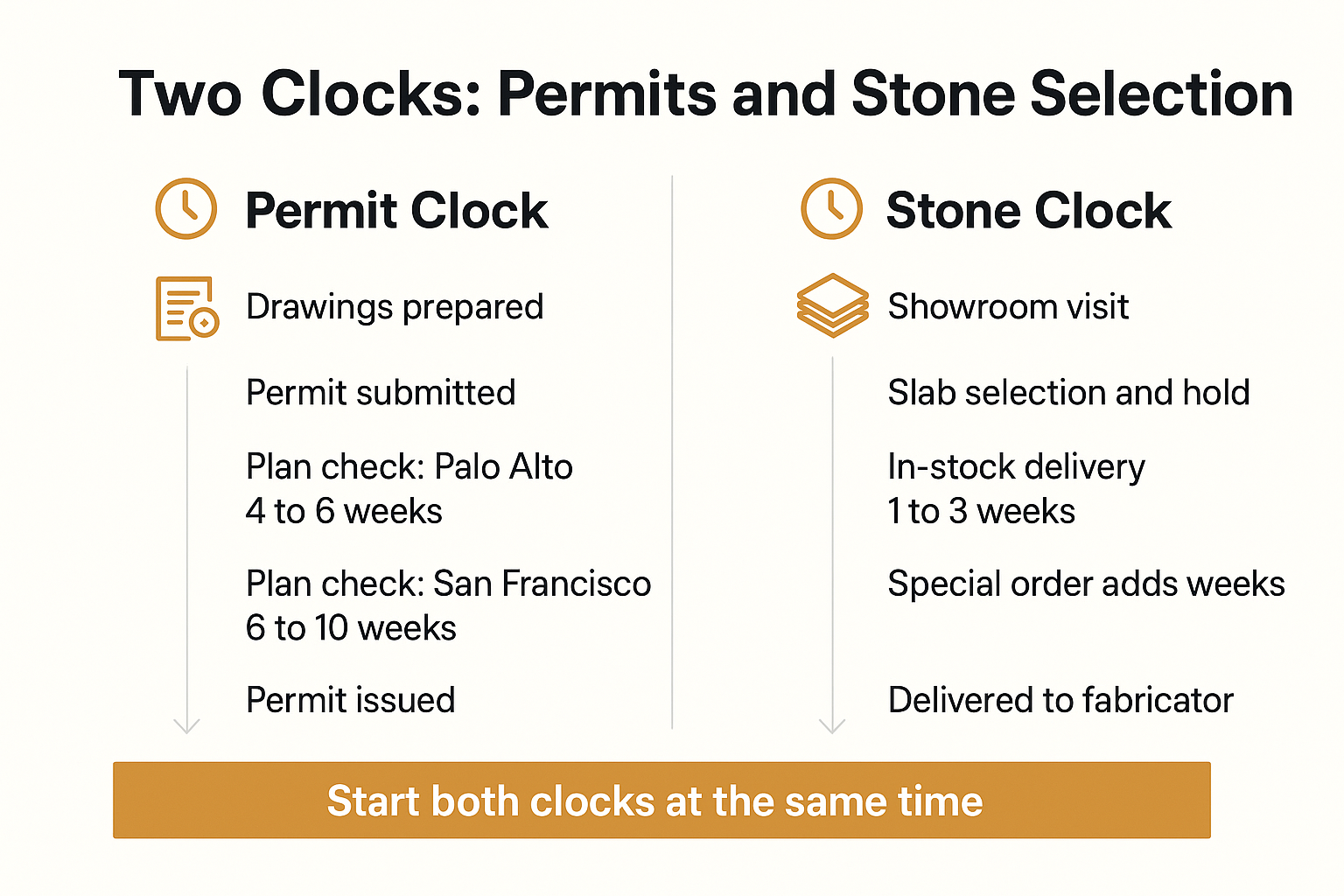
The two clocks running on your remodel
Permits and stone availability move on separate schedules. This shows how they overlap when the sequence is handled well.
Holding a slab while your permit is in plan check
This is the move that separates smooth projects from stressful ones, and it is not reserved for designers.
Most slab suppliers, including this one, will place a time-bound hold on a specific bundle while you confirm details with your fabricator or wait on approvals. The hold is not indefinite, and it should not be. But it gives you a real window.
A practical sequence for a permitted Carmel, Monterey, or Palo Alto remodel:
1. Visit a showroom while drawings are still being finalized
2. Narrow to two or three materials and take samples home to see them in your own light
3. Select the actual slabs and request a hold as the permit application goes in
4. Give your fabricator the material name, slab count, and thickness so they can plan templating
5. Coordinate delivery once cabinets are set and the template is complete
One pattern shows up repeatedly in showroom conversations: a buyer says they just need the square footage from their contractor and then they are ready. That buyer is close, but the slab still has to exist when they circle back.
If you are considering porcelain, sequence matters even more, because your fabricator choice matters more with porcelain than with stone. Not every shop handles large panels, and finding that out late costs weeks.
Worth planning your first trip properly, too. A little prep turns a two hour visit into a decision, which is the point of making the most of a stone showroom visit.
Frequently Asked Questions About Permit Timing and Stone Selection
Should I really pick stone before my permit is approved?
Yes, for anything with a real deadline. Selecting material during plan check costs you nothing and protects your options. If plan check runs 6 to 10 weeks in San Francisco, that is 6 to 10 weeks the slab you want is available to every other buyer walking the yard.
How long will a supplier hold a slab for me?
Hold policies are time-bound and vary by supplier and by material. The honest answer is to ask directly when you select, because a hold that fits a 4 week Palo Alto plan check may not stretch across a longer San Francisco review. Be upfront about your timeline and most suppliers will work with it.
Does a countertop replacement need a permit in Palo Alto or San Francisco?
Typically not, if the cabinets stay put and no plumbing, electrical, or structure moves. Once you relocate a sink or add an island with new rough-in, you are usually in permit territory. Confirm your exact scope with your contractor rather than relying on a general rule.
What if the slab I want sells before my permit clears?
There is usually a close alternative, but natural stone does not repeat. A replacement bundle of the same material name can read noticeably different in veining and tone, which is why viewing actual slabs beats approving a catalog image.
How far in advance do designers typically start material selection?
Often three to six months ahead of install on larger projects. Whole-house remodels get planned even further out, with material selections happening well before any crew mobilizes.
Planning a remodel with a fixed completion date?
If your permit application is going in this month, material selection belongs on this month’s calendar too. The showrooms in Carmel, Palo Alto, and Sand City keep live inventory on the floor, and walk-ins are welcome if you would rather see slabs before committing to anything. Questions about current availability or lead times can go to (650) 800-7840 or info@carmelimports.com.