
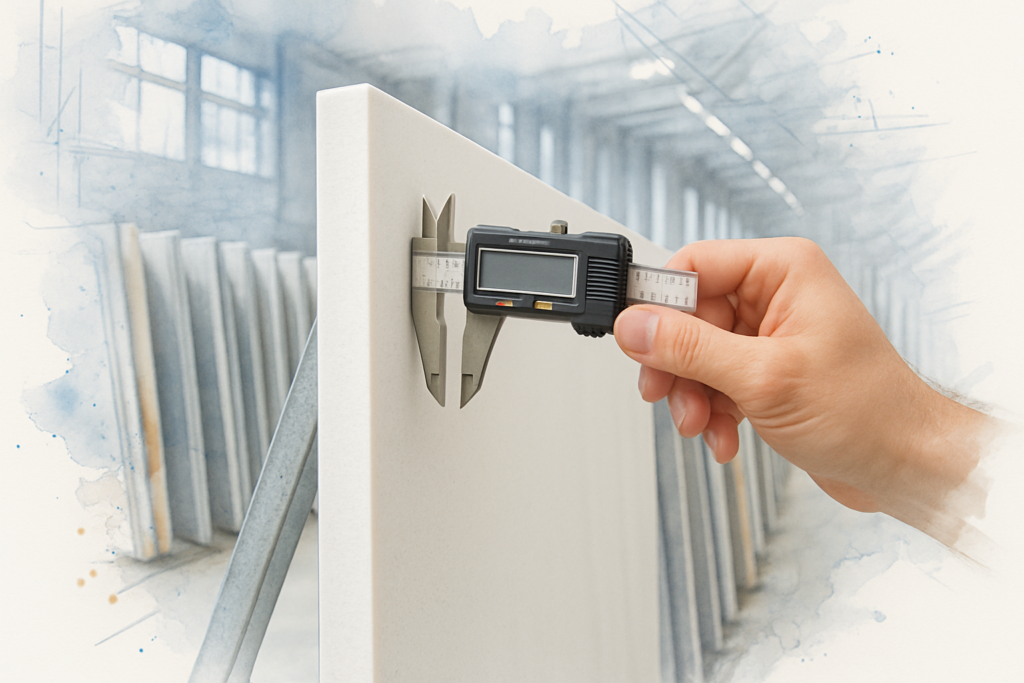
Direct Answer: Confirm the material exists in the size, thickness, and finish you need before it goes on a client board. Then request product documentation and photos of the actual slabs.
You found the surface. The client loves the rendering. Then the fabricator says the slab is two inches short of his minimum, and you are back in the showroom explaining why the board changed.
That is the fear behind most trade calls on the Monterey Peninsula. Designers and contractors working in Carmel-by-the-Sea, Pebble Beach, and Pacific Grove are not worried about picking an ugly material. They are worried about promising a client something that turns out to be unavailable in the size or finish the drawings call for.
This guide covers what actually belongs in a silica free engineered stone spec, how to catch a slab-size problem before it costs you a week, and how to handle the shower wall comparison your client is going to ask about.
What a Silica Free Engineered Stone Spec Actually Needs
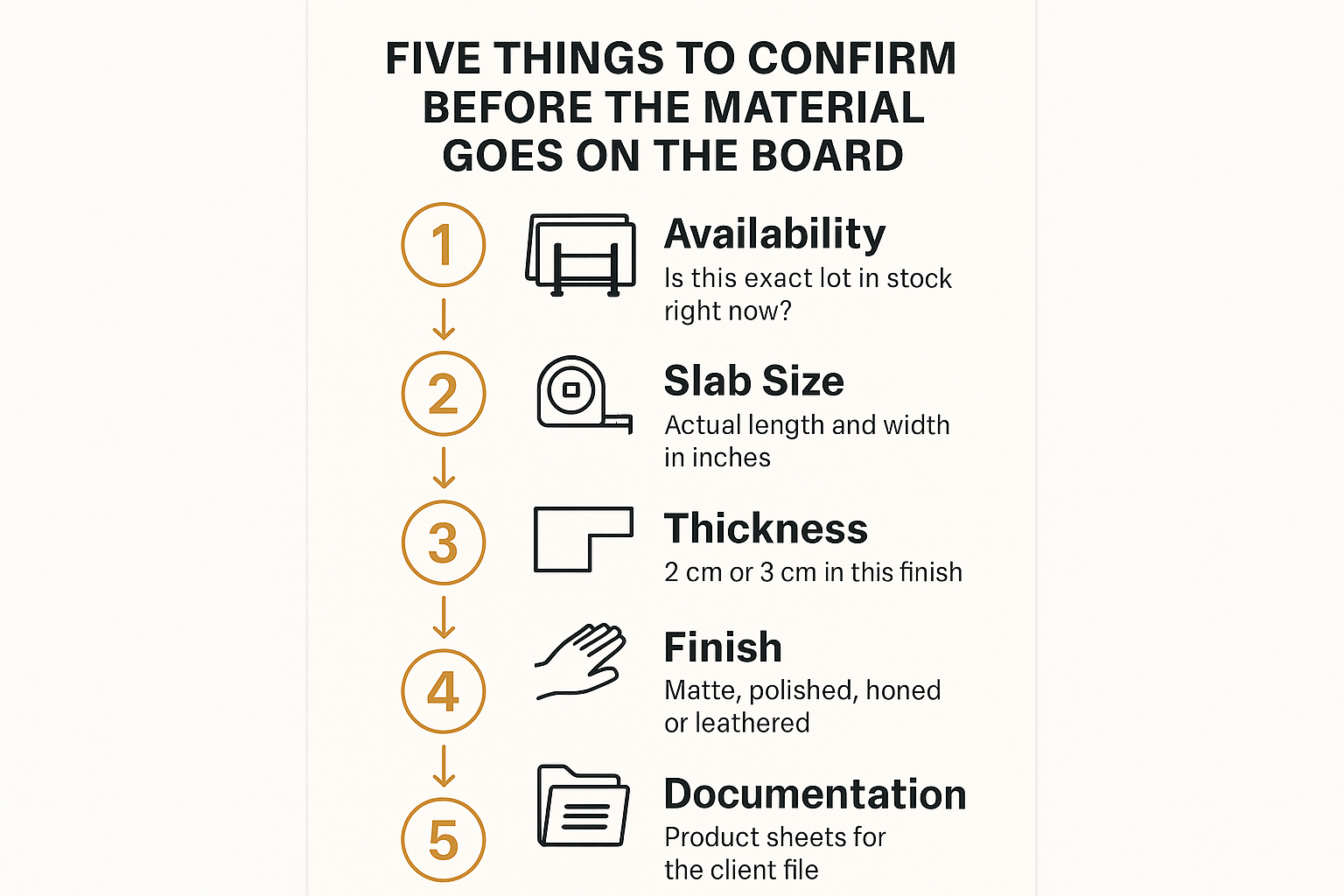
Before a material goes on a client’s board, confirm it exists in the size and finish you need. Then ask for the documentation.
A large share of the calls that come into the Carmel Rancho Lane showroom each month are some version of the same question: do you have this material, right now, in this size and this finish. That question gates everything downstream. Nothing else in the spec matters until it is answered.
Here is what a trade buyer should pin down before the material goes in a submittal or a client file:
- Confirmed availability on the specific lot, not the product line. Live inventory changes as containers land.
- Actual slab dimensions in inches, length and width, for the slabs on hand right now.
- Thickness, usually 2 cm or 3 cm, and whether both are available in that finish.
- Finish, matte, polished, honed, or leathered, confirmed on the slabs in stock rather than the catalog photo.
- Quantity on hand and whether a hold is possible while the fabricator templates.
- Product documentation for the submittal or the client file.
That last one matters more than it used to. When a client asks a technical question about a surface, the cleanest answer is the manufacturer’s own documentation, which the showroom team can share on request. You are not the one who should be interpreting it secondhand.

Ask Your Fabricator for Their Minimum Before You Fall for a Slab
This is the fastest way to avoid a second round of selections. Call your fabricator, get their minimum slab length, and carry that number with you into the showroom.
The threshold that trips up the most projects is around 130 inches. It comes up often enough on trade calls that showroom staff check for it before quoting. Islands and long uninterrupted runs are where it bites, because a slab that falls short forces a seam the client never agreed to.
Some questions worth asking your fabricator before you select anything:
- What is your minimum usable slab length for this layout?
- How much do you lose to edge trim and sink or cooktop cutouts?
- Where would the seam fall if we cannot get a single slab?
- Do you want 2 cm with a buildup edge or 3 cm, and does that change the slab count?
In Carmel and Pebble Beach kitchens, where island waterfalls and 12-foot runs are common, the slab count is often the whole conversation. Larger slabs reduce seams, but only if the fabricator can actually handle them and the access to the house allows it. Narrow driveways off Highway 1 have killed more than one oversized delivery plan.
If the slab works but the timing does not, ask about a hold. Most suppliers will reserve material for a short defined window, and holding a slab while your fabricator confirms measurements is a normal trade request, not a favor.
Five Things to Confirm Before the Material Goes on the Board
A short sequence trade buyers can run through on the phone or in the showroom before committing a material to a client presentation.
Shower Walls and Tub Surrounds: A Fit Question, Not a Contest
This one comes in from property managers and restoration contractors as often as it does from designers. A three-wall alcove tub surround, matte finish, and two candidate materials: silica free engineered stone at 2 cm, or large-format porcelain at 12 mm.
Neither is the automatic answer. Walk your client through it the way you would walk them through any fit decision.
Weight and wall structure. Porcelain at 12 mm is lighter per square foot than a 2 cm slab. On an older Pacific Grove bathroom with questionable blocking, that difference is worth raising with the contractor early.
Seams. Both materials come in panels large enough to do a standard alcove with minimal joints. Map the seam layout before you present, because the client will notice the joint over the valve long after they stop noticing the veining.
Finish behavior. Matte reads softer and hides water spotting better than polished in a wet area. Confirm the matte finish on the actual panels in stock, since matte varies between producers.
Fabrication demands. Large-format porcelain is less forgiving at the cutout and the edge. Fabricator choice matters more with porcelain than with most natural stone, and that should factor into who you recommend.
Install method. Wet-area wall installs follow published industry methods for substrate, waterproofing, and setting materials. The Tile Council of North America publishes the handbook most installers reference, and your installer should be able to name the method they are using.
For larger tiled surrounds rather than slab panels, the install requirements shift again, which is covered in more detail in what large-format stone tile demands in a shower.
Comparing the Two for a Three-Wall Surround
A side-by-side your client can follow without a materials background. Confirm every spec against the panels actually in stock.
| Consideration | Silica Free Engineered Stone | Large-Format Porcelain |
|---|---|---|
| Common slab thickness | 2 cm, sometimes 3 cm | 6 mm to 12 mm |
| Relative weight | Heavier per square foot | Lighter per square foot |
| Seam count on a standard alcove | Low, panel sizes cover most walls | Low, often the largest panel format available |
| Matte finish availability | Common, varies by producer | Common, varies by producer |
| Fabrication tolerance | Familiar to most fabricators | Less forgiving at cutouts and edges |
| Pattern continuity | Consistent across panels | Printed surface, confirm repeat and face match |
| Best fit | Clients who want a uniform look with a thicker edge read | Weight-sensitive walls and very large unbroken panels |
Your Client Wants to See It Before They Say Yes
Approvals move on visuals. Catalog images do not get a signature, and in natural stone they are close to useless because no two slabs out of the same block match.
Ask for photos or video of the specific slabs on hand, not the product line shot. Showroom teams get this request constantly, and it is the single clearest signal that a project is moving. Several reviewers mention getting images and samples quickly, including one designer who wrote that the team “will have samples ready when needed.”
When you request visuals, be specific about what you need:
- Full slab shot, straight on, against a neutral background
- A detail shot of the area that will land on the island or the feature wall
- Something in frame for scale so the client can read the vein size correctly
- Confirmation of the finish, since matte and honed photograph almost identically
- A take-home sample where one is available for that material
Photos get you to a yes without a second trip over the hill from Carmel to Sand City. They do not replace a showroom visit for final selection on natural stone, but they let a client approve direction before anyone drives anywhere. If you are presenting from images, what to confirm before you show a client a slab photo is worth reading first.
The Vocabulary Your Clients Are Starting to Use
Something shifted in the last year. Homeowners are walking into showrooms asking for silica-free surfaces by name, where a year ago they just said quartz.
Keep your terms straight so the spec sheet and the conversation match:
- Silica free engineered stone, silica free quartz, zero silica quartz, and crystalline silica-free quartz all describe the same category of manufactured slab.
- Quartzite is a natural stone quarried out of the ground. It is not quartz and it does not belong in the same column on your spec sheet.
- Porcelain slab is a third category entirely, manufactured, and specified by thickness in millimeters rather than centimeters.
That quartzite distinction trips up clients constantly. Someone who read about silica free surfaces will sometimes point at a quartzite slab and assume it is the same product. Correcting it early saves an awkward conversation at the template stage. If you want a plain-language explainer to forward, what crystalline silica-free quartz actually means for a kitchen does the job.
If a client raises a regulatory or technical question, point them to the supplier’s product documentation rather than answering from memory. Nobody expects a designer to be a materials scientist. They do expect you to know who has the paperwork.
What Actually Drives the Number on the Quote
Trade buyers comparing suppliers usually want a per-square-foot figure on the first call. Material pricing moves with the market, so treat any number you have heard as context rather than fact, and get a written quote before it reaches a client budget.
The factors that move the number most on Monterey Peninsula projects:
- Slab count, which is driven by the layout and the fabricator’s yield, not just the square footage
- Thickness, since 3 cm and 2 cm with a buildup edge price differently
- Finish, where leathered and specialty finishes carry additional processing
- Delivery coordination to the fabricator shop or the job site, which depends on distance and access
- Fabrication and install, which is billed separately by your fabricator, not by the slab supplier
That last line catches homeowners off guard regularly. A slab supplier sells material. A fabricator cuts and installs it. The breakdown in who handles what between supplier, fabricator, and installer is a useful thing to send a client at kickoff.
One more Central Coast note: in Carmel and unincorporated Monterey County, permit review timing can push a kitchen schedule by weeks. Confirm material availability early, but do not take delivery before the site is ready to receive it.
Frequently Asked Questions About Specifying Silica Free Engineered Stone
Can I get documentation for a submittal or a client file?
Yes. Ask the showroom team for the product documentation on the specific material and they can share what the manufacturer provides. That is the right source for technical questions, rather than a designer answering secondhand.
Do you have anything larger than the slab sizes listed online?
Sizes vary by material and by container, and listed dimensions are not always the full picture of what is on the floor. Call with your fabricator’s minimum length and the team can check live inventory across the Carmel, Palo Alto, and Sand City locations and confirm what is actually there.
Is quartzite the same thing as silica free quartz?
No. Quartzite is a natural stone quarried from the earth. Silica free engineered stone is a manufactured slab. They look similar in a photo and behave differently in a kitchen, so keep them in separate lines on your spec.
Can I get photos of the actual slabs before I bring my client in?
That is a standard trade request. Ask for straight-on full slab shots plus a detail of the area that will land on the island, and specify the finish you need confirmed. Many designers use the images to get direction approved, then bring the client in for the final pick.
Does the supplier fabricate and install?
No. A slab supplier sells and delivers material. Your own fabricator or installer handles templating, cutting, and installation, and the showroom team can share referrals if you need one on the Monterey Peninsula.
How far ahead of the permit should I lock in material?
Select early, take delivery late. Confirm the material exists and ask about a hold window while drawings go through review in Carmel or Monterey County, then coordinate delivery once the fabricator has templated and the site can receive the slabs.
Planning a Slab Selection on the Monterey Peninsula?
Designers and contractors tend to come back to the same showroom because confirming stock, getting photos, and coordinating delivery with a fabricator happens in one conversation instead of three. Live inventory across the Carmel, Palo Alto, and Sand City locations means a trade buyer can check sizes and finishes without starting the search over each time. The team at Carmel Stone Imports can confirm what is on the floor and arrange a slab selection appointment at (650) 800-7840 or info@carmelimports.com.