
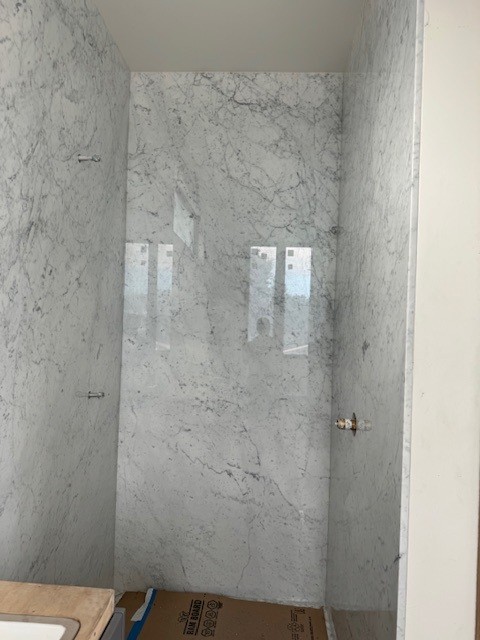
Direct Answer: Photos can carry a slab specification if you request five specific shots, confirm the SKU, lot, and slab count, and route fissures, pitting, and book-match questions to someone standing at the rack.
Your client wants to see something by Friday. The slab is sitting in a rack in Sand City, your templating window is three weeks out, and you are not driving down Highway 1 to look at one piece of stone.
So you ask for photos. That request has quietly become the first real step in specifying a slab, and it is one of the most common things people ask for on the phone before they visit or order.
It works, but only if you treat it as a process with known blind spots. Here is what a usable photo set actually includes, what to lock down alongside it, and which questions no image will ever answer.
Why photo approval works at all on the Monterey Peninsula
Photo approval only works when there is a real slab in a real rack behind the image. That is the difference between a photo of your material and a catalog shot of the same stone name from a different block.
Natural stone varies slab to slab, even from the same quarry block. A designer sourcing for a Pacific Heights kitchen and a contractor framing a Pebble Beach remodel are both asking the same underlying question: is this the piece I am getting, or a representative sample?
The practical answer comes down to live inventory. When a supplier holds stock across locations in Palo Alto, Sand City, and Carmel, a photo request can be answered with a specific slab in a specific rack, with a bundle number attached.
That is also why staff continuity matters more than people expect. The person who shoots the photos today should be the person who picks up the phone next month when your fabricator has a question about the same bundle.
If you want the longer version of how stock gets tracked, what live inventory at a slab supplier actually means covers it in detail.
The five photos to request, and why each one exists
Most people ask for “a picture” and get one wide shot from twelve feet away. That tells you almost nothing about movement, finish, or defects.
Ask for these five instead:
- Full slab, straight on. Camera square to the face, whole slab in frame. This is the only shot that shows how veining travels corner to corner and where the movement concentrates.
- One square foot, close up. Tight enough to read grain, crystal structure, pitting, and any filled areas. This is where honed surfaces give themselves away.
- The edge. Shows actual thickness (2 cm versus 3 cm reads very differently on a waterfall), plus any resin treatment or mesh backing on the reverse.
- A wet or sealed section. Spraying water on a honed or leathered area previews how much the stone darkens once it is sealed. Clients are often surprised by this at install.
- Something in frame for scale. A tape measure, a hand, a sample tile. Veins look dramatically smaller in a photo than they do on an eight foot island.
One honest caveat: phone white balance and warehouse lighting both shift color. Judge relative tone and movement from photos. Reserve the final color call for an in-person look or a take-home sample, and test that sample properly under your client’s actual lighting.

Photo approval and stock confirmation are two different things
This is where projects break. A photo proves a slab exists. It does not prove it is still available, still unsold, or available in the quantity you need.
Stock availability is the single most common question suppliers field, and the doubt behind it is always the same: I saw it on the website, do you actually have it right now? Several callers with tight timelines walk away entirely once they learn that import or special order timing can run months rather than weeks.
Lock three facts in the same conversation as the photos:
- The SKU or bundle identifier. Not the stone name. Two slabs sold under the same name can come from different blocks and look nothing alike.
- How many slabs are available from the same block or lot. An island plus perimeter counters plus a full height backsplash is often three slabs, and they need to come from the same bundle.
- Whether the material can be held, and for how long. Hold windows are usually short and defined, so get the end date in writing.
The useful question is not “do you have it.” It is “how many, from which lot, and for how long.” If your timeline is the constraint, in-stock versus special order timing is worth reading before you present anything.
What to ask alongside the photos
Use this as a quick script when you are on the phone and short on time.
| Ask this | Why it matters | A thin answer sounds like |
|---|---|---|
| What is the SKU or bundle number? | Ties the photos to one identifiable piece, not a stone name | “It’s the Taj Mahal quartzite” |
| How many slabs from this same lot? | Island, counters, and backsplash usually need matching material | “We have plenty of that stone” |
| Can it be held, and until when? | Gives your client a decision window without losing the slab | “Should be fine for a while” |
| What are the actual dimensions? | Some fabricators set minimums near 130 inches for long runs | “Standard size” |
| Is it resined or mesh backed? | Affects how the fabricator handles cutting and edges | Silence, or no answer on the call |
The photo set at a glance
Five shots, each answering a different question about the slab.

What a photograph genuinely cannot tell you
This is the part most suppliers skip, and it is the part that protects you on templating day.
Photos will not reliably show:
- Natural fissures and how they run relative to a sink cutout. A fissure that reads as a faint line in a photo can sit directly where the fabricator needs to cut. Cristallo and other translucent quartzites are known for this, which is why fissures deserve a look before you commit.
- Pitting in a honed surface. It shows up under raking light and your fingertip, not under flat warehouse lighting.
- Whether a vein actually continues across the second slab. Book matching depends on sequential slabs from the block, and a photo of each one separately will not prove it.
- How the finish reads underfoot or under cabinet lighting. A leathered surface photographs flat and behaves completely differently in a Carmel-by-the-Sea bathroom with low morning light.
- Whether the material comes in the format you need. One homeowner asked whether a stone she found online was available as tile or only as slab. Photos never answer that.
The Natural Stone Institute publishes technical guidance on how these natural characteristics are classified, and it is a useful reference when a client asks whether a fissure is a defect. Short version: in most natural stone, it is not.
Send these questions to someone standing in front of the slab, or to your fabricator, who is the one who has to work around them.
Turn the photo set into a record you can defend
If you are presenting to a client, your photos are a specification, not a mood board. Keep a short record attached to them.
It takes two minutes and should include:
- SKU or bundle identifier
- Lot or block reference
- Slab dimensions and thickness
- Finish
- Date the photos were taken
- Name of the person who confirmed availability
That last line matters more than the rest. Follow-up promises that go unconfirmed are the most common reason a warm project stalls, so get a name and a date in the thread.
Keep the scopes separate too. Material selection and fabrication are two different jobs. Measurement, templating, seam placement, and edge detail belong to your fabricator. Slab condition, lot availability, and hold windows belong to whoever is standing in the warehouse. The supplier, fabricator, installer breakdown spells out the handoff if a client is confused about who to call.
Frequently Asked Questions About Approving a Slab From Photos
Can I order a slab based only on photos?
You can, and plenty of trade professionals do it on tight timelines. But treat it as a two-part approval: photos confirm the look, and a named person confirming SKU, lot, slab count, and hold window confirms the material. Skip the second part and you are guessing.
How different will the slab look in person?
Movement and pattern usually translate well. Color and depth often do not, because phone white balance and warehouse lighting both shift the read. Honed surfaces in particular look lighter in photos than they do once sealed, which is why a wet shot is worth requesting.
Do I need photos of every slab if I’m buying three?
Yes. Three slabs from the same lot can still vary, and if you are planning an island plus a full height backsplash, you need to see each face. Ask for them photographed in sequence as they come off the block if a book match is the goal.
How long will a slab stay on hold while my client decides?
Hold windows are short and defined, often a matter of days rather than weeks, and they vary by supplier and by how in demand the material is. Get the exact end date when you request the hold. There is more on how holds work here.
What should I do if my fabricator flags something in the photos?
Send the question straight back to whoever has the slab in front of them, and be specific about location. “Is there a fissure in the lower left quadrant near where our sink cutout lands” gets a real answer. “Is this slab okay” does not.
Want to see the actual slab before you present it?
Photos can carry a specification a long way, and a take-home sample or a walk through the racks closes the gap on color and finish. Showrooms in Carmel and Palo Alto are open for slab viewing, with the Sand City warehouse holding inventory for Central Coast projects. If you want photos of a specific piece or a hold while your client decides, the team at Carmel Stone Imports can be reached at (650) 800-7840 or info@carmelimports.com.