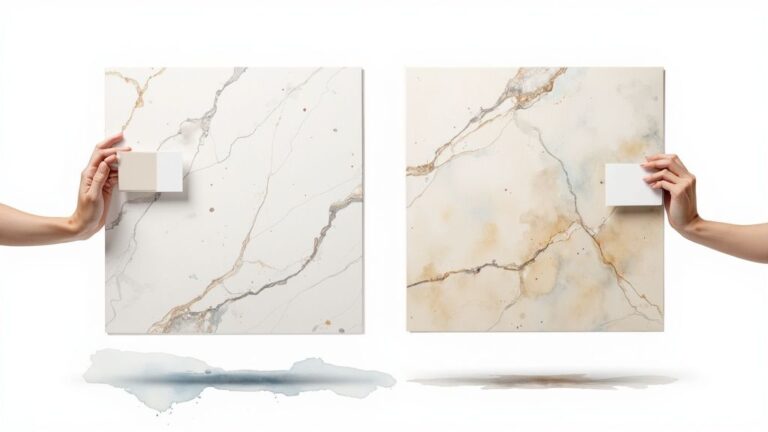
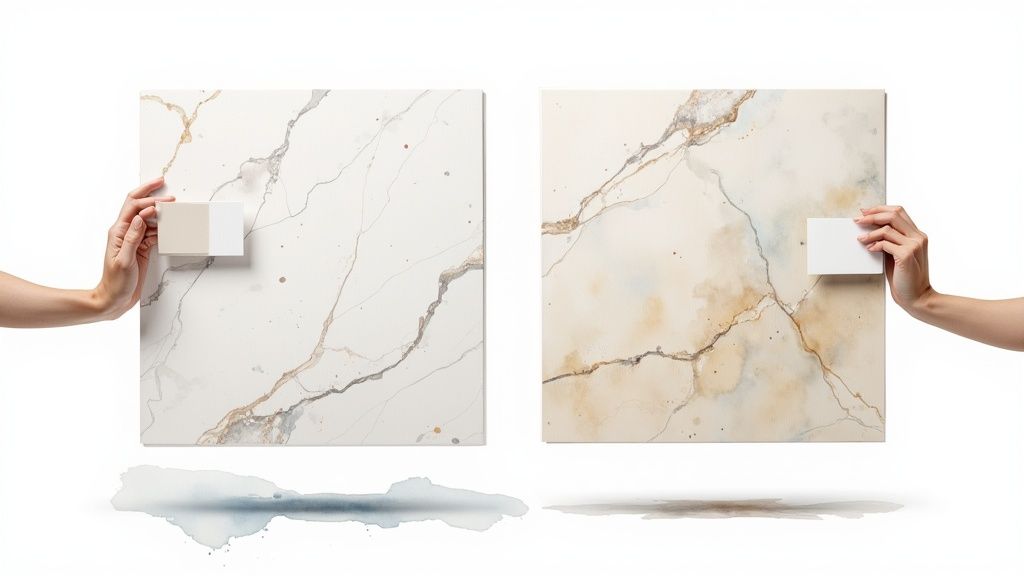
Choosing between quartz and quartzite for your home can feel like a tough decision. It often comes down to a classic design choice. Do you prefer the unique beauty of natural stone or the sleek reliability of an engineered surface?
If you love one-of-a-kind patterns and need a countertop that can handle the heat of a busy kitchen, natural quartzite is a great fit. On the other hand, if you want a non-porous surface that resists stains and needs no maintenance, engineered quartz is the clear winner for modern family life. Making the right choice now means you'll have a countertop that not only looks incredible but works for your lifestyle for years to come.
Understanding The Core Differences
Before you start your project, it's important to understand the key differences between these two materials. They sound almost the same, but their look and performance are very different.
This quick visual breaks down the main strengths of each stone. It shows the raw durability of quartzite against the engineered convenience of quartz.
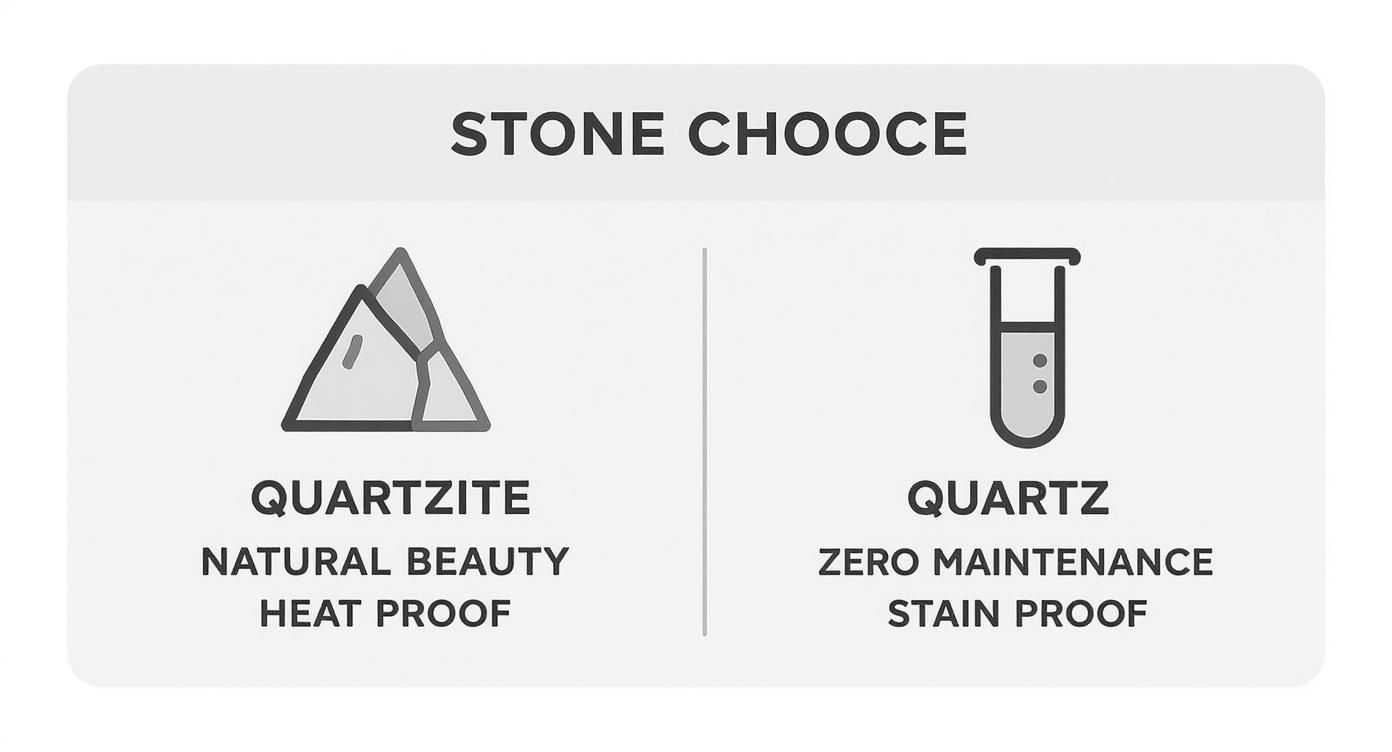
The takeaway here is pretty clear. For those who value the organic look that only nature can create, quartzite is the obvious choice. But if you want guaranteed consistency and a countertop that handles coffee rings or wine spills without a second thought, quartz is the way to go.
Quick Comparison: Quartz vs Quartzite
To make things even clearer, here is a simple table that breaks down the features of each material. Whether you’re designing a minimalist kitchen in Palo Alto or a relaxed coastal retreat in Monterey, this side-by-side look will help you see which stone fits your vision.
| Feature | Quartz (Engineered) | Quartzite (Natural) |
|---|---|---|
| Composition | 90-95% ground quartz, resins, and pigments | 100% natural metamorphic rock |
| Appearance | Uniform and consistent patterns | Unique, organic veining and color variations |
| Heat Resistance | Good, but can be damaged by extreme heat | Excellent; can withstand high temperatures |
| Stain Resistance | Excellent; non-porous and never needs sealing | Good, but requires sealing to prevent stains |
| Maintenance | Low; easy to clean with soap and water | Requires periodic sealing to maintain its integrity |
| Durability | Very durable and scratch-resistant | Extremely durable and harder than granite |
| UV Resistance | Not recommended for outdoor use; can discolor | Excellent for outdoor use; UV stable |
| Ideal For | Busy families, modern designs, low-maintenance living | Avid cooks, luxury aesthetics, indoor/outdoor kitchens |
Homeowners often choose quartzite for its authentic, natural-stone look and amazing heat tolerance. Meanwhile, quartz is popular for its flawless consistency and zero-fuss maintenance.
Beyond just picking a stone, knowing how to create a stylish and functional kitchen will help you integrate your new countertop perfectly. Our complete guide on how to choose countertops can also walk you through every step of the selection process.
Understanding Their Composition and Origin
To really understand the quartz vs. quartzite debate, you have to start with how they are made. While they share a similar name, these two materials are very different. One is made by nature, and the other is made by people.
This core difference affects their final look, performance, and feel in your home.
The Natural Story of Quartzite
Quartzite is a perfect example of nature’s power. It starts as simple sandstone, a rock packed with quartz mineral grains. Over millions of years, deep inside the Earth, this sandstone is exposed to intense heat and pressure.
This process, called metamorphism, recrystallizes the sand and fuses the grains together. The result is an incredibly dense, hard, and durable natural stone. This geological journey gives quartzite its signature look.
The flowing veins, subtle colors, and crystalline shimmer are authentic records of its natural history. Each slab is a unique piece of the Earth, so no two quartzite countertops will ever be identical. For homeowners in the Bay Area looking for a truly one-of-a-kind centerpiece, quartzite tells an unmatched story.
The Science Behind Engineered Stone
In contrast, quartz countertops are a product of advanced manufacturing. The main ingredient is natural quartz, but the final product is engineered for precision. The process involves blending roughly 90-95% ground quartz crystals with polymer resins and pigments.
This mixture is poured into a mold, compressed under pressure, and then cured at high temperatures. This creates a solid, non-porous slab. This controlled process allows for an amazing array of colors and patterns that nature can't produce.
To learn more about this modern material, you can explore the details of what is engineered stone and its production process. This engineering is why quartz is so valued for its predictability. This reliability has helped make engineered quartz a dominant force, holding 46% of the market share for its perfect blend of beauty and practicality.
Comparing Aesthetic Appeal and Design Versatility
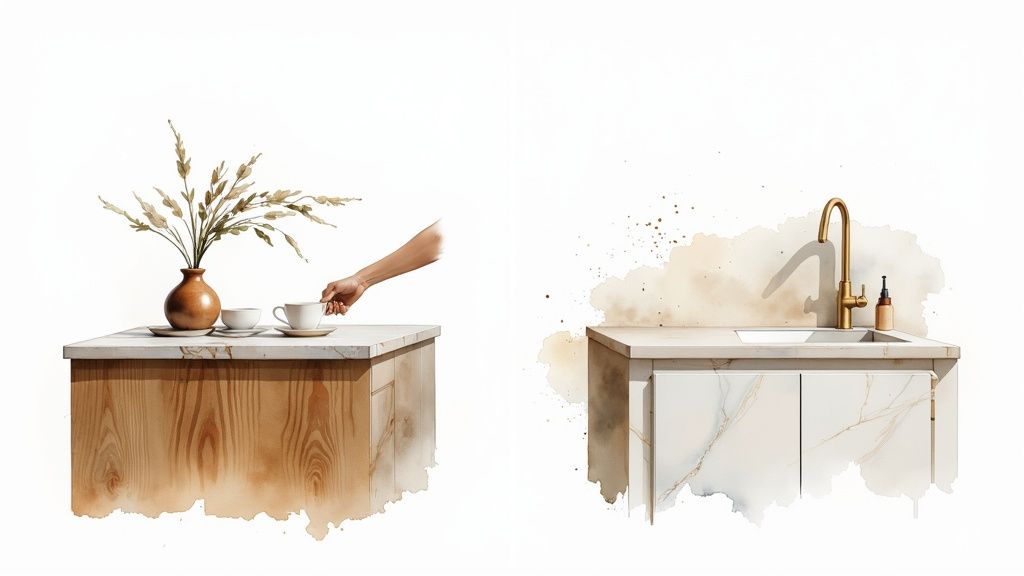
When choosing between quartz and quartzite, the look is often the deciding factor. The visual character of each stone speaks a different design language. One celebrates the perfect imperfections of nature, while the other offers flawless consistency for modern precision.
The Natural Artistry of Quartzite
Quartzite is prized for its one-of-a-kind natural beauty, often drawing comparisons to high-end marble. Because it's formed by nature, every slab is a unique piece of art. It is defined by soft, feathery veining and subtle, earthy color palettes.
This uniqueness makes quartzite a perfect centerpiece for the "quiet luxury" aesthetic popular in Palo Alto and Monterey homes. It adds an element of organic elegance that feels both grounded and timeless. The natural variations in a quartzite slab are not flaws; they are the signature of an authentic material.
Recent industry reports show that quartzite is gaining appeal for its durability and natural beauty, now holding 6% of the market. The growing demand is a testament to its captivating look.
The Limitless Design Freedom of Quartz
While quartzite’s beauty is found in nature’s randomness, quartz offers beauty through precision. As an engineered product, it provides nearly limitless design freedom. Manufacturers can create a vast spectrum of colors and patterns.
This versatility makes quartz a designer’s dream. You can find slabs that perfectly mimic the look of concrete, Carrara marble, or even bold, solid colors like pure white or jet black. This predictability is ideal for modern Bay Area designs where uniformity and clean lines are key.
The finish of the stone also plays a huge role in its final look. Both materials can be finished in different ways to achieve distinct styles. To understand how finishes impact design, check out our guide on how to choose the right stone finish for your space.
Analyzing Durability and Everyday Performance
When you're trying to decide between quartz vs. quartzite: which stone is right for you?, you have to think about how each one holds up in a real home. A beautiful countertop is only as good as its ability to handle daily life. Your lifestyle will be a huge factor in which stone is best for you.
Both materials are incredibly strong, but they show their strength in different ways. Quartzite’s natural formation gives it a raw, geological toughness. The engineering behind quartz offers a different kind of practical resilience.
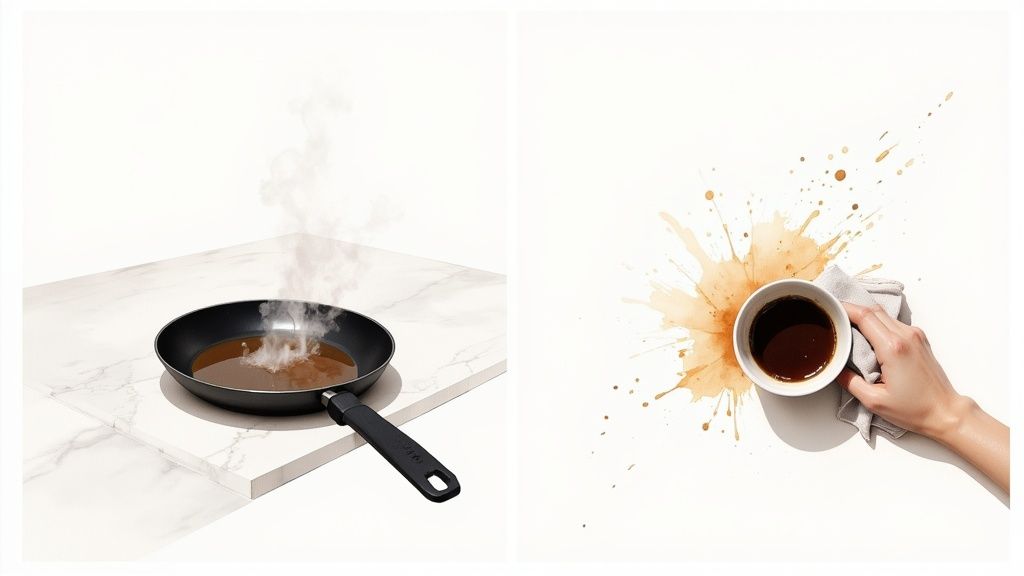
Unmatched Hardness and Scratch Resistance
When it comes to pure hardness, quartzite is one of the toughest materials you can put in your home. It scores a 7 out of 10 on the Mohs scale of mineral hardness, putting it above even granite.
This incredible density means it resists scratches and etching very well. You can learn more about its strength by exploring the detailed quartzite countertops pros and cons in our guide.
Quartz is also exceptionally durable. It holds up beautifully against daily use, but it is technically a bit softer than pure quartzite. A slip of a sharp knife could potentially leave a mark, so using a cutting board is always a good idea.
Performance Under Heat
Heat resistance is one of the biggest differences between these two stones. For anyone who loves to cook, this is a critical point.
Quartzite’s natural origins give it incredible heat tolerance. It can handle a hot pan or baking sheet placed directly on its surface without risk of damage. This is a major advantage for busy cooks.
Engineered quartz, on the other hand, can be damaged by high temperatures. The resins that bind the quartz particles can be damaged by heat above roughly 300°F. Using trivets is essential to protect a quartz surface.
Stain Resistance and Porosity
Here, the tables turn, and engineered quartz takes the lead. The manufacturing process creates a totally non-porous surface. This means liquids like coffee, red wine, or olive oil simply can't penetrate the stone to cause stains.
- Quartz: Never needs sealing and is naturally resistant to staining.
- Quartzite: As a natural stone, it's porous and must be sealed to prevent stains.
Because it was formed in the earth, quartzite is naturally porous. Without a proper sealant, it can soak up spills, which can lead to tough stains. For homeowners who value low-maintenance living, the zero-effort stain protection of quartz is a huge draw.
Understanding Long-Term Maintenance Requirements
When you invest in a new countertop, you want it to look great for years. Understanding the day-to-day care for each material is a key part of the quartz vs. quartzite: which stone is right for you? decision. Their upkeep is quite different.
The Simple Care of Natural Quartzite
Quartzite’s natural elegance comes with a very simple care routine. Because it’s a porous stone, the most important thing you can do is have it periodically sealed. Sealing creates an invisible shield that stops liquids from seeping in.
For daily cleaning, all you need is a soft cloth with a bit of mild soap and water. With proper sealing, your quartzite countertop will resist spills and keep its raw beauty. If you're new to the process, our guide on how to seal natural stone walks you through it.
The Set-It-and-Forget-It Appeal of Quartz
Engineered quartz is famous for being incredibly low-maintenance. This is a huge plus for busy households in the Bay Area. Thanks to its non-porous surface, quartz never needs sealing.
The resin binders make it naturally tough against stains from coffee, wine, and oil. A quick wipe-down with soap and water is all it takes to keep it looking perfect. You should always avoid harsh chemical cleaners or abrasive scouring pads on quartz, as they can dull the finish over time.
Key Maintenance Differences at a Glance
The upkeep for these two stones gets to the heart of what makes them different. One is a product of nature that asks for a little care, while the other is engineered for total convenience.
- Quartzite: Needs to be sealed from time to in order to protect its naturally porous surface.
- Quartz: Is completely non-porous and will never need a sealer.
Understanding these needs is key. For example, knowing how to properly care for a marble top provides a good reference, as it’s another natural stone with its own care routine. This minimal-effort maintenance is a top reason why quartz leads the way in modern kitchen design.
Finding the Best Use in Your California Home
Choosing the perfect stone isn't just about looks. It's about matching the material to the demands of each room. When you're weighing quartz vs. quartzite: which stone is right for you?, thinking about how each space functions is key.
The ideal surface for a busy family kitchen in Palo Alto might be different from what's best for a calm bathroom in Monterey. The trick is aligning their unique strengths with the way you live.
The Heart of the Home: The Kitchen
For most California families, the kitchen is the command center. Countertops here face hot pans, spills, food prep, and constant traffic. This is where the practical differences between quartz and quartzite become clear.
For the serious home chef, quartzite is the undisputed champion. Because it's a natural stone, it has incredible heat resistance. You can set a hot pan down near the cooktop without panicking.
On the other hand, for a busy family that needs easy cleanup, quartz is a fantastic option. Its non-porous surface is your best defense against common spills like coffee, red wine, and olive oil. That durability is a lifesaver in hectic households.
Creating a Serene Bathroom Oasis
In the bathroom, the needs are different. Here, moisture resistance and ease of cleaning take top priority.
This is where quartz is the clear winner. Its completely non-porous surface makes it resistant to moisture, mold, and mildew. That's a huge advantage for vanities and shower surrounds.
Quartzite can create a stunning, spa-like atmosphere in a bathroom, but it requires more attention. As a natural stone, it must be properly sealed to prevent water absorption and potential staining from soaps or cosmetics.
Expanding Beyond Kitchens and Baths
The versatility of both stones means they can bring luxury to other areas of your home. Thinking beyond the obvious can create a cohesive design.
Here are a few other places these materials shine:
- Fireplace Surrounds: With its great heat resistance, quartzite makes a dramatic choice for a fireplace surround.
- Laundry Rooms: The stain resistance and toughness of quartz make it a perfect work surface for a laundry room.
- Wet Bars: A quartz countertop is a smart pick for a wet bar, ensuring that spills are never a concern.
Frequently Asked Questions
Navigating the world of countertops can bring up a lot of questions. To help you finalize your decision in the quartz vs. quartzite debate, we’ve pulled together the most common questions we hear from homeowners in our Monterey and Palo Alto showrooms.
Is quartzite more expensive than quartz?
Generally, yes, high-quality quartzite is often more expensive than most quartz options. Quartzite is a natural stone that must be quarried from the earth, which is a complex process that adds to its cost. In contrast, quartz is an engineered product with more predictable pricing.
Can I use quartz or quartzite for my outdoor kitchen?
Quartzite is a fantastic choice for outdoor kitchens, especially in our sunny California climate. As a natural stone, it is UV stable, meaning its color won’t fade or yellow in direct sunlight. Quartz, however, is not recommended for outdoor use, as the resins can be damaged by prolonged UV exposure.
How can I tell the difference between them in a showroom?
It can be tricky at first glance! Quartzite often has more organic, flowing patterns similar to marble, and every slab is completely unique. Quartz tends to have a more uniform pattern, even in designs that mimic natural stone. Our design experts at Carmel Stone Imports can show you the distinct characteristics of each.
Which stone adds more value to a home?
Both are considered premium materials that can significantly boost a home’s value. Unique quartzite slabs are often seen as a luxury feature appealing to buyers who value one-of-a-kind beauty. Quartz is also highly desirable for its durability and low maintenance, making it a popular investment that appeals to many people.
Does quartzite stain more easily than quartz?
Because it's a natural stone, quartzite is porous, which means an unsealed slab can absorb liquids and stain. This is why a quality sealer is essential. Conversely, the resins in quartz make the material completely non-porous and naturally stain-resistant from day one, so it never needs a sealer.
Ready to see these beautiful stones in person? The experts at Carmel Stone Imports are here to help you find the perfect surface for your project. Visit one of our showrooms in Palo Alto, Carmel, or Sand City for a personalized consultation. https://carmelimports.com