Choosing a countertop is a big decision. When looking at quartz vs. quartzite vs. marble, the main difference is simple. Marble and quartzite are natural stones, each with a unique look. Quartz is a man-made product known for being strong and consistent.
The right choice for your California home depends on what you value most. Do you love the unique patterns of natural stone, or do you prefer the reliable strength of an engineered surface? This guide will help you understand the key differences so you can make a choice you’ll love for years.
Choosing Your Perfect Countertop in California
Picking the right countertop for your home in Monterey or the Bay Area is a serious investment. You're not just choosing a surface. You are setting the style for your space and picking a material you will use every day.
With so many beautiful options, it can be confusing. Understanding the core differences between these three popular materials is the first step. It helps ensure your decision fits both your design vision and your lifestyle.
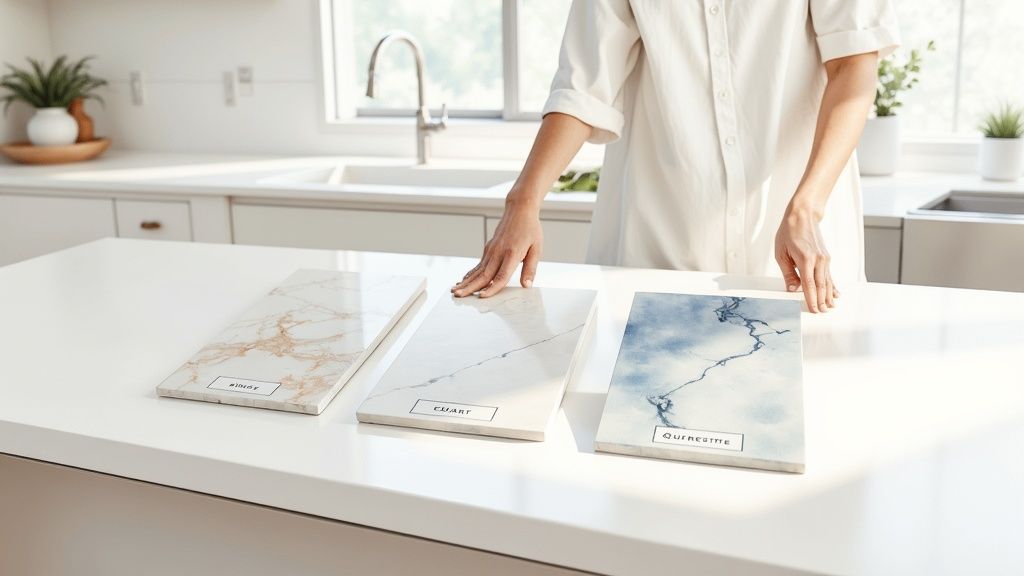
A Quick Comparison
This guide will break down quartz, quartzite, and marble for you. We will look at how each one holds up in a real California home. From a busy family kitchen in San Jose to a calm bathroom in Palo Alto, we’ll cover what you need to know.
| Feature | Quartz | Quartzite | Marble |
|---|---|---|---|
| Material Type | Engineered | Natural Stone | Natural Stone |
| Primary Benefit | Low Maintenance | Extreme Durability | Timeless Beauty |
| Appearance | Consistent & Uniform | Unique Veining | Classic Veining |
| Stain Resistance | High (Non-Porous) | Good (When Sealed) | Low (Porous) |
High-income homeowners in areas like Monterey and San Jose are spending over $22K on home upgrades. Making the right material choice is more important than ever to avoid buyer's remorse and ensure long-term value.
By understanding these key points, you can make a smarter investment in your home. For a deeper dive, our countertop materials comparison offers more detail. You can also explore other kitchen countertop materials to see all your options. At Carmel Stone Imports, we have over two decades of expertise to help guide your choice.
Understanding the Core Differences
To make the right call in the quartz vs. quartzite vs. marble debate, you need to know what they are. How each material is formed affects its looks, strength, and how it performs in your home. Think of them as having three different personalities.
Marble and quartzite are both natural stones, taken directly from the earth. Every slab is unique, so no two are exactly alike. Quartz, on the other hand, is a man-made product, which gives it a very consistent appearance.
Marble: The Timeless Classic
Marble is a metamorphic rock that starts as limestone. Deep in the earth, heat and pressure change the limestone into the beautiful stone we know.
Its famous, elegant veins come from minerals like clay that were trapped in the original limestone. These minerals create the soft, flowing patterns that have made marble a symbol of luxury for centuries. It's a classic, but it is also a softer, more porous stone.
Quartzite: The Natural Powerhouse
Quartzite also starts as a natural stone—sandstone rich in quartz. It goes through a similar process of intense heat and pressure. The quartz grains in the sandstone fuse together, creating an incredibly dense and durable stone.
This process makes quartzite one of the hardest natural surfaces available. It often has dramatic, sweeping veins that can look like marble. This gives homeowners in places like Palo Alto a stunning and strong option for high-traffic areas.
Key Takeaway: Both are natural stones, but their origins matter. Marble comes from limestone, making it softer. Quartzite comes from sandstone, making it extremely hard and tough.
Quartz: The Engineered Innovator
Unlike its natural cousins, engineered quartz is a mix of materials. It’s made of about 90% ground natural quartz crystals and 10% polymer resins, binders, and pigments. This mix is pressed into dense, non-porous slabs.
This process gives quartz its biggest advantages. It never needs sealing and is very resistant to stains and scratches. Homeowners across the Bay Area often choose quartz for its wide range of consistent colors and patterns. Our guide on what is engineered stone explains more about how it's made.
This quick table shows how these three materials compare on the most important features.
At-a-Glance Comparison: Quartz vs. Quartzite vs. Marble
| Attribute | Quartz (Engineered) | Quartzite (Natural) | Marble (Natural) |
|---|---|---|---|
| Composition | ~90% quartz crystals, ~10% resins & pigments | Natural metamorphic rock (from sandstone) | Natural metamorphic rock (from limestone) |
| Appearance | Consistent color & pattern | Unique, often with sweeping veins | Unique, classic soft veining |
| Hardness | Very hard, scratch-resistant | Extremely hard, very scratch-resistant | Softer, can scratch and etch |
| Porosity | Non-porous, no sealing needed | Low porosity, but requires sealing | Porous, requires regular sealing |
| Stain Resistance | Excellent | Good to excellent (when sealed) | Prone to staining (especially acids) |
| Heat Resistance | Good (resins can be damaged by extreme heat) | Excellent | Good (can be damaged by thermal shock) |
| Maintenance | Low (soap & water) | Moderate (sealing required) | High (sealing & careful cleaning) |
This table is a great starting point. Now, let’s look at how each material performs in the real world.
Comparing Durability for Everyday Life
In a busy California home, your countertops need to be durable. Whether it’s in a family kitchen in San Jose or an entertainer’s bar in Palo Alto, a surface must hold up to daily life. The way quartz, quartzite, and marble perform is very different.
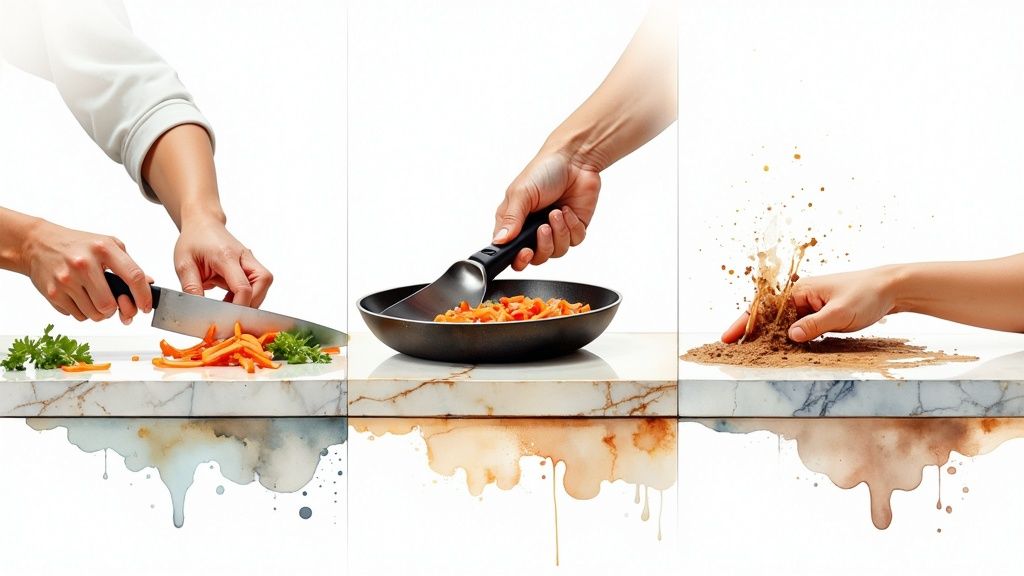
Understanding how each stone handles scratches, chips, and heat is key. This knowledge helps you see the long-term value of your investment.
Hardness and Scratch Resistance
A material’s hardness is often measured on the Mohs scale, from 1 (softest) to 10 (hardest). This scale tells us how well your countertop will resist scratches from everyday items like knives or keys.
Quartzite: This natural stone is the winner for hardness. It is made of quartz crystals fused together, creating a very dense material. It scores a 7 on the Mohs scale, making it extremely resistant to scratches. You can learn more about its strengths in our guide to quartzite countertops pros and cons.
Engineered Quartz: This material is also very hard, typically around a 7 on the Mohs scale. The mix of natural quartz and resins creates a tough, scratch-resistant surface ideal for busy kitchens.
Marble: Because it comes from softer limestone, marble ranks much lower on the scale, usually between a 3 and 5. This means it can be scratched by common kitchen tools and requires more careful use.
Resilience to Heat
Heat resilience is another important test in a kitchen. The way each material handles a hot pan can be the difference between a lasting surface and a costly repair.
- Quartzite: Because it was formed in extreme heat, quartzite handles high temperatures very well. You can usually place hot pans directly on it, though using a trivet is always safest.
- Marble: As a natural stone, marble is also quite heat-resistant. It can handle a hot pan without a problem in most cases.
- Engineered Quartz: This is the one major weakness for quartz. The resins that bind the quartz crystals can be damaged by high heat, usually above 300°F (150°C). A hot pan can cause permanent discoloration or cracks, so using trivets is a must.
For the modern California homeowner, balancing looks with function is key. Quartzite offers natural beauty similar to marble but with much greater strength, making it a top choice for active kitchens.
Chipping and Impact Resistance
You also have to think about impacts, like dropping a heavy pot. A material's structure determines how well it resists chipping.
Engineered Quartz: The resins in engineered quartz give it some flexibility. This helps it absorb impacts and resist chipping and cracking very well.
Quartzite: Its incredible density makes quartzite very strong. However, like any natural stone, it can chip if a heavy object hits an edge or corner.
Marble: As the softest of the three, marble is the most likely to chip or crack from an impact. You’ll need to be extra careful, especially around sink edges and corners.
Evaluating Maintenance and Long-Term Care
How much upkeep a countertop needs is a big part of your long-term happiness. Your lifestyle and how much time you want to spend on care will guide you to the right stone. This is where the quartz vs. quartzite vs. marble decision gets personal.
Some surfaces are easy to care for, while others need more attention. Let's break down what you can expect from each.
The Ease of Engineered Quartz
For a busy family in San Jose or anyone wanting a low-maintenance life, engineered quartz is the clear winner. Its non-porous surface is a result of how it is made.
The mix of quartz crystals and resins creates a sealed surface that does not let liquids seep in. This means things like wine or coffee are unlikely to cause stains.
Because it's non-porous, quartz never needs to be sealed. Daily cleaning is simple—just use mild soap and water. This makes it a practical choice for busy kitchens and bathrooms.
Key Takeaway: If low maintenance is your top priority, quartz is the best choice. Its engineered surface removes the need for sealing and makes cleanup easy.
Caring for Natural Quartzite
As a natural stone, quartzite needs some routine care to stay beautiful. Even though it's very tough, it is still porous. This means it can absorb liquids if not sealed, leading to stains.
Quartzite countertops must be sealed to protect them. This is usually done every one to two years. Sealing creates an invisible shield against stains. For natural stones, use specialized natural stone cleaners that are pH-neutral to protect the sealant.
Our guide on how to seal natural stone offers some helpful tips.
The Delicate Beauty of Marble
Marble's elegance is undeniable, but it comes with a real commitment to maintenance. It is the most porous of the three, so it can stain easily if not sealed regularly.
Besides stains, marble's biggest weakness is etching. An etch is a chemical reaction. When acidic things like lemon juice or vinegar touch the stone, they dull the surface, leaving a lighter-colored mark.
- Preventing Etching: Always use cutting boards and wipe up acidic spills immediately.
- Embracing Patina: Some homeowners in coastal California homes learn to love the gentle wear marble develops over time. They see it as a beautiful story of a well-lived life.
Choosing marble means you are ready to care for it. For those who love the look but not the upkeep, quartzite is a great alternative. It offers similar veining with much better durability.
Matching Aesthetics to Your Design Vision
Your countertop is a key design element in your kitchen or bath. When you’re choosing between quartz vs. quartzite vs. marble, you must match the material to your home's style. Each stone fits different California design trends, from coastal retreats in Monterey to modern homes in Palo Alto.
Natural stones like marble and quartzite are unique, so no two slabs are ever the same. Engineered quartz offers consistency, which is perfect for a more controlled design.
Marble: The Essence of Quiet Luxury
Marble has long been a symbol of elegance. Today, it fits perfectly with the "quiet luxury" trend popular in upscale California homes. Its soft, graceful veining creates a sense of movement and depth.
This classic appeal makes marble ideal for spaces that feel calm and luxurious. It works well for a master bathroom vanity or a formal dining room buffet.
Quartzite: Bold Natural Artistry
If you love the drama of natural stone but need something tougher than marble, quartzite is for you. It often features bold, sweeping veins and unique colors that look like exotic marbles but with better durability.
This makes quartzite a showstopper for a large kitchen island. It bridges the gap between raw, natural appeal and refined elegance, a popular style in many Bay Area homes.
For many California homeowners, the decision comes down to the story they want their space to tell. Quartzite speaks of strength and natural drama, while marble whispers of timeless elegance.
Quartz: Consistent and Contemporary
Engineered quartz offers a design flexibility that natural stone cannot match. It comes in a huge range of colors and patterns, from bright whites to deep blacks. The patterns are consistent from one slab to the next.
A 2023 Houzz report shows that engineered quartz is the top countertop material, chosen by 46% of homeowners for its clean look and reliability. This consistency is perfect for modern homes. Don't forget that the finish is also important, so learn how to choose the right stone finish to complete your look.
Making the Right Choice for Your Home
Trying to choose the perfect countertop can feel hard, but the final call in the quartz vs. quartzite vs. marble debate comes down to your personal priorities. Each stone offers a unique mix of beauty, strength, and practicality. Let's bring it all together to help you choose with confidence.
This visual guide can help you match your personal style to the right material.
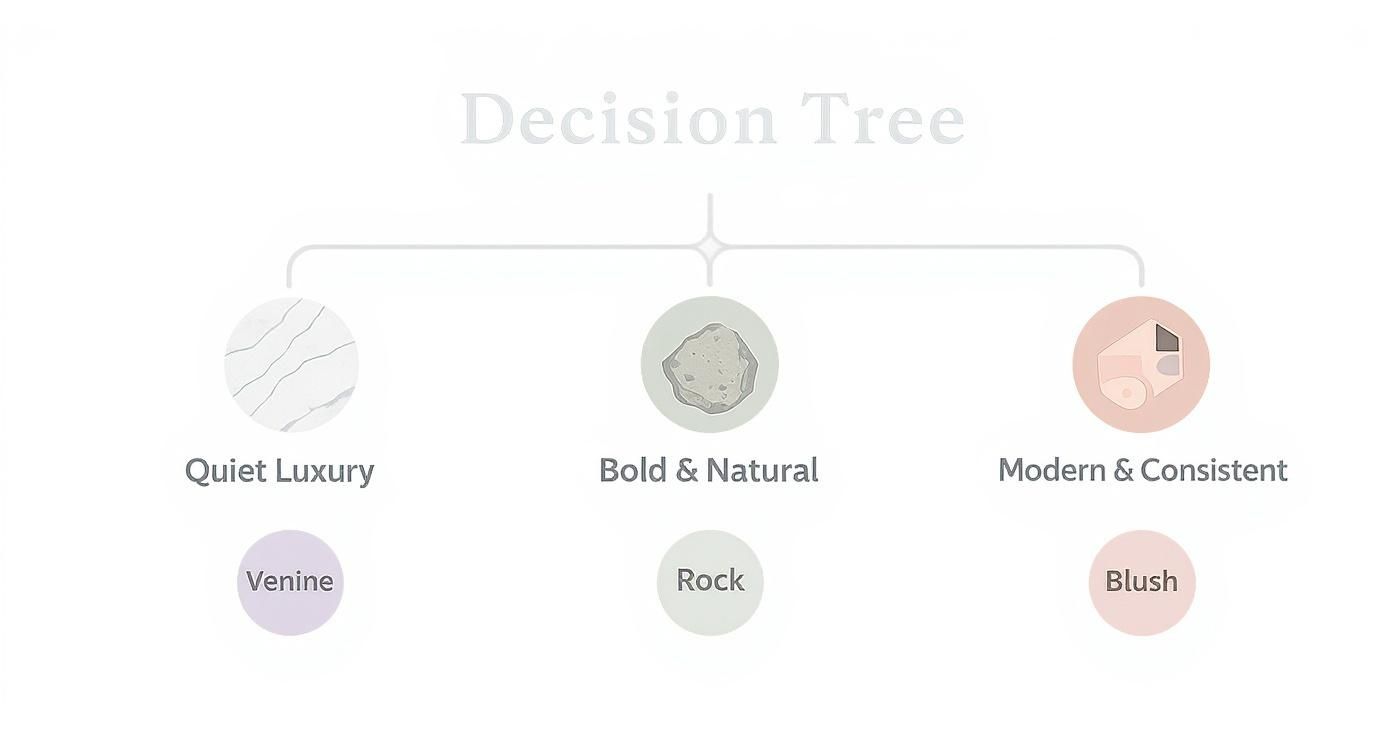
There is a perfect stone for every style, whether you love quiet luxury, a bold natural statement, or modern consistency. Once you know the look you want, you can think about your lifestyle to find the ideal material.
Recommendations for Your Lifestyle
We've matched each stone to a common California homeowner profile to make your choice easier. See which one sounds most like you.
For the Busy Family: Engineered Quartz
If your kitchen is the busy center of your home, then engineered quartz is your best bet. Its non-porous surface needs no sealing and resists spills and stains. For homeowners in the Bay Area who need maximum durability with minimum fuss, quartz offers peace of mind.
For the Design Enthusiast: Natural Quartzite
Do you love the look of marble but worry about scratches and etching? Quartzite is the perfect solution. It gives you the dramatic, unique veining of natural stone with much better hardness and heat resistance. This makes it a great choice for a showstopper kitchen island in a Palo Alto home.
For the Timeless Traditionalist: Classic Marble
For a true sanctuary space—like a master bathroom or a formal bar—nothing compares to the timeless beauty of marble. In these lower-traffic spots, its softer nature is less of a concern. For anyone in Monterey looking to create an atmosphere of pure elegance, marble is still the best choice.
Our Expert Advice: The best way to make your decision is to see and touch these materials in person. Photos can't capture the small differences in texture, color, and veining.
Choosing the right surface is an investment in your home. By understanding these key differences, you can pick a countertop you’ll love for years. We invite you to visit a Carmel Stone Imports showroom in Palo Alto, Carmel, or Sand City to explore our collection. Our experts can offer personalized advice to help you find the perfect stone.
Frequently Asked Questions
Making a final decision on the right stone for your home can come down to a few specific questions. Here are some answers to what we hear most often from California homeowners.
Which countertop is best for a modern, minimalist design?
Engineered quartz is almost always the top choice for minimalist and modern homes. Its main advantage is consistency. You can get solid, uniform colors or subtle patterns that you can't find in natural stone, which is perfect for the clean, sleek look of contemporary design.
How often do I need to seal marble and quartzite?
As a general rule, we recommend sealing porous natural stones like marble and quartzite every one to two years. You can do a simple water test at home. If water beads up on the surface, your seal is still strong. If it soaks in, it’s time to reseal.
Is quartz completely stain-proof?
Engineered quartz is highly stain-resistant because it is non-porous. This means liquids like coffee and wine have a hard time seeping in to cause stains. However, no material is completely stain-proof, so it is always best to wipe up spills quickly.
Does quartzite really look like marble?
Yes, it often does. Many quartzite slabs have the beautiful veining and soft colors that people love in classic marble. This is why quartzite is so popular in places like Monterey and Palo Alto. It offers the luxurious look of marble with much better durability.
Which countertop can handle the most heat?
Natural quartzite is the most heat-resistant of the three. It was formed under intense heat and can usually handle a hot pot placed directly on its surface. Marble is also very heat-resistant. Engineered quartz is the one you need to be careful with, as its resins can be damaged by high heat.
Ready to see these beautiful materials in person and find the perfect stone for your California home? The expert team at Carmel Stone Imports is here to guide you. Come visit one of our showrooms in Palo Alto, Carmel, or Sand City for personalized advice or to schedule a design consultation.
Explore our collections and get in touch with our specialists today at Carmel Stone Imports.