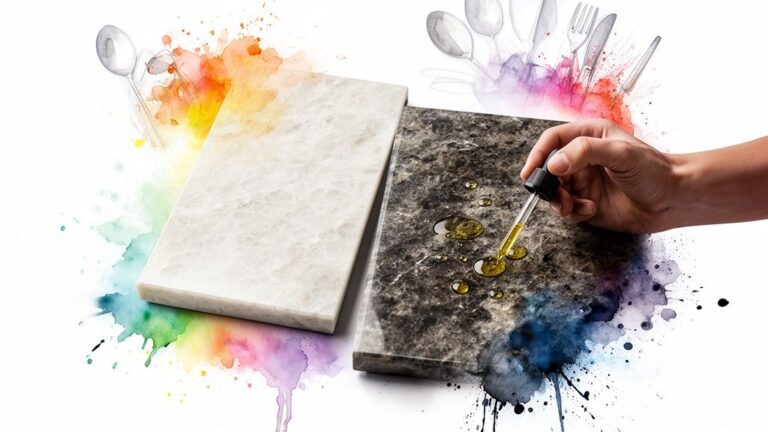
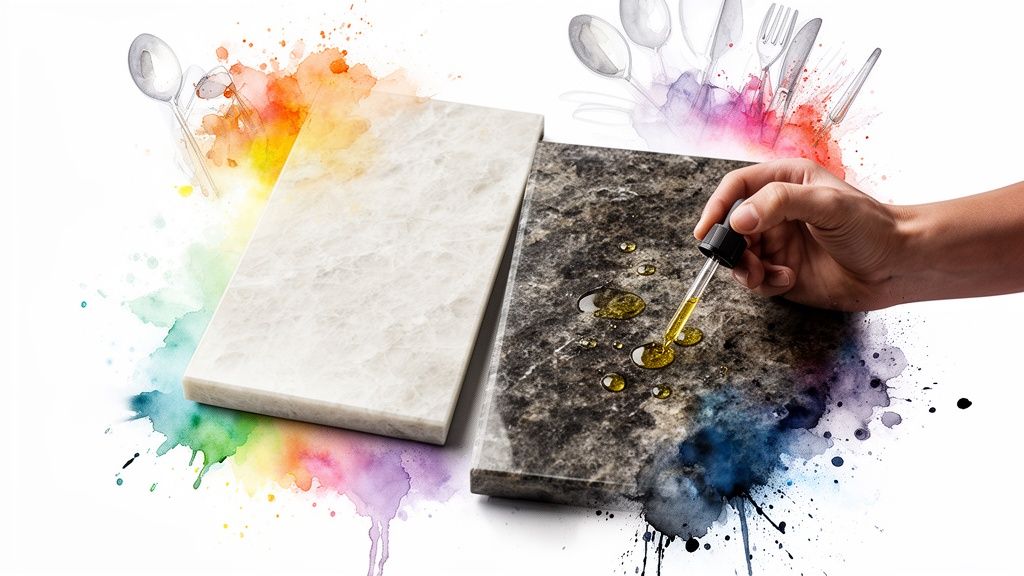
Yes, quartzite can stain — and some slabs are far more vulnerable than others. Porosity, resin coatings, and edge treatment all determine how a specific slab performs in real use. The only reliable way to know what you're buying is to test the actual slab in the showroom before you commit.
The Straight Answer on Quartzite Staining
 tile versus a clean white tile with colorful splatters.” />
If you're asking, does quartzite really stain?, you’ve likely been told it's a "low-maintenance" alternative to marble. You're trying to figure out if that’s accurate and if the slab you love will hold up in your kitchen or bathroom.
The truth is, "quartzite" on a label doesn't guarantee uniform behavior. Some slabs are incredibly tough, while others are more sensitive. It all comes down to the properties of each individual slab.
Understanding Porosity in Practical Terms
The staining conversation is all about porosity. Think of it as a stone's natural network of microscopic pores. These tiny openings are what can absorb liquids.
A stone with high porosity acts like a sponge, quickly soaking up spills like water, oil, or wine. In contrast, a dense, low-porosity stone behaves more like glass, giving you plenty of time to wipe things up. This is why one quartzite can be nearly bulletproof while another needs more care.
The Key Factor: Porosity Varies
Quartzite is a natural stone, so its porosity changes depending on its origin, finish, and whether a resin has been applied. A slab's geological makeup creates a unique porosity level. This is the single biggest factor in how it will resist stains.
For homeowners in coastal California communities from Monterey to the Bay Area, understanding a stone’s real-world performance is key. Humidity and salt air can affect natural stone, making it even more important to choose a slab that fits your environment.
Why Hardness Is Not The Same As Stain Resistance
One of the biggest misconceptions in the stone industry is that hardness equals stain resistance. Quartzite is very hard, but its ability to resist scratches is a completely separate property from its ability to resist stains.
Correcting this misunderstanding is the key to knowing if a quartzite slab will stain. It helps you move past marketing hype and evaluate a slab based on what really matters for daily use.
The Mohs Scale Only Measures Scratch Resistance
When you hear that quartzite is a 7 on the Mohs Hardness Scale, it only tells you one thing: it resists scratches well. For perspective, glass is around 5.5 and a steel knife is about 6.5. This means quartzite is tough against everyday wear and tear.
But the Mohs scale says nothing about porosity. A stone's hardness comes from its mineral structure. Porosity is about the empty spaces within that structure. A hard stone can still be a porous stone.
Porosity Determines Stain Resistance
Porosity is the factor that dictates how a stone will behave with liquids. It determines whether a drop of olive oil beads up on the surface or soaks in to form a stain.
Two different quartzites can have the same high Mohs hardness rating but sit on opposite ends of the porosity spectrum.
- Low-Porosity Quartzite: These dense slabs have few pores. Spills tend to sit on top, giving you time to wipe them away.
- High-Porosity Quartzite: These slabs have a more open internal structure. They can absorb liquids quickly, making a high-quality sealer non-negotiable.
This is why you can't rely on a hardness rating alone. For Bay Area homeowners investing in a luxury surface, understanding your chosen slab’s specific porosity is what guarantees long-term satisfaction.
How to Know Before You Buy: Three Essential Showroom Tests

The only way to know what you’re buying is to test the actual quartzite slab. These three simple tests give you clear proof of a slab's porosity and acid sensitivity, so you know exactly what to expect.
1. The Water Drop Test (Absorption Speed)
This test reveals a stone's porosity in real-time. It’s a quick, honest look at how fast it will soak up liquids.
How to Do It:
- Ask to test a corner of the slab.
- Place a few drops of water on the surface and start a timer.
What the Results Mean:
- Immediate Absorption: If the water soaks in right away and darkens the stone, it’s a highly porous quartzite. This slab will demand a top-tier sealer.
- Slow Absorption (10-15 minutes): If a dark spot slowly forms, it has moderate porosity. The stone will perform well with a quality sealer.
- No Absorption: If the water beads up indefinitely, you’ve found a dense, low-porosity quartzite—a great sign for a kitchen.
2. The Lemon Juice Test (Etch Sensitivity)
This test checks if a slab will react to common kitchen acids. Always perform this on a small, approved sample piece, never on the main slab.
How to Do It:
- On your sample piece, put a drop of lemon juice.
- Let it sit for 5 to 10 minutes, then wipe it clean.
What the Results Mean:
- A Dull Spot Appears: If you see a hazy or dull mark, the stone has etched. This means it contains minerals that react to acid, and spills from wine or vinegar will leave a similar mark.
- No Change: The surface looks the same. This is a true, hard quartzite that won’t etch from kitchen acids.
3. The Oil Test (Stain Risk)
Oil is thicker than water and can leave more stubborn stains. This test mimics a real-world kitchen accident, like a splash of olive oil.
How to Do It:
- Use a sample or the slab's edge. Apply a small drop of cooking oil.
- Let it sit for about 10-15 minutes, then wipe it off.
What the Results Mean:
- A Dark Spot Remains: If the oil leaves a mark, the stone is susceptible to oil stains. This confirms the need for an oil-repelling sealer.
- No Mark: The surface wipes clean. This stone has excellent natural resistance to grease and is a fantastic choice for a hardworking kitchen.
By running these three tests, you get direct evidence of how a specific quartzite slab will perform in your Monterey or Palo Alto home.
The Carmel Stone Imports Advantage: Test Your Stone In Person

We believe the best way to answer does quartzite really stain? is to let you find out for yourself. That's why we built our Palo Alto and Carmel showrooms around a massive, live inventory. You can evaluate the full, breathtaking slab destined for your home.
Test the Exact Slab for Your Project
Our team invites you to perform these simple water, lemon, and oil tests right on our showroom floor. We’ll walk you through the process on the actual slab you’re considering.
This hands-on approach removes the guesswork. You’ll see with your own eyes how a slab reacts, ensuring the stone you fall in love with truly fits your lifestyle.
Expert Guidance on Performance
Our design experts are partners in your project. They know the story behind each slab and can provide guidance on performance expectations and maintenance realities.
We will explain how different finishes affect performance:
- Polished finishes tend to have a more closed surface, giving them a head start against spills.
- Honed and leathered finishes offer beautiful texture but can have more open pores, making a high-quality sealer essential.
This guidance helps you choose a material perfectly suited for your home’s environment, from the coastal climate of Monterey to modern Bay Area aesthetics.
Frequently Asked Questions
1. What's the difference between quartzite and quartz?
Quartzite is a natural metamorphic rock, quarried from the earth. Quartz is an engineered (man-made) product created by combining crushed quartz crystals, resins, and pigments. While both are durable, their performance with stains, heat, and UV light differs significantly.
2. If my quartzite gets a stain, can it be removed?
Yes, most stains can be removed. Oil-based stains can often be lifted with a specialized poultice paste that pulls the oil out of the stone’s pores. The best strategy is always prevention by keeping your quartzite sealed and wiping up spills promptly.
3. How often should I seal my quartzite countertop?
Let the stone tell you. Periodically perform the water drop test on a busy area of your counter. If water beads up, the sealer is working. If it soaks in and darkens the stone, it’s time to reseal.
4. Does a honed or leathered finish stain more easily?
Textured finishes can be slightly more susceptible to staining than a polished finish because the process opens the stone's pores a bit more. However, with a high-quality sealer applied correctly, honed and leathered quartzites perform beautifully in any kitchen.
5. Is any type of quartzite guaranteed not to stain?
No natural stone is 100% stain-proof. However, some varieties like Taj Mahal and Sea Pearl are extremely dense and highly resistant to staining. The golden rule is to always test your exact slab before you buy.
At Carmel Stone Imports, we believe an informed decision is the best one. Our team is here to help you test slabs and find the perfect stone. Visit our showrooms in Carmel or Palo Alto to explore our collection.