

Direct Answer: Blue Marine is a trade name, not a geologic classification. Slabs sold under it range from true quartzite to feldspar-rich stone sold as granite, so ask the supplier for the classification.
You saw a deep blue slab on a designer’s board or across a showroom floor, and you fell for it. Then one person called it Blue Marine Quartzite and someone else called it Blue Marine Granite, and now you are not sure what you are actually buying.
That mix-up shows up constantly. Over the summer, visitors to our site asked about this one blue stone more than any other material, and they asked using both names, sometimes in the same week.
The category is not trivia. It changes how the surface handles lemon juice, red wine, and olive oil in a working kitchen. Here is what the name hides, how to verify it before you commit, and where a stone this dramatic actually belongs.
Why One Blue Stone Carries Two Different Names
Trade names come from the people who sell stone, not from a lab. A quarry or distributor picks a name that sounds good on a tag, and that name travels with the material long after anyone remembers what the rock is made of.
Strong color makes this worse. Blue is rare in natural stone, so almost anything blue gets grouped loosely under whatever category the seller thinks will sell it.
That is how one slab ends up listed three different ways:
- Quartzite, if the seller is pointing at hardness and durability
- Granite, if the seller is grouping it with dark, feldspar-heavy stones
- Marble or dolomite, if the stone is softer and the seller is being more literal
All three can look similar from across a Carmel Rancho Lane showroom. Under a bottle of vinegar, they behave nothing alike.
This is not unique to blue stone. Granite itself has shifted a lot in what the name covers, and quartzite names get stretched the same way. What matters is the mineral makeup underneath the tag, not the words printed on it.
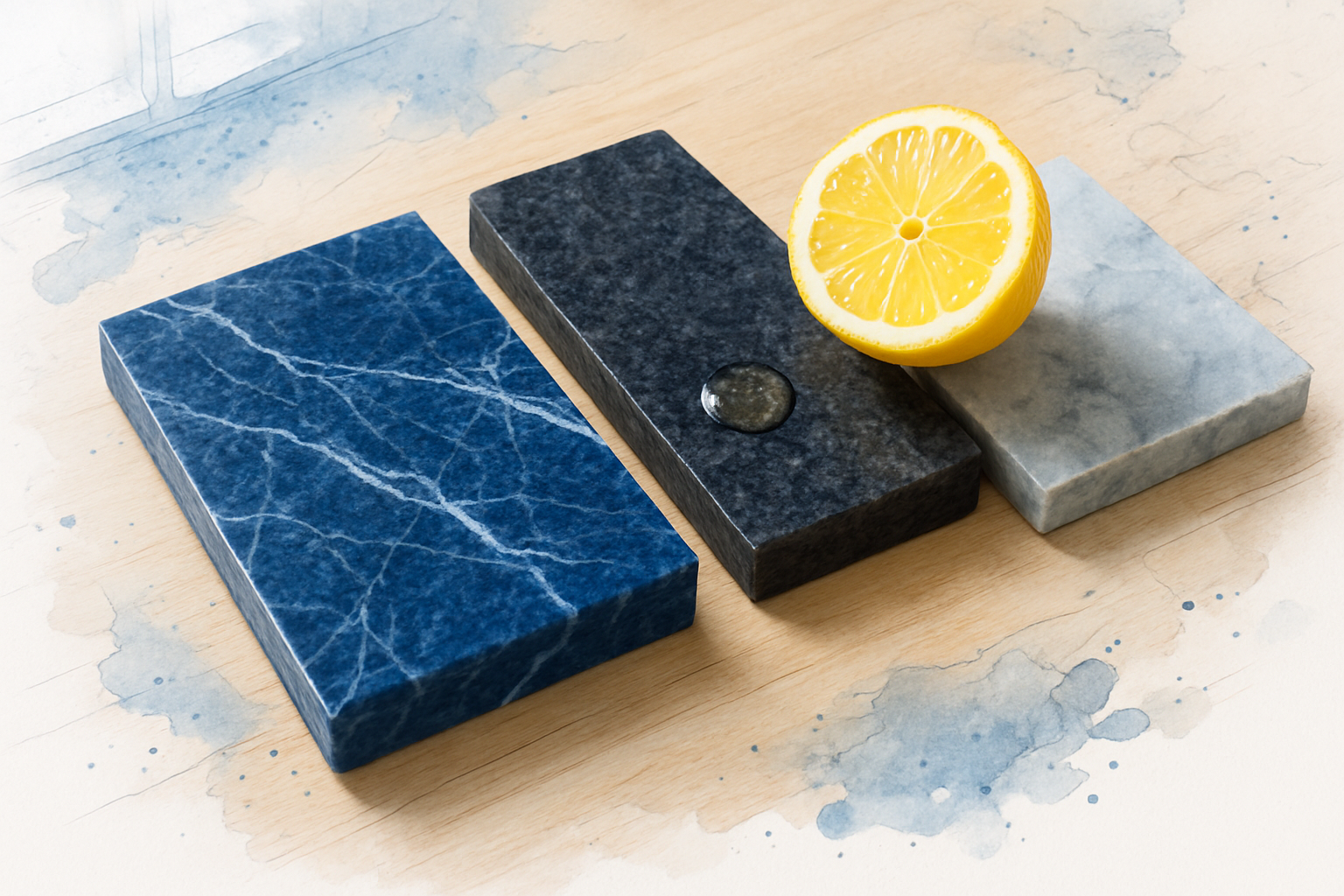
Three Behaviors That Actually Separate These Stones
Forget the geology lecture. In a kitchen, the differences come down to three things you will notice within the first year.
How it reacts to acid. Marble and dolomite are calcium-based, so lemon juice, wine, and tomato sauce can etch a dull spot into a polished surface. Quartz-based stones and feldspar-heavy stones shrug that off.
How much liquid it absorbs. A more porous stone will take on olive oil and dark liquids, especially around the sink and cooktop. Denser stone resists it, and sealing helps either way.
How well it resists scratching. True quartz-based stone is hard enough that a knife slip usually leaves nothing. Softer blue stones mark more easily, which shows badly on a dark surface.
Natural stone has published test methods behind these questions. The Natural Stone Institute’s ASTM reference covers absorption, compressive strength, and abrasion resistance, which are exactly the numbers to ask about when a stone’s category is unclear.
If you have narrowed to two blue lookalikes and want a plainer breakdown of how named quartzites differ, this comparison of Taj Mahal, Mont Blanc, and the rest walks through the same thinking.
How the Lookalike Families Behave in a Kitchen
Three stones can read the same shade of blue on a showroom floor and still live very different lives in a working kitchen. This is the short version.
| Stone family | Acid from lemon or wine | Liquid absorption | Best fit |
|---|---|---|---|
| True quartz-based stone (quartzite) | Generally unaffected | Low, sealing still recommended | Full kitchen, island, heavy-use counters |
| Feldspar-heavy dark stone (granite family) | Generally unaffected | Low to moderate depending on block | Full kitchen, outdoor counters, pool surrounds |
| Blue marble or dolomite | Can etch on polished finishes | Moderate, more attention near sink and cooktop | Vanities, powder rooms, backsplash, low-traffic surfaces |
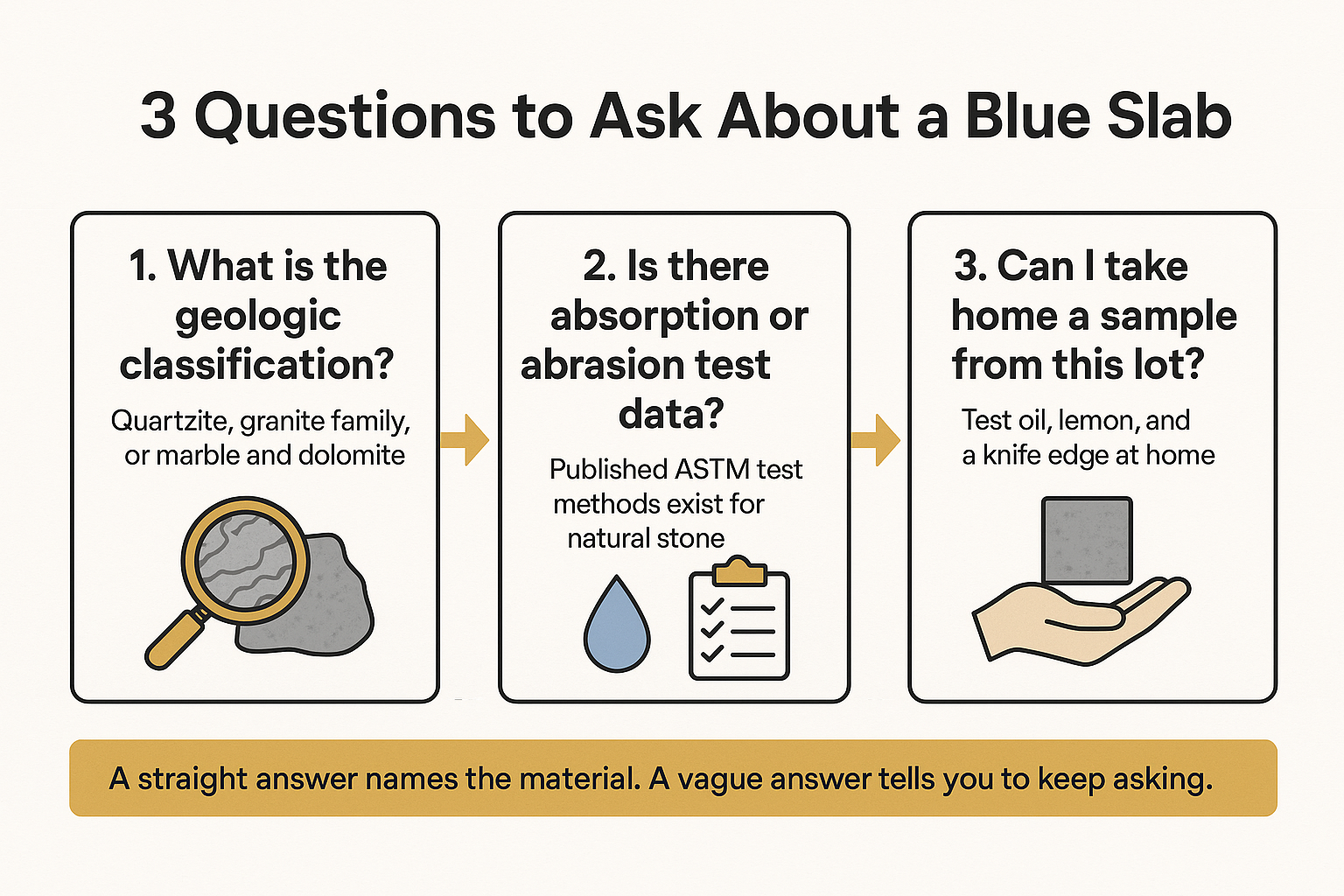
The Three Questions to Ask Before You Commit
Buyers who walk in with these three questions get a very different conversation than buyers who walk in with a photo.
What a Straight Answer Sounds Like
Buyers in this market are already precise. Form submissions come in with SKU, thickness, finish, and slab size spelled out before anyone picks up a phone, so being specific with a supplier is normal here.
Ask the classification question first. A good answer names the material family and says where the block came from. A vague answer sounds like “it’s a hard stone, you’ll be fine,” and that is your signal to keep asking.
Then ask for test data. Not every slab has a full test report attached, and that is honest. But a supplier who can pull product documentation or tell you plainly what they do and do not have is a supplier worth buying from.
Finally, take home a sample from the same lot as the slab you are considering. Two blocks sold under one trade name can differ in density and color, which is also why two slabs with the same name can price very differently.
On the sample, leave a few drops of olive oil and lemon juice overnight on an unsealed corner and see what happens. Your fabricator can tell you what sealing will and will not change once you have picked a slab.
Where a Blue Stone Belongs, and Where It Causes Regret
Heavy blue movement reads completely differently depending on how much surface it covers. On a 9-foot island, the veining becomes the room. On a powder room vanity, it reads as jewelry.
That is the honest question to answer before you fall for a slab: how much of this room do you want this stone to carry?
A few patterns we see work:
- Island only, with a quieter stone on the perimeter counters
- Vanity or powder room, where one slab does all the work
- Full-height backsplash paired with the island, which usually means sourcing two to three slabs from the same block
That last one is the most common use case for a dramatic blue stone, and it is also where slab count matters most. Vein matching across an island and a tall backsplash takes planning, and the same math applies to any high-movement stone.
One more honest note. A single statement slab is a different decision than a whole-kitchen material. If the blue is the thing you love, give it one surface and let the rest of the room stay calm.
Finish and Light Change This Stone More Than Most
A phone photo of a blue slab is close to useless for judging tone. Blue picks up whatever light is in the room, and the difference between finishes is often the difference between loving the stone and tolerating it.
- Polished pushes the blue darker and makes veining pop, and it shows water spots and fingerprints
- Honed softens the color and reads more gray in low light
- Leathered adds texture, hides smudges, and mutes the contrast between vein and field
Light on the Monterey Peninsula is not the same light as the Palo Alto and San Jose corridor. A marine layer morning in Carmel or Pacific Grove flattens color in a way that inland sun does not, and a slab that looked electric in a Bay Area showroom can go moody by the time it is installed near the coast.
This is why buyers ask staff to pull slabs into better light before deciding. One customer searched a long time for a leathered quartzite for her kitchen island and only landed on it after seeing it in person, and that is a common story. Another review describes seeing the right slab only after it was set in the right light next to her cabinet door.
Why This Particular Stone Has to Be Seen in Person
Natural stone varies slab to slab even from the same quarry block, and blue stone varies more than most. What you commit to is a specific numbered slab, not a catalog image.
Carmel Stone Imports keeps live inventory across the Carmel, Palo Alto, and Sand City locations, with Sand City acting as the inventory hub for Central Coast projects. Stock moves as containers land, so availability on any named stone is something the team confirms rather than promises online.
Take-home samples are available for most materials, which is the step that settles the finish question. Material selection happens at the showroom; fabrication and installation are handled by your own fabricator, and the team can share referrals if you need one.
Frequently Asked Questions About Blue Marine Quartzite
Is Blue Marine Quartzite the same thing as Blue Marine Granite?
Often the same slab, sold under two different names. Trade names are marketing, not geology. The only way to know what you are buying is to ask the supplier for the material’s classification and any test documentation they have on that lot.
Can I use a blue stone like this on a kitchen island that gets daily use?
It depends entirely on what the stone actually is. If it tests out as a true quartz-based stone, it handles a working kitchen well. If it is a blue marble or dolomite, acid can etch a polished surface, which usually pushes it toward a vanity or backsplash instead.
Do you have Blue Marine in stock right now?
Inventory changes as shipments arrive, so that is a question for the team rather than a web page. Call or email with the material, finish, and the slab size your fabricator needs, and they will confirm what is actually on the floor.
How many slabs do I need for an island plus a full-height backsplash?
Most projects in that range land at two to three slabs, but it depends on island size, backsplash height, and how closely you want the veining to match. Bring your layout and the showroom team can walk through slab count with you before you commit.
Does a dark blue stone show scratches and water spots more than lighter stone?
Dark polished surfaces show water spots and fingerprints more than light ones. A honed or leathered finish hides both, which is one of the main reasons people choose texture on a dramatic stone.
Want to See a Blue Slab in Real Light Before You Decide?
Blue stone is one of the few materials where seeing the actual slab changes the decision, not just confirms it. The Carmel showroom on Carmel Rancho Lane, along with the Palo Alto and Sand City locations, keeps live inventory and take-home samples for most materials. If you want to look at options or ask what a specific stone actually is, the team can be reached at (650) 800-7840 or info@carmelimports.com.