Direct Answer: Fusion quartzite varies slab to slab, so choose the exact slabs in person, record the lot number, and settle your scope first. Most kitchens need 2-4 slabs depending on waterfalls and backsplashes.
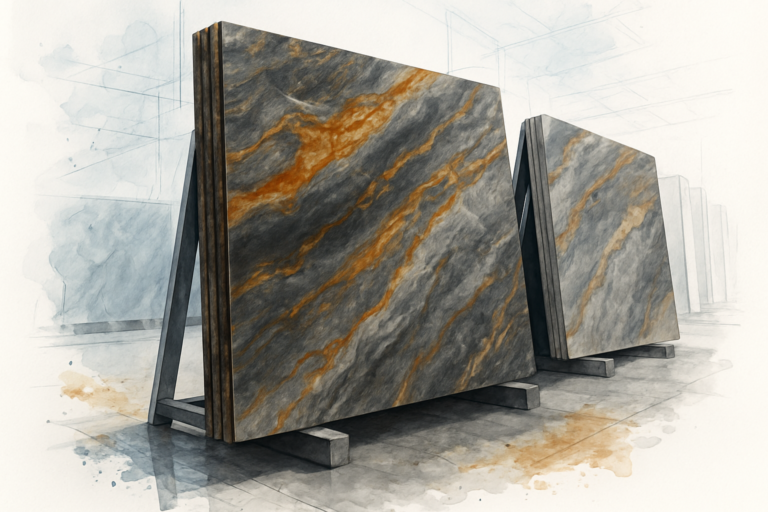
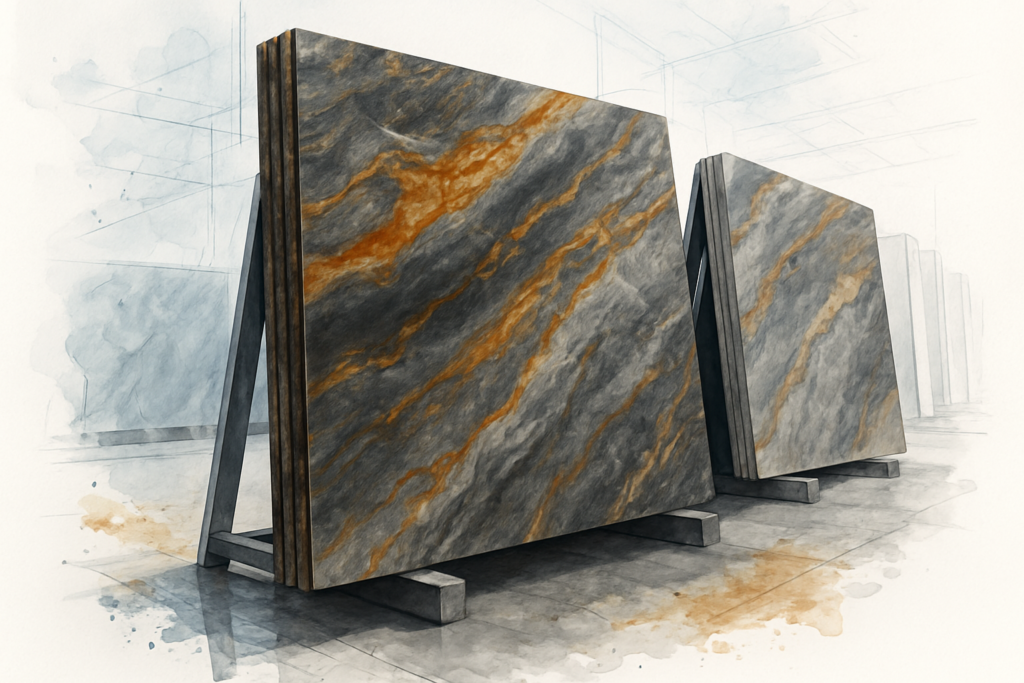
People choose Fusion quartzite for one reason: the movement. Rivers of rust, gold, gray, and deep charcoal run across the face, and no two slabs carry them the same way.
That same movement is what makes the material hard to plan. Two slabs cut from the same block can read like two different stones once they are stood up under warehouse lighting, which is why a photo on a phone screen is close to useless for a final decision.
This guide covers the three things that actually decide how a Fusion kitchen turns out on the Monterey Peninsula: reading the specific slab and its lot number, counting slabs against your real scope, and locking vein layout before purchase, not after.
Why Two Fusion Quartzite Slabs From the Same Block Look Different
Fusion is a high movement stone. The color banding shifts as the saw moves through the block, so slab one and slab six out of the same lot can differ in how much charcoal shows, how wide the gold streams run, and how the pattern sits on the slab.
That is normal geology, not a defect. But it means the only slab you can plan around is the one you actually stood in front of.
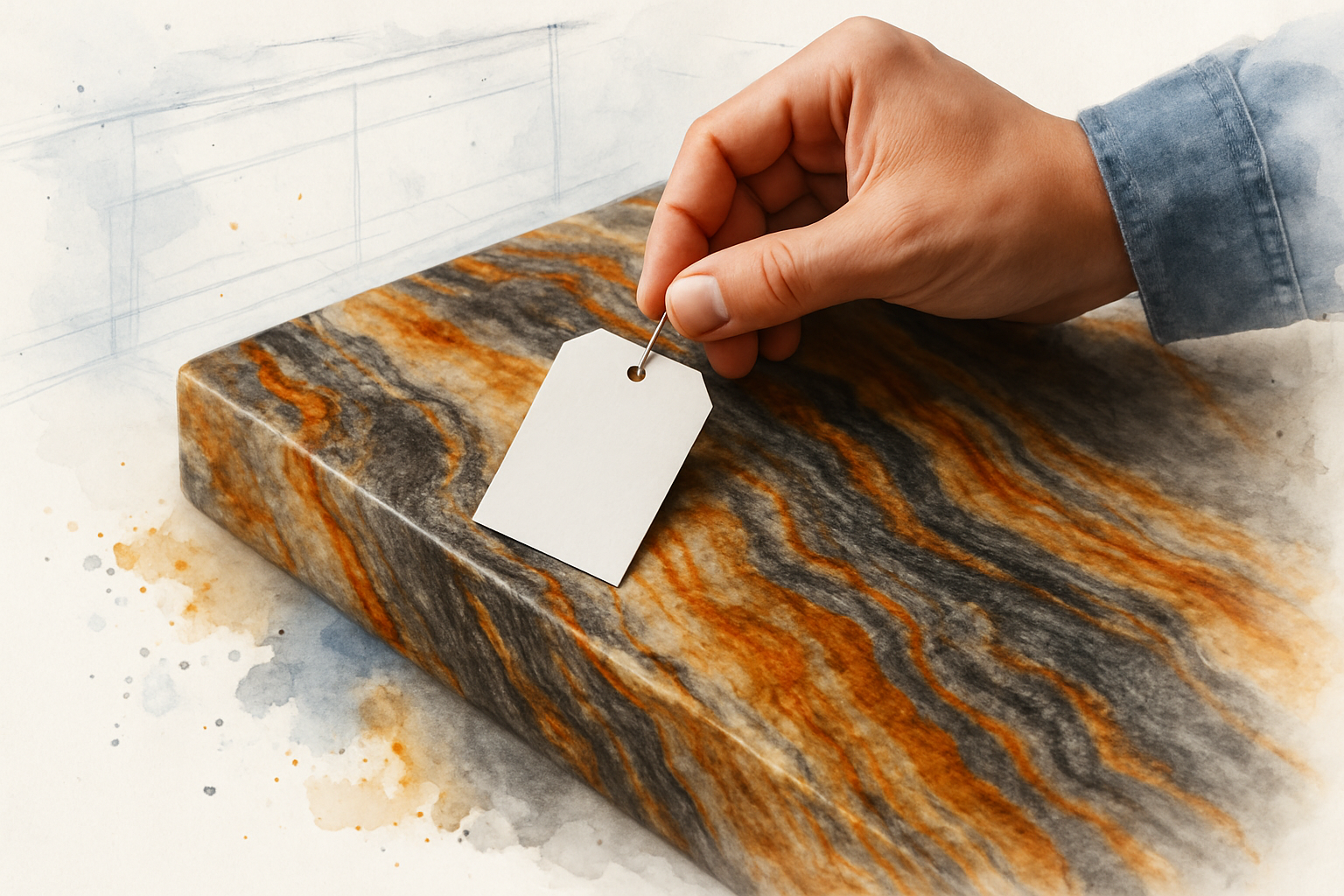
When you find a lot you like, write down three things before you leave the yard:
- The lot or batch number stamped or tagged on the slabs
- The individual slab numbers you want, in order
- The finish on those specific slabs
Carry that lot number through every later conversation. Your designer, your fabricator, and the yard should all be saying the same number back to you, because “Fusion quartzite” alone is a trade name that can cover several unrelated lots that landed months apart.
Callers ask us for photos constantly, and photos are useful for narrowing the field. They are not a substitute for viewing the slab. Lighting, camera color, and scale all lie, and a 10 foot slab compressed into a 4 inch screen hides the very thing you are paying for.
This is the same discipline that applies to reading any dramatic natural stone. If you want the longer version, see reading marble slabs, veining, movement, and batch numbers.
How Many Slabs Does a Fusion Quartzite Kitchen Actually Need?
This is the question most homeowners get wrong, and it is the one that causes real problems late in a project.
Many buyers already arrive knowing the shape of the answer. Contacts routinely come in saying they need 2 to 3 slabs for counters plus a full height backsplash. One installer working across five bathrooms in a single home was pricing four slabs to cover counters plus a waterfall island.
Scope drives the count more than square footage does. These features eat material fast:
- Waterfall ends on an island, which each take a full slab-height panel
- Full height backsplashes, which can double the material a kitchen needs
- Thick mitered edges, which require extra strips cut from the same slab for color match
- Long uninterrupted runs with no seam, which limit how the layout can be nested
High movement stone also gives you less usable field than a quiet stone does. Your fabricator is cutting around the veining you want to keep, so a slab that measures 120 square feet may only yield 80 or 90 square feet you would actually accept in the finished kitchen.
Decide your scope before the showroom visit. Buyers who show up knowing whether they want a waterfall and a full height backsplash do not find out three weeks later that the lot is one slab short.
How Scope Changes Slab Count
Rough planning ranges for a typical Central Coast kitchen. Your fabricator’s layout is the only count that governs.
| Kitchen scope | Typical slab range | What drives it |
|---|---|---|
| Perimeter counters plus island, standard 4 inch backsplash | 2 slabs | Flat runs nest efficiently on a slab |
| Counters plus full height backsplash behind the range | 2 to 3 slabs | Vertical panels come off the same lot for color match |
| Counters, island with waterfall on one end | 3 slabs | Each waterfall panel needs full slab height |
| Counters, waterfall island, full height backsplash | 3 to 4 slabs | Vertical work plus vein matching reduces usable field |
| Kitchen plus multiple bathrooms from one lot | 4 or more | Everything must come from the same block to match |
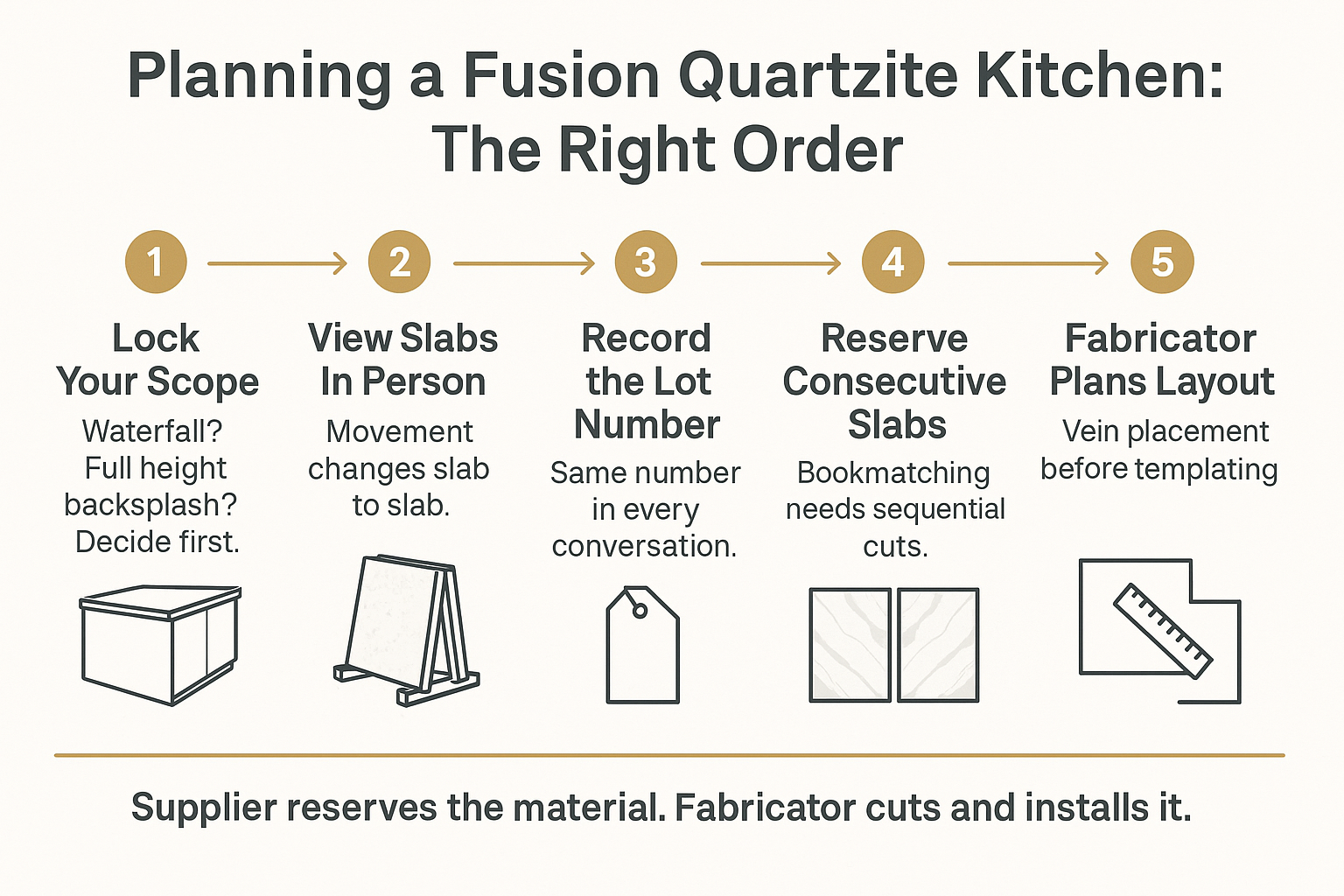
The Order These Decisions Belong In
Most Fusion problems come from doing these steps out of order. Here is the sequence that keeps a lot intact.
Bookmatching and Vein Layout Have to Happen Before You Buy
Bookmatching means two slabs are opened like the pages of a book so the veining mirrors across a seam. It only works if the slabs are consecutive cuts from the same block.
Consecutive numbering is exactly what it sounds like. Slab 3 and slab 4 out of one block share nearly the same pattern, so they mirror cleanly. Slab 3 and slab 9 will not.
A lot may only hold a handful of sequential slabs. Once someone buys slab 4 for a bathroom, the bookmatch you pictured for your island is gone, and no other lot will replace it.
So make the layout call before purchase. Your fabricator should see the vein layout plan before templating, so the gold stream lands where you pictured it on the island face instead of dying under the sink cutout.
One more thing worth stating plainly, because callers ask about it every week: a stone supplier and a fabricator are two different businesses. The supplier imports, stocks, displays, and reserves the material. The fabricator templates your kitchen, cuts the slabs, builds the miters, and installs. Most yards, including this one, do not cut or install, though good ones will hand you names of fabricators they have worked alongside for years.
Understanding that split saves you time. It also explains why your slab reservation and your fabrication schedule are two separate clocks you have to manage.
Test the Slab Before You Commit, Not After
Quartzite is sold under trade names, and Fusion is one of them. Hardness gets confused with stain and etch behavior constantly, and a stone can be hard enough to scratch glass while still drinking up olive oil.
Ask these questions at the yard, about the specific lot:
- Has this slab been resined or coated at the factory?
- Are there absorption values available for this material?
- Is it a true quartzite, or a dolomitic stone sold under a quartzite trade name?
The honest way to compare stone performance is measurable properties, not trade names or hardness assumptions. Absorption testing under ASTM C97 and related methods is how the industry actually rates it, and the Natural Stone Institute’s testing resources explain what those numbers mean.
Then take a sample home. Put water, lemon juice, and a drop of olive oil on a hidden corner, leave them 15 minutes, wipe clean, and look at the surface in daylight.
For a working kitchen in Pacific Grove or a Los Altos island that sees dinner every night, that 15 minute test tells you more than any brochure claim. If you want the deeper version of this issue, why brand new quartzite sometimes stains walks through what causes it.
Finish Changes How Fusion Reads, So Decide It Early
Finish is a decision many buyers leave for last, and it should come much earlier. The same Fusion lot reads three different ways depending on how it is surfaced.
- Polished pulls maximum depth out of the darker mineral streams and makes the gold glow
- Honed calms the whole thing down and softens the contrast
- Leathered adds texture and hides fingerprints and water spots on a working island
A returning customer put the search this way: “After a lot of searching for a specific leathered quartzite for our kitchen island, we found the most beautiful slab” – Tracy M.
Do not decide from a sample chip. Ask to see the same material in two finishes side by side, full slab, standing up. A 4 inch honed sample gives you almost no information about how a 10 foot honed island will look at eight in the morning. There is more on this in the finish decision nobody explains.
Availability, Timing, and What Changed in 2026
Inventory on named quartzite lots is live. A slab a designer saw on Tuesday can be sold by Friday, and most yards will not hold material without a deposit.
If you are touring showrooms in Sand City or Palo Alto during the summer contractor rush, learn the reservation mechanics before you fall in love with a lot. A short, time bound hold while you confirm square footage with your fabricator is standard and worth asking about up front.
General timing on the Central Coast:
- Stock material moves quickly and can usually be released to a fabricator within days
- Special orders typically run a few weeks
- New import lots land on shipping schedules through the Port of Oakland, which is what sets when fresh material appears
The 2026 supply picture is worth knowing if you are specifying. Trade data reported this spring showed U.S. countertop material imports down sharply year over year, with granite hit hardest and Brazilian shipments falling steeply, while Italy moved into the top exporter position on marble and quartzite volume.
For a Monterey Peninsula or Bay Area project, the practical takeaway is simple: a specific named lot of Brazilian quartzite may not be reliably replaceable six months from now. That raises the value of buying every slab your project needs in one purchase.
On cost, skip the per square foot shortcut. Price on Fusion is driven by block rarity, slab dimensions, thickness, finish, and how much material your layout demands, and the only real number comes from the yard for the specific lot in front of you. Why two slabs with the same name cost different amounts explains the mechanics.
Frequently Asked Questions About Fusion Quartzite
Can I just pick Fusion quartzite from photos online?
You can shortlist from photos, but not decide. Movement varies enough between slabs in one lot that the piece you saw online may not be the piece you get. View the actual slabs and record the lot number before you commit.
How many slabs do I need for a kitchen with a waterfall island?
Most kitchens with counters plus one waterfall end land around 3 slabs, and 4 if you add a full height backsplash. Your fabricator’s layout is the number that governs, so get their count before you reserve.
Does the supplier cut and install the stone?
No. A stone supplier imports, stocks, and reserves the material. A separate fabricator does the templating, cutting, mitering, and installation. Most suppliers will share names of fabricators they have worked with locally.
Will Fusion quartzite stain in a busy kitchen?
It depends on the specific slab. Ask whether the lot was resined, ask about absorption values, and run your own 15 minute test with water, lemon juice, and olive oil on a take home sample before you buy.
How long will a yard hold a slab for me?
Holds are usually short and usually require a deposit, because inventory is live and other buyers are looking at the same lot. Ask about hold terms on your first visit rather than assuming the slab will still be there next week.
Seeing Fusion Quartzite in Person Before You Plan Around It
Carmel Stone Imports keeps quartzite lots on display across three Northern California locations, with slabs viewable standing up rather than chosen from a catalog image, and founder Robbie Robinson personally inspects the quarries and factories behind the collections. Because most of the staff have been here 15 years or more, the person who helped a designer last year is usually the same person answering this year. Take home samples are available for most materials, and the showrooms in Carmel and Palo Alto can arrange a slab selection appointment at (650) 800-7840 or info@carmelimports.com.