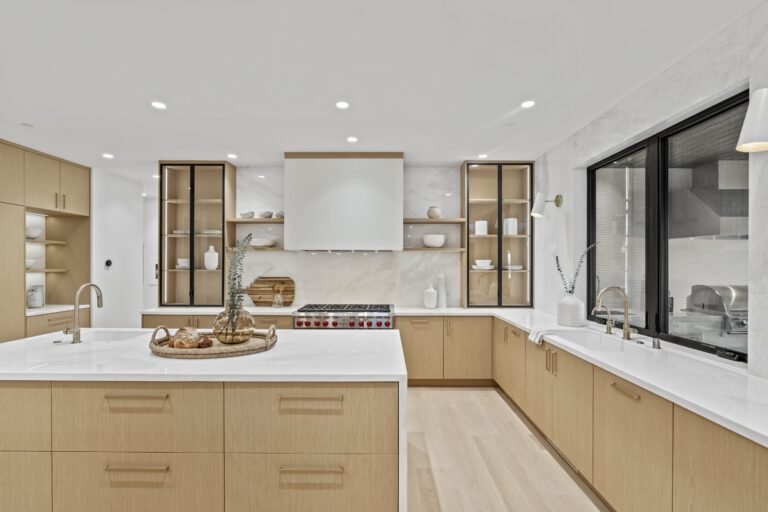
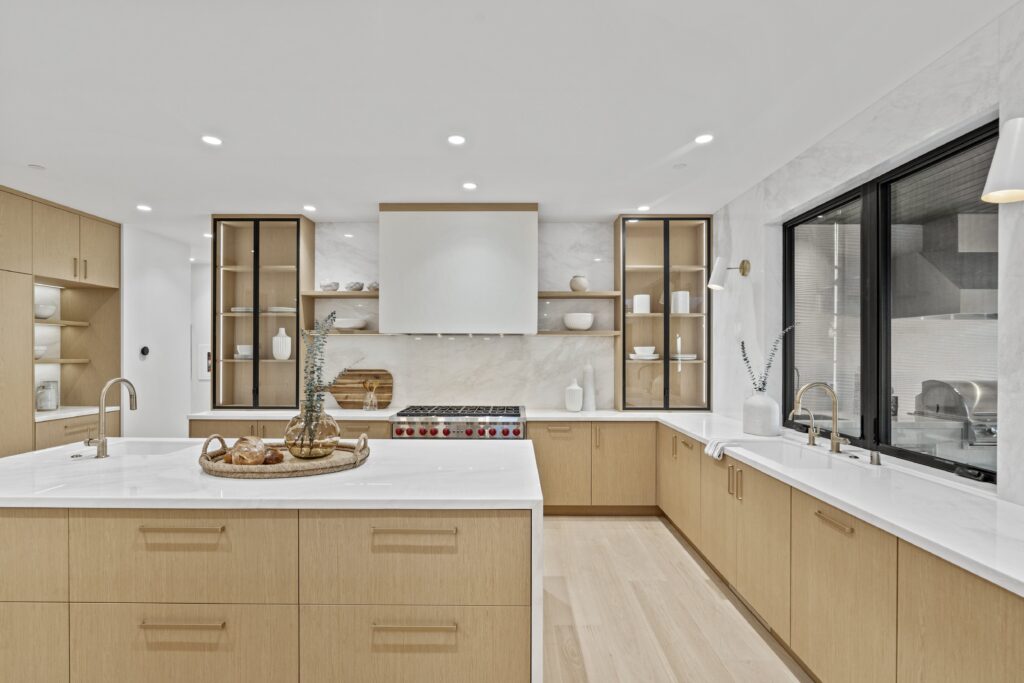
Direct Answer: Crystalline silica-free quartz is a manufactured slab surface made without crystalline silica. It gives kitchens a consistent, repeatable look, and it is the only quartz category stocked on the showroom floor.
A lot of kitchen projects on the Monterey Peninsula start with one word on a planning list: quartz. Then the shopping begins, and new terms show up. Silica free quartz. Zero silica quartz. Silica free engineered stone.
If your remodel plans started with quartz, you do not need to start over. Silica free quartz is the version you will find on showroom floors around Carmel, and the clearest way to judge it is standing next to the other surfaces you are weighing.
This guide covers what the name actually describes, how the material compares to natural stone and porcelain, why quartzite is a completely different material, and who handles each part of the job once you pick a slab.
Crystalline Silica-Free Quartz, in Plain Terms
Crystalline silica-free quartz is a manufactured slab surface. It is produced in a factory rather than cut from a quarry block, which is why the pattern across one slab looks even and repeatable.
You will see the same category sold under several names, and they all point to the same thing:
- silica free quartz
- silica-free quartz
- zero silica quartz
- silica free countertops
- silica free engineered stone
If a product page uses one of those terms and the showroom uses another, you are still looking at the same family of material.
This is the only quartz category Carmel Stone Imports stocks. You will not find a mixed quartz wall at the Carmel Rancho Lane showroom where you have to sort out which slab is which. Everything in that section of the floor is silica free.
One more point worth setting straight up front: no article should be your source for product specifics. Each manufacturer publishes documentation on its own slabs, including finish, thickness, and care instructions. The team can pull those sheets for any slab you are looking at, and that is the document to read before you commit.
How It Compares to the Quartz You Pictured
You may have seen quartz come up in the news over the past couple of years. Rather than sorting through headlines, here is what the material itself does in a kitchen.
The look is consistent. That is the whole point of a manufactured surface. If you have an L-shaped run plus an island in a Pacific Grove kitchen, the pattern on the island will closely match the pattern on the perimeter. Natural stone cannot promise that, because a quarry block decides the veining, not a factory.
That consistency is why silica free quartz tends to land in:
- Busy family kitchens where someone is going to set a hot pan down wrong eventually
- Secondary baths and powder rooms that need to look finished without becoming a maintenance project
- Laundry rooms and mudrooms off the garage, which take abuse and get almost no attention
- Rental and second-home kitchens around Carmel and Pebble Beach where nobody is on site to babysit a surface
Care is simple, but confirm the specifics. Manufactured surfaces generally do not need the sealing schedule that porous natural stone does. Cleaning usually means a soft cloth and a non-abrasive cleaner. Harsh scrubbing pads and strong solvents are where people get into trouble.
For the exact cleaner the maker recommends on the slab you choose, ask for the care sheet. That beats guessing, and it beats advice from a forum thread.

Silica Free Quartz vs. Natural Stone vs. Porcelain
Most Central Coast homeowners are choosing among three groups of material, not one. Here is how they differ on the things people actually ask about.
| Surface | Slab-to-slab variation | Everyday care | Commonly chosen for |
|---|---|---|---|
| Silica free quartz | Consistent by design; patterns repeat predictably | Soft cloth, non-abrasive cleaner; follow the maker’s care sheet | Family kitchens, vanities, laundry rooms, second homes |
| Marble | Every slab differs; veining is one of a kind | Sealing plus quick cleanup; etching and dull spots can be restored | Islands, primary baths, fireplace surrounds |
| Quartzite | Varies even within one quarry block | Sealing and a pH neutral cleaner | Kitchen counters where movement is the point |
| Granite | Varies, though the pattern is usually tighter | Sealing and mild cleaner | Kitchens, outdoor kitchens, patio bars |
| Large-format porcelain | Printed pattern repeats across pieces | Wipe clean, no sealing | Waterfall edges, shower walls, exterior applications |
Quartz and Quartzite Are Not Two Grades of the Same Thing
Two words that look almost identical describe very different materials. This is the single most common mix-up we see in search questions and in person.
Quartzite is a natural stone. It started as sandstone, got cooked and compressed underground over a long stretch of geologic time, and came out as a hard metamorphic rock. It is quarried, cut into slabs, and no two slabs are identical. The Natural Stone Institute is a reasonable starting point if you want background on how natural stone categories are defined.
Silica free quartz is manufactured. It never existed as a block in the ground. The consistency you see is a production choice.
So when someone asks which is nicer, the honest answer is that the question is comparing two different kinds of decision:
- Pick quartzite if you want movement, depth, and a slab nobody else has, and you are fine with sealing and a little attention.
- Pick silica free quartz if you want the countertop to look the same in year eight as it did on install day, with less fuss.
This matters locally because quartzite is popular here. Callers come in asking about specific stones by name, leathered quartzite for an island, or wanting to know how one named quartzite compares to another. Those conversations go better once everyone agrees on what category the material belongs to. If you are weighing the natural stone side, this breakdown of marble, quartzite, granite, and porcelain walks through it, and quartzite pricing varies more than people expect even between two slabs sharing a name.
Who Handles Which Part of a Countertop Project
Choosing the material and cutting the material are two separate jobs, handled by two different businesses. Here is the normal sequence.

A Photo Will Not Settle This Decision
One caller put the request plainly: can you send me a photo of the actual slab, because I want to see the movement before I decide. That instinct is right, and photos do real work early on. They just cannot finish the job.
Lighting changes everything. A slab shot under warehouse lighting in Sand City reads differently than the same slab under the afternoon fog light coming through a Carmel kitchen window. Scale changes things too. A tight phone photo flattens veining that reads as dramatic across a nine-foot island.
What a showroom visit gives you that a screen cannot:
- Side-by-side comparison of silica free quartz, natural stone, and porcelain in one trip
- Full slab context instead of a cropped section
- Your own materials in hand, meaning the cabinet door, the floor sample, the paint chip, the faucet finish
- Take-home samples so you can look at the finalists in your own light for a few days
Call ahead before you drive. Stock questions are the most common thing the phones get, by a wide margin. Inventory moves as containers arrive and as slabs get tagged, so the team will confirm what is actually on the floor before you make the trip from Salinas, Monterey, or over the hill from the Bay Area. Nobody wants to lose a Saturday to a slab that sold Tuesday. How live inventory works at a slab supplier explains why that confirmation call matters more with stone than with most purchases.
What Happens After You Pick the Slab
This trips up more homeowners than any other part of the process. A showroom that imports and stocks slabs is a supplier. It is not a fabrication shop.
So the handoff looks like this. You select the material at the showroom. Your fabricator templates the kitchen, cuts the slab, polishes the edges, and installs it. If you do not have a fabricator yet, ask for a referral list; plenty of Peninsula homeowners end up with a shop they found that way, and one reviewer described the fabricator referral as the part that made the whole project work.
A few planning notes that save pain later:
- Know your slab count before you fall in love. Large islands and full-height backsplashes eat material fast. This piece on slab yield and seams covers how to read it.
- Ask your fabricator about minimum slab dimensions. Some shops want a specific length to get a one-piece island, and that requirement should be known before you tag a slab.
- Sequence selection against your permit timeline. Monterey County and the City of Carmel-by-the-Sea both have their own review rhythms, and material decisions often need to land earlier than people expect. Stone selection and permit timing gets into the order of operations.
- Talk about edge profile and finish early. A honed finish and a polished finish on the same material read as two different countertops, and the finish decision rarely gets explained well.
On cost: material pricing moves with slab size, thickness, finish, and what the container cost to land. Import duties have shifted more than once in the past year, which affects some categories differently than others. Any number you see online should be treated as a rough starting point, and the showroom team can confirm current pricing on a specific slab.
Frequently Asked Questions About Silica Free Quartz
Is silica free quartz the same as quartzite?
No. Quartzite is a natural stone that comes out of a quarry, and every slab is different. Silica free quartz is a manufactured surface with a consistent, repeatable pattern. They are different categories of material, not two grades of one thing.
Does silica free quartz need to be sealed?
Manufactured surfaces generally do not need the sealing schedule that porous natural stone does, but care instructions vary by manufacturer. Ask for the product documentation on the specific slab you are considering rather than applying a general rule.
Can I see silica free quartz next to natural stone and porcelain in one visit?
Yes. All three sit in the same buildings, which is the main reason to visit in person. Comparing a manufactured surface against a marble and a large-format porcelain in the same lighting, on the same day, usually settles a decision faster than three weeks of browsing photos.
Do you cut and install the countertops?
No. This is a supplier and showroom business. You choose the material here and your own fabricator handles templating, cutting, and installation. If you have not lined one up yet, ask the team for a referral.
How much should I expect to spend per square foot?
That depends on the specific slab, its thickness and finish, and current import costs, all of which move. Avoid treating any published range as a quote. Bring your rough square footage to a showroom and the team can price the actual slabs you are weighing.
Do I need an appointment to come look at slabs?
Walk-ins are common, and more than one reviewer has described walking in without an appointment and finding someone who kept a big decision from feeling overwhelming. Calling first is still smart, both to check hours and to confirm the slab you want to see is on the floor.
Seeing Silica Free Quartz Next to the Alternatives
The fastest way to settle a countertop decision is to stand in front of the finalists in one room, on one day, with your cabinet door in hand. Carmel Stone Imports keeps silica free quartz, natural stone, and large-format porcelain under the same roof at showrooms in Carmel-by-the-Sea, Sand City, and Palo Alto, and the team can share manufacturer product documentation on any slab you are considering. If you want to check hours or confirm what is currently on the floor before you drive over, the number is (650) 800-7840 or info@carmelimports.com.