
Direct Answer: Gascogne Beige is a dense French limestone that performs well on bath floors, shower walls, vanity tops, fireplace surrounds, and shaded terraces. It etches from acids, so heavy prep kitchen counters are risky.
You saw a photo of a soft, warm, even beige floor and something clicked. It looked calm. It looked like it would age well. Then someone told you limestone stains, and now the whole selection feels like a gamble.
That worry is fair, but it is usually aimed at the wrong problem. Most homeowners on the Monterey Peninsula mix up three different things: scratching, staining, and etching. They are not the same, and only one of them is really about hardness.
This guide covers what Gascogne Beige limestone actually is, the rooms where it earns its place, the rooms where it creates regret, and how finish and sealing change the outcome more than most people expect.
What Gascogne Beige Limestone Actually Is
Gascogne Beige is a dense French limestone with a fine, even grain and very little visual movement. The color reads warm beige to soft greige depending on the lot and the light in the room. You will see occasional fossil traces and faint shell fragments, which is normal and part of the material.
Because it is quiet, it does what heavily veined marble cannot: it settles a room down instead of dominating it. That is why designers keep specifying it into large floors and full shower walls.
Now the part people get wrong. Limestone is calcium carbonate, so it reacts with acid no matter how hard or dense the block is. The Natural Stone Institute publishes care guidance that makes this same point across the calcite stone family.
Here is the plain-language version of the three words homeowners use interchangeably:
- Scratching is physical damage from grit, a dragged pot, or sand tracked in from the beach. It is about surface hardness.
- Staining is absorption. A liquid soaks into the pores and darkens the stone from within. Sealer slows this down.
- Etching is a chemical reaction. Lemon, vinegar, wine, or the wrong bathroom cleaner dulls the surface where it touched. Sealer does not stop it.
A homeowner who understands those three words before ordering rarely feels misled two years later.
Where It Holds Up, and Where It Creates Regret
This stone earns its place in spaces with steady use and low acid exposure. It is very good at looking soft and understated without going fragile.
Strong applications:
- Bathroom floors, primary and secondary, where the traffic is real but the chemistry is mild
- Shower walls in the right finish, paired with a cleaning routine that skips acidic products
- Vanity tops, where the daily contact is water, soap, and hands
- Fireplace surrounds and hearths, including cast stone assemblies
- Interior wall cladding on feature walls and stair enclosures
- Shaded exterior terraces and covered loggias
The harder sell is a heavy prep kitchen island. If lemon juice, wine, and olive oil hit that surface daily, it will develop a patina. The honest framing is not “never do it.” It is “choose it knowing what you are signing up for,” because some clients genuinely love that aged, lived-in surface and others are miserable within a month.
One more note for the trade. Designers and architects specify this material into structural details too, and on cast stone fireplace assemblies the weight-bearing and thickness questions come up before aesthetics do. Confirm slab thickness, piece sizes, and support with your fabricator early. Spec accuracy matters as much as color on those jobs.

Finish Changes This Stone More Than Color Does
Two orders of the same limestone in two different finishes can look like two different materials. This is the decision most buyers underthink.
- Honed is the standard for limestone. Matte, soft, and quiet in person. It shows the true color better than any other finish.
- Brushed adds a light texture that hides foot traffic wear and small scuffs. Good for entries and hallways.
- Tumbled softens the edges and the face, reads older and more rustic, and offers better grip underfoot in wet zones.
- Polished is uncommon on limestone and rarely the right call. It exaggerates etch marks and fights the material’s whole character.
In wet areas, texture is a safety issue, not just a look. Brushed and tumbled surfaces give you more traction on a shower floor or a pool deck than a smooth honed face does.
Aged and time worn finishes are worth asking about too. Architects around the Bay Area request them in specific formats, often small 3×12 pieces for feature walls or large 24×24 for floors, and format changes the price per square foot as much as the finish does.
One customer put the honed look simply after a large tile order: “We are thrilled with our purchase of honed limestone tiles from Carmel Stone.”
Test a Sample Before You Commit
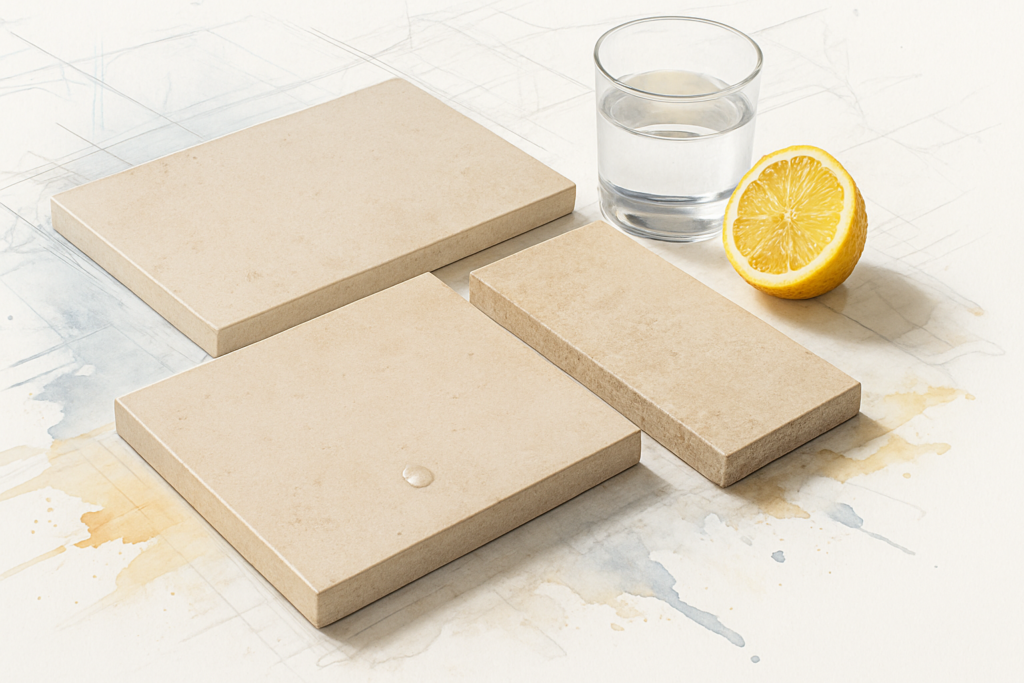
Take a sample home and run this on the back of the piece, not the face. Twenty minutes of testing prevents a two-year regret.

Sealing Helps. It Does Not Make Limestone Acid Proof
An impregnating sealer sits inside the pores and slows absorption. That buys you time to wipe a spill before it soaks in, which is genuinely useful on a vanity or a bath floor.
What it does not do is stop a chemical reaction on the surface. Vinegar, citrus, and a bathroom cleaner with the wrong pH will still leave a dull mark. Use a pH neutral cleaner and skip anything labeled for soap scum or lime removal.
Resealing cadence depends on use and moisture, not the calendar alone. A powder room floor and a coastal terrace do not need the same schedule.
And here is the part most homeowners never hear. Natural stone can be honed, refinished, and restored years later by a stone care professional. Etch marks and dull spots come back out. Damage to engineered products generally cannot be corrected the same way, which is worth weighing when you compare limestone against sintered stone and other engineered surfaces.
Application, Finish, and What to Expect
A quick reference for matching Gascogne Beige to the room you are actually working on.
| Application | Finish to Consider | What to Expect |
|---|---|---|
| Bathroom floor | Honed or brushed | Holds up well. Watch hard water spotting near the shower. |
| Shower walls | Honed | Fine with pH neutral cleaning. No acidic descalers. |
| Shower or wet floor | Tumbled or brushed | Better grip underfoot, hides wear over time. |
| Vanity top | Honed | Toothpaste and soap are fine. Nail polish remover is not. |
| Fireplace surround | Honed or brushed | Excellent fit. Confirm thickness and support with your fabricator. |
| Shaded exterior terrace | Brushed or tumbled | Works in shade. Damp coastal exposure means more frequent sealing. |
| Heavy prep kitchen island | Honed | Expect patina from citrus, wine, and oil. Choose it on purpose. |
Coastal Monterey Conditions vs. Inland Bay Area Projects
A limestone terrace in Carmel-by-the-Sea and one in Los Altos are not living the same life. Salt air, marine fog, and long damp stretches keep exterior stone wetter here, and wet stone stays dirtier and takes on more organic growth in shade.
That pushes a few decisions:
- Favor brushed or tumbled finishes outdoors so wear and grime read as texture instead of damage
- Plan a shorter resealing interval than an inland project would need
- Think twice about a north-facing terrace that never fully dries as the home for a soft stone
If the exterior is the main event on your project, it is worth reading through which stone surfaces hold up to California weather outdoors before you settle on material.
For Bay Area interiors, two variables matter more than the tile choice itself. Radiant heat floors affect setting materials, movement, and how the installer handles the assembly. Hard water in Peninsula and South Bay bathrooms leaves mineral deposits that people mistake for stone damage. Raise both with whoever is installing before the material arrives on site.
Why Limestone Is a See-It-In-Person Stone
Photos mislead on limestone more than on almost any other material. Blocks vary in tone. Fossil inclusions and shell traces come and go. Tile runs vary by production lot, and a screen cannot show you any of that honestly.
Which leads to the practical warning. Matching a reorder years later is genuinely hard. Suppliers regularly field calls from homeowners trying to source a discontinued material to patch an existing floor, and often there is nothing left in the world to send them.
So over-order tile by a sensible margin at the start, store the extra somewhere dry, and label it. It is cheap insurance against a cracked tile in year six. One caller said it best before booking a visit: “I want to come in and see it in person before I commit.”
Sourcing depth matters here too, because French, Turkish, Israeli, and Egyptian limestones all sit under the same general label and behave differently. A Jerusalem stone is not a French limestone, even when the photos look close.
Carmel Stone Imports imports directly from quarries in a dozen countries, with founder Robbie Robinson personally inspecting quarries and factories, and keeps live inventory across Carmel, Palo Alto, and Sand City so buyers can compare full slabs and tile runs side by side. The company supplies material only. It does not fabricate, cut, or install, and fabricator referrals are a normal part of the conversation.
Frequently Asked Questions About Gascogne Beige Limestone
Is Gascogne Beige limestone hard enough for a kitchen floor?
Yes for most kitchens. Hardness is rarely the issue with this stone. The bigger risk is etching from dropped food and acidic cleaners, and a brushed finish plus a walk-off mat at the door handles most of what a kitchen floor throws at it.
What does Gascogne Beige limestone tile cost?
It depends on format, finish, thickness, and current lot availability. Small mosaic and aged finishes usually price differently than a standard honed 12×24. Ask for a written quote on your exact format and square footage rather than working from a general per-square-foot number.
Can I use limestone in a shower?
Yes, and it is one of the better uses for it. Use a pH neutral cleaner only, skip anything sold for soap scum or lime scale, and squeegee the walls if you have hard water. Those three habits do more for the finish than any sealer.
How long does sealer last on limestone?
It varies by product, exposure, and how much water hits the surface. A guest bath floor goes far longer than a coastal terrace. Test it: drop water on the stone and see if it darkens within a few minutes. If it does, it is time to reseal.
If it etches, can it be fixed?
Usually, yes. A stone care professional can hone and refinish natural limestone years after installation and bring the surface back. That repairability is one of the real advantages natural stone has over engineered products.
How much extra tile should I order?
Talk it through with your installer, but plan for more than the strict square footage. Cuts, breakage, and future repairs all pull from the same lot, and matching a limestone lot years later is often impossible.
Want to See Gascogne Beige in Person Before You Decide?
Limestone is a material worth standing in front of, in daylight, next to the cabinet door or plumbing finish it has to live with. Showrooms in Carmel, CA and Palo Alto keep live slab and tile inventory, and take-home samples are available for most materials so you can run the water, oil, and lemon test at home. To check current availability or set up a slab selection appointment, call (650) 800-7840 or email info@carmelimports.com.