Direct Answer: Sintered stone is made by fusing mineral powders under extreme heat and pressure, producing a dense, resin-free surface that resists UV, heat, and staining, making it well-suited to outdoor kitchens and high-use interior countertops.
If you have spent any time researching countertop materials lately, you have almost certainly run into the term sintered stone, usually attached to brand names like Dekton, Neolith, Lapitec, or Laminam. The marketing copy tends to describe it the same way it describes engineered quartz and porcelain slabs: ultra-compact, non-porous, low maintenance. That overlap in language is exactly where buyer confusion starts.
Sintered stone is a distinct material category with real performance advantages in specific applications. But it also has trade-offs that most suppliers gloss over, particularly around edge chipping and fabricator selection, and those trade-offs matter more on a kitchen island in Carmel or a covered outdoor bar in Pebble Beach than they do in a product brochure.
This article focuses on three things: what sintered stone actually is and why it behaves the way it does, how it compares functionally to the other surfaces buyers often confuse it with, and what to watch for before you commit to it.
What Sintered Stone Actually Is
Sintered stone starts as a blend of natural minerals, quartz, feldspar, silica, and similar raw materials, ground to a fine powder and then subjected to extreme heat and pressure in a process called sintering. The result is a surface where the particles fuse together at a molecular level, with no resin binders holding anything together.
That last point is the one that matters most in practice. Engineered stone countertops, the quartz surfaces most homeowners are familiar with, are held together with polymer resins. Those resins are what makes quartz sensitive to prolonged UV exposure and direct heat. A sintered stone slab has no resin component, so it will not yellow outdoors or scorch from a hot pan.
Porcelain slabs occupy a middle ground. They are kiln-fired ceramic, which makes them durable and non-porous, but the sintering process produces a denser, harder final surface than most porcelain achieves. Porcelain slab durability is genuinely good, but sintered stone and porcelain are not interchangeable in terms of hardness, fabrication requirements, or edge behavior. Treating them as the same material because both are described as “ultra-compact” is a decision that tends to create problems downstream.
Sintered Stone vs. Engineered Quartz vs. Porcelain Slab
These three surfaces share some marketing language but behave differently where it counts. This comparison covers the functional differences most relevant to countertop selection.
| Property | Sintered Stone | Engineered Quartz | Porcelain Slab |
|---|---|---|---|
| Binder / composition | Fused minerals, no resin | Quartz + polymer resin binders | Kiln-fired ceramic clay body |
| UV stability | Yes, safe outdoors | No, resins yellow and degrade | Yes, outdoor-rated |
| Heat resistance | High, no resin to melt | Moderate, protect from direct heat | High, kiln-fired tolerates heat |
| Surface hardness | Very high (often 8+ Mohs) | Moderate-high | High, but typically softer than sintered |
| Edge chipping risk | High, brittle under point impact | Low | Moderate, fabrication-dependent |
| Fabrication complexity | High, requires specific diamond tooling | Moderate | Moderate-high |
| Outdoor kitchen use | Yes | Not recommended | Yes, grade-dependent |
The Edge Chipping Risk Nobody Talks About
Sintered stone’s extreme hardness is its biggest selling point. It is also the source of its most common real-world complaint. Because the material is so dense, it is brittle under point-impact loads, meaning a sharp knock at an edge or corner can chip it in a way that softer materials simply absorb.
This shows up most often at undermount sink cutouts and at the outside corners of kitchen islands. It is a different problem from the edge chipping that sometimes occurs with porcelain slabs, where technique during fabrication is usually the culprit. With sintered stone, the brittleness is a property of the material itself, and it can appear weeks or months after installation if the edge geometry concentrates stress.
Edge profile selection genuinely reduces this risk. The profiles that tend to hold up better are:
- Eased edges, a slight softening of the top corner that removes the most vulnerable point
- Radius or bullnose profiles, rounded edges distribute impact load across a larger surface area
- Avoid sharp mitered edges at outside corners, particularly on islands, where incidental contact is frequent
Fabricator experience matters here more than it does with most other stone categories. Cutting sintered stone requires specific diamond blades and continuous water cooling. Improper technique produces micro-fractures that are invisible at installation but become chips months later. A homeowner in Palo Alto or Monterey choosing sintered stone for a kitchen island should ask the fabricator directly: have you completed sintered stone projects before, and can I see examples? That is a reasonable question, and a qualified shop will have a straightforward answer.
Thickness Selection: A Decision Most Buyers Make Too Late
Sintered stone slabs are available in a range of thicknesses, and the right choice depends on application, not personal preference or what looks good in a catalog. Buyers routinely ask about sintered or porcelain slabs without realizing that a slab at one thickness is a fundamentally different product than the same pattern at another.
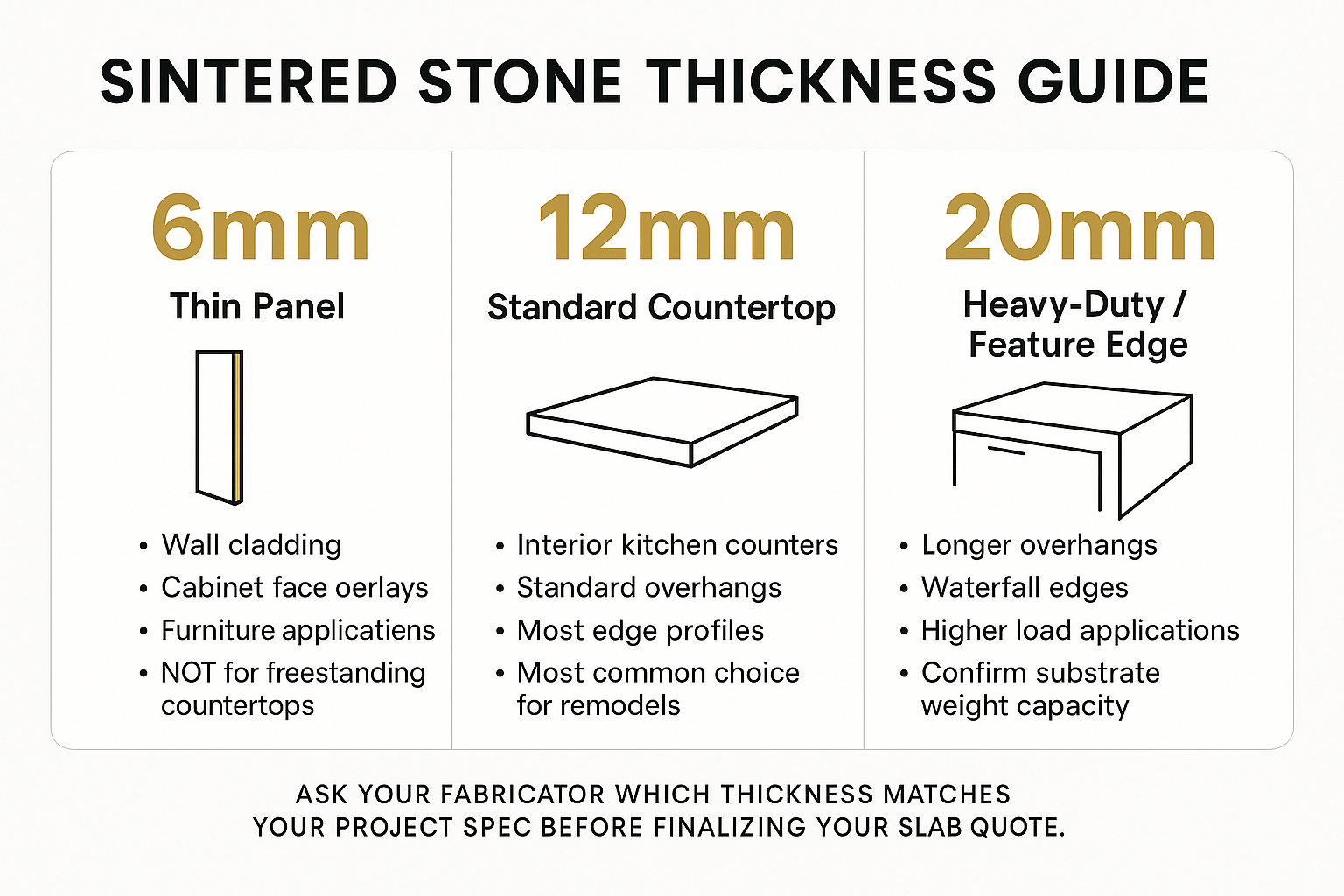
Here is how the three common thickness ranges actually break down:
- 6 mm panels: Well-suited for wall cladding, cabinet face overlays, and furniture applications. They are not appropriate as freestanding countertops without a rigid substrate underneath. Using a 6 mm panel as a countertop without full support is a structural error, not an aesthetic one.
- 12 mm slabs: The standard countertop thickness for most interior kitchen applications with supported edges. Works for standard overhang lengths and most edge profiles. A good starting point for kitchen counters in most Carmel or Monterey Peninsula remodels.
- 20 mm slabs: Suited for longer overhangs, waterfall edges, and applications where the edge itself is a design feature. Also used when the countertop needs to carry more load or project weight. More material means more weight, which affects delivery and substrate requirements.
If you are getting a quote on a sintered stone slab, confirm the thickness before comparing prices. A 6 mm and a 20 mm version of the same pattern are not priced the same, and they are not interchangeable once a fabricator begins templating. The marble and quartzite selection process involves similar thickness decisions for natural stone, and the same principle applies here: nail down the spec before the layout conversation.
Sintered Stone Thickness Guide
A quick reference for which sintered stone thickness works for which application, one of the most common questions buyers ask before finalizing a slab quote.
Where Sintered Stone Actually Makes Sense
The applications where sintered stone genuinely outperforms other surfaces are ones where UV exposure, heat, or heavy daily use rule out alternatives.
Outdoor kitchens along the California coast are a strong fit. Designers speccing alfresco bars in Pebble Beach or covered lanais in Carmel Valley often weigh sintered stone because it will not degrade under sun exposure the way resin-bound quartz does. The outdoor stone selection process involves several material categories, and sintered stone sits alongside granite and certain porcelains as an outdoor-appropriate option, with the added benefit that most sintered stone carries a high PEI wear rating for surface durability.
For interior kitchens, sintered stone works well when the priority is a surface that genuinely does not require sealing, resists staining from acidic foods, and holds up under a busy household. It is worth being honest that natural stone carries aesthetic qualities, the depth of veining in a marble or the movement in a quartzite, that sintered stone, however technically impressive, does not replicate. Buyers choosing between them are often choosing between two different things they value, not one right answer.
Sintered stone is a harder fit for:
- Households with small children who run and bump corners regularly
- Designs calling for sharp mitered edges as a feature element
- Fabricators without documented experience working the material
- Budgets that have not accounted for the higher fabrication cost relative to most natural stone
Frequently Asked Questions About Sintered Stone Countertops
Is sintered stone the same as porcelain slab?
No. Both are fired at high temperatures and are non-porous, but the manufacturing process and resulting properties differ. Sintered stone is formed by fusing mineral powders under pressure, producing a denser and harder surface than most porcelain. They also behave differently during fabrication and have different edge chipping characteristics. The terms are sometimes used interchangeably in marketing, but they are not the same product.
Can sintered stone go outdoors?
Yes, and this is one of its genuine advantages over engineered quartz. Because sintered stone contains no resin binders, it is UV-stable and will not yellow or warp under direct sun exposure. It is commonly specified for outdoor kitchens, covered patios, and alfresco bars in California coastal climates. Verify that the specific product is rated for outdoor use, since not every sintered stone line is manufactured to the same spec.
Does sintered stone need to be sealed?
No. Sintered stone is non-porous and does not require sealing. This is one of the practical low-maintenance advantages it holds over natural stone surfaces like marble or unsealed quartzite.
Why does sintered stone chip at the edges?
The same extreme hardness that makes sintered stone durable on its face makes it brittle at edges and corners when hit with a sharp impact. Point-impact loads, a dropped pan, a knocked corner, pressure at an undermount sink cutout, can chip the edge in ways that softer materials absorb. Choosing eased or radius edge profiles instead of sharp mitered corners reduces this risk significantly. Fabricator experience with sintered stone specifically also matters, since improper cutting technique creates invisible micro-fractures that can lead to delayed chipping after installation.
How does sintered stone compare to engineered quartz for a kitchen countertop?
The biggest practical differences are heat resistance and UV stability. Engineered quartz uses polymer resin binders that can be damaged by prolonged direct heat or outdoor sun exposure. Sintered stone has neither of those vulnerabilities. For a standard indoor kitchen without outdoor exposure, both are non-porous and low-maintenance day to day. The trade-off with sintered stone is higher fabrication complexity and edge brittleness. You can read more about what the quartz category involves in our post on engineered stone countertops.
What should I ask a fabricator before choosing sintered stone?
Ask whether they have completed sintered stone projects before and whether you can see examples of past work or speak to a reference. Also confirm that they use diamond blades rated for sintered stone and water-cooling equipment. A fabricator who works sintered stone regularly will answer these questions without hesitation. One who hedges or suggests their standard stone tooling is fine is worth pressing further before you commit.
Ready to Compare Sintered Stone and Porcelain Slabs in Person?
Finish, thickness, and surface texture read very differently in person than they do in catalog photography, and the distinction between a 12 mm and 20 mm slab becomes immediately clear when you are standing next to both. Carmel Stone Imports maintains live slab inventory across its Carmel-by-the-Sea and Palo Alto showrooms, and staff can walk you through the performance differences between sintered stone and large-format porcelain in the context of your specific project. Call (650) 800-7840 or email info@carmelimports.com to check current availability or schedule a slab selection appointment.