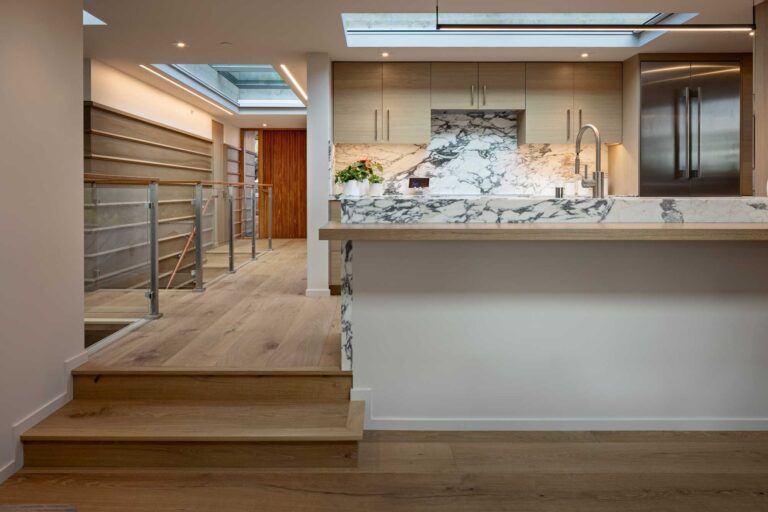
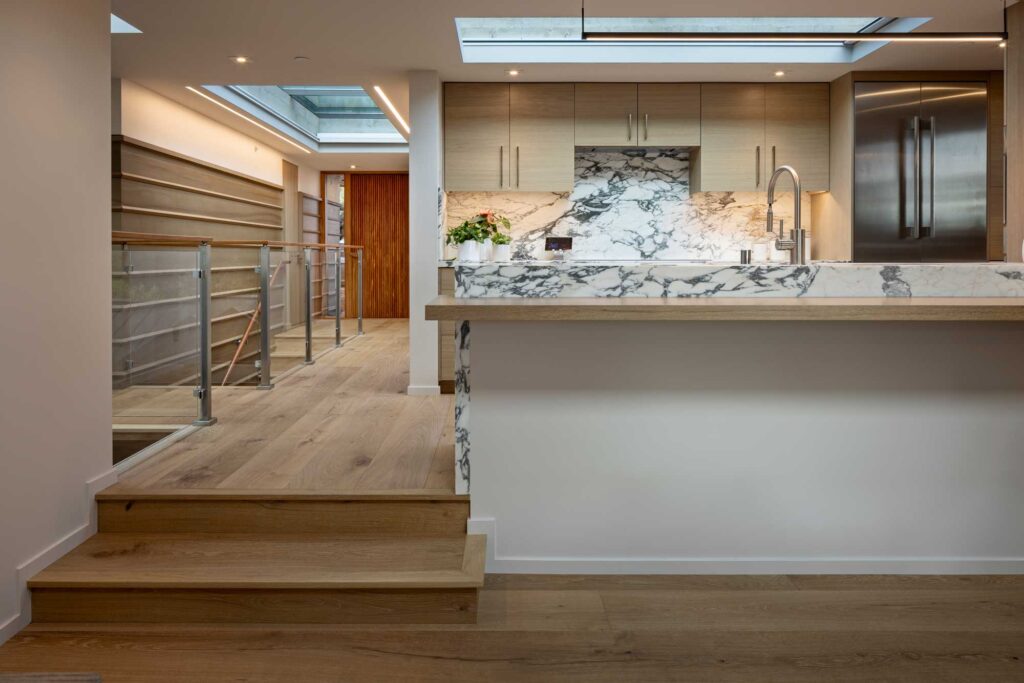
Direct Answer: The finish on a natural stone countertop affects how it resists etching, absorbs stains, and needs to be sealed, often more than the stone type itself does.
Most people choosing natural stone countertops spend a lot of energy on the stone itself, the veining, the color, whether it’s marble or quartzite. The finish gets about thirty seconds of attention, usually based on a photo. That’s where a lot of post-installation regret starts.
The finish is the surface you actually touch, clean, and live with every day. It changes how the stone responds to spilled lemon juice, how visible fingerprints are on a kitchen island, and how often you need to re-seal. Two slabs from the same quarry block can perform very differently depending on how their surfaces were processed.
This is especially relevant for homeowners on the Monterey Peninsula, where coastal kitchens and bathrooms deal with salt air, hard water, and a lot of natural light, all of which interact with surface finish in ways worth understanding before you commit.
Polished vs. Honed: The Trade-Off Most Buyers Discover Too Late
A polished finish is what most people picture when they think of marble countertops. The surface is buffed to a high sheen, which deepens the color and makes veining pop in a way that a matte surface simply cannot replicate. It photographs beautifully, which is partly why it dominates kitchen inspiration boards.
But polished is also the most unforgiving finish for an active kitchen. Acidic liquids, citrus juice, wine, vinegar-based cleaners, can etch the surface, leaving a dull patch that stands out against the reflective sheen. On a honed surface, that same etch is much less visible because there is no high shine to contrast against.
A honed finish is flat and matte. It softens the look of the stone and tends to feel warmer and less formal. The trade-off is that the open surface is more porous, which means it can absorb stains if sealing is inconsistent or delayed. This matters a lot for lighter stones, white or cream marbles with a honed finish require more vigilant maintenance than their polished counterparts. If you want to understand how this plays out across different materials, Natural Stone Countertops: What Nobody Tells You Before You Choose covers the broader picture of what buyers often learn after installation rather than before.
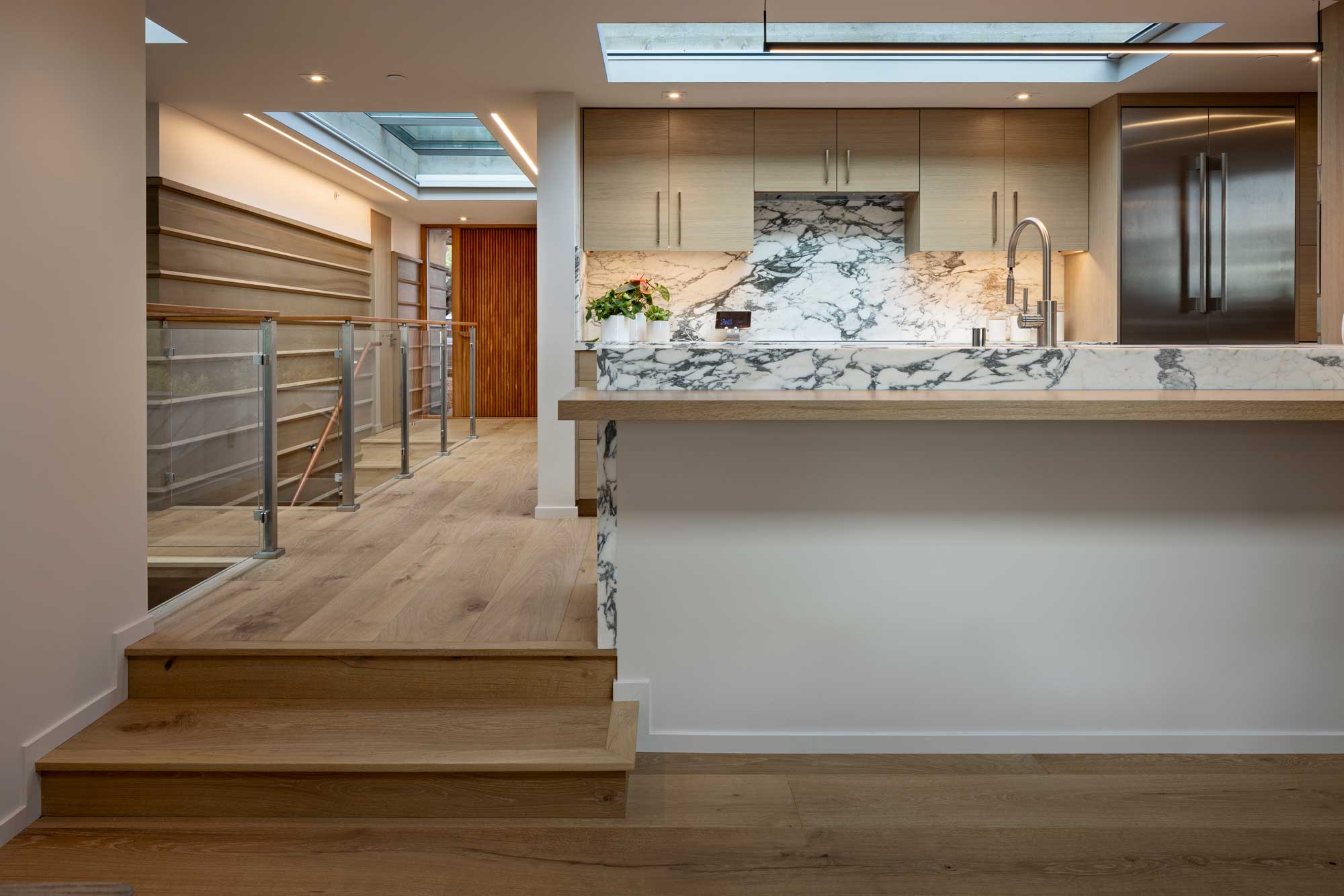
Why Leathered and Brushed Finishes Have Become the Go-To for Kitchen Islands
A leathered finish is created by running diamond-tipped brushes across the stone surface after it is honed. The process creates a soft, tactile texture, not rough, but noticeably dimensional. It also closes some of the stone’s surface pores slightly, which gives it better resistance to staining than a standard honed surface.
The practical benefit that keeps coming up with kitchen clients is fingerprint resistance. A polished countertop on a heavily used island shows every hand print. A leathered surface, because of its texture and lower reflectivity, hides surface marks well. One customer who came in specifically searching for leathered quartzite for a kitchen island described finding exactly what she needed after looking at multiple suppliers, the texture and color hit what she had been after, and the stone went on to become a material she ordered additional pieces around.
A brushed finish is similar to leathered but generally lighter in texture, the surface is softened without the same degree of dimensional depth. It reads as somewhere between honed and leathered. Both finishes work particularly well on quartzite and granite, which have the hardness to hold up under brushing without losing structural integrity. For a deeper look at how quartzite behaves across different conditions, Why Does Brand-New Quartzite Sometimes Stain, and How Do You Prevent It? is worth reading before you make a final call.
How Common Stone Finishes Compare in Real-World Use
This table summarizes how each finish performs across the factors that matter most for kitchens and bathrooms, not just how they look.
| Finish | Best For | Etching Visibility | Stain Risk | Sealing Frequency |
|---|---|---|---|---|
| Polished | Feature walls, lower-use bathrooms | High, shows clearly against sheen | Lower with proper sealing | 1-2x per year typical |
| Honed | Bathrooms, low-acid kitchens | Low, blends into matte surface | Higher on open-pore stones | More frequent, 2-3x per year |
| Leathered | Kitchen islands, high-traffic counters | Low, texture hides surface marks | Moderate, slightly closed pore | Less frequent than honed |
| Brushed | Transitional and casual kitchens | Low to moderate | Similar to honed | 1-2x per year typical |
| Flamed | Outdoor pavers, exterior terraces | Not applicable | Low, texture disperses liquid | Minimal for exterior use |
Flamed Finish: The One That Belongs Outside
A flamed finish is almost never used on interior countertops, and that’s intentional. The process applies intense heat to the stone surface, causing crystals to burst and creating a rough, slip-resistant texture. It is designed for exterior applications, pavers, pool surrounds, outdoor terraces, and steps.
For coastal properties in Carmel or Palo Alto, flamed granite is a practical choice for outdoor living spaces. The texture gives traction on wet surfaces, which matters near a pool or in a climate where morning fog leaves everything damp. The rough surface also weathers gracefully rather than showing wear.
The Marble Institute of America notes that surface finish selection should factor in both the intended use environment and the specific stone species, since not all materials respond to finishing processes the same way. If you are planning an outdoor project, Outdoor Kitchen Stone That Can Handle California Weather covers the material and performance questions specific to this climate.
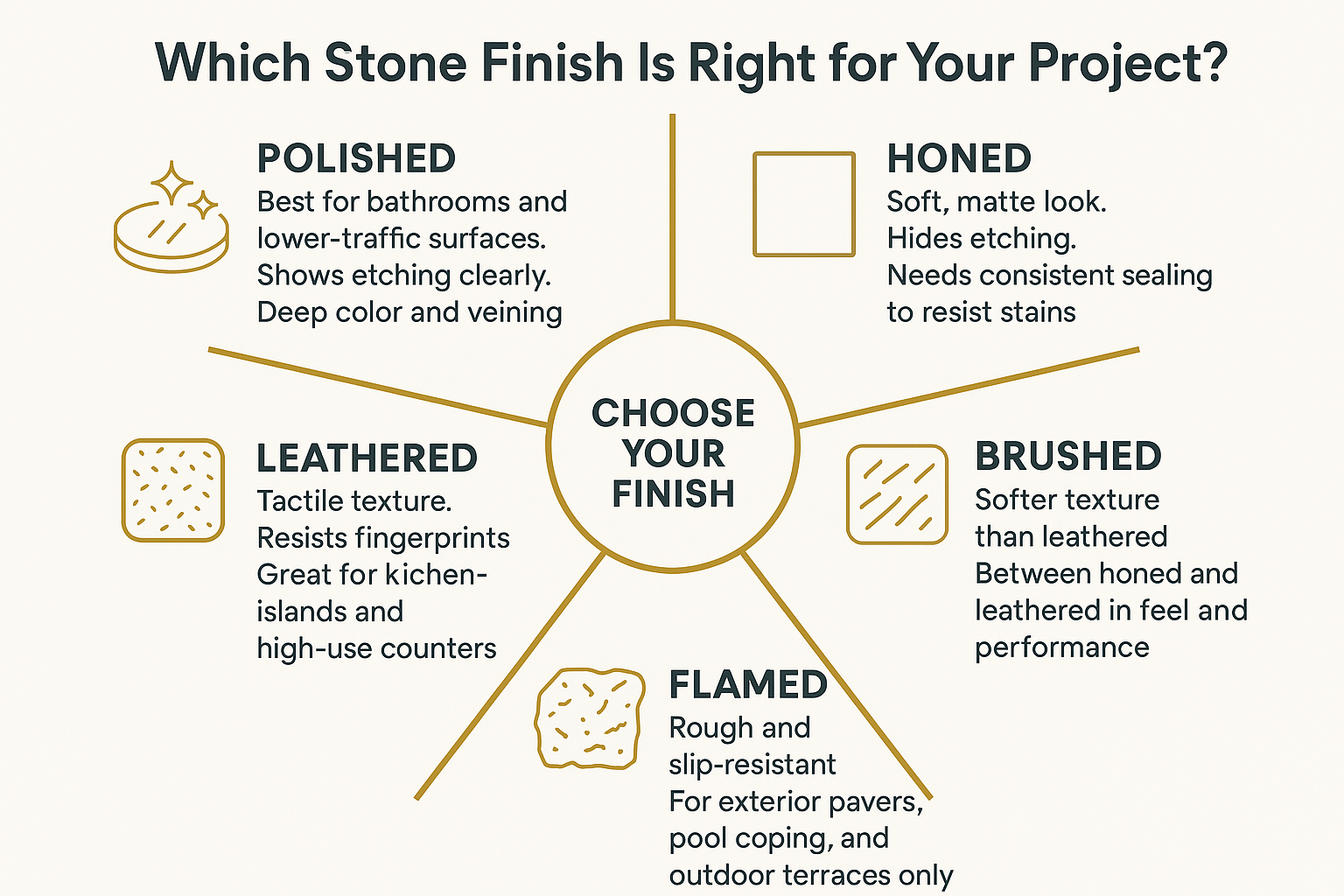
Finish Selection at a Glance
This infographic maps each finish type to the room and use case where it tends to perform best.
The Maintenance Difference Nobody Mentions at Point of Sale
Finish affects sealing requirements more than most buyers realize, and this is where the real-world divergence between finishes shows up. A honed marble requires sealing more frequently than a polished one on the same material, because the open surface invites penetration. Skipping or delaying sealing on a honed white marble in a kitchen is one of the faster ways to end up with a stained surface that is difficult to reverse.
A leathered granite, by contrast, may need sealing less frequently than its polished version because the finishing process closes some surface pores. This is not universal across all stones, but it is a consistent enough pattern to factor into your decision if low maintenance is a priority.
Buyers who choose a finish based on looks alone and then discover its maintenance profile after installation are one of the most common sources of frustration in the stone category. The Natural Stone Countertops: What Nobody Tells You Before You Choose post touches on this broadly, but the finish variable is specific enough to deserve its own attention. The Marble Slab Questions Worth Asking Before You Choose article also has a useful framework for the pre-selection conversation, including questions about how different finishes on the same material behave over time.
The Natural Stone Institute publishes care and maintenance guidelines by stone type and finish that are worth reviewing before you finalize any decision.
The Practical Test: Side-by-Side Before You Commit
The single most useful thing you can do before finalizing a finish choice is ask to see the same material in at least two finishes, side by side. Most showrooms with live inventory can pull comparison samples. Viewing them next to your cabinet door sample or tile selection, under showroom light and, ideally, in natural light, is the fastest way to understand how the finish interacts with the rest of your design.
Several customers have noted that staff at the Sand City and Carmel showrooms surfaced this comparison without being asked, which made the difference between choosing confidently and second-guessing later. One reviewer described walking in with a vague idea of what she wanted and leaving with a leathered quartzite that staff identified specifically because it matched what she described, texture, color, and finish all aligning once she could see the options together rather than separately.
If you are also navigating the choice between natural stone and engineered alternatives, Marble, Quartzite, Granite, or Porcelain, How to Actually Decide lays out the material-level trade-offs in plain terms. Finish is one layer of the decision, but once you have the material right, finish is often what determines whether you are happy with it two years later.
Frequently Asked Questions About Stone Slab Finishes
Does the finish affect how much a slab costs?
Sometimes, yes. Leathered and brushed finishes require additional processing steps, so they can carry a modest premium over a standard polished or honed surface. The difference varies by supplier and material. Contact Carmel Stone Imports directly for current pricing on specific finishes, costs depend on the stone, slab size, and current inventory.
Can I change the finish on a slab I already own?
In some cases, yes, a fabricator can re-hone a polished surface, for example. But this is a significant job that affects the entire surface, and the result depends on the stone type and how the original finish was applied. It is not a simple resurfacing. Your fabricator is the right person to advise on whether it is feasible for your specific material.
Is a leathered finish harder to clean than polished?
For most homeowners, leathered is actually easier to maintain day-to-day because it hides fingerprints and surface marks well. Cleaning is similar, a damp cloth and a pH-neutral stone cleaner. The texture does not trap debris any more than a standard surface does.
Which finish is best for a bathroom versus a kitchen?
There is no single right answer, but a useful rule of thumb: polished works well in bathrooms where acid exposure is lower and the reflective quality adds elegance. For kitchens, especially islands and prep surfaces, honed, leathered, or brushed tend to live better because they are more forgiving with etching and daily wear. The specific stone matters too, marble behaves differently than quartzite at every finish level.
Does finish affect how often I need to seal my countertop?
Yes, meaningfully. A honed surface is more open and porous than a polished one on the same material, so it generally requires more frequent sealing, sometimes two to three times a year versus once for polished. A leathered finish can require less frequent sealing than honed because the process closes some pores. Always ask about the sealing schedule for any specific stone and finish combination before purchasing.
Ready to See the Finish Difference in Person?
The comparison that matters most happens in person, not on a screen. Carmel Stone Imports carries live inventory across showrooms in Carmel-by-the-Sea and Palo Alto, and staff can pull side-by-side samples of the same material in multiple finishes so you can see exactly how each one interacts with your cabinet samples and lighting. Call (650) 800-7840 or email info@carmelimports.com to schedule a slab selection appointment.