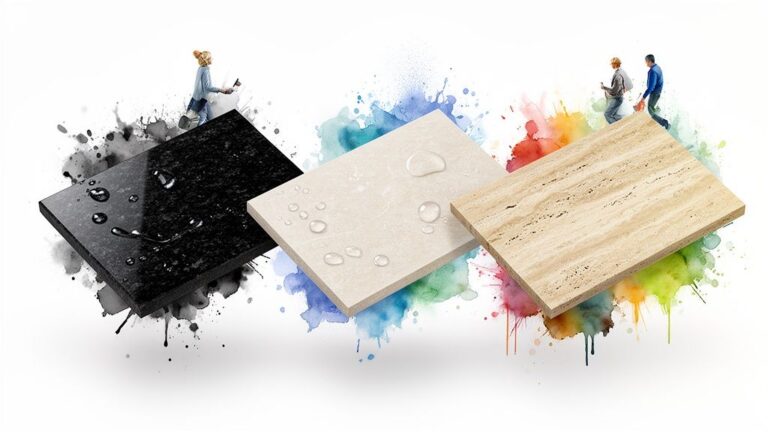
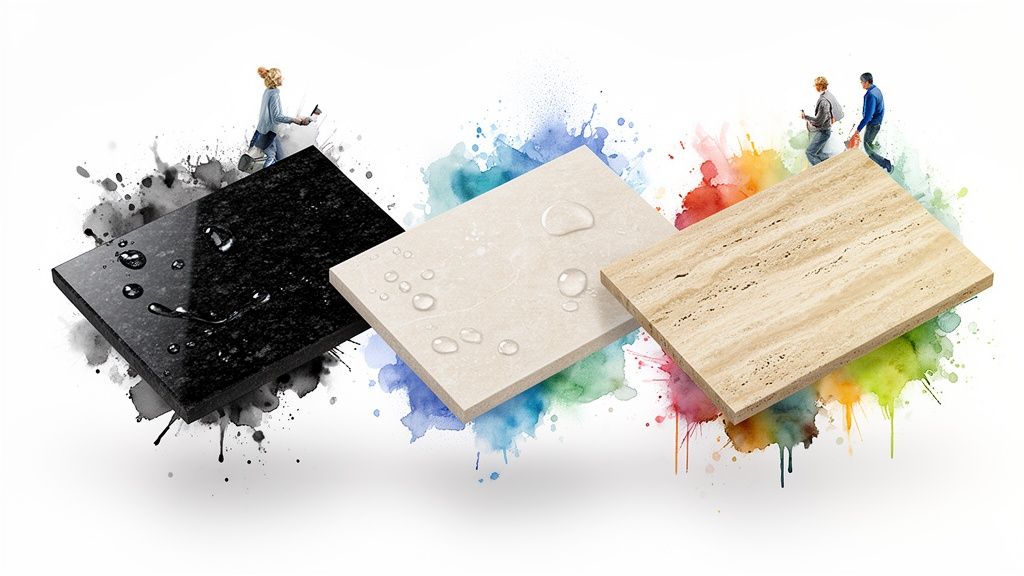
One of the most common questions we hear is, "Can I really use natural stone in a wet area like a shower?" Many people assume materials like limestone or travertine are off-limits for bathrooms.
But the truth about natural stone tile and water resistance is that this is more of a myth than a fact. When you make the right choices, natural stone performs beautifully. This guide will show you how to choose the right stone with confidence.
Debunking the Myth About Natural Stone in Wet Areas
The idea that natural stone and water don’t mix is a stubborn one. This often leads homeowners in the Bay Area to overlook it for bathroom remodels.
However, writing off all natural stone is a mistake. The secret isn't avoiding it, but selecting it with knowledge. Success with natural stone in wet areas comes down to three factors.
The Three Pillars of Water Resistance
It’s the interplay between these three elements that creates a durable, water-resistant surface.
Porosity: This is about the tiny spaces inside the stone that can hold liquid. Some stones, like quartzite, are dense, while others, like travertine, are more open.
Finish: The texture of the tile’s surface is for more than just looks. A honed or brushed finish offers much better grip than a polished one, making it safer for bathroom floors.
Sealing: A high-quality sealer is like an invisible shield. It soaks into the stone's pores to repel water and prevent stains.
Understanding how these three factors connect is key. When you choose a stone with the right density, match it with a safe finish, and protect it with a sealer, you unlock its true potential. This approach ensures your stone looks spectacular and holds up to daily life.
Understanding Porosity and Why It Matters
To understand how natural stone and water interact, we have to start with porosity. Picture the difference between a sponge and a glass marble.
The sponge is full of holes and soaks up liquid. The marble is solid, and water just beads up on its surface. Natural stone operates on this same principle.
Every slab of stone has a unique internal structure. This network of tiny, empty spaces is its porosity. It's the most important factor in how a stone will perform in a wet area like a shower.
Measuring Water Absorption The Industry Standard
We rely on a standardized test, ASTM C97, to measure a stone's water absorption rate. This test calculates how much water a stone soaks up as a percentage of its total weight.
A lower percentage means the stone is denser and less absorbent. This makes it better for moisture-prone areas. For designers and homeowners, this number is gold.
Key Takeaway: Porosity isn't a flaw; it's a natural characteristic. Understanding a stone's absorption rate helps you make an informed choice for your Palo Alto master bath or Carmel spa.
This balance between a stone's properties, the finish, and the sealer is crucial.
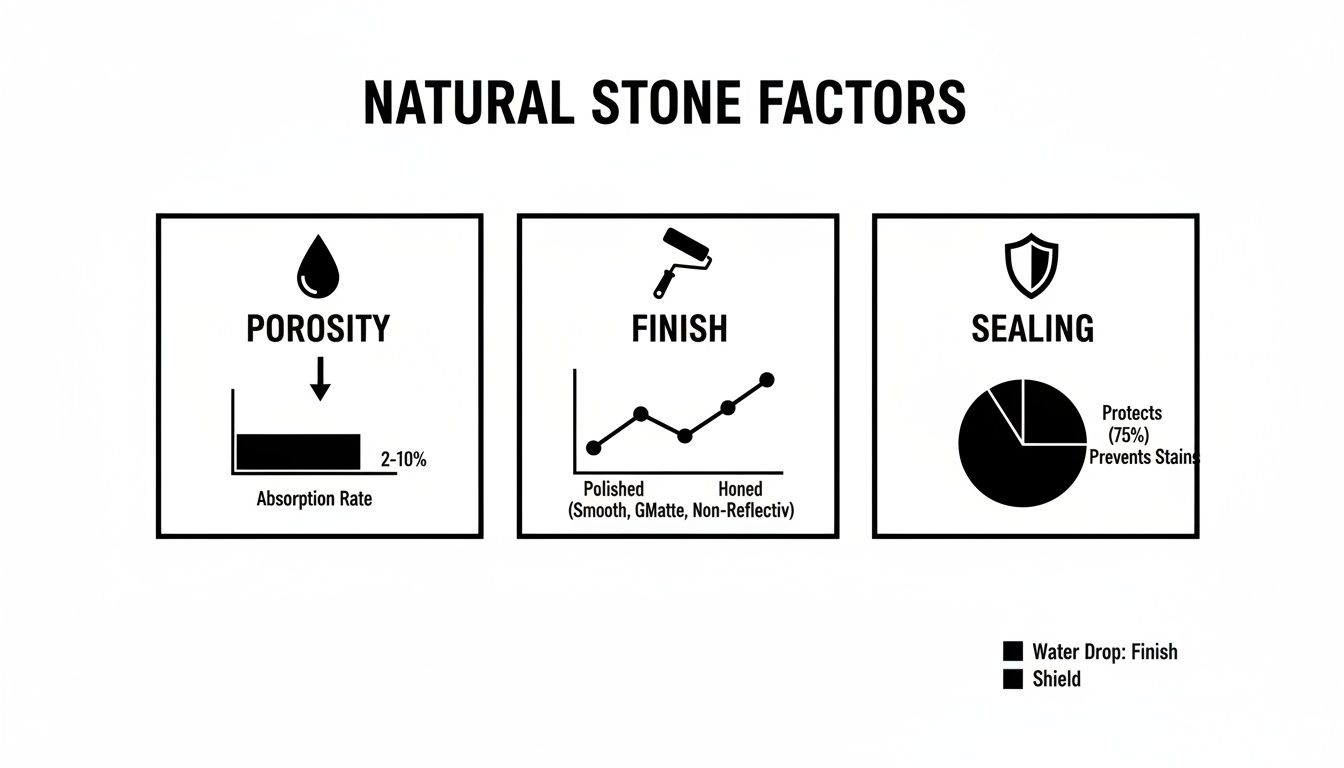
As the infographic highlights, these three elements work together. A successful project depends on getting this combination just right.
Natural Stone Water Absorption Rate Comparison
To see how this plays out with real materials, it helps to compare popular stones. The table below breaks down their typical absorption rates.
| Stone Type | Typical Water Absorption Rate (ASTM C97) | Porosity Level | Best Use in Wet Areas |
|---|---|---|---|
| Granite | < 0.4% | Low | Excellent for showers, countertops, and outdoor use. |
| Quartzite | 0.05% – 0.2% | Low | Superior performance in all wet environments; very durable. |
| Slate | < 0.4% | Low | Ideal for flooring, showers, and pool surrounds. |
| Marble | 0.5% – 2.0% | Medium | Good with proper sealing; best for vanities, tub surrounds. |
| Limestone | 1.0% – 8.0% | Medium to High | Requires diligent sealing; suitable for low-splash areas. |
| Travertine | 2.5% – 10%+ | High | Needs high-quality sealing and regular maintenance. |
| Sandstone | 1.0% – 6.0% | High | Best for outdoor applications away from constant water. |
This comparison makes it clear that not all stones are created equal. A dense granite is practically waterproof, while a beautiful travertine needs a good sealer to perform its best.
Grouping Stones by Porosity
We can simplify this by grouping stones into performance categories.
Low Porosity (Excellent Water Resistance): These are the workhorses. They absorb very little water and are great for high-moisture areas. Think Quartzite, Granite, and most Slate.
Medium Porosity (Good Water Resistance with Sealing): This category includes many timeless beauties. They perform well in wet spaces once they’re properly sealed. This is where most Marble and denser Limestone fall.
High Porosity (Requires Diligent Sealing): These stones have a more open structure. They demand a high-quality sealer and consistent maintenance. Travertine, many types of Limestone, and Sandstone belong here.
Knowing these differences is the first step toward choosing your stone with confidence. As you explore the various types of natural stone, keep porosity in mind.
How Stone Finishes Improve Safety and Performance
Understanding porosity is a critical first step, but the surface finish is just as important. The texture on the tile directly influences how it performs in wet areas.
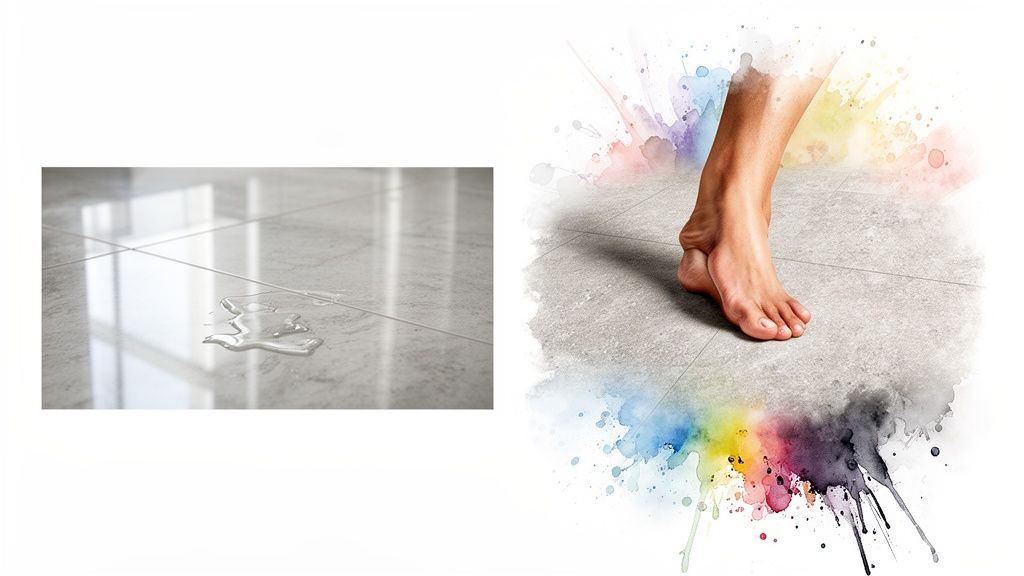
A high-gloss, polished finish can become dangerously slick on a wet bathroom floor. For high-moisture areas, finishes with more texture are essential for safety.
Beyond Beauty: The Functional Role of Texture
The finish on a tile changes how it interacts with water and your feet. A textured surface creates more friction, which we measure as slip resistance. In a shower, high slip resistance is non-negotiable.
Here are some common finishes and how they perform in wet environments:
- Polished: This glossy finish helps close the stone's pores. However, its smooth surface offers little grip, making it a poor choice for wet floors.
- Honed: A honed finish has a matte or low-sheen look. It provides much more slip resistance than polished stone, making it a safe choice for bathroom floors.
- Brushed: This finish creates a subtly textured surface with a soft feel. It offers excellent grip and is perfect for showers or outdoor patios.
- Tumbled: Tumbled stone has a rustic, aged look. Its textured surface provides outstanding traction, making it a go-to for pool decks.
Choosing a finish is a design decision. The soft feel of a honed limestone floor can complement a modern Bay Area aesthetic.
Key Takeaway: The right finish is a perfect marriage of safety and style. Textured finishes like honed or brushed provide the necessary grip for wet areas without sacrificing beauty.
Matching Finishes to Your Space
Think about how a space will be used to choose the right finish. A guest bath has different needs than a busy master shower. The goal is a surface that is both safe and beautiful.
For instance, a honed finish on marble offers a spa-like feel for a bathroom floor while ensuring secure footing. A brushed finish on travertine for a shower floor prevents slips and helps hide water spots.
By prioritizing texture, you can confidently use natural stone in any wet area. To explore these textures in person, you can learn more about how to choose the right stone finish for your space.
The Protective Power of a Quality Stone Sealer
If porosity and finish are the first two pillars, sealing is the final, essential step. A proper seal transforms a porous stone into a high-performance, water-resistant powerhouse.
Think of a quality impregnating sealer as an invisible shield. It dives deep into the stone’s pores to repel water and stains from within. This is what makes using limestone or travertine in a Palo Alto master bathroom practical.
Why Sealing Is Non-Negotiable
For porous stones in wet areas, sealing isn’t just a good idea—it’s a must. It's the single most effective way to protect your investment.
A quality sealer delivers on several fronts:
- Drastically Reduces Water Absorption: It acts as a barrier, stopping water from soaking in.
- Prevents Stains: It repels common bathroom culprits like soap and oils.
- Simplifies Cleaning: Dirt sits on the surface instead of getting trapped in pores.
- Preserves Natural Beauty: It protects the stone from water marks and etching.
A great seal also makes future effective tile and grout cleaning far less intensive.
From Porous to Protected: A Look at the Numbers
The impact of a good sealer is dramatic. Regular sealing is critical for porous stones, slashing their water absorption rate.
Tests show that properly sealed travertine can see its absorption rate drop from over 10% to under 1%. That puts it in a performance category similar to porcelain. More details on these performance metrics on smartfloorsusa.com are available online.
The Truth About Sealing: Sealing isn't complicated. It's a simple maintenance step that ensures your stone performs at its peak. It’s the key to achieving both timeless beauty and total peace of mind.
This protective layer makes water bead up on the surface instead of soaking in.
Maintaining the Shield: How Often to Reseal
How often a stone needs to be resealed depends on two things. These are the stone’s porosity and how much traffic the area gets.
A high-use master shower with porous travertine might need sealing every year. A denser granite on a guest bathroom vanity may only need it every three to five years.
The process is straightforward. For a complete overview, check out our guide on how to seal natural stone.
Matching the Right Stone to Your Wet Area
We've covered the science of porosity, finishes, and sealers. Now, let's put it all together. This is where the truth about natural stone tile and water resistance really matters.
Choosing the right stone is about matching its strengths to your space. A master shower used daily has different needs than a sun-drenched pool deck in Carmel.
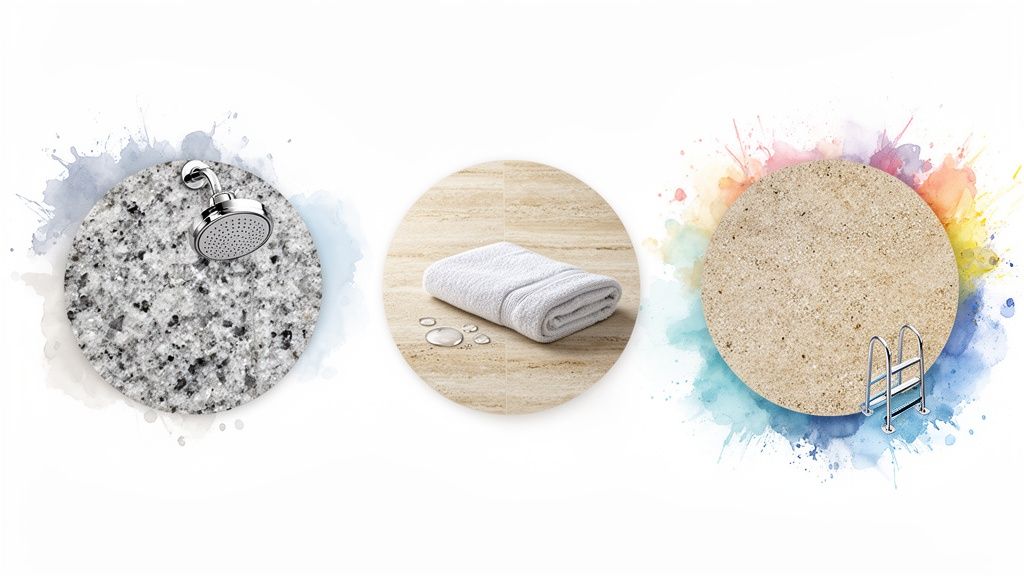
Recommendations for Key Wet Areas
Making the right choice is simpler when you break it down by area. Here are our recommendations for common wet areas in Northern California homes.
For Shower Walls: Density and low maintenance are your biggest priorities. Quartzite or a low-porosity Granite are excellent choices.
For Bathroom Floors: Safety is everything. A honed and sealed Travertine or Limestone offers a soft texture and secure footing.
For Shower Floors: This spot requires maximum grip. A tumbled Travertine mosaic is perfect. The extra grout lines and texture create outstanding traction.
For Steam Rooms: This environment needs a stone that can handle high heat and moisture. Dense Quartzite is the undisputed champion here.
For Outdoor Pool Decks: The stone must be slip-resistant and stay cool. Tumbled Travertine is a classic choice for its texture and heat-dissipating nature.
This same logic applies to outdoor hardscaping projects. The principles of porosity and finish are always critical.
Bringing Your Vision to Life
Seeing and feeling these stones and finishes in person is the most important step. A photo can't show you the rich depth of a hand-chiseled French limestone.
At Carmel Stone Imports, we believe in empowering our clients. We help you find stone that is perfectly suited for a Monterey poolside or a modern Palo Alto bath.
Our team lives and breathes stone. We can walk you through the options, explaining the unique character of each slab and tile.
The best way to really understand the nuances is to explore the options for yourself. For a deeper look, check out our guide on the best stone for shower walls.
Your Partner for Choosing Stone with Confidence
What's the big takeaway here? Natural stone is a fantastic choice for wet areas, but you need to understand it. The truth about natural stone tile and water resistance is not about avoiding certain stones.
Success comes down to the three pillars: porosity, finish, and sealing. When these are chosen correctly for your project, the results are beautiful and durable.
From Vision to Reality
Choosing a stone is a sensory experience. You need to see the veining and feel the texture to appreciate its character. That’s why we invite you to our showrooms.
At Carmel Stone Imports, we bridge the gap between your design vision and the perfect material. Our experts help you find a stone that fits your aesthetic and is suited for its environment.
Thinking about the right finish or sealer can feel overwhelming, but our team makes it easy. We give you the practical knowledge needed to choose confidently.
We will walk you through slip ratings, porosity levels, and maintenance needs for any stone you're considering. To see these options up close, you can visit a stone showroom near you and start turning your ideas into a plan.
Frequently Asked Questions
Here are some of the questions that come up most often, with our straightforward answers.
What is the best natural stone for a shower?
For shower walls, dense stones like quartzite and granite are excellent choices because they absorb very little water. For shower floors, a honed or tumbled finish on travertine or limestone provides great slip resistance.
Is sealing natural stone difficult?
Not at all. Sealing is a simple process that you can do yourself. It usually involves cleaning the surface, applying the sealer with a cloth or brush, letting it soak in, and wiping away the excess.
Can I use limestone in a bathroom?
Yes, limestone can be a beautiful choice for bathrooms when selected and cared for properly. A honed finish provides better grip for floors, and consistent sealing is essential to protect it from water absorption and stains.
How do I know if my stone needs to be resealed?
A simple water test can tell you. Sprinkle a few drops of water on the surface. If the water beads up, your sealer is still working. If it soaks in and darkens the stone, it’s time to reseal.
Which is more water-resistant, granite or marble?
Granite is naturally more water-resistant than marble. Granite has a very low porosity (typically under 0.4% absorption), while marble is more porous (0.5% – 2.0%). Both perform well in wet areas when sealed correctly.
Want help choosing the right natural stone tile for your next bathroom or spa project? Visit a Carmel Stone showroom in Palo Alto, Sand City, or Carmel—our team will help you choose confidently and install with clarity. https://carmelimports.com