It's the most common question in any kitchen remodel: "So, how much do porcelain slabs cost?" But getting a straight answer can be frustrating, often leaving homeowners feeling confused and unsure if they are getting a fair price.
This guide will explain why pricing isn't always simple. We will cover the factors that affect cost and give you the confidence to navigate the process like a pro.
Why Getting a Straight Answer on Porcelain Slab Pricing Is So Hard
Have you ever asked for the price of a porcelain slab and received a vague answer? If so, you're not alone. It’s a common frustration for homeowners planning projects in areas like Monterey and Palo Alto.
Many customers feel left in the dark because suppliers refuse to discuss pricing upfront. According to online forums, homeowners are often told to "ask your fabricator," which creates a frustrating lack of transparency. This leaves people unsure if they’re getting fair treatment or being upsold.

Common Missteps in Pricing Expectations
Many people assume slab pricing works like tile or wood flooring, where you get a simple square-foot rate. However, porcelain slabs are different. Their final cost is tied to several factors that a supplier needs to understand before giving you an accurate estimate.
Not knowing this can lead to unrealistic expectations or sticker shock later on. Understanding the key variables is the first step toward a realistic budget.
What Influences the Initial Cost
Several key variables determine what a porcelain slab costs before it leaves the warehouse. Here's a quick breakdown of the main factors.
| Influencing Factor | How It Affects the Price |
|---|---|
| Slab Origin & Quality | A premium slab from a renowned Italian design house will cost more than a standard one. |
| Size & Thickness | Larger and thicker slabs use more raw material and are more complex to handle and ship. |
| Finish & Complexity | A simple matte finish is more budget-friendly than a high-gloss polish or an intricate design. |
A good partner will walk you through what each of these means for your project. To put it all in perspective, it's helpful to understand the average cost of a kitchen renovation so you know where your slab budget fits.
At Carmel Stone Imports, we offer transparent, educational guidance. Our team explains how porcelain slab pricing works and welcomes homeowners to browse slabs in person, without pressure.
The Key Factors That Determine Porcelain Slab Costs
Trying to pin down the exact cost of porcelain slabs for a kitchen remodel can feel like a moving target. The final material price is shaped by several key factors. Getting a handle on these elements is the first step toward building a realistic budget.
Let’s break down what really drives the price you’ll see on an estimate.
Brand, Origin, and Quality
Not all porcelain is created equal. The brand and country of origin play a huge role in the final cost.
- Italian and Spanish Brands: These are widely considered the gold standard. They’re known for cutting-edge technology that creates hyper-realistic veining and patterns. This reputation for quality means they command a premium price.
- Other Manufacturers: While many other countries produce excellent porcelain, the material cost can often be lower. These options are perfect for projects on a tighter budget.
At Carmel Stone Imports, we specialize in exclusive imported lines you won't find in big-box stores. This gives Bay Area homeowners direct access to world-class design and quality.
Slab Thickness and Durability
The thickness of a porcelain slab is another critical piece of the cost puzzle. For countertops, the standard thicknesses are typically 12mm (1.2cm) and 20mm (2cm).
A 12mm slab is robust enough for most kitchen applications. Thinner slabs, like 6mm, are generally reserved for wall cladding or backsplashes. A thicker slab costs more because it uses more raw material and requires a more intensive manufacturing process.
A common misstep is assuming slab pricing works like tile or flooring. You can learn more about how slabs and tiles differ in our detailed guide on porcelain slab tiles.
Finish, Texture, and Complexity
Finally, the slab's finish and the complexity of its design are major price drivers. A simple, solid-color slab with a basic matte finish will always be your most budget-friendly option.
The price climbs as you move into more intricate designs and finishes. This includes things like:
- Polished or Honed Finishes: These require extra manufacturing steps to create smooth, reflective, or velvety surfaces.
- Textured Finishes: Finishes that mimic the feel of leathered or chiseled stone involve advanced production techniques that add to the cost.
- Book-Matched Patterns: Slabs with dramatic, continuous veining that can be mirrored are premium products. The artistry and precision needed to create that seamless flow adds considerable value.
Understanding Porcelain Slab Price Tiers
When you start shopping for porcelain slabs, it helps to think of them in different price tiers. Breaking it down this way—entry-level, mid-range, and premium—is the easiest way to connect your design dreams with a realistic budget.
Each category has its own characteristics, from design complexity to where the slab was made. Knowing what defines each tier means you can walk into a showroom with confidence.
This visual breaks down the key factors that determine which tier a slab falls into.
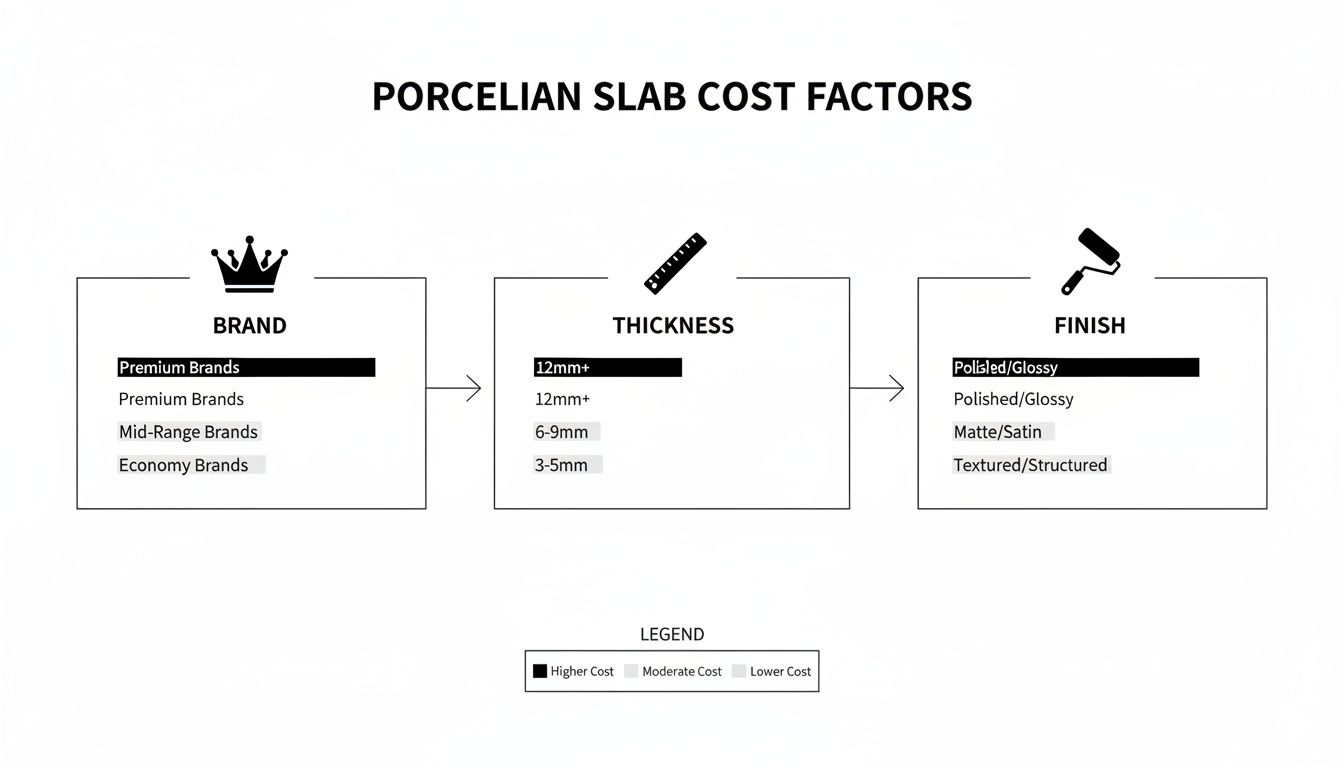
As you can see, the final material cost is a blend of brand reputation, slab thickness, and the intricacy of the finish.
Porcelain Slab Material Cost Tiers
This table gives you estimated material-only price ranges for different porcelain slab tiers, making it easier to budget for your kitchen countertops.
| Price Tier | Estimated Material Cost (Per Sq. Ft.) | Common Characteristics |
|---|---|---|
| Entry-Level | $35 – $55 | Solid colors, simple patterns, standard matte finish. Domestic production is common. |
| Mid-Range | $55 – $85 | More complex patterns like subtle marble veining or concrete textures. Multiple finish options (e.g., honed, textured). |
| Premium | $85 – $150+ | Dramatic, book-matched veining, exclusive designs from high-end Italian brands, advanced finishes (e.g., high-gloss polish). |
These figures are a great starting point for estimating your material expenses.
Entry-Level Slabs
Entry-level porcelain slabs are your most budget-friendly route to a clean, modern look. For homeowners in San Jose or Monterey, these are a fantastic starting point.
- Characteristics: You'll mostly find solid colors here—think classic whites, grays, or beiges—or very simple, subtle patterns.
- Finishes: The go-to finish in this tier is a standard matte, which is both stylish and practical.
- Best For: These slabs are perfect for projects where functionality and cost-effectiveness are the main goals.
Mid-Range Slabs
Step up to the mid-range, and a new world of design possibilities opens up. This tier is the sweet spot for many homeowners, balancing style and cost.
This is where you'll find designs with subtle veining that mimics classic marble or soft, concrete-like textures popular in modern Bay Area homes. You can explore the differences between popular materials like granite, quartz, and porcelain to see what fits your lifestyle best.
In the mid-range, you see the power of advanced digital printing. The patterns become far more realistic, giving you that convincing natural stone look without the maintenance.
Premium and Luxury Slabs
At the top of the market are premium and luxury slabs. These are the showstoppers, often imported from the world's leading design houses in Italy.
- Characteristics: Expect dramatic, large-scale veining that flawlessly replicates rare marbles like Calacatta Gold or Statuario.
- Finishes: Here you’ll find advanced finishes, from a high-gloss polish to richly textured surfaces that feel like honed natural stone.
- Book-Matching: Many premium slabs are designed for book-matching. This is a high-end technique where two adjoining slabs mirror each other, creating one continuous, symmetrical pattern.
How Slab Size and Waste Factor Into Your Budget
Beyond the finish and brand, the dimensions of the porcelain slabs play a huge role in your total material cost. Making a smart choice here can dramatically reduce waste and minimize seams.
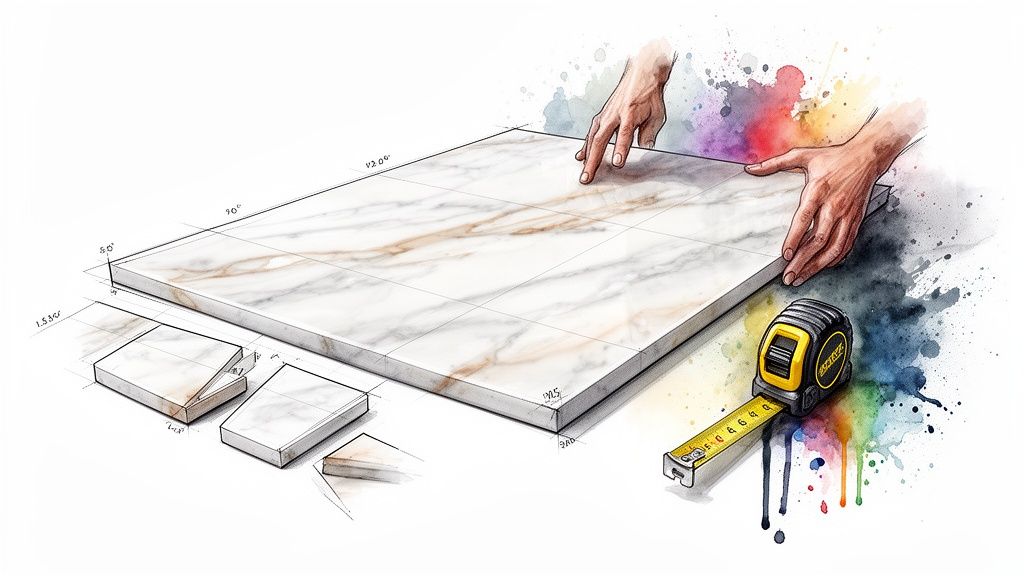
Getting familiar with size options is the first step in planning a cost-effective project. This knowledge is key when figuring out how much porcelain slabs cost for kitchen remodels.
Standard vs. Jumbo Slabs
Porcelain slabs are generally sold in two main size categories: standard and jumbo. The difference is significant.
- Standard Slabs: These typically measure around 126 x 63 inches. They work well for most countertop runs and smaller kitchen islands.
- Jumbo Slabs: These often exceed 128 x 78 inches. They're perfect for large kitchen islands in modern Palo Alto homes, giving you a seamless look.
While a jumbo slab might have a higher price tag, choosing one could save you from buying an entire second slab just to cover a small remaining section.
Calculating Yield and the Inevitable Waste Factor
When putting together a budget, one of the most critical concepts is yield. This is the amount of usable countertop surface you can get from a single slab.
No matter how perfectly your kitchen is planned, there will always be leftover material from cuts. This unusable portion is known as waste.
As a rule of thumb, you should always factor in a 10-15% waste factor when calculating how much material you need. Forgetting this is a common budgeting mistake.
To get a quick estimate of how many slabs your project will require, follow these simple steps:
- Calculate Your Total Square Footage: Measure the length and width of all countertop surfaces and add them together.
- Add the Waste Factor: Multiply your total square footage by 1.15 (for a 15% waste factor).
- Determine Slabs Needed: Divide that adjusted number by the square footage of a single slab (e.g., a 126"x63" slab is about 55 sq. ft.).
This calculation helps you have a clearer discussion with your supplier. For a deeper dive, explore our guide to large format porcelain slabs.
How to Get a Clearer Price Estimate from Suppliers
To get a real price estimate, you need to have a productive discussion about your specific project. By asking smarter questions, you empower suppliers to give you a much more accurate picture of the costs involved.
Shift Your Questions for Better Answers
Start by asking the supplier to walk you through the factors that affect cost. Even if you don’t get an exact quote, a trustworthy showroom will help you understand what contributes to pricing. Be upfront about your project size and timeline to get more accurate ballparks.
Here are a few powerful questions to get the conversation rolling:
- "What are the main cost differences between these two slabs?"
- "Can you show me options across different price tiers that would fit my design?"
- "Based on my rough measurements, what factors will have the biggest impact on my material budget?"
By framing your questions this way, you’re not just asking for a number; you’re asking for education. This is a core part of a smarter way to shop for porcelain slabs.
Come Prepared for a Productive Visit
A little preparation goes a long way. When you arrive with key details, the supplier’s team can provide better guidance.
Before you go, try to gather these essentials:
- Rough Measurements: Bring a simple sketch of your kitchen layout with approximate dimensions.
- Design Inspiration: Have a few photos or a mood board of the styles and colors you like.
- Appliance Specs: Know the general locations for your sink and cooktop.
If you’re remodeling in San Jose, San Francisco, or anywhere along the Central Coast, visit one of Carmel Stone’s three showrooms. You can speak with a real expert and see full porcelain slabs—not just samples—to plan with clarity and confidence.
Partnering With Experts for a Transparent Remodel
Getting a handle on porcelain slab pricing doesn't have to be confusing. The key is finding a supplier who prioritizes transparency and education. A true partner empowers you to plan your kitchen with complete confidence.

Before you get lost in the details, it helps to zoom out. Getting a grasp of the big picture by understanding kitchen remodel costs in general will help you see where your slab budget fits.
At Carmel Stone Imports, we designed our showrooms in Palo Alto, Carmel, and Sand City to be educational resources. Our team explains how porcelain slab pricing works and welcomes homeowners to browse our exclusive imported lines you won’t find in big-box stores.
If your project is in San Jose, San Francisco, or anywhere along the Central Coast, we invite you to start your journey with a team dedicated to clarity.
Frequently Asked Questions
Even after breaking down the numbers, a few common questions always pop up. Let's clear the air on some of the most frequent ones we hear from homeowners.
Are porcelain slabs more expensive than quartz or granite?
It’s surprisingly competitive. The material cost for porcelain slabs lines up very closely with mid-to-high-end quartz and many popular granites. Premium porcelain often delivers a luxury look with superior performance for a comparable investment.
Does the pattern on a porcelain slab affect its price?
Yes, absolutely. A slab with a simple, uniform color is less complex to produce than one with intricate, book-matched veining. The advanced technology required to create stunning, realistic patterns is a major factor in the material's final cost.
Why can't I just buy porcelain slabs online?
Because every slab is unique, and photos don't do them justice. A picture can't capture the true depth of color, subtle textures, or the way a pattern flows. Visiting a showroom in the Bay Area is the only way to ensure the slab you choose is exactly what you envision.
Do I have to buy the entire slab even for a small kitchen?
In almost every situation, yes, you'll need to purchase the whole slab. Suppliers sell porcelain in full-slab formats because the leftover pieces, or remnants, are often too small to be useful for other projects. The best way to handle this is to plan your layout carefully to maximize the material.
Is thicker porcelain always more expensive?
Generally, that's the case. A thicker 12mm slab requires more raw material and energy to produce than a 6mm slab, and that increase is reflected in the price. However, that extra thickness provides greater durability, which is important for high-use areas like kitchen islands.
Ready to explore the perfect porcelain slab for your kitchen? The experts at Carmel Stone Imports are here to provide transparent guidance and help you find a stunning surface that fits your budget and style. Visit one of our showrooms today to see our collection in person. https://carmelimports.com