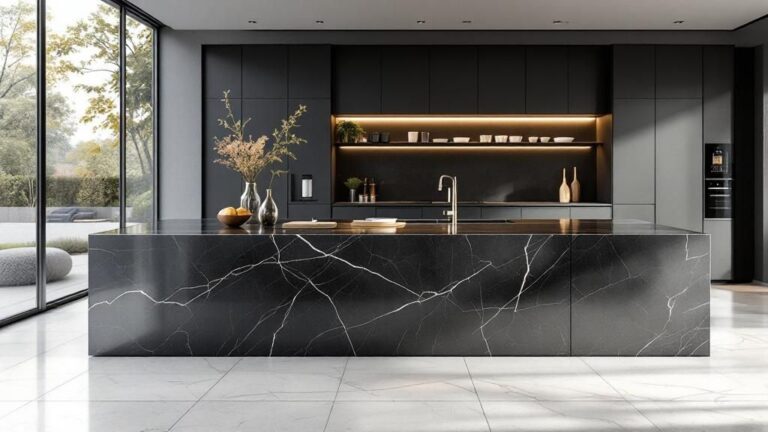
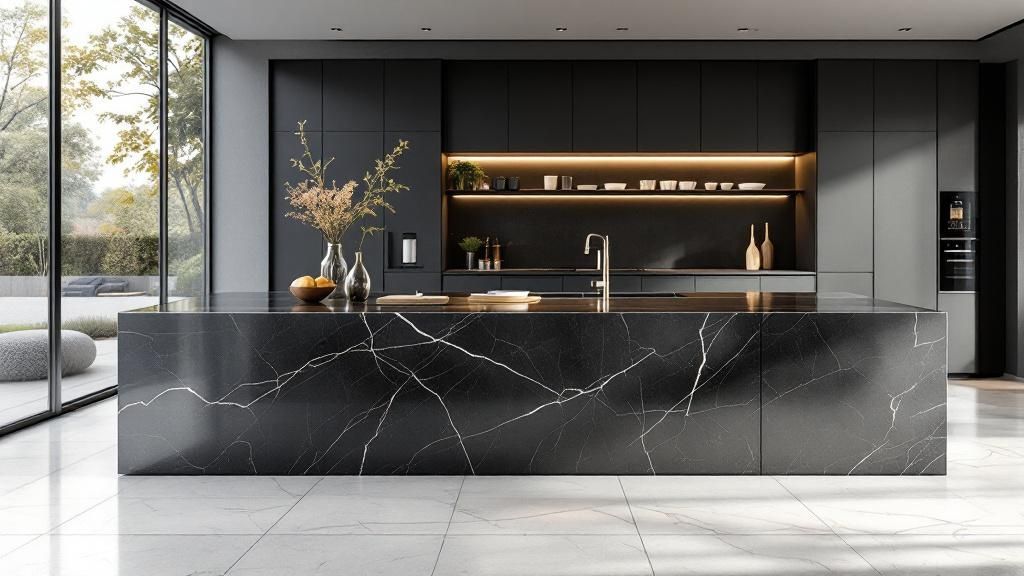
Picture a kitchen island crafted from a single, seamless piece of stone, or a shower wall that flows without a single grout line to break the view. Imagine a fireplace that stands as one dramatic, monolithic feature. This isn't a design fantasy; it's the new reality that large format porcelain slabs are bringing to modern homes. This guide covers how they deliver incredible durability, next-to-zero maintenance, and a breathtaking aesthetic that's changing the game for Bay Area homeowners and designers alike.
Why Porcelain Slabs Are Redefining Modern Spaces
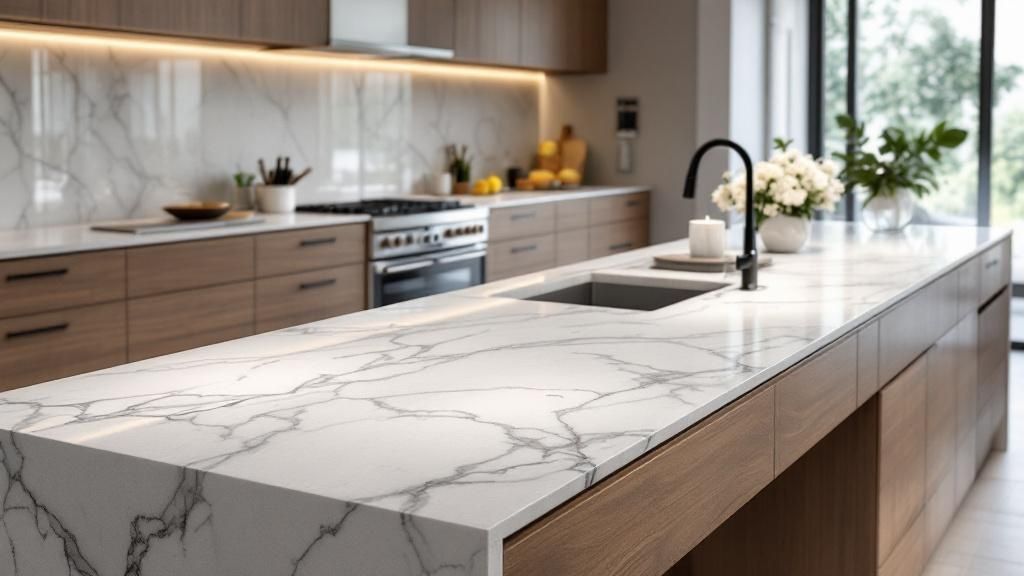
The buzz around large format porcelain slabs signals a major evolution in how we think about surfaces, both inside and out. For years, designers and homeowners had to accept the visual grid created by grout lines. Now, these massive slabs offer an escape, creating clean, expansive surfaces that transform a space from standard to stunning.
Think of them as a giant, super-strong canvas for your home. They can perfectly replicate the look of the world's most coveted natural stones—like the soft veining of marble or the texture of limestone—without the fragility or upkeep. From sleek Palo Alto residences to high-end commercial projects across the Bay Area, the appeal is undeniable.
The Growing Demand for Seamless Surfaces
The numbers tell the story. The global market for large format porcelain is projected to be valued at around $15 billion in 2025, and it’s not slowing down. According to industry analysis, a projected compound annual growth rate of about 7% through 2033 means the market is on track to soar past $28 billion.
This explosive growth is fueled by our love for minimalist design and incredible leaps in manufacturing technology. Porcelain's durability also makes it one of the top sustainable building materials for modern homes because you won't need to replace it for decades, a key consideration for environmentally conscious California projects.
Large format porcelain hits the ultimate design trifecta: scale, performance, and beauty. It gives architects and designers the freedom to think bigger, creating those continuous, jaw-dropping surfaces that used to be impossible without a web of distracting seams.
Beyond Aesthetics: The Practical Appeal
Of course, the appeal of these massive slabs goes far beyond just looking good. Homeowners and builders are flocking to porcelain for its sheer practicality, a point we dive into in our post about https://carmelimports.com/blog/why-san-jose-and-bay-area-residents-are-renovating-with-porcelain-floor-and-wall-tile/. Because the material is non-porous, it’s a game-changer for kitchens, bathrooms, and other areas where hygiene and easy cleanup are non-negotiable.
In the end, large format porcelain slabs offer a brilliant solution that combines the epic look of quarried stone with the unmatched resilience of advanced engineering. They are proof of how innovative materials can completely reshape our homes, opening up a world of possibilities for creating clean, luxurious, and incredibly practical spaces.
The Practical Advantages of Porcelain Slabs
While the seamless, jaw-dropping look of large format porcelain slabs is what usually turns heads first, their real genius is in how they perform day in and day out. These slabs aren't just for show. They're built to handle the chaos of real life, making them a brilliant choice for everything from bustling family homes in Monterey to high-traffic commercial spaces.
The secret is in the manufacturing process. Fine clays and minerals are baked at extreme temperatures, creating a surface so dense it’s practically non-porous. This process gives porcelain its famous toughness and a whole roster of benefits that other materials just can't touch.
Unmatched Hygiene and Stain Resistance
The non-porous surface of porcelain is its true superpower. Unlike natural stone with its microscopic pores that can trap moisture and bacteria, porcelain creates a completely sealed barrier. This makes it one of the most hygienic surfaces you can install in a kitchen, bathroom, or any area where cleanliness is non-negotiable.
This density also means it’s incredibly resistant to stains. Spills like red wine, coffee, or even olive oil bead up on the surface instead of soaking in. Cleanup is a simple wipe away, without the nagging fear of a permanent mark.
The key to porcelain’s performance is its incredibly low water absorption rate, which is typically less than 0.5%. This essentially makes it waterproof, which is a massive win for preventing mold, mildew, and bacteria in damp environments.
Better yet, porcelain slabs never need to be sealed. This is a huge leg up on natural stone, which requires regular resealing to keep it from absorbing stains and moisture. We dive deeper into this in our guide on how porcelain slabs can save you time, work, and money over the years.
Built for Durability and Daily Life
Porcelain’s strength is more than just skin deep. It’s engineered to take a beating, whether it's in a busy family kitchen or a demanding commercial project in the Bay Area.
Key Durability Features:
- Scratch and Abrasion Resistance: The surface is fired so hard that it's extremely difficult to scratch. It easily stands up to the daily grind of dropped keys, sliding cookware, and even knife slips.
- Heat Resistance: Go ahead and place a hot pan directly on your porcelain countertop. It won't scorch, burn, or discolor—a major advantage over materials like quartz that can be damaged by direct heat.
- UV Stability: Porcelain is completely unfazed by ultraviolet light. Its color won't fade or yellow over time, making it perfect for sun-drenched California rooms and even outdoor kitchens.
- Chemical Resistance: It holds up beautifully against common household cleaners and chemicals, so you don't have to worry about damaging the finish.
The Best of Both Worlds: Beauty and Brawn
Maybe the most impressive thing about large format porcelain slabs is how they manage to be both incredibly beautiful and ridiculously tough. Thanks to sophisticated digital printing, manufacturers can now recreate the delicate, flowing veins of Calacatta marble, the soft textures of limestone, or the dramatic patterns of exotic granite with stunning realism.
This technology allows for multiple unique designs, so even on large installations, you won’t see obvious repeating patterns. It looks and feels natural. You can finally get that high-end, designer look you've been dreaming of without any of the maintenance headaches.
Endless Design Possibilities for Your Project
The real magic of large format porcelain slabs is how they empower you to think bigger and create spaces that truly break the mold. Their sheer size gives you a massive, uninterrupted canvas to work with. Picture a kitchen island topped with a single, flowing slab of faux marble or a shower wall that feels like it was carved from one solid piece of stone.
This isn't just a niche trend; it's a significant shift in the industry. The market for large-format ceramic panels, where porcelain is the clear leader with a 57.4% share, is expected to skyrocket from $90.9 billion in 2024 to an incredible $178.8 billion by 2034 according to market reports. Homeowners are driving this wave, with the residential sector accounting for 47.1% of the market, as more people choose these premium materials for their durability and stunning looks.
Kitchen Countertops and Islands
The kitchen is where most people first fall in love with large format porcelain, and it's easy to see why. As the most popular application, countertops make up 36.1% of the market. A single, sweeping slab creates a gorgeous, grout-free work surface that’s as practical as it is beautiful.
An island made from a porcelain slab instantly becomes the heart of the kitchen. The continuous pattern flows from edge to edge, creating a clean, monolithic look that's hard to achieve with smaller tiles or even some natural stones. Our guide on porcelain slab countertops digs deeper into why they're such a smart choice for any modern kitchen.
Spa-Like Bathrooms and Showers
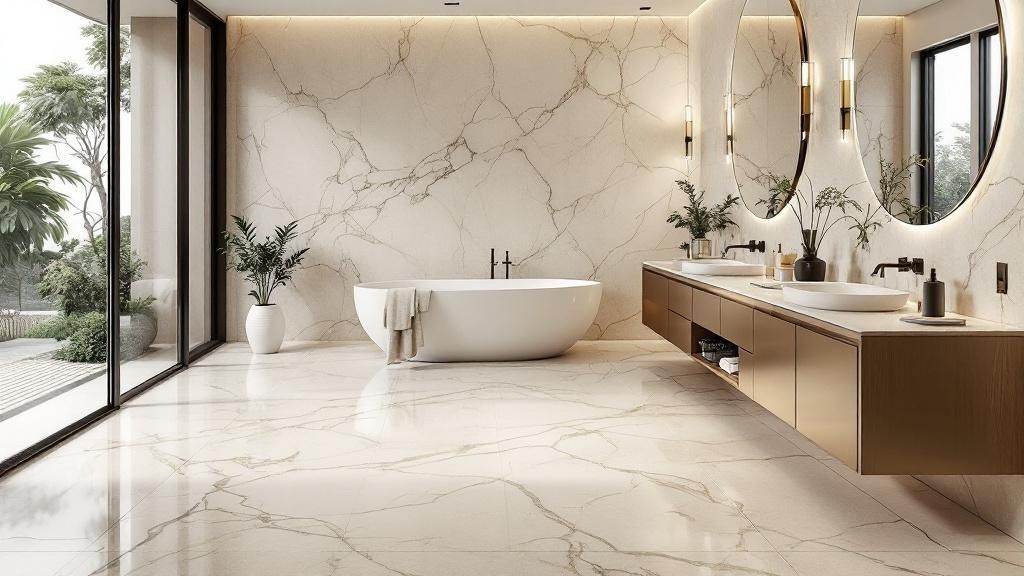
Nowhere does large format porcelain make a more dramatic statement than in the bathroom. When you wrap shower walls, floors, and vanity tops in the same material, you create an immersive, sanctuary-like space that feels incredibly high-end.
- Seamless Shower Walls: Getting rid of grout lines isn't just a design choice; it's a practical one. It gives you a sleek, unbroken visual while eliminating the number one spot for mold and mildew to grow.
- Monolithic Floors: Using the same oversized slabs on the floor ties the whole room together, making it feel more expansive and cohesive. It's a go-to trick for creating a sense of luxury in coastal California homes.
- Custom Vanities: Fabricating a vanity from the same porcelain as the walls gives you a truly custom, built-in aesthetic that feels thoughtful and deliberate.
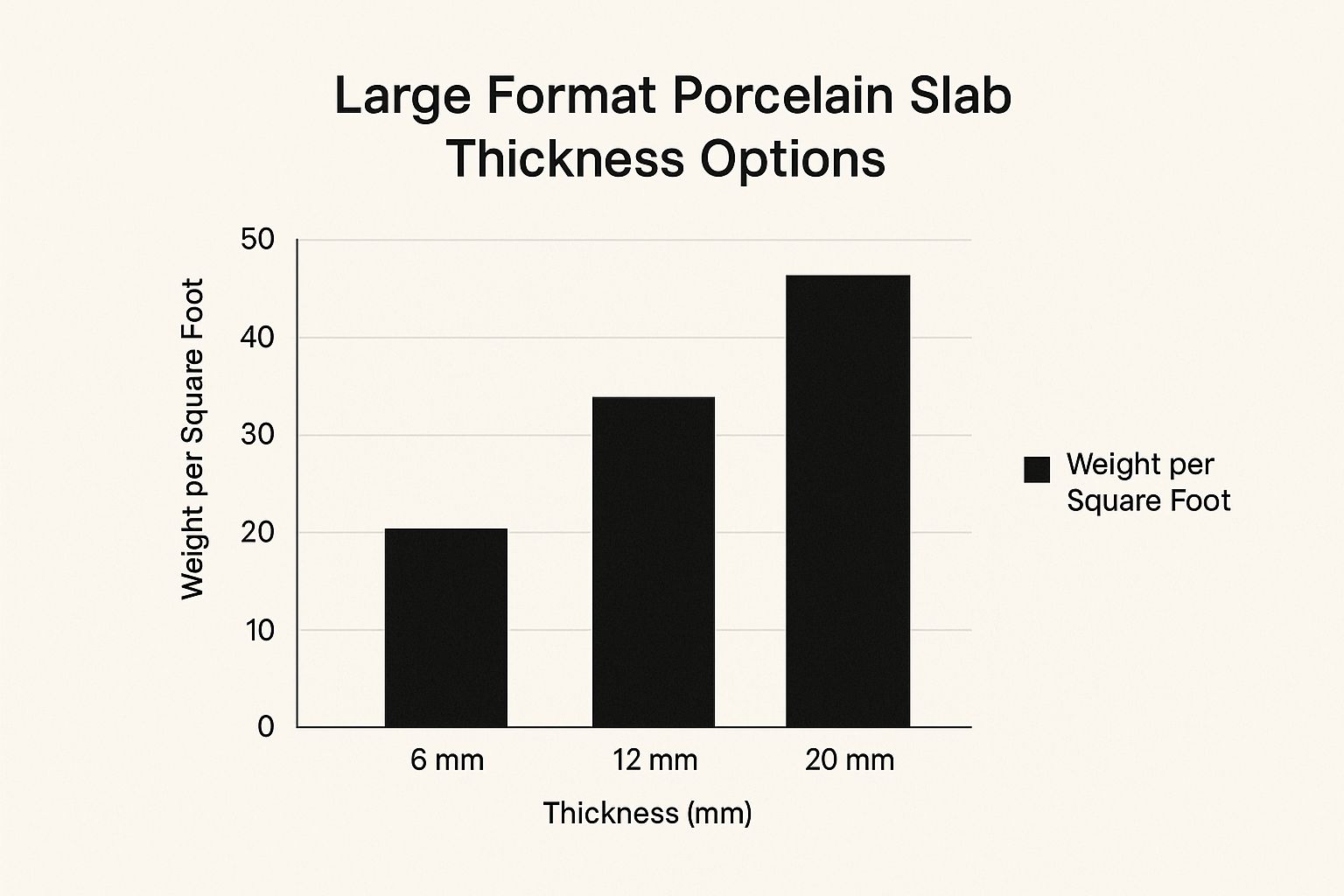
The image above breaks down common thicknesses and their applications. As you can see, the robust 20 mm slabs are perfect for hardworking countertops, while the lighter 6 mm slabs are ideal for wall cladding where weight is a bigger factor.
Large Format Porcelain vs Traditional Materials
| Feature | Large Format Porcelain | Natural Stone (e.g., Marble) | Standard Tiles |
|---|---|---|---|
| Grout Lines | Virtually none; seamless look | Some seams depending on slab size | Many, requiring regular maintenance |
| Porosity | Non-porous; stain-resistant | Porous; requires sealing, prone to staining | Grout is porous and stains easily |
| Durability | High; scratch, heat, & UV resistant | Can scratch, chip, and etch | Can chip or crack; grout can degrade |
| Design Consistency | Uniform and predictable patterns | Unique, but can have unpredictable veins | Repetitive patterns can look busy |
| Maintenance | Very low; easy to clean | High; requires special cleaners and resealing | High; grout requires frequent scrubbing |
This comparison really highlights the practical wins of porcelain. You get the high-end look of natural stone without the high-maintenance headaches, and you achieve a sophisticated, seamless finish that standard tiles just can't match.
Feature Walls and Fireplace Surrounds
Don't just think horizontally. Large format porcelain is stunning when used vertically, creating breathtaking feature walls that can define an entire room. Imagine a floor-to-ceiling slab behind a sofa or in an entryway—it becomes a work of art.
Fireplace surrounds are another perfect fit. Porcelain is naturally fire- and heat-resistant, so it's a safe and durable choice. Plus, with designs that mimic everything from rich, veiny marble to raw industrial concrete, you can make a powerful design statement that anchors the space.
Durable Exterior Cladding and Patios
One of porcelain's biggest strengths is its ability to move seamlessly from inside to out. It’s incredibly resilient and UV-stable, meaning its colors won't fade or yellow, even after years of enduring Monterey weather.
This opens up a world of possibilities for:
- Exterior Facades: Cladding your home's exterior with porcelain slabs creates a sleek, modern, and weather-resistant shield that holds up beautifully.
- Outdoor Kitchens: Build a complete outdoor kitchen with porcelain countertops that won't be fazed by spills, sun, or rain.
- Seamless Patios: Use large porcelain pavers that match your interior flooring to create that coveted indoor-outdoor flow, blurring the line between your living room and your backyard.
How to Choose the Perfect Porcelain Slab
This is where the fun really begins. Picking out the perfect large format porcelain slab is the moment your design vision starts to become a reality. But it’s more than just falling in love with a pattern; it's about making sure that beautiful slab works for your lifestyle and project needs.
We'll walk you through the key considerations—from the surface finish to the slab’s thickness—so you can make your choice with total confidence. After all, a slab destined for a busy kitchen island has to perform differently than one used as a dramatic feature wall.
Finding Your Finish: Polished vs. Matte
One of the first decisions you'll face is the finish. This single choice dramatically influences not only the look and feel of your room but also its daily functionality.
- Polished Finish: If you're after a touch of glamour, a high-gloss polished surface is hard to beat. It reflects light beautifully, making any space feel bigger, brighter, and more luxurious. This is a fantastic choice for creating that show-stopping effect, especially with slabs that mimic classic marbles like Calacatta.
- Matte or Honed Finish: For an understated, contemporary feel, a matte finish is the way to go. It offers a soft, natural elegance by absorbing light instead of reflecting it. This creates a more organic look, is brilliant at hiding smudges, and offers better slip resistance, making it practical for floors in high-traffic homes.
A simple rule of thumb? Think about the room's main job. For a high-impact kitchen backsplash or an eye-catching feature wall, a polished finish delivers the drama. For an entryway or bathroom floor, a matte finish provides better slip resistance and gracefully handles the realities of daily life.
Selecting the Right Slab Thickness
Slab thickness isn't just a technical spec—it’s directly tied to your surface's strength and application. While your fabricator is your expert guide here, knowing the basics helps you be a more informed part of the conversation.
The two most common thicknesses for large format porcelain slabs are 12 mm (about 1/2 inch) and 20 mm (about 3/4 inch). You might also come across thinner 6 mm slabs, which are typically reserved for wall cladding or covering cabinet fronts where keeping weight down is the top priority.
Common Thickness Applications:
- 12 mm Slabs: This is the versatile workhorse. It’s strong enough for most countertops, backsplashes, and wall installations, making it a go-to for many projects.
- 20 mm Slabs: When you need extra strength, the 20 mm slab is the answer. Its added rigidity makes it the top choice for hardworking kitchen islands, outdoor counters, or any design that calls for a thick, substantial edge profile.
Coordinating with Your Design Palette
A porcelain slab is a star player in your design, but it has to work with the rest of the team. To create a space that feels cohesive and intentional, you need to see how your slab choice interacts with your other materials.
Always bring samples of your cabinetry, flooring, and paint swatches with you when you visit a showroom. Most importantly, you must see the full slab in person. A small sample simply can’t convey the true scale of the pattern or the way light dances across the surface. Visiting a Carmel Stone Imports showroom in Palo Alto showroom or Carmel is the best way to visualize how it will look in your home. Our guide on choosing between natural stone or porcelain slabs for your home offers more tips.
Why Pro Installation and Fabrication Is Non-Negotiable
Getting that flawless, magazine-worthy finish comes down to expert execution. The sheer size and weight of large format porcelain slabs put their installation in a league of its own. This isn't a weekend DIY job; it’s a specialized craft that absolutely requires a professional fabricator and installer.
Moving these oversized pieces requires specific equipment and a deep understanding of how the material behaves under stress. Without the right gear and know-how, the risk of chipping, cracking, or a failed bond skyrockets, potentially ruining your investment.
The Specialized Tools of the Trade
The journey from a raw slab to a seamless countertop is a delicate dance of precision. Smaller tiles can be forgiving, but large format slabs show everything. Professionals bring a whole different set of tools to the job.
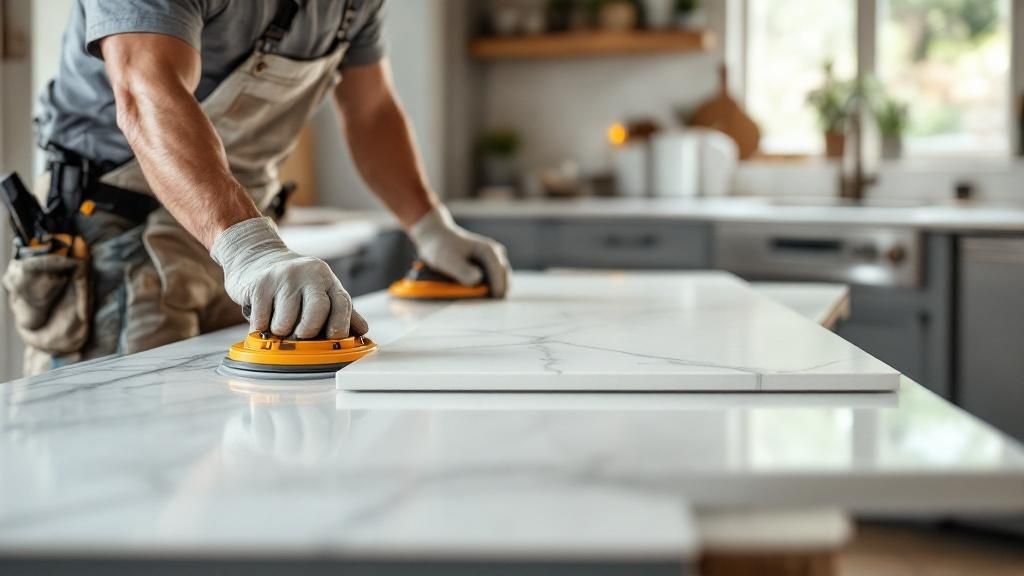
- Reinforced Carrying Frames: These rigid exoskeletons attach with suction cups and distribute the slab's weight evenly, preventing it from bending and developing stress fractures during transport.
- High-Capacity Suction Cups: These industrial-strength tools let the team lift and maneuver a heavy slab into place without ever touching the fragile edges.
- Specialized Cutting Tools: To get those clean, perfect cuts for sinks and outlets, fabricators use serious equipment like a water-jet cutter or a diamond-bladed bridge saw.
Steps to a Flawless Finish
A professional installer's job starts long before they even bring the slab to your house. An expert team will first check that the substrate—whether it's your kitchen cabinets or a subfloor—is perfectly level and can support the weight.
The industry has a golden rule for flatness: the surface underneath can't have a variation of more than 1/8 of an inch over a 10-foot span. Anything more creates tension points that can lead to cracks down the road.
Then comes the most critical step: back-buttering. A full coat of a specialized, polymer-modified mortar is troweled onto the entire back of the slab and the installation surface. This achieves 100% mortar coverage, eliminates air pockets, and ensures the slab is fully supported for decades. When you work with a trusted supplier like Carmel Stone Imports, we can connect you with a network of fabricators who handle these details perfectly.
Simple Care for Lasting Porcelain Surfaces
One of the best things about large format porcelain slabs is how incredibly easy they are to live with. You can forget about complicated cleaning schedules or stocking up on specialty products. Keeping these surfaces looking brand new is refreshingly simple.
The secret lies in porcelain's dense, non-porous structure, which acts as a powerful shield against the messes of everyday life.
Daily Upkeep and Spill Management
For daily cleaning, all you need is a soft cloth, warm water, and a drop of pH-neutral soap. This gentle combination is perfect for wiping away spills and crumbs without ever damaging the slab’s beautiful finish.
Because porcelain is so non-porous, liquids like red wine or coffee can't penetrate the surface. They just sit on top, waiting to be wiped away. A quick wipe is usually all it takes to leave the surface spotless.
What to Avoid for a Lifetime Finish
While porcelain is tough, using the wrong tools can harm its finish over time. Sticking to the right supplies is key.
- Avoid Steel Wool: Never use steel wool or other abrasive scouring pads. They can create tiny scratches that will eventually dull the surface.
- Skip Harsh Chemicals: There's no need for cleaners containing bleach or harsh acids. They’re overkill and can compromise the slab's integrity.
- Use Soft Cloths: Microfiber cloths and soft sponges are the ideal tools for both everyday wipes and cleaning up tougher messes.
If you want a more detailed breakdown, you can learn more about how to clean porcelain countertops in our complete guide. It covers everything you need to know for total peace of mind.
Frequently Asked Questions
Making a big decision for your home in Monterey, Palo Alto, or anywhere in the Bay Area comes with questions. We've gathered the most common queries we hear from clients and provided straight-to-the-point answers to help you feel confident in your choice.
Are large format porcelain slabs more expensive than natural stone?
Initially, porcelain's price tag is often comparable to mid-range natural stones like granite or certain marbles. However, the real savings come over time. Porcelain requires no sealing and is highly resistant to scratches and stains, making it more economical over the life of your countertops or floors.
Can I use the same slab for my indoor kitchen and outdoor patio?
Yes, and this is one of porcelain's most exciting features for California homes. Many slabs are engineered to handle the elements—they're UV-resistant, non-porous, and frost-proof. This allows for a seamless design flow from your indoor living space to your outdoor patio.
How do installers prevent such large slabs from cracking?
Professional installation is the key. Experts use rigid carrying frames to support the slab's weight, meticulously prepare the surface to be perfectly flat, and use a full-coverage adhesive method. This specialized process eliminates stress points and guarantees a durable, lasting installation.
Do the patterns on porcelain slabs look repetitive?
This is a problem of the past. Modern digital printing technology creates dozens of unique variations, or "faces," for a single design. Across a large installation, like a kitchen island or a feature wall, you'll see minimal to no repetition, resulting in a look that feels remarkably organic and natural.
How does the durability of porcelain compare to quartz?
Both are highly durable, but porcelain edges out quartz in heat resistance and outdoor performance. You can place hot pots directly on a porcelain countertop without worry, and its 100% UV stability means it will never fade or yellow from sun exposure, making it the superior choice for outdoor applications. You can dive deeper into the global porcelain slabs market trends at dataintelo.com.
Ready to see the beauty and potential of large format porcelain for yourself? The expert team at Carmel Stone Imports is here to guide you through our stunning collection. Stop by one of our showrooms in Carmel or Palo Alto, or get in touch with us today to find the perfect slab for your project.