
Direct Answer: Porcelain slab thickness matches the surface, not the budget. Use 6mm to 9mm for walls and overlays, 12mm for most kitchen and bath counters, and 20mm for patios, pool surrounds, and long spans.
Most people meet this question the same way. A fabricator or a showroom sheet asks which thickness you want, the options read 6mm, 12mm, or 20mm, and nothing on the page explains what the number actually changes.
If you are remodeling in Carmel, Pacific Grove, or anywhere on the Monterey Peninsula, you are probably also juggling a layout that is not final yet. Picking a gauge feels like one more expensive decision you cannot take back.
So here is the short version, then the long one. The millimeter number is not a quality score. It tells you which surfaces the slab was made for, and that is a question you can answer yourself once you know how the gauges split up.
Porcelain Slab Thickness Is a Fit Question, Not a Quality Rating
A 6mm panel is not cheap porcelain and a 20mm panel is not premium porcelain. They are pressed and fired to serve different loads, different spans, and different edge treatments.
That means the same material, in the same color and finish, can be the right call on one surface in your house and the wrong call on another surface twenty feet away. A thin panel behind a range is doing a job that has almost nothing in common with a slab carrying weight across an unsupported island overhang.
Weight matters here too. Porcelain at countertop gauge comes in noticeably lighter than 3cm natural stone, which is why it keeps showing up in two situations:
- Retrofits where the existing cabinets and substrate were never built for heavy stone
- Wall-hung and floating vanities, where everything hangs off the wall framing
- Upper-floor installs where getting material up a staircase is part of the problem
So when you are asked to name a gauge, the honest answer starts with a different question: what surface is this going on, and what is underneath it?
Which Gauge Belongs on Which Surface
Manufacturer and industry spec material lines up pretty consistently on this, and it breaks into three bands.
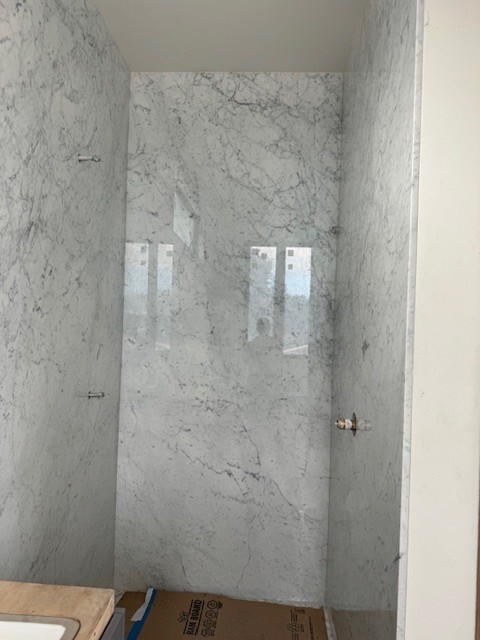
6mm to 9mm: vertical work and overlays. This is wall cladding, full-height backsplash, shower walls, fireplace surrounds, and cabinet or furniture faces. It is also the gauge used to overlay existing countertops instead of tearing them out.
12mm: the common residential countertop gauge. Kitchen counters, islands, bath vanities, and the waterfall panels that run off them. If someone asks about a Palo Alto kitchen remodel with no unusual spans, this is usually the band they land in.
20mm and up: exterior and long spans. Outdoor kitchens, terraces, pool coping and surrounds, pedestal-set decks, and anywhere impact or point load is a real risk.
The Monterey Peninsula version of that last band is worth saying plainly. A Pebble Beach patio or pool surround lives in salt air and takes rain from roughly October through March, and it gets walked on, dropped on, and furniture-dragged across. That is a completely different demand than a kitchen island inside a heated house.
Thin and mid-gauge panels also depend heavily on the substrate and setting method behind them. The Tile Council of North America publishes the installation methods most fabricators and tile setters work from for large-format panels, and those methods change with thickness.

Porcelain Gauge Reference by Application
Use this as a starting point for the conversation with your fabricator, not as a final spec. Your layout, substrate, and overhangs can move the answer.
| Gauge | Where it typically belongs | What to watch for |
|---|---|---|
| 6mm to 9mm | Wall cladding, backsplash, shower walls, overlay on existing counters | Needs full, continuous support behind it; substrate prep matters more than the panel |
| 12mm | Kitchen counters, islands, vanities, waterfall panels | Edge reads about half an inch unless a mitered build-up is added |
| 20mm and up | Patios, pool surrounds, outdoor kitchens, pedestal decks, long spans | Heavier to handle and set; confirm your color and finish is offered in this gauge |
Thickness Decides What Your Finished Edge Looks Like
This is the part that surprises homeowners more than anything else in the topic. A 12mm porcelain counter reads about half an inch at the edge, which is a thin, crisp profile.
That chunky stone edge most people picture does not come from the slab. It comes from a mitered build-up, where the fabricator cuts the panel at an angle, folds a strip down the front, and bonds it into a thicker-looking profile.
It works, and it looks good when it is done well. But it is worth knowing what it adds:
- Extra fabrication labor, usually quoted per linear foot, so cost scales with how much perimeter you have
- A bonded joint running the length of the edge, which needs a careful color and pattern match
- More handling of the panel, which is where porcelain edge chipping tends to originate
A 20mm panel can often take a simpler eased edge and still read solid at the profile, with no miter at all. That is a real reason some projects step up a gauge even indoors.
Bring the gauge question to your fabricator early, before the slab is ordered. Edge treatment is a fabrication decision, and your fabricator choice matters more with porcelain than it does with granite or quartzite.
How to Land on Your Gauge in Four Questions
Work through these in order. Most projects arrive at a clear answer by the third question.

Confirm the Gauge, Finish, and Quantity All Exist Together
Here is the trap. A color and finish you fell in love with online may only be produced in one or two gauges, and the photo you saved will not tell you which.
Stock availability is the single biggest gate between an inquiry and a showroom visit. Callers ask some version of the same thing constantly, and one put it almost word for word: “I saw it on your website, do you actually have it in stock?”
So get all of it answered in one conversation:
- The gauge you need, in writing
- The finish (polished, matte, honed) in that gauge
- The sheet size, since large-format panels vary and your fabricator may have a minimum
- How many pieces are on hand right now
- Whether more is arriving, or whether it would have to be ordered
That last point changes your schedule, not just your paperwork. Material sitting in a Sand City or Palo Alto warehouse is the fast path. A special order from an overseas factory is a scheduling decision, and import timelines can run 90 to 120 days depending on the producer and the shipping window.
If your job already has a start date, read up on in-stock slabs versus special order timing and on what live inventory at a slab supplier actually means before you commit to a color.
Why You Should See the Gauge in Person
Porcelain photographs beautifully, and that is the risk. Two slabs sold under the same name can read very differently once you see the actual panel, the actual finish, and how the pattern behaves at the edge.
When the slab is standing in front of you, look at three things:
- How the pattern runs to the edge, since a veined porcelain is printed and the vein stops at the face unless the body is through-colored
- How the finish reads under light, because matte and polished behave completely differently in a Carmel bathroom with one north-facing window
- What the thickness looks like at the profile, which is the only honest way to decide whether you want a miter
Then take a sample home and live with it for a week under your own lighting. There is a short guide on how to test a take-home sample that applies just as well to porcelain as it does to stone.
One more local note. Across Palo Alto and the surrounding corridor, where the median home dates to the early 1960s, a thin overlay gauge over existing counters is a legitimate question worth raising before demo is scheduled. It is a different conversation once the old tops are in a dumpster.
Customers tend to remember the side-by-side comparison work more than anything else. As one reviewer put it: “Brianna was super helpful in finding us great porcelain and stone tiles for our bathroom remodel.”
Frequently Asked Questions About Porcelain Slab Thickness
Is 12mm porcelain strong enough for a kitchen island?
For most residential islands, 12mm is the standard countertop gauge and performs fine when the substrate and support are right. The variable is overhangs. If you have a seating overhang or an unsupported span, your fabricator may call for added support or a heavier gauge, so get the layout in front of them before you order.
Can porcelain go over my existing countertops instead of replacing them?
Thin gauge porcelain, typically 6mm to 9mm, is made for overlay work and is used that way. Whether it works in your kitchen depends on the condition and flatness of what is under it, plus how the new edge meets your cabinets and backsplash. That is a fabricator assessment, not a material question.
Does a thicker porcelain slab cost more per square foot?
Generally yes, since there is more material in the panel, but thickness is only one input. Finish, pattern, producer, sheet size, and current freight all move the number, and a mitered edge on a thin slab can close the gap fast once fabrication labor is counted. Ask the showroom team to confirm current pricing for the exact gauge and finish you want.
Do you cut and install the porcelain, or just supply it?
Carmel Stone Imports is a supplier and showroom. Selection, samples, and delivery coordination happen here, and fabrication and installation happen with your own fabricator, who the team can refer you to. There is a full breakdown of who handles what in a remodel if you want the whole sequence.
Can I compare two gauges of the same material side by side?
Often, yes, depending on what is on hand at the time. Live inventory across the Carmel, Palo Alto, and Sand City locations means the team can pull what is physically there and stand it up in good light. Call ahead with the material name and the gauges you are weighing so they can check before you drive over.
Seeing the Gauges in Person
The showrooms in Carmel, CA and Palo Alto are open on weekdays for slab viewing, and the Sand City warehouse holds the inventory for most Central Coast projects. If you want to stand in front of two gauges of the same porcelain and look at the profile before you decide, the team can check what is on hand and set a time. Reach them at (650) 800-7840 or info@carmelimports.com.