
Direct Answer: Crystalline silica-free quartz needs no sealing and wipes clean with mild soap and water. The one habit change is heat: keep a trivet where hot pans land, and skip abrasive or bleach-based cleaners.
In the showroom, you are looking at veining and color. You hold a sample up to a cabinet door, turn it toward the window, and picture the finished kitchen.
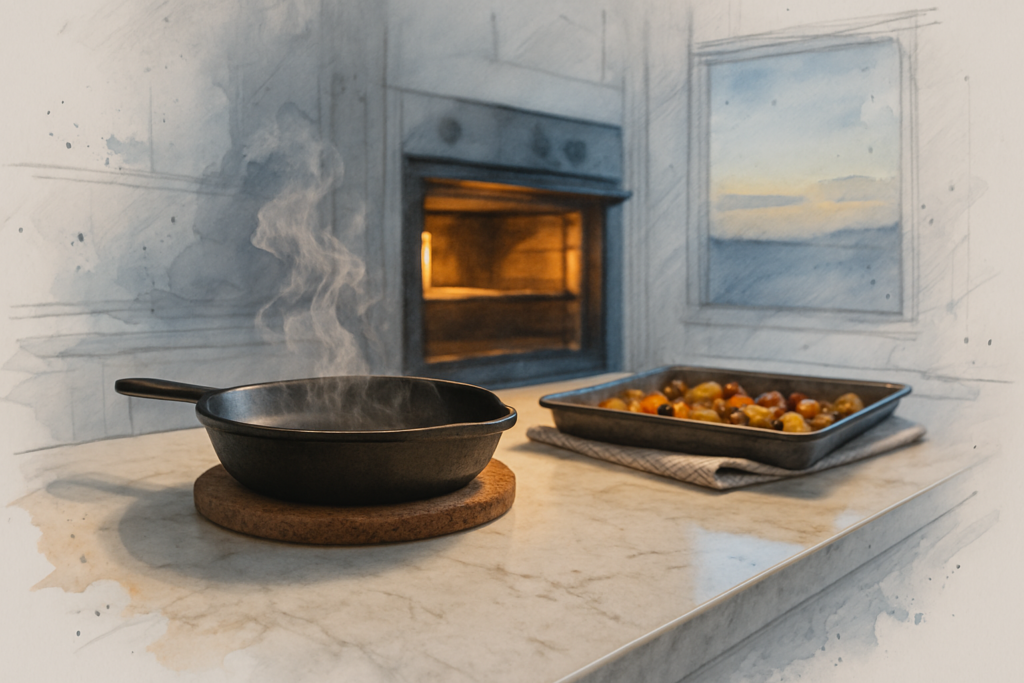
Then there is the Tuesday night version of that same counter. Cast iron in one hand, a sheet tray in the other, the oven door open, and nowhere clean to set anything down. That moment is what you actually live with, and almost nobody shops for it.
This is a plain look at what crystalline silica-free quartz is like to own over the next ten years in a Carmel, CA kitchen. Not what the sample board says. What the surface asks of you, where it is forgiving, and the one habit you will need to change.
What Crystalline Silica-Free Quartz Is Actually Like to Own
Most of the time, it asks nothing of you. The surface is non-porous, so a glass of red wine left overnight is a wipe-up, not a project. Olive oil, lemon juice, coffee rings, turmeric from last night’s curry: none of that soaks in the way it can on a porous natural stone.
That is the real daily difference. You stop being careful in a way you may not even notice until you compare notes with a neighbor who has marble.
The other thing you live with is consistency. The slab you choose is the slab you get, and the pattern repeats across a run instead of drifting the way natural movement does.
- Color stays put indoors. A north-facing Carmel kitchen and a south-facing one will not age differently.
- Pattern is predictable. What you see on the slab is close to what lands on your island.
- No sealing schedule. More on that below, because it trips people up.
- Direct sun and exterior use are a separate conversation. For Carmel courtyards, Pebble Beach patios, and outdoor kitchens that live in salt air, porcelain and natural stone usually enter the discussion instead.
If you want the deeper background on the material itself, there is a full explainer on what crystalline silica-free quartz means for your kitchen.
Heat Is the One Habit You Have to Change
This is the honest downside, and it deserves more than a one-line trivet warning.
These slabs hold stone content bound together with resin. The stone does not mind heat. The binder is the heat-sensitive part, which is why manufacturer care sheets across this category consistently advise against setting hot cookware straight onto the surface.
The offenders in a real kitchen are specific, and they are rarely the ones people picture:
- The cast iron pan coming off the burner. The worst one, because cast iron holds heat long after the stove is off.
- The slow cooker that runs all afternoon in the same spot. Lower heat, but hours of it, concentrated in one place.
- The air fryer vented against a backsplash. The exhaust hits the vertical surface, not the counter.
- The roasting pan parked beside the range while the oven door hangs open. Two heat sources at once.
The fix is boring and it works: a trivet or a heat mat kept where the hot thing actually lands, not in a drawer across the room. Most people who have trouble are not careless, they just stored the trivet somewhere inconvenient.
Exact temperature guidance varies by product line. The team can pull the manufacturer’s documentation for the specific slab you are considering so you are not guessing.

The Sealing Question, and What You Still Have to Do
Here is the part that quietly confuses people who have owned natural stone: there is no sealing schedule. No annual bead test, no sealer bought every October before the holidays, no reapplication after a deep clean.
That saves real money over ten years, and it removes a maintenance task most homeowners forget anyway.
What you still do is short:
- Mild soap and warm water for daily wiping. That is genuinely it for most messes.
- Prompt cleanup on anything pigmented. Turmeric, beet juice, red wine, hair dye in a bath vanity. Non-porous is not the same as indestructible against pigment sitting for days.
- No abrasive pads. Scouring powders and green scrub pads dull the finish, and a dulled spot shows under the kitchen lights.
- No harsh alkaline or bleach-based products. Oven cleaner, drain cleaner, and heavy degreasers attack the resin binder, not the stone.
One more thing worth saying out loud. If your island is silica free quartz and your backsplash is marble, or your floors are limestone, you now have two care routines in one room.
A cleaning business owner contacted us after a pH neutral cleaner did almost nothing on built-up grime on limestone floors. That is the normal result of the right product on the wrong material. The Natural Stone Institute care guidance is a solid reference for the natural stone side of the room, and the finish you chose matters too, which is covered in the finish decision nobody explains.
Everyday Situations and What to Reach For
A quick reference for the moments that come up most often in a working kitchen.
| Situation | Do this | Skip this |
|---|---|---|
| Daily crumbs and spills | Mild soap, warm water, soft cloth | Scouring powder, green scrub pads |
| Red wine or turmeric sitting overnight | Wipe promptly, soap and water, repeat if needed | Bleach wipes, oven cleaner |
| Dried-on food | Plastic scraper, then soap and water | Steel wool or abrasive paste |
| Hot pan off the burner | Trivet or heat mat kept at the landing spot | Setting it straight on the surface |
| Annual upkeep | Nothing. No sealing required | Buying sealer out of habit |
Where Heat Actually Hits a Countertop
The four heat sources that cause the most trouble in a real kitchen, and the simple fix for each.

Almost Nobody Finishes a Kitchen in One Material
The honest version of this article has to cover how silica free quartz behaves next to the other surfaces it shares a room with. One homeowner recently asked us to compare silica free quartz against large-format porcelain slabs for a three-wall alcove tub surround in a matte finish. That side-by-side is exactly the math people are running in their heads.
A plain division of labor helps:
- Perimeter runs that take abuse. Prep, cleanup, kids, dog bowls. Silica free quartz earns its spot here because it does not need babysitting.
- The island that gets photographed. This is where a quartzite or marble slab with real movement usually wins, and where owners accept a little more care.
- The bath vanity that lives in steam. Non-porous is a genuine advantage in a secondary bath nobody protects.
- The laundry counter. Detergent, bleach splash, hot irons. Worth thinking about before you spec anything delicate.
Geography shifts the answer too. In a Palo Alto corridor kitchen, where much of the housing stock dates to the early 1960s, finishes often get replaced on a renovation cycle, and a predictable surface that matches cleanly matters more.
In Carmel-by-the-Sea or Pebble Beach, the owner is frequently making a once-and-done choice for a house they intend to keep for decades. That changes which room gets the statement slab and which gets the workhorse. If you are matching into an existing kitchen, extending an older kitchen with silica free quartz walks through that problem.
Part of How It Ages Is Decided Before You Ever Wipe It Down
Seam placement, edge profile, and the sink cutout all shape where chips start and where grime collects. A square edge behaves differently from an eased one. A seam that lands in the middle of a prep zone will show its age faster than one tucked near a cooktop cutout.
That work belongs to the fabricator, not the supplier. Material selection and fabrication are two separate steps, and these are questions for whoever does your template. Referrals to fabricators are available on request, and how many slabs a kitchen takes is a useful read before that conversation.
Frequently Asked Questions About Living With Silica Free Quartz
Do I ever need to seal silica free quartz countertops?
No. There is no sealing schedule, which is the biggest day-to-day difference from marble, limestone, or travertine in the same room. If a product label tells you to seal it, that label is written for natural stone.
What happens if I forget and set a hot pan down?
It depends on how hot, how long, and how fast the temperature changed. A quick touch with a warm pan is usually nothing. Cast iron straight off a burner, or a heat source sitting in one spot for hours, is where problems start, because the resin binder is the heat-sensitive part. Keeping a trivet at the landing spot removes the question entirely.
Can I use bleach wipes or a heavy degreaser?
Skip them. Harsh alkaline and bleach-based cleaners work on the binder, not the stone content, and repeated use can dull the finish. Mild soap and water handles nearly everything a kitchen produces.
Can I put it outside on a patio or in a full-sun sunroom?
Exterior and full-sun placement is a different conversation. On the Monterey Peninsula, porcelain and certain natural stones typically come up for courtyards, outdoor kitchens, and pool surrounds. Bring the specific location to a showroom visit so the team can pull the manufacturer’s documentation for whatever line you are considering.
Do you fabricate and install the countertops?
No. We are a supplier and showroom. You select the material, then work with your own fabricator or contractor, and the team can share referrals if you need one. Why fabricator choice matters covers how much that decision affects the finished result.
What drives the cost difference between slabs that look similar?
Thickness, finish, slab size, and the product line all move the number, and import conditions have shifted pricing in this category recently. Rather than quoting a figure that may not match your project, the team will confirm current pricing on the specific material and quantity you need.
Want to See the Slabs in Person Before You Decide?
Live inventory changes as containers arrive, so slabs are viewed in person at the Carmel, Palo Alto, or Sand City showrooms, and take-home samples go home with most materials. The team can also pull the manufacturer’s documentation on heat, finish, and care for a specific line. As one Carmel, CA customer put it in a review, “the people who work here guide you through the many options so that you are not overwhelmed.” Questions or a slab selection appointment: (650) 800-7840 or info@carmelimports.com.