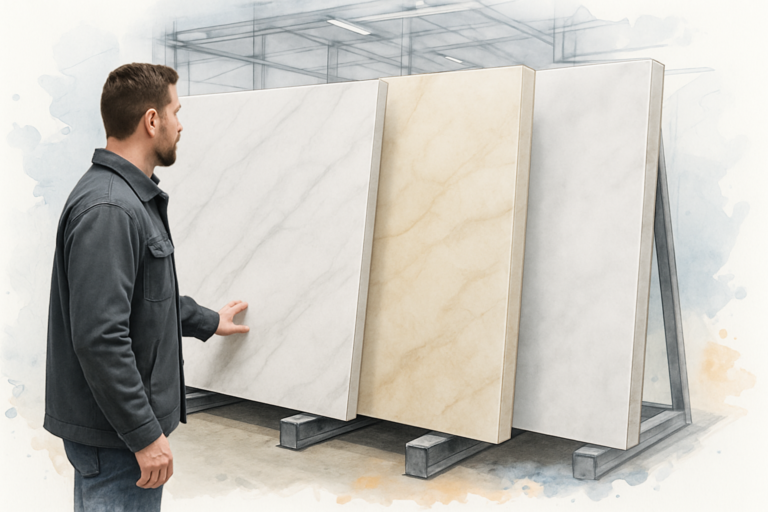
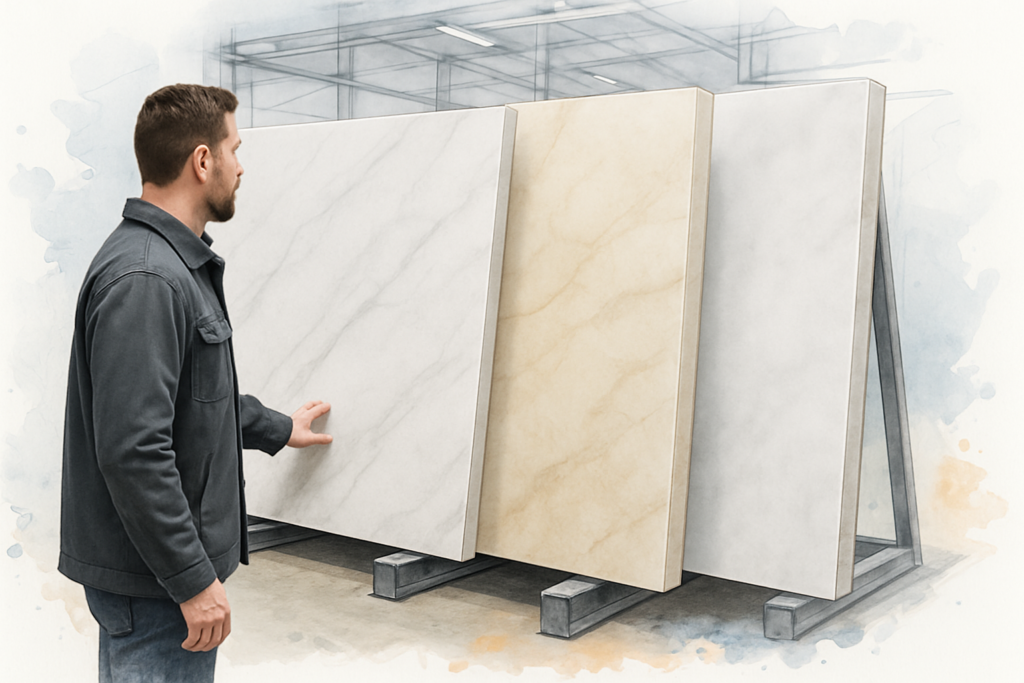
Direct Answer: Taj Mahal, Mont Blanc, and White Macaubas are trade names tied to a quarry region and a look, not performance grades. Density, porosity, and finish vary slab to slab.
You have a folder of saved photos. Maybe it is Taj Mahal and Mont Blanc. Maybe White Macaubas and Perla Venata snuck in there too. You are not asking what quartzite is anymore. You are stuck picking between three stones that all look right.
That is the most common place people land before they call a stone showroom. Quartzite is the single most-asked-about material on incoming calls here on the Central Coast, and callers almost always name a variety rather than a category.
This article is about comparing those varieties against each other. What the names actually mean, what varies inside the category, and what changes once you see the slabs flat and lit instead of on a screen.
The names are commercial labels, not performance grades
Taj Mahal, Mont Blanc, White Macaubas, Perla Venata, Dolce Vita. These are trade names, tied to a quarry region and a general look. They are not standardized grades, and no governing body audits them.
That is why two slabs sold under the same name can behave differently in a working kitchen. The block came from a different part of the deposit, or a different quarry face, or a different year of extraction.
A few things a name genuinely tells you:
- The rough color family and background tone
- The general vein pattern buyers associate with that stone
- The country and region it usually comes from
A few things a name does not tell you:
- How dense or porous that specific slab is
- How tightly the grains are fused
- Whether it has been resin treated, and how heavily
- How it will take a sealer over the first year
This is also why two slabs with the same name can carry very different price tags, a topic covered in more detail in quartzite countertop pricing. Same label, different block, different material.
The real spread inside the quartzite category
Quartzite is a sandstone that got cooked and compressed until the quartz grains fused. How completely that happened varies enormously from quarry to quarry. Some material is nearly glass-tight. Some is only partway there.
And some stone sold as quartzite is closer to a dolomitic marble in hardness. It is not necessarily mislabeled on purpose, the commercial trade has used these names loosely for decades. But the difference shows up at the sink and near the cooktop, not in the photo. If that possibility concerns you, the piece on whether dolomite works for countertops explains where that stone fits.
Here is what you can reasonably check standing in front of the slab:
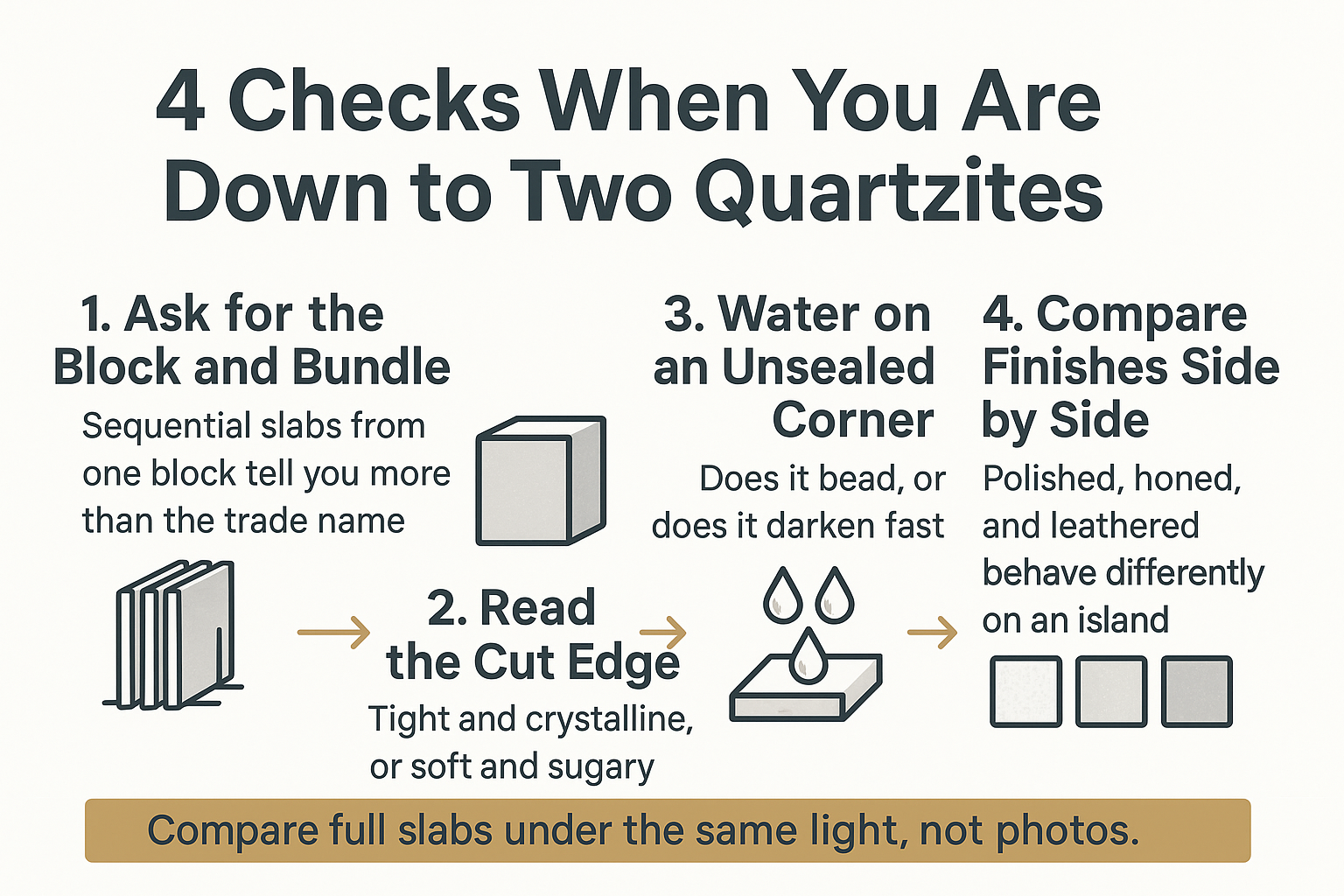
- Ask which block and bundle it came from. Slabs are cut sequentially from one block. Knowing you are looking at sequential slabs from a single block tells you far more than the name does.
- Look at the cut edge, not just the face. The edge shows you the grain structure and whether the stone reads tight and crystalline or soft and sugary.
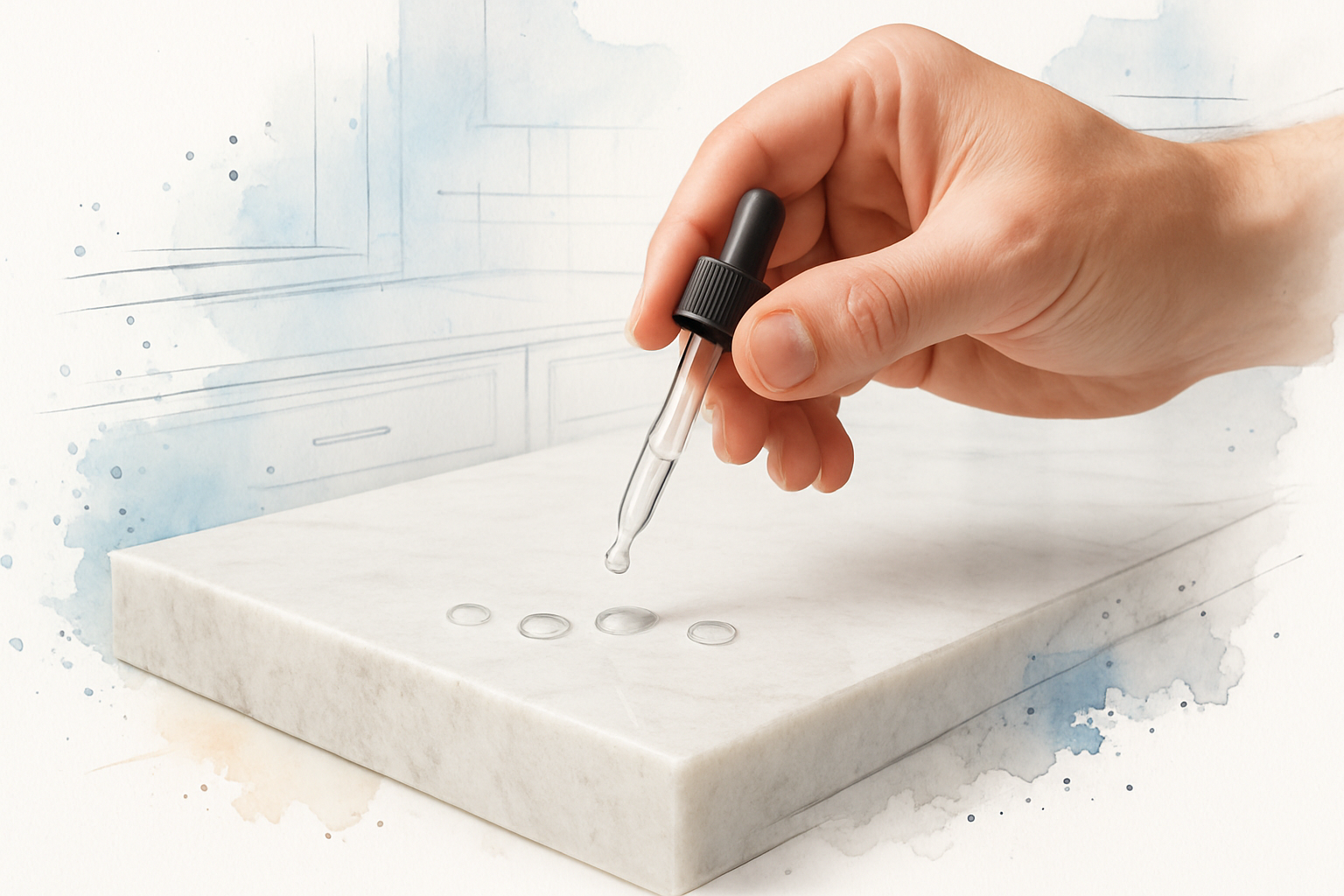
- Watch a few drops of water on an unsealed corner. If the water darkens the stone quickly, that spot is more absorbent. If it sits and beads, it is tighter. This is a rough read, not a lab test.
- Check the back of the slab for mesh or heavy resin. Both are normal in some material. Both are worth knowing about before your fabricator sees it for the first time.
None of this replaces a proper at-home sample routine, which is covered separately on this blog. This is about ranking two or three candidates against each other in the same hour, in the same light.
What the popular quartzite names usually signal
Use this as a starting frame, not a spec sheet. What any individual slab actually does depends on the block it came from.
| Trade name | What the name usually signals | What varies most slab to slab |
|---|---|---|
| Taj Mahal | Warm cream to soft beige background with quiet, low-contrast movement | Background warmth and how much grey or gold veining runs through the bundle |
| Mont Blanc | Cooler white to pale grey field with linear grey veining | Vein density and how tight the material reads at the cut edge |
| White Macaubas | Bright white ground with strong, directional grey banding | Contrast level and how dramatically the banding lands across a long slab |
| Perla Venata | Creamy white with gold and amber veining, softer overall read | Gold saturation and porosity, which can differ noticeably between blocks |
Finish is usually the tiebreaker
When two slabs are close on look, finish decides it. Same stone, three finishes, three completely different kitchens to live in.
- Polished reflects the most light and pulls the color forward. It also shows water spots, fingerprints, and any etch mark more openly than the other two.
- Honed reads softer and flatter. It hides less than people expect, and on a lighter stone it can show oils near the cooktop.
- Leathered has a faint texture you can feel. It is the most forgiving surface for fingerprints and small wear on a working island.
Buyers on the Monterey Peninsula walk in leaning toward leathered for islands more often than not. That preference is strong enough that people will chase a specific leathered slab across multiple showrooms. One customer put it this way in a review: “After a lot of searching for a specific leathered quartzite for our kitchen island, we found the most beautiful slab at Carmel Stone Imports!”
If finish is where your decision is actually stuck, the deeper breakdown lives in the finish decision nobody explains.
Four checks that separate two quartzites you like equally
A quick visual of what to do when you are standing between two slabs and cannot decide.
Why photos and 4-inch samples will mislead you here
A quartzite slab runs somewhere around 120 inches long. Veining, movement, and background tone shift across that length in ways a cropped photo cannot show you.
Some version of “I want to come in and see it in person before I commit” comes up on calls constantly. Roughly a third of incoming calls start with whether a specific material is in stock right now, and in what sizes, because people will not drive over without that confirmation.
What actually changes when the slab is pulled, stood up, and lit:
- Where the veining lands. A dramatic vein that looks gorgeous in a photo may run straight through your sink cutout.
- Whether two slabs will book-match. You can only judge that with both slabs from the same bundle in front of you.
- Warm versus cool. Screens flatten this. A stone that read cool grey online often reads warm beige in person, and that changes your cabinet and paint decisions.
- Quantity. Whether there is enough matching material for your full layout, which ties directly to how many slabs a kitchen takes.
Seeing the candidates together also gives you something a single visit cannot: a direct comparison under one light source, at one time of day.
The Monterey Peninsula and the Palo Alto corridor are different decisions
These two markets are 70 miles apart and the buying problem is not the same.
On the Monterey Peninsula, including Carmel-by-the-Sea, Pebble Beach, and Pacific Grove, this is usually a considered, once-and-done choice for a home people intend to keep. The marine layer keeps interior surfaces damp longer than inland, so sealing intervals tend to come up sooner than a homeowner in Salinas or San Jose would expect.
For that buyer, the porosity read on the slab matters more than anything else on this page. A tighter stone means fewer maintenance conversations five years out. The article on why brand-new quartzite sometimes stains is worth a read before you commit.
In the Palo Alto and San Jose corridor, much of the housing stock dates to the early 1960s and the project is a finish replacement running on a contractor’s calendar. Availability and matching quantity carry as much weight as the look.
For that buyer, the question order flips. Confirm there are enough slabs from one bundle sitting in a local warehouse right now, then decide between the three candidates. A 90 to 120 day import lead time will not survive a framed-in kitchen with a fabricator already booked.
One reason quartzite inquiries climbed through 2026
California regulators have moved toward restricting the fabrication and installation of high-silica artificial stone products. Buyers reading that news have been looking harder at natural options.
The important distinction: that concern is occupational. It falls on the workers who cut, grind, and polish the material, not on homeowners living with a finished countertop, per the California Department of Industrial Relations.
If you want the rulemaking explained properly rather than summarized in two lines, see what California’s engineered stone ruling means.
Frequently Asked Questions About Comparing Quartzite Countertops
Is Taj Mahal harder than Mont Blanc?
Not reliably, and that is the point. Both names cover material from multiple blocks and multiple quarry faces over the years. A dense Mont Blanc slab can easily outperform a softer Taj Mahal slab, or the reverse. Judge the slab, not the name.
How much do quartzite countertops run on the Central Coast?
Pricing moves with the block, the finish, the thickness, and current availability, so ranges published online are rough at best. Two slabs with identical names can price very differently. Ask for a quote on the specific slabs you are considering rather than the variety.
Can I just order the slab I saw online?
You can reserve material, but it is worth seeing it standing up first. Natural stone varies slab to slab even inside one quarry block, and veining placement on a 120 inch slab is the thing that most often surprises people after templating.
Does a showroom handle the fabrication and install too?
Not here. This is a supplier and showroom operation, which means material selection and delivery coordination. The cutting, templating, and installation are handled by your own fabricator or contractor, and referrals to local fabricators are available if you need them.
Do I need an appointment to compare several slabs?
Walk-ins are welcome, but if you want three specific quartzites pulled and staged next to each other, calling ahead is the difference between comparing them properly and hunting through racks.
Seeing all three together beats deciding one at a time
Live inventory rotates across the Carmel, Palo Alto, and Sand City locations, and staff will pull and stage slabs so you can compare your candidates under the same light in one visit. A large share of the sales team has been here well over a decade, so the person walking you through Taj Mahal versus Mont Blanc has watched both stones live in real kitchens for years. Material selection happens at Carmel Stone Imports, while fabrication and installation stay with your own fabricator, and appointments can be arranged at (650) 800-7840 or info@carmelimports.com.