

Direct Answer: Pick granite by viewing the actual slab in person, understanding its porosity with a simple water test, and choosing the finish and thickness that match your real kitchen habits.
Granite has been a go-to kitchen countertop material for decades — and buyers still get it wrong. They choose based on a small sample chip, drive two hours to pick it up, and realize the full slab looks completely different from what they imagined.
That gap between what you expect and what you get is the single biggest source of regret in stone selection. And on the Monterey Peninsula, where kitchen remodels can run deep into six figures, that’s a regret worth avoiding.
This guide focuses on three things that actually drive the decision: what to look for in the slab itself, what the price differences really mean, and how to plan the timeline so your project doesn’t stall waiting on stone.
Why Viewing the Actual Slab — Not a Sample — Changes Everything
The most common call a stone showroom receives goes something like this: a buyer wants to confirm what’s in stock before making the drive. That instinct is right — but it only solves half the problem.
Even when a specific granite is confirmed in stock, a 2-inch sample tile tells you almost nothing about how a full slab will read in your kitchen. Granite is a natural material with variation across every slab. The sample you fell in love with at the cabinet shop may have been cut from the most photogenic corner of a stone that’s largely grey.
Viewing the exact slab you’ll be purchasing — standing in front of it, seeing how light hits the surface, checking the movement and pattern across the full length — is the only way to know what you’re actually buying. Several buyers who’ve worked through this process describe that moment of seeing the slab in person as the point where the whole project clicked into place.
For granite specifically, there are three things to look at in person:
- Pattern consistency: Does the veining feel balanced across the full slab, or does it cluster in one area?
- Color accuracy: Natural light reads differently than showroom lighting — ask to view the slab near a door or window
- Surface condition: Look for any natural fissures, pits, or inclusions that your fabricator will need to account for during templating
As one homeowner’s experience described it — they found a leathered quartzite they loved, but only because they were standing in front of the real thing, not looking at a catalog photo. The same principle applies to granite. Picking a marble slab in person vs. online covers this dynamic in more detail if you want to understand why the in-person difference is so consistent across stone types.

What Drives the Price Difference Between Granite Slabs
Buyers often walk into a showroom expecting granite to be the affordable option and leave confused by the range. The gap between one granite slab and another can be significant — and it’s not random.
Four factors explain most of the price variation:
- Grade and origin: Commercial-grade granite quarried domestically or from common sources runs lower. Premium imported granite from Brazil, Italy, or Norway — stones with rare color combinations or dramatic movement — prices considerably higher.
- Color rarity: Blue, green, and red granites are rarer to quarry than standard black or beige. Rarer color = higher price, period.
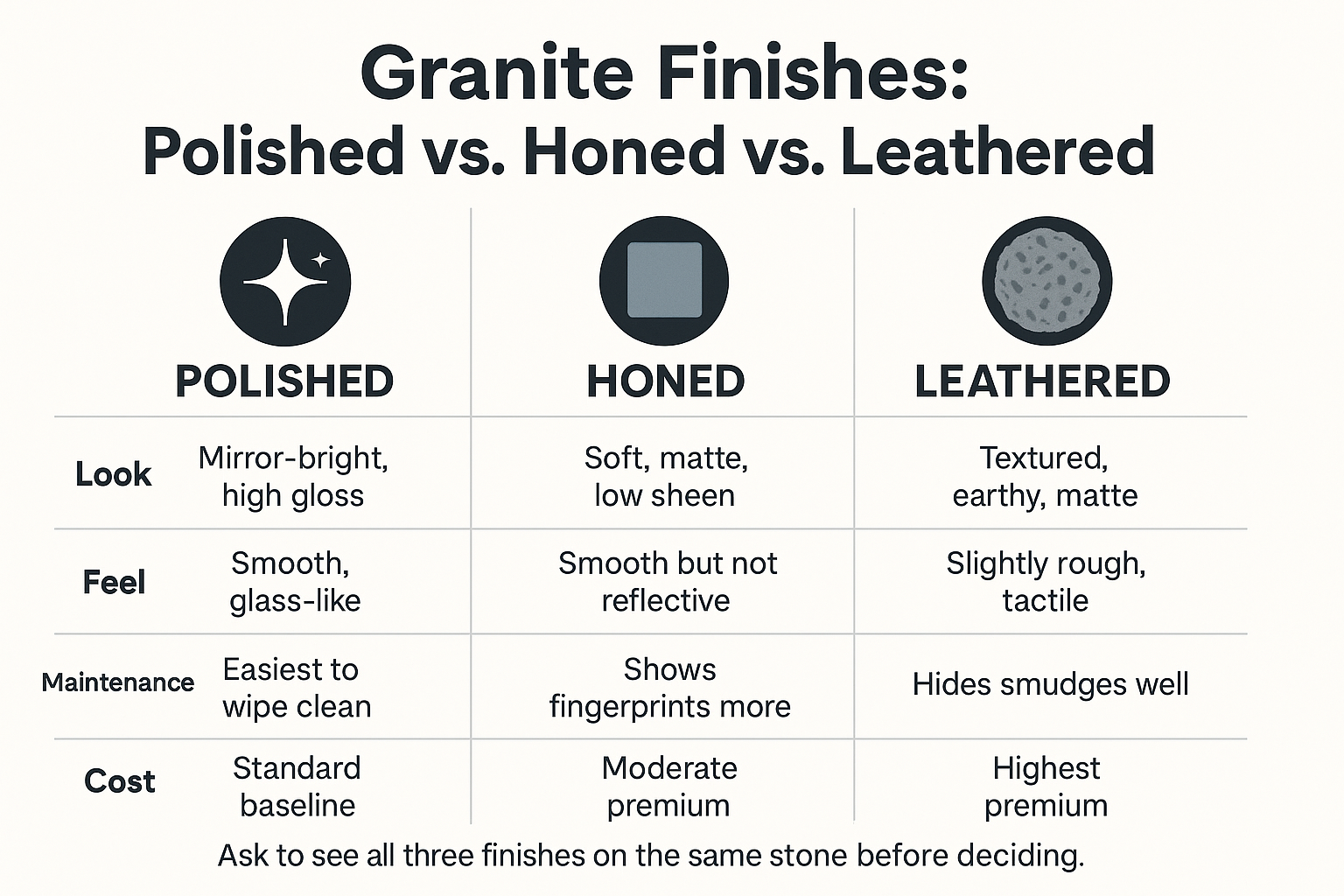
- Finish: A polished finish is the standard and typically the baseline price point. A honed finish (matte, softer look) often adds cost due to additional processing. A leathered finish — which gives the stone a textured, slightly matte surface — is increasingly popular in Carmel and Pebble Beach kitchens and typically commands the highest premium of the three.
- Thickness: 2cm slabs are thinner, lighter, and lower cost — but typically require a plywood substrate for countertop applications. 3cm slabs are heavier and more structurally independent, which most fabricators prefer for kitchen counters. The jump from 2cm to 3cm meaningfully affects both the slab price and your fabricator’s labor.
For context on what Central Coast homeowners typically encounter: granite slab pricing varies widely based on the above factors, and the best way to get an accurate number for a specific slab is to ask at the showroom directly. What looks like a small spec difference on paper can be a significant cost difference in practice.
If you’re still sorting out whether granite is the right material at all — or weighing it against quartz or porcelain — Granite, Quartz, or Porcelain — How Do You Actually Decide? walks through the comparison clearly.
Granite Finish Comparison at a Glance
The finish you choose affects how the stone looks, how it feels underhand, and how it performs over time. Here’s how the three main options compare.
The Sealing Question — What Granite Actually Needs
Ask ten people whether granite needs sealing and you’ll get ten different answers. The honest answer is: it depends on the specific stone.
Granite is a natural igneous rock, and its porosity varies from one variety to the next. A dense black granite from South Africa may be so tight-grained it barely absorbs anything. A lighter, more crystalline granite from Brazil may be notably more porous and benefit from regular sealing.
The fastest way to know where your slab lands is a water test — and you can do it right in the showroom before you commit. Drip a small amount of water on the surface and watch what happens over 10–15 minutes:
- Water beads up and stays: The stone is dense and doesn’t need sealing urgently
- Water darkens the surface within a few minutes: The stone is absorbing moisture and will benefit from a sealer before use
- Water soaks in almost immediately: Sealing is a real priority, and you’ll want to plan for resealing every year or two
For busy kitchens — and especially for households cooking heavily through the fall and holiday season — granite’s natural heat resistance makes it one of the more forgiving choices. A hot pan set directly on the surface won’t scorch or discolor the way it might with some engineered surfaces. But that performance advantage is worth less if a wine spill or olive oil drip absorbs into an unsealed surface before anyone can wipe it up.
Sealing is a straightforward process, and there are products designed specifically for natural stone that a fabricator or stone care specialist can recommend after installation. The main thing is not to assume — confirm the porosity of your specific slab before it’s installed, not after.
Granite Performance Quick Reference
How granite compares on the properties that matter most in a working kitchen.
| Property | Granite Performance | What to Know |
|---|---|---|
| Heat resistance | Excellent | Can handle hot pans — but trivets are still good practice |
| Scratch resistance | Very good | One of the hardest countertop surfaces available |
| Stain resistance | Varies by porosity | Confirm with water test; seal if needed before first use |
| Maintenance | Low to moderate | Annual sealing recommended for porous varieties |
| Finish options | Polished, honed, leathered | Leathered most popular for contemporary Monterey Peninsula kitchens |
| Thickness | 2cm or 3cm | 3cm preferred for kitchen counters; check with your fabricator |
Planning the Timeline: From Slab Selection to Installed Counter
One of the most consistent frustrations buyers describe is starting the process too late. A kitchen remodel has a lot of moving parts, and granite countertops are not the last step — they’re a middle step that everything else waits on.
Here’s a realistic sequence to plan around:
- Slab selection: Done at the showroom, ideally before cabinets are fully installed. You want to know your stone before your fabricator needs to schedule.
- Slab purchase and hold: Most suppliers won’t hold a slab without a deposit. If you’ve found the one, securing it before it sells is worth doing immediately — popular colors in smaller quantities can move quickly.
- Fabricator templating: Templating typically happens after cabinets are set and plumbing rough-in is complete. This is when your fabricator measures the exact cutouts for sinks, cooktops, and edges.
- Fabrication: After templating, fabrication and edge work typically takes 1–2 weeks depending on your fabricator’s schedule and the complexity of the cuts.
- Installation: Once slabs are fabricated, installation is usually a single-day process.
From the moment you select your slab to the day it’s installed, a realistic window for most projects is 3–5 weeks — assuming your fabricator isn’t backed up and cabinets are ready for templating when expected. In Carmel and the Monterey area, fabricator schedules can tighten considerably in fall when homeowners are rushing to finish before the holidays. Planning slab selection in early September rather than mid-October makes a measurable difference.
Note that Carmel Stone Imports coordinates delivery of the slab to your fabricator — they don’t provide fabrication or installation services. That part of the timeline lives with your contractor. What Happens When You Visit a Stone Showroom for the First Time is a good read if you want to understand what the showroom part of that process actually looks like before you go.
Frequently Asked Questions About Picking a Granite Slab
Can I confirm what’s in stock before driving to the showroom?
Yes — and it’s worth doing. Call ahead and ask about specific materials or color ranges you’re considering. Staff can confirm availability and tell you which location has the slabs you want. That said, photos and phone descriptions only go so far. The actual slab visit is where real decisions get made — seeing the stone in person, under real light, is what prevents surprises later.
What’s the difference between 2cm and 3cm granite slabs, and which should I choose?
Thickness affects both cost and structural requirements. A 2cm slab is lighter and less expensive but requires a plywood buildup underneath for most countertop applications. A 3cm slab is thicker, heavier, and structurally sufficient on its own for most counters — which is why most fabricators working on kitchen countertops prefer it. Ask your fabricator what they recommend before selecting a slab thickness.
Does all granite need to be sealed?
No — but you shouldn’t assume yours doesn’t. Do the water test on the slab before purchasing: drip water on the surface and watch how quickly it absorbs. Dense granites may need sealing rarely or not at all. More porous varieties should be sealed before first use and resealed annually. This is a 20-second test you can do right in the showroom.
Can I place a hot pan directly on granite?
Granite is one of the most heat-tolerant countertop materials available — it’s formed under extreme heat, so a pot off the stove won’t harm it. That said, most stone care professionals recommend trivets as a habit anyway, because repeated thermal cycling over years can affect sealers and, in rare cases, stress natural fissures in the stone.
What makes one granite slab more expensive than another?
Four things: origin and grade (imported stones from Brazil or Italy typically price higher than domestic commercial grades), color rarity (blue and green granites command premiums), finish (leathered costs more than polished), and thickness (3cm runs more than 2cm). All four interact — a leathered, 3cm blue granite from Brazil is going to price very differently than a standard polished grey from a domestic quarry. The showroom team can walk you through where any specific slab lands.
How far in advance should I select my granite slab for a fall kitchen remodel?
If you’re targeting a finished kitchen before the holidays, slab selection should ideally happen by early September. Fabricator schedules on the Monterey Peninsula tighten significantly in October, and you need to account for templating, fabrication (1–2 weeks), and installation after your cabinets are set. Starting late is the most common reason kitchens don’t finish on time.
Ready to See the Actual Slab Before You Decide?
Carmel Stone Imports carries live granite inventory across its showroom locations in Carmel-by-the-Sea and Palo Alto — which means you can walk in and view the exact slab you’d be purchasing, not a catalog photo. To check availability before you make the drive, or to schedule a slab selection appointment, call (650) 800-7840 or email info@carmelimports.com.