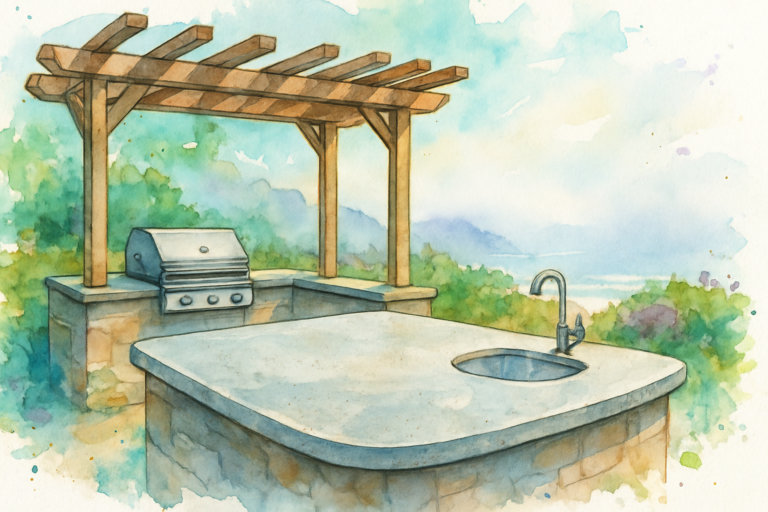
Direct Answer: Granite, quartzite, and porcelain slabs are the most reliable outdoor kitchen stones for California’s wet winters. Limestone and travertine can work but require consistent sealing and a real maintenance plan.
If you’re planning an outdoor kitchen on the Monterey Peninsula — or finishing one in Palo Alto before the rains arrive — the stone you choose matters more than most people expect. The Central Coast doesn’t get a forgiving climate. Fog rolls in off the Pacific most mornings, winter storms bring sustained rainfall, and even a moderate El Niño year means months of wet, humid conditions that will test every exposed surface on your property.
Most homeowners walk into a stone showroom thinking any slab that works indoors will work outside. That’s where projects go wrong. Porosity, surface finish, and material density are the factors that determine whether your outdoor countertop looks great in five years or starts showing damage after the first wet season.
This guide focuses on what actually matters for outdoor kitchen stone in a California climate — specifically the Monterey and Central Coast region. If you’re still deciding between materials or haven’t locked in your slab yet, read this before you do.
Why California Weather Is Harder on Outdoor Stone Than People Expect
California doesn’t have freeze-thaw cycles the way the Sierra foothills do, so a lot of homeowners assume outdoor stone isn’t a major concern. But the Monterey Peninsula runs its own kind of stress test on exposed surfaces.
Fog is the biggest factor most people ignore. Marine layer moisture settles on stone surfaces for hours every morning, often year-round. During an El Niño winter, that’s compounded by weeks of actual rainfall and standing water. For porous stone, this means repeated wet-dry cycles that force water in and out of the surface — slowly weakening sealers, pulling minerals to the surface, and creating conditions for staining and biological growth.
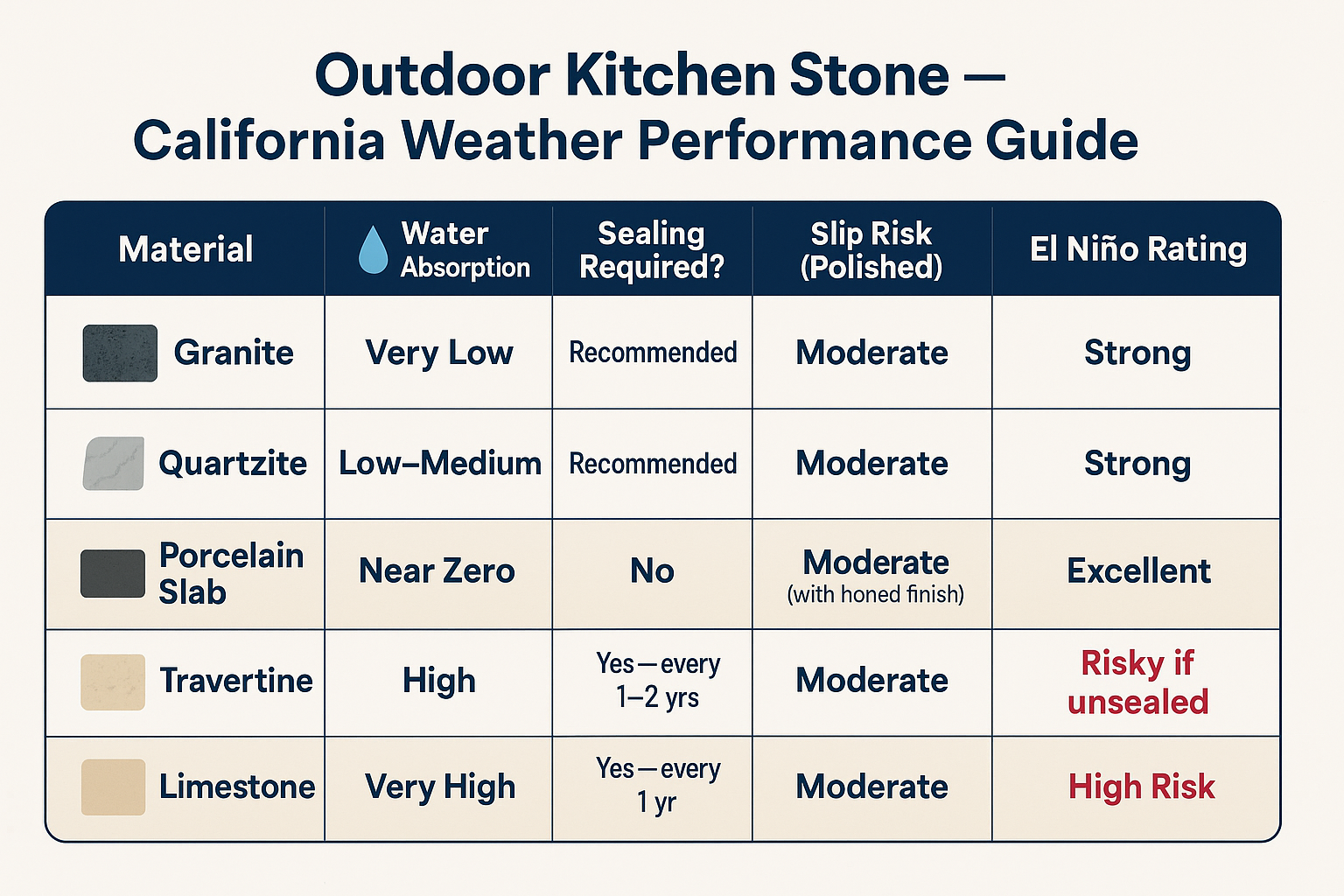
The difference between a stone that handles this well and one that doesn’t comes down to water absorption rate. Here’s where the common outdoor materials land:
- Granite — very low absorption, dense structure, strong outdoor performer
- Quartzite — low to medium absorption depending on the specific stone; generally solid outdoors
- Porcelain slabs — near-zero absorption, no sealing required, the most weather-consistent option
- Travertine — naturally porous and holey; can work outdoors sealed, but requires real commitment to maintenance
- Limestone — highly porous, vulnerable to moisture damage and staining when unsealed; higher-risk for outdoor use
For more on which stone surfaces hold up to California weather outdoors, that breakdown goes deeper into material-by-material performance.
The Finish Question Most People Don’t Think to Ask
Choosing the right stone is only half the decision. The surface finish matters just as much for outdoor applications — and this is where a lot of otherwise good projects create real safety problems.
A polished finish is beautiful. It’s what most people picture when they think of a marble kitchen counter. But polished stone outdoors is a genuine slip hazard when wet. That same reflective surface that photographs beautifully becomes dangerously smooth under a drizzle or morning dew.
For outdoor countertops, bar tops, and adjacent patio surfaces, you want one of these finishes instead:
- Honed — matte, flat, still smooth to the touch but with far better grip when wet
- Brushed — slightly textured surface created by wire brushing; gives stone an aged, natural look and meaningful traction
- Leathered — similar to brushed, with a soft sheen and irregular texture that reads as intentional and design-forward
- Flamed or sandblasted (for pavers and flooring applications) — aggressive texture for maximum grip underfoot
When you’re selecting slabs for an outdoor kitchen, ask specifically about finish options for whatever material you’re considering. Not every slab comes in every finish, and some materials — particularly certain quartzites and granites — take a brushed finish exceptionally well.
If you’re also selecting adjacent patio pavers or pool coping, the real difference between these three stone surfaces is a useful primer on how finish affects performance differently across material types.
Outdoor Stone Performance at a Glance
This infographic summarizes how the most common outdoor kitchen stones compare on the factors that matter most for California’s wet winters.
What Actually Happens When Unsealed Stone Spends Six Months in the Rain
This isn’t a scare tactic — it’s just what happens at a material level, and it’s worth understanding before you commit.
Porous stones like limestone and travertine have an open internal structure. When water gets in repeatedly — and on the Central Coast, it will — a few things start to occur. Minerals inside the stone get carried toward the surface and leave whitish deposits called efflorescence. Cooking oils, wine, and organic residue from outdoor use get pulled into the stone and become very difficult to remove. In shaded outdoor kitchens, moisture retention can also lead to biological growth — algae and moss — that stains the surface and breaks down sealer faster.
None of this is irreversible, and some homeowners are happy managing it. But managing it means resealing every 12 to 24 months, cleaning promptly after any spill or storm, and accepting that the surface will look lived-in over time.
Granite and quartzite behave very differently. Their denser structure absorbs far less water, sealer lasts longer, and they’re much more forgiving if a season goes by without maintenance. The most common mistake homeowners make with outdoor stone covers this pattern in more detail — it almost always comes back to underestimating how much maintenance a given material actually needs in a real outdoor setting.
Why Porcelain Slabs Make a Lot of Sense for Outdoor Kitchens
Porcelain isn’t a compromise. For outdoor kitchen countertops and vertical cladding, it’s often the most practical choice — and it’s worth understanding why.
Manufactured under extremely high heat and pressure, porcelain slabs have a water absorption rate of less than 0.5%. In practice, that means rain, fog, standing water, and cooking spills all sit on the surface rather than soaking in. There’s no sealing schedule. No worrying about what El Niño will do to your counter over a six-month rainy season.
For design-forward projects, large-format porcelain slabs now come in surfaces that read convincingly as marble, quartzite, or concrete. Some of the options Carmel Stone Imports carries in live inventory have the visual depth of natural stone with none of the outdoor maintenance burden.
A few things worth knowing before you choose porcelain for outdoor use:
- Specify a honed or matte finish — polished porcelain is just as slippery as polished natural stone when wet
- Porcelain requires precise fabrication — thin slabs especially need an experienced fabricator; this affects who you hire, not what you buy
- Color and veining are consistent slab-to-slab, which simplifies matching across a large outdoor kitchen layout
If you want more background on what makes porcelain slabs different from other countertop options, porcelain slab countertops: what nobody tells you before you buy walks through the full picture.
Outdoor Kitchen Stone — Quick Comparison for the Monterey Peninsula Climate
Use this as a quick reference when weighing your options against the specific conditions on the Central Coast.
| Material | Best Use Outdoors | Maintenance Level | Sealing Needed? | Notes for Coastal CA |
|---|---|---|---|---|
| Granite | Countertops, bar tops | Low | Recommended every 2–3 yrs | Dense, fog-resistant, widely available in live slab inventory |
| Quartzite | Countertops, feature walls | Low–Medium | Recommended every 1–2 yrs | Verify hardness by material — varies by quarry origin |
| Porcelain Slab | Countertops, cladding, flooring | Very Low | No | Best for high-rainfall seasons; specify honed finish outdoors |
| Travertine | Patio pavers, accent surfaces | Medium–High | Yes, every 1–2 yrs | Porous; fill-and-seal versions perform better than open-pore outdoors |
| Limestone | Accent only / protected areas | High | Yes, annually | High absorption risk in sustained wet conditions; use cautiously outdoors |
Timing Your Slab Selection Before Contractor Schedules Fill Up
El Niño forecasts tend to trigger a rush. Once word spreads that a wet winter is coming, homeowners who’ve been sitting on outdoor kitchen plans suddenly want everything done by October. Fabricators and contractors on the Monterey Peninsula and in the Bay Area feel that crunch fast.
The stone selection piece of this is often underestimated in terms of lead time. Slab selection takes more than one visit for most people — especially when you’re choosing for an outdoor setting where natural light, material texture, and finish all need to be evaluated together. Live inventory at a showroom lets you see the actual slab, not a catalog photo, which matters even more for outdoor applications where lighting conditions change dramatically.
If you’re working with a designer or contractor who’s already pulling permits or finalizing plans, getting your stone locked in now gives your fabricator the dimensions and material specs they need to schedule your job before the fall backlog hits.
For context on what to expect when you walk into a stone showroom for the first time, what happens when you visit a stone showroom for the first time is a useful read before your appointment — it takes the guesswork out of the process.
Frequently Asked Questions About Outdoor Kitchen Stone in California
Can I use the same stone indoors and outdoors in my kitchen project?
Sometimes, but not always. Granite and quartzite can often transition from indoor countertops to an outdoor bar top or outdoor kitchen island — the material performs well in both settings. But a polished finish that works great indoors becomes a slip hazard outdoors when wet. If you’re using the same stone in both areas, plan to specify different finishes — polished inside, honed or brushed outside.
Does porcelain look cheap compared to natural stone in an outdoor kitchen?
It used to. The current generation of large-format porcelain slabs has changed significantly — the printing and surface texture technology has advanced to the point where many options are genuinely difficult to distinguish from quartzite or marble at a glance. The key is seeing it in person. Photos rarely do it justice, and the difference between a convincing porcelain and a flat-looking one is obvious when you’re standing in front of the actual slab.
How often does outdoor stone actually need to be sealed in the Monterey area?
It depends on the material and how much direct weather exposure the surface gets. Granite in a covered outdoor kitchen might go 2–3 years between sealing cycles. Travertine or limestone in a fully exposed outdoor kitchen on the Monterey Peninsula — given the fog and rain — should be sealed every 12 months, and checked after any major storm season. A quick water bead test tells you when sealer is wearing thin: pour a small amount of water on the surface and see if it absorbs within a few minutes or beads up and sits.
Is there a stone that works well for both the countertop and the outdoor flooring in the same kitchen?
Porcelain is the most consistent option across both applications because it comes in large-format slabs for countertops and matching tile formats for flooring — and the same near-zero absorption rate applies to both. If you want natural stone throughout, granite is a strong choice for counters, and a brushed or flamed granite paver handles foot traffic outdoors well. Just confirm with your fabricator that the pavers you select are rated for outdoor use.
My outdoor kitchen is covered by a pergola — does that change what stone I should use?
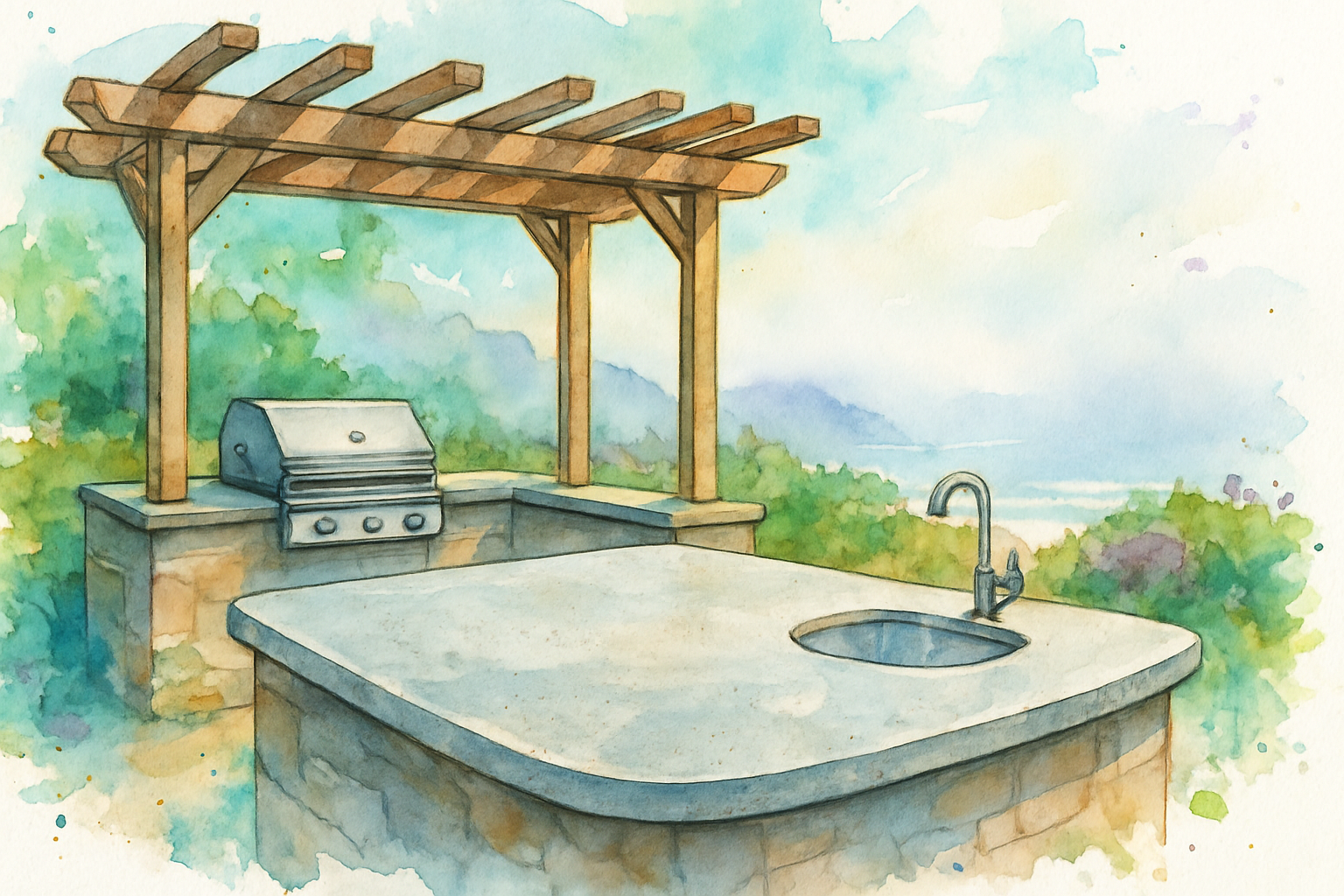
It helps, but it doesn’t eliminate the exposure. Fog and humidity still reach covered surfaces on the Monterey Peninsula. A pergola reduces direct rain contact, which lowers your risk with more porous materials — but you’d still want to seal travertine or limestone regularly even under cover. For a fully covered setup, your material options widen a bit, but the finish choice still matters for safety. Honed or brushed is still the right call over polished.
Can I see outdoor-appropriate stone in person before I decide?
Yes — and it’s worth doing. The Carmel-by-the-Sea and Palo Alto showrooms carry live slab inventory, so you can view the actual material you’d be selecting rather than a small sample chip or a catalog image. For outdoor projects especially, seeing full-slab scale and evaluating the finish in person makes a real difference in the final decision.
Ready to See Your Outdoor Kitchen Stone in Person?
If you’re finalizing material selections before the wet season arrives, Carmel Stone Imports carries live slab inventory across its Carmel-by-the-Sea and Palo Alto showrooms — including granite, quartzite, and large-format porcelain options suited for outdoor kitchen applications. You can schedule a slab selection appointment by calling (650) 800-7840 or emailing info@carmelimports.com to find a time that works before contractor schedules tighten up.