Quick Answer
1920 style homes are defined by strong architectural character, practical layouts, and honest materials. If you're renovating one today, the key is matching the original language of the house while choosing surfaces that fit modern wear, cleaning, and moisture exposure, especially in kitchens, baths, and exterior spaces.
If you're looking at a 1920s house and trying to decide what to preserve, what to replace, and what to reinterpret, the material decisions get complicated fast. The house may call for limestone, marble, travertine, oak, and decorative tile, but daily use asks a different question: will those choices hold up where your life happens?
That tension is where most good remodels either stay disciplined or go off course. A successful update to 1920 style homes doesn't come from copying old finishes blindly. It comes from understanding which materials gave the era its character, and where modern alternatives make better sense.
The Defining Architectural Features of 1920 Style Homes
The 1920s produced houses with clearer lines and more restrained proportions than the Victorian homes that came before them. The housing boom also brought mass-produced construction techniques, and homes built in that period were often slightly smaller than pre-1920s Victorian properties, with exteriors that mixed materials like red brick, pebbledash, and half-timbering, while American Craftsman and bungalow houses emphasized low-pitched roofs, wide porches, and natural materials for practical living (Fun Kids Live on 1920s and 1930s houses).
That matters because material choices weren't decorative add-ons. They were tied to the shape and function of the house.

Craftsman and bungalow forms
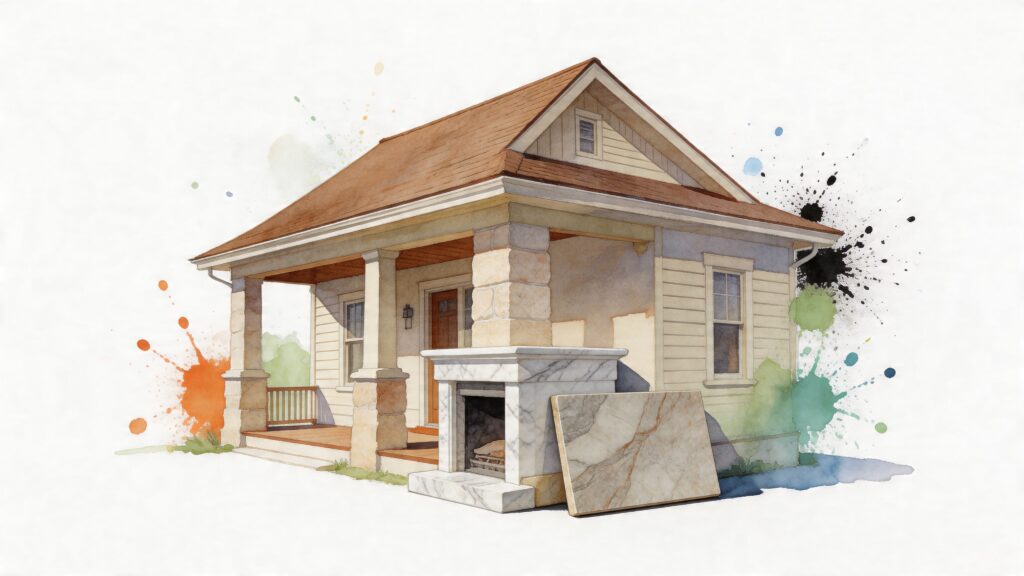
In many American neighborhoods, the Craftsman bungalow is the clearest expression of 1920s domestic design. You see low-pitched roofs, broad eaves, tapered porch columns, and a strong connection between indoors and outdoors.
These homes usually want materials with visual weight. Stone at the porch base, a substantial hearth, matte tile, and warm wood all belong here. Highly polished, cold-looking finishes can feel out of step unless they're used very selectively.
Practical rule: Start with the roofline and porch before you choose any stone. If the exterior massing says Craftsman, the surface palette should support that, not fight it.
Tudor Revival details
Tudor Revival homes bring a different set of cues. The roof is steeper, the facade is often more vertical, and the exterior may combine brick, stucco, and half-timber accents.
Inside, these houses usually handle heavier materials well. Honed limestone, darker marble, textured tile, and carved fireplace surrounds feel more natural here than light, beachy finishes. If you're planning a hearth update, these stone fireplace ideas for character-driven homes are useful to review through a period lens.
Spanish Colonial and Mediterranean influence
Some of the most elegant 1920 style homes pull from Spanish Colonial and Mediterranean precedents. These usually feature stucco walls, clay tile roofs, arched openings, ironwork, and courtyards or patios.
The material language shifts with that style. Travertine, limestone, terracotta-look tile, and patterned surfaces make sense. Cool gray engineered finishes often don't. Even when the layout is updated, the house still tends to want warmth, texture, and a bit of visual irregularity.
What to identify before selecting finishes
Before choosing any slab or tile, pin down these features:
- Roof profile determines whether the house wants a grounded palette or a more formal one.
- Window style helps you judge how refined or rustic surrounding materials should feel.
- Porch or entry treatment tells you whether the stone should read structural, decorative, or both.
- Original fireplace presence usually reveals the right level of ornament for the interior.
Get those cues right first. The rest of the material palette starts to make more sense.
Signature Stone Materials of the Roaring Twenties
Between 1920 and 1940, the Period Revival movement dominated American home design, bringing back Mediterranean, Spanish, and English Revival influences. In these homes, natural stone wasn't incidental. Limestone facades, marble accents, and travertine patios helped establish authenticity and gave the architecture permanence (Build Show Network on Period Revival styles).
In practice, each stone carried a different job. Some were chosen for formality. Some for softness. Some because they aged well in visible areas.
Limestone for facades, fireplaces, and architectural trim
Limestone is one of the most convincing period materials for 1920s work because it can read either restrained or formal depending on color and cut. On Tudor and English Revival homes, it works well for surrounds, mantels, stair details, and exterior cladding accents.
Its strength is visual calm. Limestone doesn't usually shout. It gives the room shape and weight.
Where it works best:
- Fireplace surrounds in honed or lightly textured finishes
- Entry floors where a muted, old-world tone is more important than visual movement
- Exterior architectural elements such as sills, trim, or facade accents
Where people get into trouble is using a limestone that's too crisp, too bright, or too uniform. That can make a house feel new in the wrong way.
Marble for vanities, hearth accents, and formal rooms
Marble has always had a place in 1920 style homes, especially in bathrooms, fireplace details, and decorative insets. It brings refinement, and in the right setting it looks exactly right.
It also asks for realism. Marble is not the easiest surface in busy kitchens or children's bathrooms. It can still be the right choice, but only if the owner understands the maintenance and accepts that patina is part of the material, not a defect.
Marble fits the 1920s beautifully in rooms where elegance matters more than abuse resistance.
Travertine for patios, entries, and Mediterranean influence
Travertine belongs naturally in Spanish Colonial and Mediterranean-influenced projects. It gives patios and transitional spaces a relaxed, sun-worn feel that many 1920s-inspired remodels need.
It also helps bridge indoor and outdoor areas. That's useful in California projects where the patio isn't an afterthought but part of daily living.
Comparing Classic 1920s Natural Stones
| Stone Type | Common Applications | Aesthetic | Key Consideration |
|---|---|---|---|
| Limestone | Fireplace surrounds, facades, entry floors, trim | Quiet, tailored, old-world | Can feel too sharp if the color is overly bright or the finish is too smooth |
| Marble | Vanities, fireplace accents, decorative details | Formal, elegant, refined | Better in lower-abuse areas if you want to limit etching and wear |
| Travertine | Patios, entries, Mediterranean-style floors | Warm, relaxed, textured | Best when the project benefits from natural movement and softer character |
For a broader material read before narrowing a palette, this guide to different types of natural stone for residential projects is worth reviewing.
Matching stone to the house, not just the mood board
A common mistake is picking a stone because it looks right in isolation. That usually fails in 1920s work. The better question is whether the slab or tile speaks the same language as the architecture.
Use that filter:
- Craftsman houses usually want quieter movement, earthy tones, and surfaces with substance.
- Tudor homes can handle deeper contrast and more carved detail.
- Spanish Colonial houses often benefit from warmer stone and finishes that don't look machine-perfect.
Good period work isn't about making everything old-looking. It's about choosing materials that belong to the house.
Beyond Stone Other Authentic Finishes and Details
Stone does a lot of the heavy lifting in a 1920s project, but it doesn't carry the house alone. The rooms that feel convincing usually combine stone with wood, decorative tile, and metalwork in a way that feels layered rather than matched.
That's especially true inside. A limestone fireplace can look correct and still feel incomplete if the surrounding millwork, tile, and hardware belong to a different decade.

Woodwork sets the tone
Many 1920 style homes rely on wood for warmth and structure. Floors, built-ins, cased openings, stair rails, and ceiling details often ground the room more than the stone does.
Oak and mahogany tones tend to support period stone well because they add depth without making the space feel glossy or overfinished. If the wood is too pale or the grain pattern looks overly contemporary, the entire palette starts to drift.
Tile brings in personality
Decorative tile mattered in this era. Bathrooms, hearth surrounds, mudrooms, and entries often benefited from color, geometry, or handmade variation.
A few good uses still hold up today:
- Fireplace surrounds with art tile or a subtly varied field tile
- Bathroom floors with a period-minded pattern rather than a giant format that feels too modern
- Backsplashes that support the room subtly instead of trying to dominate it
The right tile in a 1920s house usually adds rhythm and texture. It doesn't need to become the loudest surface in the room.
Metal details keep the palette honest
Wrought iron, bronze, and aged-looking hardware help tie the finish package together. They work particularly well in Tudor and Spanish-influenced homes, where a little visual weight is an asset.
Bright, highly reflective metal finishes can disrupt the balance fast. If the stone and wood have softness, the metal should usually follow that cue.
A strong 1920s material palette often looks like this:
- Stone for permanence
- Wood for warmth
- Tile for detail
- Metal for contrast and definition
When one of those elements is missing, the house can feel flatter than it should.
Modern Interpretations for Durability and Style
The hardest question in 1920 style homes isn't historical. It's practical. A lot of original-looking materials are beautiful in photographs and less forgiving in a kitchen that sees constant use, a bathroom with strong cleaners, or an outdoor entertaining space exposed to weather.
That conflict is real. One of the biggest gaps in design guidance around 1920s-inspired homes is the lack of honest discussion about how authentic materials like marble perform in modern high-traffic kitchens and baths, and whether natural stone or engineered surfaces make more sense in those conditions (Architecture Courses on 1920s house styles).

Where authentic stone still makes sense
Natural stone is still the right answer in many places. Fireplace surrounds, powder rooms, formal baths, entry floors, and certain patio applications can all justify real limestone, marble, or travertine if the owner understands the material.
The issue isn't whether natural stone is good. It's whether the application is honest.
Use natural stone when:
- Patina is welcome and small signs of use won't bother you
- Visual depth matters more than perfect uniformity
- The room isn't going to punish the surface every day
Where modern materials usually perform better
In hard-working kitchens and family bathrooms, modern materials often do a better job of preserving the look without demanding as much from the homeowner. Quartzite can be a strong option when you want a natural look with more resistance than a softer marble aesthetic tends to offer. Porcelain slabs can also be useful when you want the tone of limestone or travertine in a more demanding setting.
For projects leaning in that direction, this article on why large-format porcelain is replacing stone this year is a practical read.
What works and what doesn't
What works is selective authenticity. A house can keep its period soul even when not every surface is original in spirit or performance.
What usually doesn't work:
- Using delicate marble everywhere because it looks historic
- Choosing engineered materials with a print or polish that feels artificial
- Applying one material across every room without regard for use
A convincing 1920s remodel doesn't require strict material purity. It requires discipline.
Wood floors present a similar issue. Original or older boards often deserve preservation, but they also need methods that respect age and wear. If you're evaluating how to refresh period floors without stripping away character, these screen and recoat techniques for historic homes are a useful companion resource.
The right approach is room by room
Treat each room according to how it lives.
A powder room can carry marble beautifully. A family kitchen island may be better served by quartzite, quartz, or porcelain. An outdoor terrace might call for travertine in one project and a stone-look porcelain in another. The correct answer is rarely ideological. It's usually tied to wear, moisture, cleaning habits, and how exacting the client is about maintenance.
Sourcing Materials with Sustainability in Mind
Sustainability in 1920 style homes isn't just about labels or trend language. It's about choosing materials that belong in the house and are likely to stay there for a long time.
That thinking lines up well with the original architecture. In 1920s Craftsman bungalows, low-pitched roofs with wide overhanging eaves were designed to reduce solar heat gain by up to 30 percent, and that passive approach could lower interior temperatures by 5 to 10°F, showing how strongly the period valued site-responsive, efficient design (Apartment Therapy on 1920s house styles).
Durability is part of responsible selection
One of the most sustainable decisions in a remodel is avoiding short-life materials that need early replacement. Stone, porcelain, and well-chosen tile all make sense when they're selected for the right location and expected wear.
That doesn't mean every project should default to the heaviest or most expensive surface. It means the material should have a long service life in its actual application.
Longevity matters more than novelty
Natural stone has a strong sustainability argument because of its lifespan and its ability to age rather than fail. Engineered materials can also make sense when they reduce maintenance demands and prevent premature replacement in busy spaces.
A useful question to ask is simple: will this material still make sense in the house years from now, once daily wear has done its work?
For a deeper look at that question, this discussion of whether natural stone is really sustainable is worth reading.
The greenest finish in many remodels is often the one you won't need to rip out early.
What responsible sourcing looks like in practice
For homeowners and designers, responsible sourcing usually comes down to a few disciplined choices:
- Work with established suppliers that can speak clearly about material origin and availability
- Choose for lifespan first instead of chasing a finish that may date quickly
- Limit over-selection so the house uses fewer competing materials and wastes less product
- Match the finish to the setting so the material can perform instead of being replaced prematurely
That approach respects both the house and the resources going into it.
Frequently Asked Questions About Designing with 1920s Materials
How do I know which stone fits my 1920s house style
Start with the architecture, not the slab rack. A Craftsman bungalow usually wants quieter, earthier stone than a Tudor Revival house, and a Spanish Colonial home often benefits from warmer surfaces like travertine or textured limestone. If you're unsure, bring exterior photos, interior photos, and any original details with you when reviewing materials.
Is marble a bad idea for a 1920s-inspired kitchen
Not automatically, but it depends on how you live. Marble is historically appropriate and visually strong in the right kitchen, yet it asks for a homeowner who can tolerate wear, etching, and a less controlled surface over time. If you want the look but not the sensitivity, it's worth comparing marble to quartzite, porcelain, or quartz.
Can I mix authentic stone with modern materials without ruining the character
Yes, if you do it intentionally. The best remodels usually keep authentic materials in focal areas and use more durable options in high-abuse zones. That balance preserves the feel of the house without forcing delicate materials into every room.
What should I bring to a showroom for a 1920s remodel
Bring floor plans if you have them, along with cabinet finishes, wood flooring samples, paint selections, and clear photographs of the house. For period homes, exterior photos matter as much as interior ones because the architecture should guide the surface palette. If you're new to the process, this guide on what to know before buying natural stone will help you prepare.
Are honed finishes usually better than polished finishes in 1920 style homes
In many cases, yes. Honed and softly textured finishes often feel more settled and more believable in period settings, especially with limestone, marble, and travertine. Polished finishes can still work, particularly in formal rooms or small accents, but they need to match the house and not overpower it.
What's the biggest mistake people make with 1920s material selection
They choose materials by trend instead of by architectural fit. A surface can be beautiful on its own and still look wrong in the house. The project usually improves when the owner edits aggressively and keeps the palette aligned with the home's original language.
Should every bathroom in a 1920s house use the same material
No. The guest powder room, primary bath, and children's bath may need completely different solutions. A formal marble vanity might be perfect in one room, while a lower-maintenance porcelain or quartz surface is more practical in another.
How do I make a new addition feel like it belongs to the original house
Keep the material palette disciplined and repeat the right cues. That may mean using the same stone family, matching tile scale more closely, or carrying similar trim and metal tones into the addition. The goal isn't to fake age. It's to avoid a jarring shift in language.
Begin Your Project with Authentic, High-Performance Materials
The best work on 1920 style homes respects two realities at the same time. The house has an architectural language worth protecting, and the people living in it need materials that can support modern routines.
That usually leads to a mixed approach. Natural stone where authenticity and depth matter most. High-performance quartz, porcelain, or other engineered surfaces where maintenance, moisture, and heavy use make them the smarter call. The key is choosing each surface on purpose, not by habit.
Seeing materials in person matters here. Color, movement, finish, and edge character read very differently in a real space than they do on a screen or in a small sample photo. For a period-driven project, that side-by-side comparison is often what clarifies the right direction.
If you're planning a remodel or new build inspired by 1920 style homes, Carmel Stone Imports can help you review natural stone, quartz, porcelain slabs, designer tile, mosaics, and exterior materials in person. Visit the Carmel showroom at 26382 Carmel Rancho Lane, STE 100, Carmel-by-the-Sea, CA, or the Palo Alto location at 3160 West Bayshore Road, Palo Alto, CA. You can also call (650) 800-7840 or visit carmelstoneimports.com. Showroom hours are Monday–Friday 8:00 AM–5:00 PM and Saturday 10:00 AM–3:00 PM.
Sources
Build Show Network. "Period Revival Styles." Year not specified. https://buildshownetwork.com/contents/Period_Revival_Styles
Fun Kids Live. "1920s and 1930s Houses and the Art Deco Movement." Year not specified. https://www.funkidslive.com/learn/building-london/1920s-and-1930s-housesm-and-the-art-deco-movement/
Architecture Courses. "1920s House Styles." Year not specified. https://www.architecturecourses.org/design/1920s-house-styles
Apartment Therapy. "1920s House Styles." Year not specified. https://www.apartmenttherapy.com/1920s-house-styles-36708588