Quick Answer
Porcelain and ceramic tile may look similar, but they’re made differently and perform differently. Porcelain is fired hotter, made from finer materials, and absorbs far less water, so it handles wet areas, heavy use, and outdoor exposure better. Ceramic is often a good fit for dry interior walls and lighter-use spaces.
If you're choosing tile for a bathroom remodel, kitchen, or patio, the porcelain versus ceramic question matters more than often realized. The difference isn't just technical. It affects how the tile holds up when the Bay Area fog rolls in, when a shower gets daily use, or when a powder room wall needs to look good without taking much abuse.
A lot of homeowners start with color and pattern, then work backward. In practice, it's smarter to start with performance, then narrow the look.
| Feature | Porcelain Tile | Ceramic Tile |
|---|---|---|
| Raw material | Finer clays and minerals such as feldspar | Coarser, less refined clay |
| Firing | Exceeds 1200°C | About 1000 to 1100°C |
| Water absorption | 0.5% or less | 3 to 7% |
| Density | Denser and heavier per square foot | Less dense |
| Typical use | Wet areas, high-traffic floors, outdoor spaces | Dry interior walls, lower-use areas |
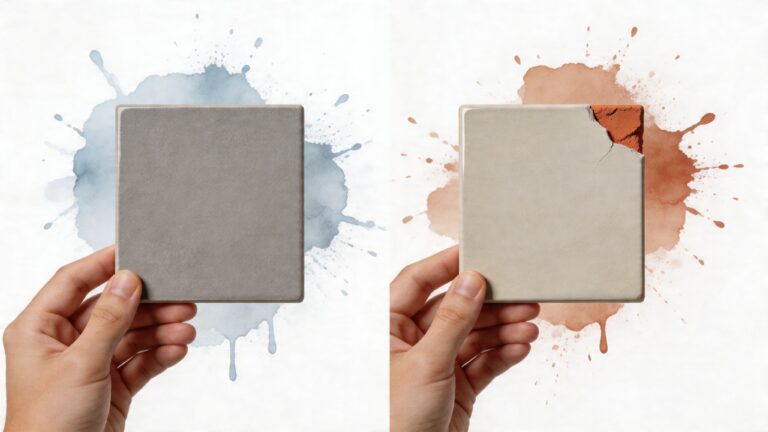
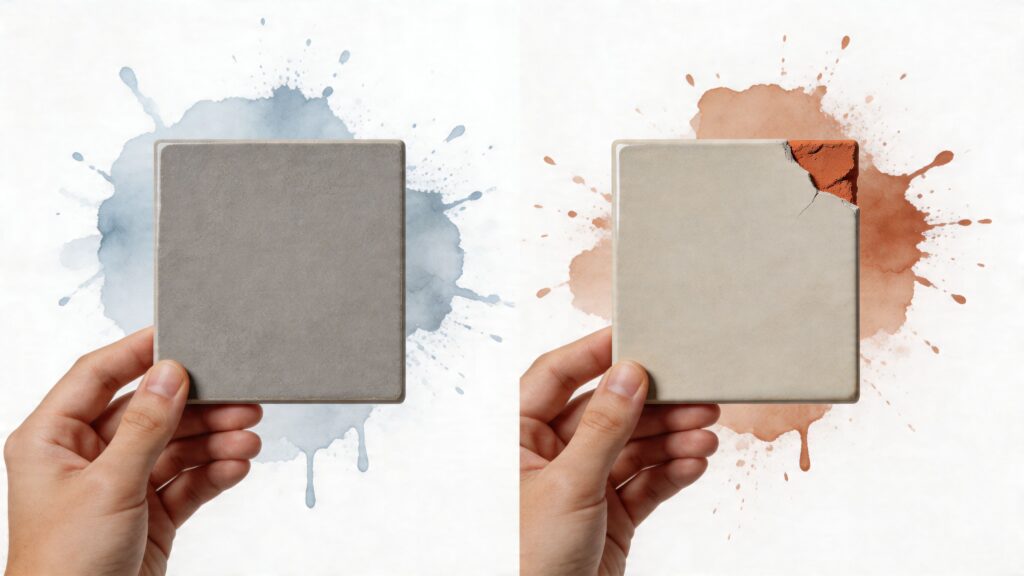
| Chipped edge appearance | More uniform through the body | Often shows a contrasting base under glaze |
The Core Difference How Porcelain and Ceramic Tiles Are Made
The answer to what is the difference between porcelain and ceramic tile starts in the kiln. Both are clay-based tile products, but they aren't built the same way.
Porcelain uses finer, less refined clay blended with minerals such as feldspar. Ceramic is usually made from coarser clay. That change in raw material affects everything that follows, including density, porosity, and how the tile behaves once it's installed.

Hotter firing creates a denser tile
Porcelain tiles are manufactured at significantly higher temperatures than ceramic tiles, exceeding 1200°C compared to 1000 to 1100°C for ceramic, which creates a denser structure with more uniform color throughout the tile body, according to Robbins' porcelain vs ceramic tile comparison.
That hotter firing matters because it changes the body of the tile, not just the surface. Porcelain becomes more vitrified, which is why it feels tighter, harder, and heavier in hand. Ceramic remains more porous and generally easier to cut, but it doesn't develop the same density.
If you want a good plain-language primer on what porcelain tile is, that overview is useful because it connects the manufacturing process to real-world applications.
Practical rule: If the space will deal with regular moisture, temperature swings, or heavy traffic, the kiln process behind the tile matters more than the color on the sample board.
Body color and chipped edges tell a story
One of the first things professionals look at is the edge or back of the tile. With many porcelain products, the color is more consistent through the tile body. With many ceramic products, the glaze carries the finished look, and a chip can reveal a different reddish or brownish base underneath.
That doesn't make ceramic a bad material. It just means surface damage can be more visible depending on the product. On a kitchen backsplash, that may not be a major concern. On a busy floor or entry, it often is.
Why this manufacturing difference shows up later
The kiln and raw materials explain why porcelain ends up heavier per square foot and less porous. They also explain why ceramic often works well on interior walls where the tile doesn't need to fight moisture or foot traffic every day.
For homeowners and designers comparing formats, porcelain slab tile applications show how that denser body opens the door to larger, more demanding uses.
Comparing Key Performance Properties
Specs matter when they connect to an actual room. A shower floor, a kitchen floor, and a covered patio don't ask the same things of a tile.
Porcelain often distinguishes itself. The performance differences are measurable, and they tend to show up in moisture exposure, wear, and daily maintenance.

Water absorption changes where the tile can live
Porcelain tiles limit water ingress to 0.5% or less by weight under ANSI A137.1 and ASTM standards, which classifies them as impervious, while ceramic tiles can absorb 3 to 7% water, according to Belk Tile's comparison of porcelain and ceramic tile.
On paper, that looks like a small percentage difference. In an actual home, it's the difference between a tile body that resists moisture and one that takes on more water over time.
For a Monterey Peninsula patio or a damp bathroom, that lower absorption gives porcelain a clear advantage. Water has fewer places to go, so the tile is less likely to struggle with staining, moisture-related weakening, or seasonal weather stress. In a dry interior wall application, ceramic's higher absorption rate is usually far less important.
A powder room backsplash and an exterior patio may use tile from the same color family, but they shouldn't automatically use the same tile body.
Wear resistance matters on floors more than walls
Another practical dividing line is wear resistance. Porcelain tiles typically rate 4 to 5 on the PEI scale, while ceramic is often better suited to lower ratings and lighter-use applications.
That isn't about one tile being universally better. It's about matching the tile to the traffic. Entryways, kitchen floors, mudroom floors, and busy family spaces need a surface that keeps its appearance under repeated use. Decorative wall areas don't face that kind of stress.
A few useful ways to think about that:
- For busy floors: Porcelain is usually the safer choice when people, pets, and daily grit are part of the equation.
- For vertical surfaces: Ceramic often makes sense because the tile isn't being walked on or dragged across.
- For long sightlines: A floor that holds its finish well tends to age better visually, especially in open-plan homes.
If you're weighing larger tile formats for a contemporary interior, why large-format porcelain is replacing stone in more projects is worth reading because format and performance are closely tied.
Density affects chips stains and general abuse
Porcelain's denser body also makes it more resistant to stains and structural shifts than ceramic in demanding conditions. That shows up in homes with active kitchens, exterior doors that bring in grit, and bathrooms that stay humid.
Ceramic still has an important place. It's often easier to work with in design-driven wall applications, and it can be a smart choice when the area is dry and the visual finish matters more than impact resistance.
On showroom samples, porcelain and ceramic can look almost identical from the top. Their difference shows up after years of use, especially where water and traffic keep testing the material.
Aesthetic and Design Options
Performance decides where a tile should go. Design decides whether you want to live with it every day.
Porcelain and ceramic both come in a wide range of colors, patterns, and finishes, but the body of the tile affects how forgiving the surface is once the project is in use.

Through-body color changes how wear looks
With many porcelain products, the color runs more consistently through the tile body. That's helpful when the tile is used on floors or in places where an edge might get bumped. A small chip tends to be less visually obvious than it would be on a glazed ceramic tile with a contrasting base.
Ceramic often shines where the face of the tile is the main event. Backsplashes, decorative bath walls, fireplace surrounds, and accent areas can benefit from ceramic's color range and glazing effects without putting the tile in a high-stress role.
Large-format design leans heavily toward porcelain
Porcelain has become especially important in modern large-format design. Market data shows porcelain accounts for over 60% of large-format tile sales in formats such as 36×36 inches and larger since 2015, driven by innovations in sintered porcelain slabs for indoor-outdoor transitions, according to Stone Centers' ceramic vs porcelain guide.
That trend makes sense in practice. Large-format surfaces ask a lot from the material. They need stiffness, dimensional stability, and a body that can support a refined finish across a bigger span.
For designers working on calm, minimal interiors, stone-look porcelain tile options are often part of the conversation because they give you a quieter, more continuous visual field with fewer grout lines.
Some of the most convincing stone looks today are in porcelain. The visual effect is one part of the story. The format flexibility is the other.
Finish still matters as much as material
Material type doesn't replace finish selection. A polished porcelain floor and a textured porcelain patio tile behave very differently. The same goes for glossy ceramic wall tile versus matte ceramic.
The right question isn't just porcelain or ceramic. It's porcelain or ceramic for this room, this light, this traffic, and this level of maintenance tolerance.
Where to Use Porcelain vs Ceramic Tile in Your Home
A tile can look perfect on the sample board and still be the wrong choice once it meets real use. I see that happen most often when a patio tile is chosen like a powder room wall tile, or when a decorative ceramic is asked to handle daily kitchen traffic.
In the Bay Area and along the Central Coast, the setting matters. Salt air, fog, wet shoes, direct sun, and sandy grit all change how a tile performs over time.

Best applications for porcelain tile
Porcelain belongs in spaces where the tile has a job to do, not just a look to deliver. That usually means bathroom floors, shower walls, shower floors, kitchen floors, entryways, laundry rooms, and exterior installations.
The reason goes beyond a spec sheet. Lower absorption and a denser body give porcelain a wider margin for error when conditions are harder on the surface. On a Monterey Peninsula patio, that difference shows up in a practical way. Morning moisture, afternoon sun, and tracked-in grit put stress on the tile day after day. In an indoor powder room wall, those same performance advantages matter far less because the tile is mostly decorative.
Outdoor work is where I push clients to be careful. A patio, terrace, or pool surround needs a tile that handles weather, moisture, and movement with less risk. Our guide on the truth about porcelain surfaces helps explain why porcelain is usually the better fit in those demanding applications.
Porcelain is also a strong choice when you want visual continuity from the main living area out to a covered terrace. That indoor-outdoor transition only works well if the material can hold up in both environments.
Best applications for ceramic tile
Ceramic makes sense where the design is doing more of the work than the tile body. It is often the right pick for kitchen backsplashes, bathroom walls outside the wettest zones, fireplace surrounds, laundry room walls, and powder room feature walls.
That is why ceramic remains so useful in residential design. If the surface will not deal with standing water, foot traffic, or outdoor exposure, ceramic can give you more decorative freedom without paying for performance you may not need. Glaze, color variation, shape, and handcrafted character are often the deciding factors in these spaces.
For kitchen projects, material pairing matters as much as tile type. This guide to kitchen countertop and backsplash combinations is useful if you are trying to coordinate wall tile with counters, cabinetry, and the overall tone of the room.
A simple room-by-room way to decide
Choose porcelain for spaces such as:
- Showers and bath floors, where regular moisture is part of daily use
- Kitchen floors and entryways, where spills, grit, and repeated traffic wear on the surface
- Patios, terraces, and outdoor kitchens, where weather exposure changes the performance requirements
- Poolside and spa areas, where water and slip resistance need closer attention
Choose ceramic for spaces such as:
- Backsplashes, where the tile is easy to clean and not underfoot
- Accent walls and powder room walls, where style usually matters more than impact resistance
- Fireplace surrounds, if the application does not involve floor-level abuse
- Low-traffic interior walls, where decorative value is the main priority
At Carmel Stone Imports, I usually frame the decision this way: will this tile spend its life being seen, or being used hard every day? Once that answer is clear, the porcelain versus ceramic choice gets much easier.
Maintenance Longevity and Cost Considerations
From a day-to-day ownership standpoint, porcelain is usually lower stress in demanding areas. Its denser body resists moisture and staining more effectively, so it tends to be the easier long-term choice for wet rooms, kitchen floors, and exterior spaces.
Ceramic can still be easy to live with in the right setting. On a backsplash or interior wall, maintenance is usually straightforward because the tile isn't under the same pressure from standing water, grit, or repeated foot traffic.
Longevity follows the same pattern. The better the material matches the environment, the better it tends to age. A ceramic wall tile in a dry room can serve beautifully for years. A porcelain tile in a shower or on a patio is generally the more durable fit because the conditions are harsher from the start.
Porcelain often carries a higher material cost because the production is more energy-intensive and the tile body itself is more demanding to manufacture. That doesn't mean it belongs in every room. It means the higher-performing material is often worth considering where replacement or visible wear would be far more expensive in the long run.
For larger formats, maintenance and long-term appearance also depend heavily on layout, substrate conditions, and edge alignment. This article on large-format tile considerations is useful if your project includes oversized pieces or slab-style surfaces.
The least expensive tile choice on day one isn't always the least expensive choice over the life of the room.
Frequently Asked Questions About Porcelain and Ceramic Tile
Can I use ceramic tile in a shower
You can use ceramic tile in some shower applications, but it needs careful product selection and placement. In general, porcelain is the safer option for full wet exposure because its water absorption is much lower. Ceramic is more comfortable in dry or lightly exposed wall areas than on surfaces that stay wet.
Is porcelain always better than ceramic
No. Porcelain is better for certain conditions, especially moisture, outdoor exposure, and heavier wear. Ceramic can be the better fit for decorative interior walls, backsplashes, and projects where surface design matters more than dense-body performance.
Why does porcelain usually feel heavier
It feels heavier because it is denser. That density comes from finer raw materials and hotter firing, which produces a tighter tile body than standard ceramic.
Will ceramic tile chip more obviously
Often, yes. Many ceramic tiles have a glazed face over a different-colored body, so a chip can be easier to see. Many porcelain products hide minor edge wear better because the color is more consistent through the tile.
What does rectified mean and should I care
Rectified means the tile edges have been mechanically finished for more uniform sizing. That can help create a cleaner look with tighter grout joints, especially on modern large-format tile. It matters most when precision and alignment are part of the design intent.
Which one should I choose for a kitchen floor
For most kitchen floors, porcelain is the more dependable choice because kitchens combine traffic, spills, chair movement, and regular cleaning. Ceramic can still work in some lower-demand interiors, but porcelain usually gives you more margin for wear and moisture.
If you're comparing porcelain and ceramic tile for a Bay Area, Monterey Peninsula, or Central Coast project, you can visit Carmel Stone Imports to review materials in person, request samples, and talk through where each option makes sense. Our showrooms are at 26382 Carmel Rancho Lane, STE 100, Carmel-by-the-Sea, CA, and 3160 West Bayshore Road, Palo Alto, CA. You can also call (650) 800-7840. Hours are Monday–Friday 8:00 AM–5:00 PM and Saturday 10:00 AM–3:00 PM.