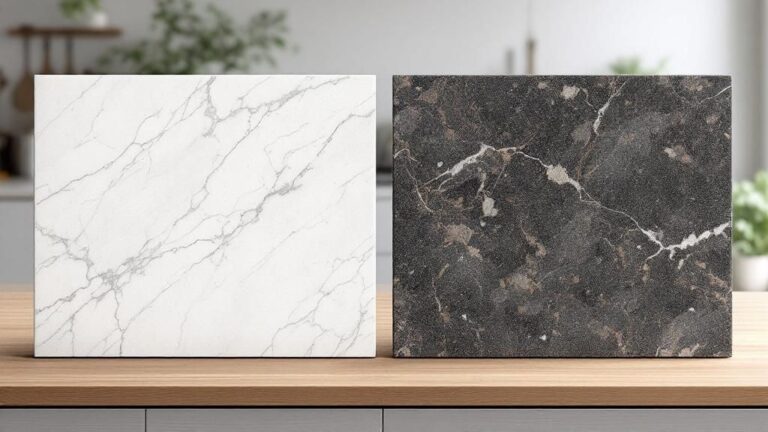
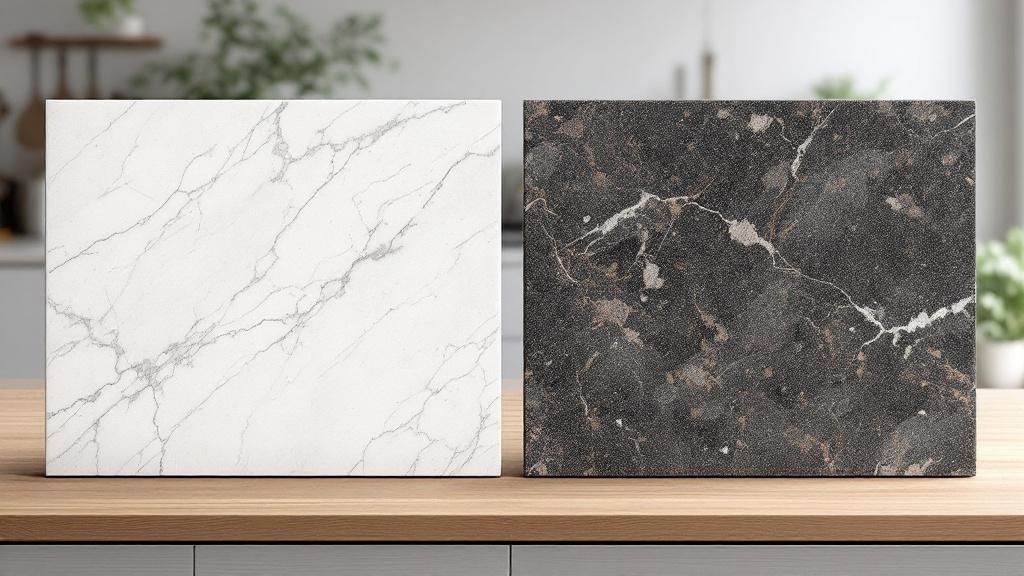
When you start comparing the price of quartzite vs granite, you'll quickly notice that quartzite usually comes with a higher price tag. This guide explores the reasons behind this cost difference, helping homeowners in California understand what drives the final installed price. While both stones offer a stunning look, their rarity and fabrication needs are key factors.
At-a-Glance Cost Comparison: Quartzite vs Granite
Choosing the right stone for your project involves balancing aesthetics, longevity, and your budget. Both quartzite and granite are premium natural stones, but their prices are shaped by different factors—from a slab's rarity to the skill required to transform it.
To get a clearer picture of the costs, let's look at a simple breakdown of what you can expect to pay per square foot, installed.
| Stone Type | Average Installed Cost (Per Sq. Ft.) | Key Cost Influencers |
|---|---|---|
| Quartzite | $60 – $120+ | Rarity of the slab, intricate patterns, fabrication difficulty |
| Granite | $50 – $100 | Color, origin, availability, and finish |
As the table shows, there's some overlap, but quartzite's ceiling is often higher. This reflects its exceptional hardness and the specialized expertise needed to cut and finish it without causing damage.
Ultimately, the final invoice for both stones will depend heavily on the specific slab you fall in love with and the complexity of your project.
The Numbers: What to Expect
Recent market data from the Natural Stone Institute highlights this price difference. You can often find granite installation starting as low as $50 per square foot, while quartzite projects typically begin around $60 per square foot.
For the most sought-after, exotic quartzite slabs, prices can climb to $120 per square foot or even more. In comparison, high-end granite tends to top out in the $40 to $100 per square foot range, installed.
This chart gives you a quick visual of the typical price gap.
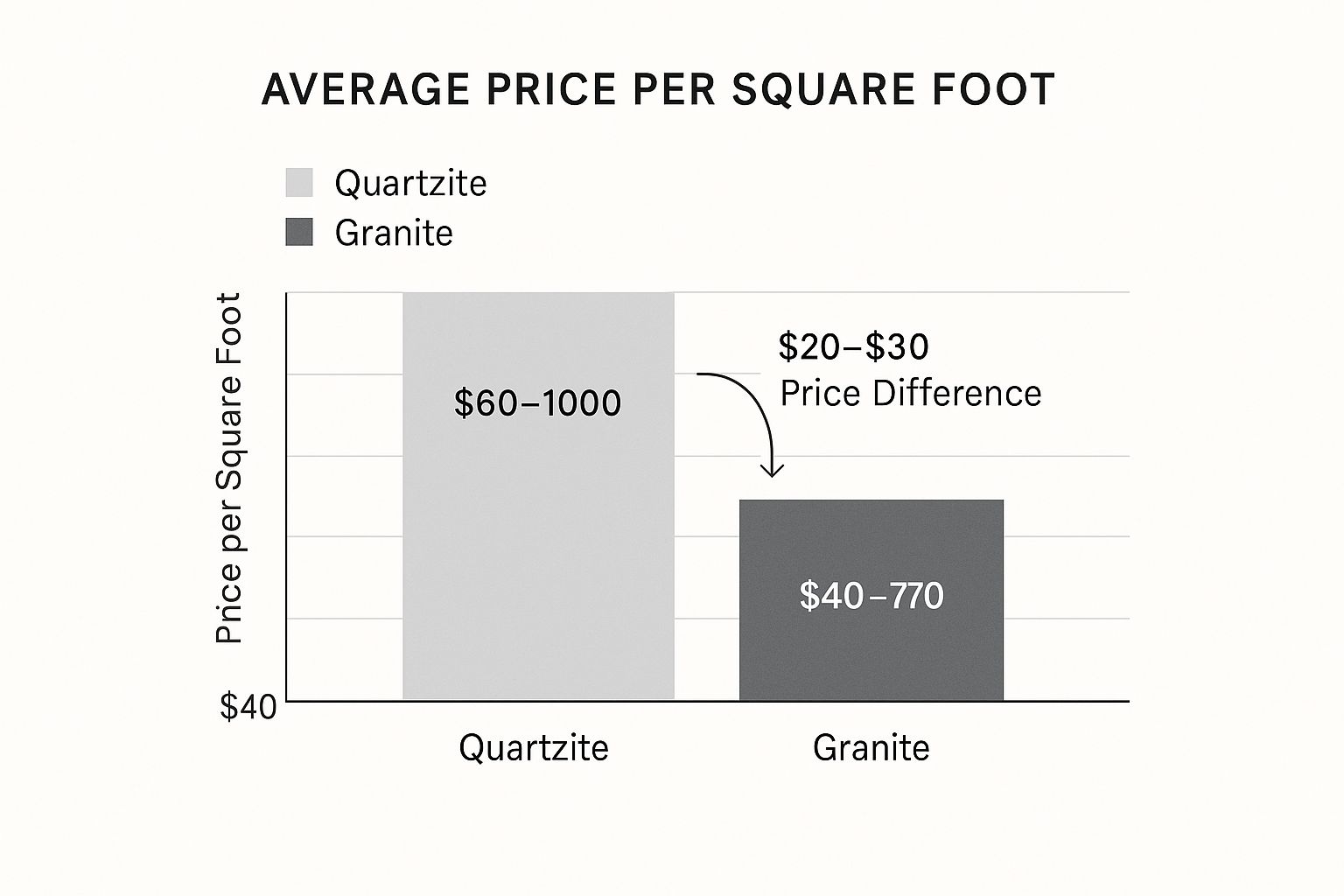
As you can see, a good rule of thumb is to budget roughly $20–$30 more per square foot for quartzite than you would for a comparable granite slab.
Key Cost Influencers
Several key elements will determine the final installed price for either stone. Getting familiar with them will help you make a much more informed decision. While we're focused on quartzite vs. granite here, it's also worth seeing how they stack up against engineered materials. For that, you can check out our guide on whether quartz is better than granite.
The main factors driving the cost up or down include:
- Material Grade and Rarity: Just like with any natural product, uniqueness comes at a premium. Exotic colors and dramatic patterns sourced from exclusive quarries will always be more expensive for both granite and quartzite.
- Fabrication Complexity: This is a big one. The more cuts, custom edge profiles, sink cutouts, and other intricate shapes your design requires, the more labor is involved, and the higher the cost.
- Slab Thickness: Standard countertops are often 2cm or 3cm thick. Opting for a thicker slab like 3cm will cost more for the material itself and may sometimes require extra cabinet support, adding to the overall project expense.
Deconstructing the Slab Price
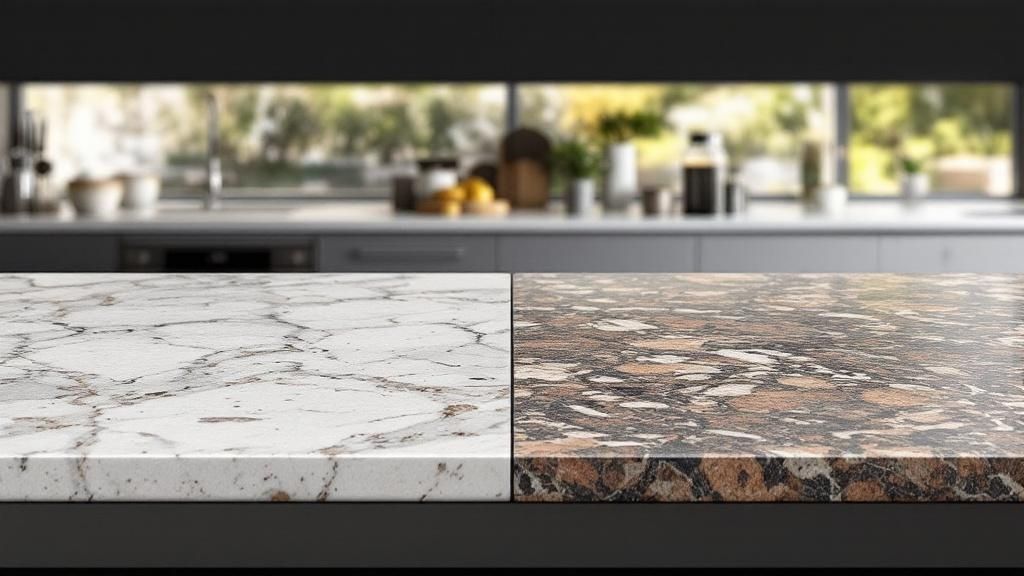
When you look at the price tag on a raw stone slab, you’re seeing the result of geology, rarity, and aesthetics. In the price of quartzite vs granite debate, it's easy to forget you aren't just buying a surface. You're investing in a unique piece of the earth, and its entire journey shapes the final cost.
With granite, abundance is a huge driver of price. Common varieties like Uba Tuba, known for their familiar speckled patterns, are quarried in massive quantities. This makes them a wonderfully affordable entry point for homeowners wanting natural stone.
On the other hand, exotic granite slabs with dramatic, sweeping veins or rare colors from exclusive quarries will command a much higher price.
The bottom line is simple supply and demand. If a stone is hard to get and has a look that everyone wants, it’s going to be more expensive than one that’s widely available. That’s true no matter what its mineral makeup is.
Rarity and Aesthetics
Quartzite’s cost comes down to its geological rarity and the marble-like look that is so in demand right now. Formed from sandstone under incredible heat and pressure, true quartzite with clean, luminous patterns is much harder to find than most types of granite. This is why high-end varieties like Taj Mahal are perfect for creating that sophisticated, modern look you see in luxury Bay Area homes.
Color and rarity make a huge difference in what you’ll pay. While many common granite colors fall between $40 to $60 per square foot, the more exotic or luxury slabs can easily jump from $60 up to $200 per square foot, all depending on their unique patterns.
This visual difference is really the key:
- Common Granite: Usually has a consistent, granular, or speckled appearance with earthy tones. It’s a classic, incredibly durable surface that offers fantastic value.
- Premium Quartzite: Known for its luminous, almost translucent quality and the kind of linear veining that mimics the world's most luxurious marbles, but with far superior durability.
Aligning Vision with Budget
Understanding these differences helps you match your design vision to your budget. Both stones are excellent choices, but knowing a slab’s price reflects its uniqueness helps you navigate the options with confidence. For a deeper dive into how different materials stack up, our countertop materials comparison guide offers even more perspective.
Ultimately, whether you’re drawn to the dependable beauty of a common granite or the breathtaking drama of a rare quartzite, nothing beats seeing it in person. Visiting a showroom in Carmel, Palo Alto, or Sand City is the best way to truly see and feel the difference for yourself.
Why Fabrication Drives Up Quartzite Costs
Turning a raw slab into a functional countertop is a highly skilled craft, and this is where the price of quartzite vs. granite often shows its most significant gap. The process, known as fabrication, involves much more than just cutting stone to size. It’s a detailed procedure where quartzite’s incredible density becomes both a benefit and a major cost driver.
Granite fabrication is a familiar process for most experienced installers. It's a hard stone, but its properties are well-understood. Quartzite, on the other hand, is a whole different ballgame. Its extreme hardness demands more time, advanced equipment, and a higher level of expertise to avoid costly mistakes.
The Challenge of Cutting and Shaping
Simply put, quartzite's density makes it notoriously difficult to cut. Fabricators must use specialized, high-quality diamond-bladed tools and sophisticated CNC machinery to get clean, precise results. These premium tools wear out faster when working with quartzite, and the cutting process itself is slower.
This increased difficulty translates directly into higher labor costs. Every custom element of your countertop design adds to the expense:
- Sink and Cooktop Cutouts: Creating openings for sinks or cooktops is a high-risk step. The internal stress within a quartzite slab can cause it to crack if not handled by a seasoned professional.
- Custom Edge Profiles: Want a detailed edge like an ogee or bullnose? It will require more time and cause more tool wear on quartzite compared to granite. A simple eased edge is always more cost-effective.
- Intricate Layouts: Kitchens with complex angles, curves, or large islands demand more seams and precision cuts. This amplifies both the labor and the risk involved with a material as hard as quartzite.
The fabrication process for quartzite is unforgiving. A single mistake, such as an improper cut or a dropped piece, can be far more costly than with granite. You're not just losing the labor; you're losing a very expensive piece of stone.
This is exactly why choosing a highly skilled fabricator is so important. When you work with the experts recommended by Carmel Stone Imports, you're not just hiring someone to cut stone—you're protecting your investment. The higher cost directly reflects the expertise, advanced tooling, and risk the fabricator assumes to deliver a perfect countertop for your Bay Area home.
Analyzing the Total Cost of Ownership
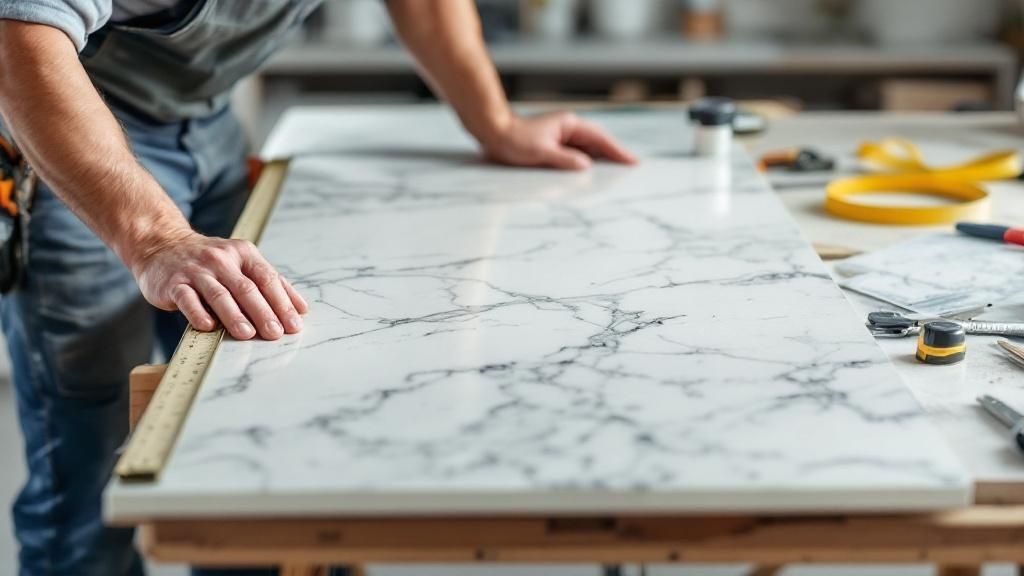
A smart investment in your home goes far beyond the initial price tag. When you're weighing the price of quartzite vs granite, looking at the total cost of ownership is what really tells you the long-term value you're getting. This means factoring in everything from maintenance to durability.
Thinking long-term is critical. It ensures the stone you choose not only fits your budget today but also works with your lifestyle for years to come. Both of these stones are built to last a lifetime, but their unique makeups mean they require different kinds of upkeep.
Sealing and Upkeep: A Key Differentiator
The biggest difference you’ll see in long-term cost comes down to maintenance—specifically, sealing. Sealing is what protects natural stone from soaking up liquids that cause stains, which is absolutely essential in a busy kitchen or bathroom.
-
Granite: Most granite countertops need to be sealed right after installation and then resealed every year. This is a predictable cost in both time and money to keep it looking great, especially for lighter-colored slabs.
-
Quartzite: Thanks to its incredible density, quartzite is naturally less porous than granite. Many top-quality quartzite slabs only need sealing every few years, and some of the densest varieties might not need it at all after the initial treatment. This lower upkeep can add up to real savings over time.
While granite requires consistent annual sealing, quartzite’s superior density often translates to less frequent maintenance, making it a lower-upkeep option for busy homeowners in places like Palo Alto and Monterey.
A Nuanced Look at Real-World Durability
Durability is another huge piece of the total cost puzzle because it determines how likely you are to face expensive repairs. While both stones are exceptionally tough, they have different strengths and weaknesses that really matter in day-to-day life.
On the Mohs scale of mineral hardness, quartzite clocks in at a 7, while granite usually falls somewhere between 6 and 7. In practical terms, this means quartzite is technically harder and more resistant to scratches. You’re much less likely to scratch a quartzite surface with everyday kitchen use.
However, that extreme hardness can also make quartzite a bit more brittle. It might be more prone to chipping from a sharp, heavy impact—like dropping a cast-iron pan on an edge. Granite, which is often slightly less dense, can sometimes be a little more forgiving with impacts. For a deeper dive into materials for specific spaces, you can check out our guide on choosing the best bathroom vanity countertop materials.
How to Choose the Right Stone for Your Home
Now it's time to put it all together. How do you actually make a final decision between quartzite vs granite countertops? It boils down to one thing: matching the stone’s strengths to your home, your lifestyle, and the look you’re trying to create.
There’s no single "best" stone—the right choice is always a personal one. Let's walk through a few scenarios to help you figure out which material truly fits your project.
Making the Decision Clear
What do you value most in a countertop? Your answer to that question will point you directly to the right slab for your space.
Choose Quartzite If:
- A Marble Aesthetic is Your Top Priority: You love the luminous look of marble but need more durability. For a sleek, high-end kitchen in a Bay Area home, the clean lines of quartzite are unmatched.
- Your Budget is Flexible: You recognize this premium look and superior hardness come with a higher price tag. You're prepared to invest in a top-tier material and the expert fabrication it requires.
- Scratch Resistance is Non-Negotiable: If you need the hardest natural surface available to stand up to daily wear and tear from a busy family, quartzite is the champion.
Choose Granite If:
- Timeless, Earthy Beauty is Your Goal: You're renovating a classic Monterey or Carmel home and want a countertop with rich, earthy patterns and unique mineral character.
- You Need Excellent Value: You want the durability of natural stone at a more approachable price point. This frees up room in your budget for other important parts of your remodel.
- Heat Resistance is Paramount: If you’re an avid cook moving hot pots and pans, you need a surface that can handle serious heat without flinching. Granite is exceptionally resilient to thermal shock.
The choice between these two incredible stones is a balance of priorities. One offers unparalleled hardness and a modern, marble-like appeal, while the other provides classic durability and outstanding value.
The final step is to see these materials for yourself. As you get closer to installation, reviewing an essential kitchen installation checklist can be a huge help. And if you’re still weighing all your surface options, our guide on choosing between natural stone or porcelain slabs can offer even more perspective.
Frequently Asked Questions
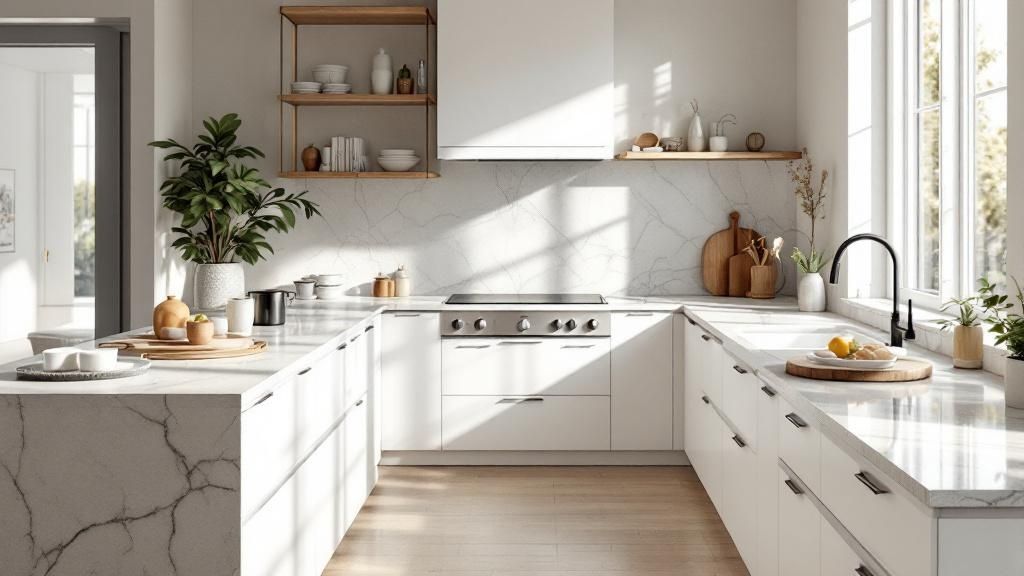
When trying to decide between quartzite and granite, many practical questions come up. Understanding cost, durability, and value is key to making a choice you'll be happy with for years to come in your California home. Here are answers to common questions we hear from homeowners in Monterey, Palo Alto, and across the Bay Area.
Is quartzite always more expensive than granite?
Generally, yes, quartzite usually has a higher price tag. While a rare, exotic granite slab can cost more than a basic quartzite, on average, quartzite is more expensive. This reflects that it's less common and requires a more complex, labor-intensive fabrication process due to its incredible density.
Which stone offers better long-term value?
This boils down to what "value" means to you. Both are fantastic investments that boost home appeal. Granite often has a lower initial cost, but typically needs annual sealing. Quartzite's higher upfront price can be offset by lower maintenance, as its density means it requires sealing far less frequently.
How does the finish affect the countertop price?
The finish you select can influence the final price for both stones. A standard polished finish is typically included in the base cost. Specialized finishes like honed (matte) or leathered (textured) require extra processing steps, which means more labor time and a higher final cost for your countertops.
Is one stone better for a busy family kitchen?
Both are excellent, tough choices for a high-traffic family kitchen in a Bay Area home. Quartzite is harder and more scratch-resistant. However, granite can be more forgiving with sharp impacts and holds up exceptionally well to heat. The best choice depends on whether you prioritize scratch resistance (quartzite) or impact and heat resilience (granite).
Will quartzite or granite increase my home's resale value?
Absolutely. Both quartzite and granite are considered premium materials that significantly increase a home's perceived and actual value. According to a 2022 survey by the National Association of Realtors, new countertops are one of the most appealing projects to potential buyers, often helping homeowners recoup a large portion of their investment upon sale. The luxurious look of either stone is a major selling point in competitive markets like the Bay Area.
Start Your Stone Selection Journey Today
Choosing between the timeless appeal of granite and the sophisticated durability of quartzite is a significant decision. The best way to finalize your choice is to see and feel these magnificent stones in person. At Carmel Stone Imports, our experts are here to guide you through the selection process, helping you find the perfect slab that aligns with your design vision and budget.
Visit one of our showrooms in Palo Alto, Carmel, or Sand City to explore our curated collection. Let us help you bring your dream kitchen or bathroom to life with the perfect natural stone. Contact us today to schedule a consultation or request a quote.