When it comes to countertops, especially here in California, the big question almost always comes down to this: is quartz better than granite? This guide offers a clear comparison to help you choose the right surface for your home, whether you're a trade professional or a design-savvy homeowner. For busy, modern households, quartz often takes the lead simply because it’s so durable and requires zero ongoing maintenance.
A Head-to-Head Comparison
Choosing between these two incredible materials means really understanding what makes each one special. Granite is all about that one-of-a-kind, straight-from-the-earth beauty, where no two slabs are ever identical. On the other hand, quartz offers engineered precision, giving you predictable patterns and unmatched durability.
For homeowners from Palo Alto to Monterey, where both style and practicality are non-negotiable, getting to grips with these differences is the first step in any successful kitchen or bath renovation. To help you decide, let's put them side-by-side.
Quartz vs Granite At-a-Glance Comparison
Here’s a quick breakdown of their core characteristics to help you see the differences clearly. This kind of at-a-glance summary makes the decision-making process a little bit easier.
| Feature | Quartz | Granite |
|---|---|---|
| Material Type | Engineered Stone (90-95% quartz, resins, pigments) | 100% Natural Igneous Rock |
| Maintenance | No sealing required | Requires periodic sealing (annually) |
| Stain Resistance | High (non-porous) | Moderate (porous, must be sealed) |
| Aesthetic | Consistent, uniform patterns and solid colors | Unique, natural veining and color variations |
| Durability | High resistance to scratches and chips | High resistance to heat, can chip or crack |
As you can see, the trade-offs become pretty clear. Granite gives you that raw, natural appeal, while quartz is designed for pure, effortless function.
The infographic below really brings these points home, visualizing key data on cost, hardness, and upkeep.
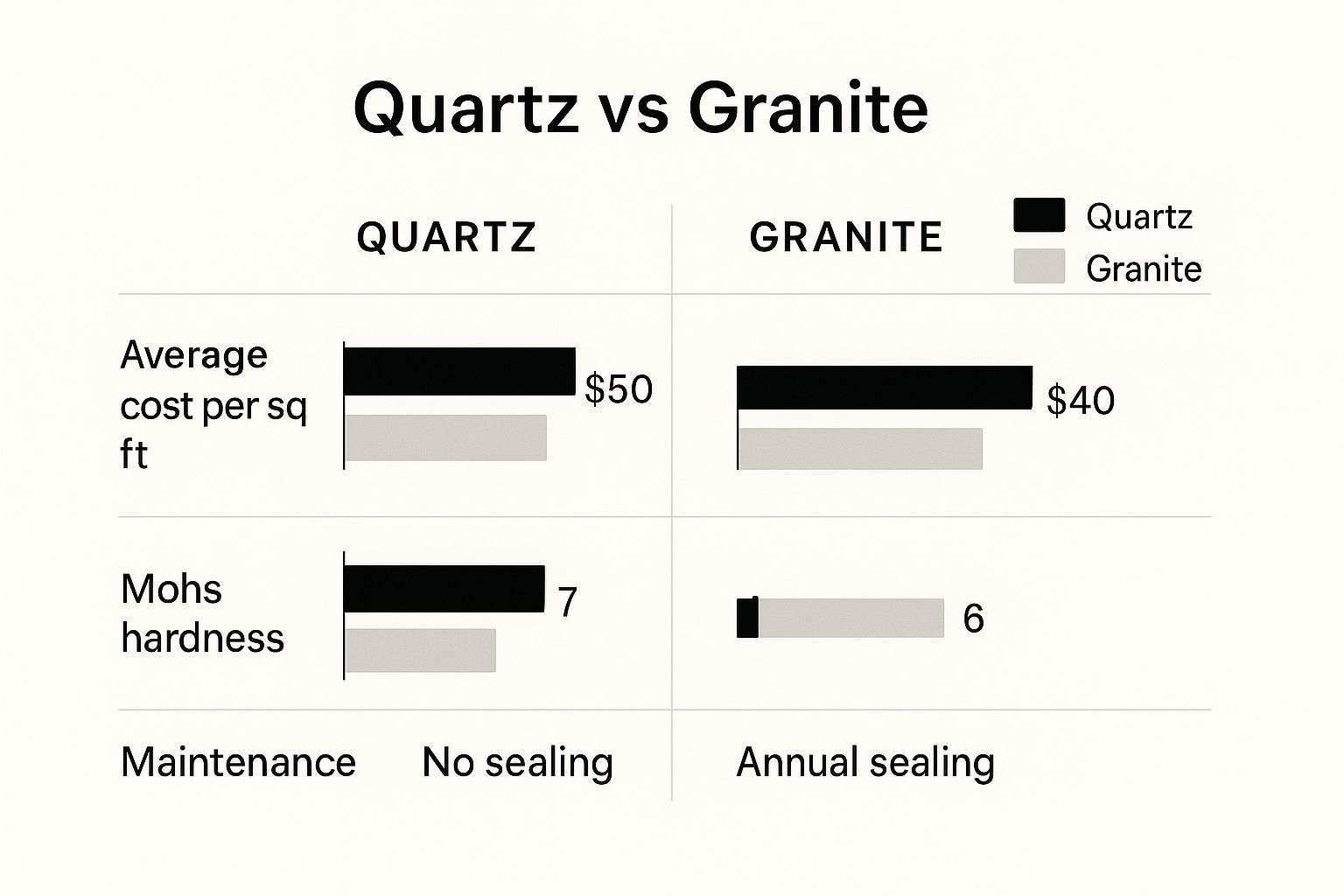
The data really highlights an important point: while granite might have a lower starting price in some cases, quartz pulls ahead in hardness and completely removes the need for regular sealing.
Key Takeaway: Your choice isn't just about how it looks the day it's installed; it's about how it will perform for years to come. Quartz is engineered for convenience and consistency. Granite celebrates raw, natural artistry. The best way to know for sure is to see and feel them for yourself—visiting a Carmel Stone Imports showroom can help you experience these differences firsthand.
Where It All Begins: Core Composition and Its Impact
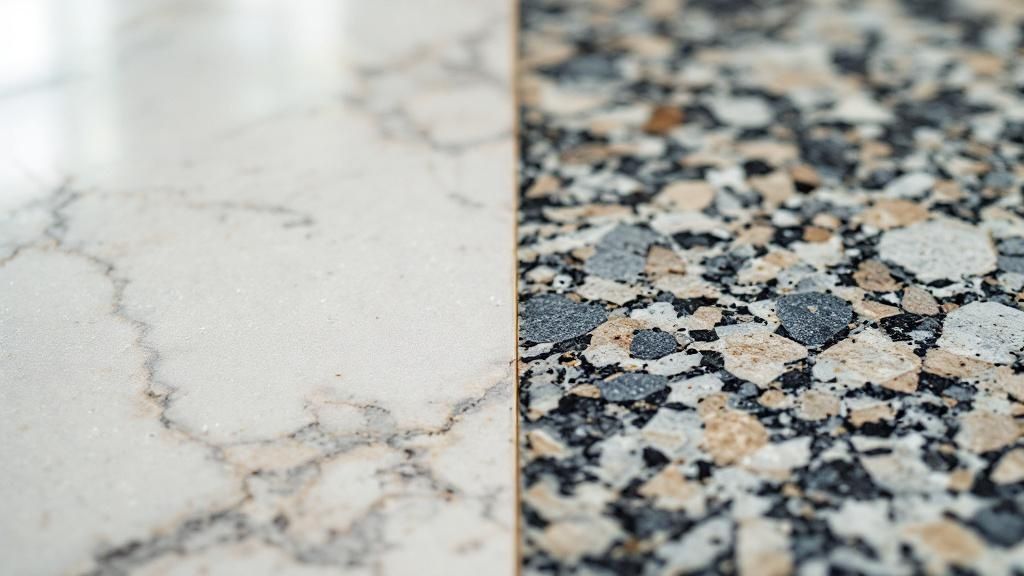
To really get to the bottom of the quartz vs. granite debate, you have to start with what they’re actually made of. The basic difference—one is completely natural, the other is engineered—shapes everything from how they look and wear to the upkeep they demand. Understanding this is the first step to making the right call for your home.
Granite is 100% natural igneous rock, pulled straight from the earth in enormous blocks. Each slab is a one-of-a-kind slice of geology, full of unique patterns formed by minerals like quartz, feldspar, and mica. This natural process guarantees that no two granite countertops will ever be the same.
Quartz, on the other hand, is an engineered stone. It’s made by mixing about 90-95% crushed natural quartz crystals with polymer resins and pigments. This manufacturing process creates a material that’s incredibly strong, consistent, and—critically—non-porous.
Natural Artistry vs. Engineered Precision
So, how does this difference play out in your kitchen every day? Granite’s natural origins mean it's porous. To prevent stains from things like red wine or cooking oil, it needs to be sealed regularly.
Quartz, held together by those resins, is completely non-porous right from the factory and never needs sealing. This low-maintenance quality is a huge reason why it’s become such a go-to choice for busy Bay Area families.
Frankly, this engineered edge is fueling its massive growth in popularity. According to Grand View Research, the global engineered stone market was valued at USD 23.42 billion in 2022 and isn't slowing down. Its built-in resistance to stains and scratches gives it a practical advantage that granite just can't match without consistent upkeep.
Key Insight: Granite gives you the raw, wild beauty of the natural world, where every single piece is an original. Quartz offers engineered peace of mind, ensuring the color and pattern you fall in love with in our Palo Alto showroom is exactly what will be installed in your home.
How Composition Shapes Your Design Choices
The way quartz is made opens up a world of design options that natural stone simply can't offer. While granite's color palette is decided by geology, quartz can be manufactured in brilliant solid whites, deep jet blacks, and even patterns that convincingly mimic high-end marble or industrial concrete.
This control gives homeowners and designers an incredible amount of creative freedom. If you're curious about the different looks you can achieve, exploring our guide on engineered stone versus natural stone offers more insight. Ultimately, your decision comes down to what you value more: the unique, organic story told by a slab of granite, or the predictable, high-performance versatility of quartz.
A Nuanced Look at Durability and Daily Use
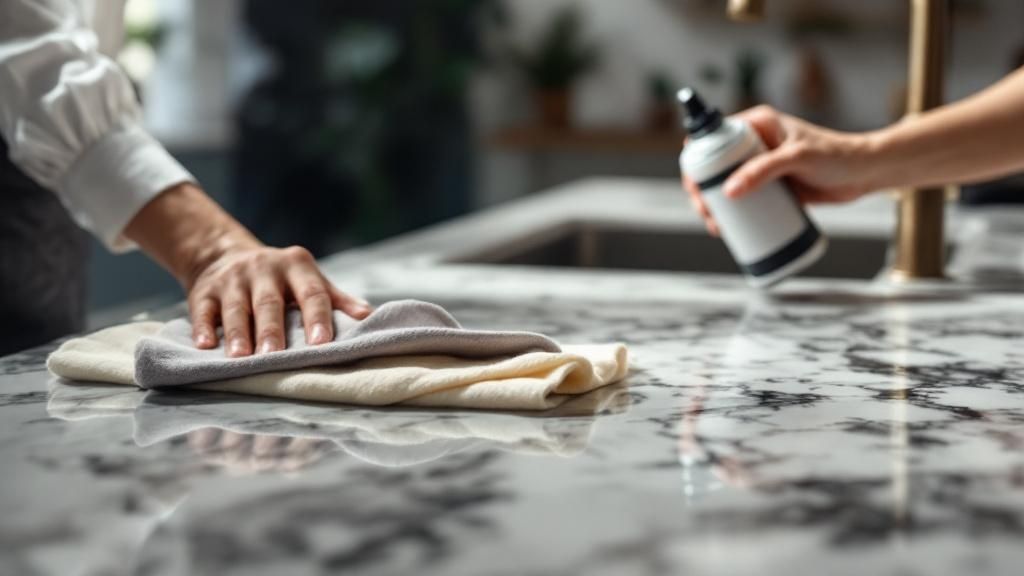
When you get past the technical details, the true test of a countertop is how it holds up to real life. The whole is quartz better than granite debate often gets settled right here, in the chaos of a busy kitchen. Both materials are incredibly hard, but their day-to-day performance reveals key differences.
Granite, being a natural stone, is porous. Without a good seal, it can absorb liquids like a spilled glass of red wine or a splash of olive oil, potentially leading to permanent stains.
This is where quartz really shines for most families. The manufacturing process binds crushed quartz with resins, creating a completely non-porous surface. This means quartz is naturally stain-resistant and, more importantly, never needs to be sealed. For a bustling Monterey kitchen, that low-maintenance perk is tough to beat.
Comparing Heat, Scratches, and Impact
The durability discussion doesn't stop at stains. Each material has its own battlefield strengths when it comes to the bumps, scrapes, and heat of a kitchen.
Heat Resistance:
Granite is the clear winner here. Forged by incredible heat deep in the earth, it has no problem with a hot pot or pan being placed directly on its surface. This makes it a favorite for serious home cooks.
Scratch and Chip Resistance:
Quartz generally takes the lead in this department. Its unique mix of hard quartz crystals and more flexible resins makes for a surface that’s highly resistant to scratches and chips. While granite is tough, its rigid crystalline structure can make it more prone to chipping on the edges if it takes a hard hit.
Practical Takeaway: Your lifestyle really dictates the right choice. If you’re constantly pulling hot pans off the stove, granite’s natural resilience is a massive plus. But if your main concern is fending off stains and scratches, the engineered toughness of quartz is probably a better match.
The Role of Sealing in Long-Term Performance
The need for sealing is one of the most fundamental differences between these two countertops. For granite, keeping that protective seal intact is absolutely essential for its long-term beauty and function.
- Granite: You'll need to re-seal it periodically, typically every one to three years, to protect its porous surface from absorbing spills.
- Quartz: It never needs sealing. Its non-porous nature is a permanent, built-in feature.
While sealing granite isn't a monumental task, it's a recurring chore that many homeowners would rather skip. If you're weighing your options, understanding the five key reasons to choose granite countertops can help you see why its timeless appeal endures, even with the required upkeep.
Comparing Design Flexibility and Aesthetics
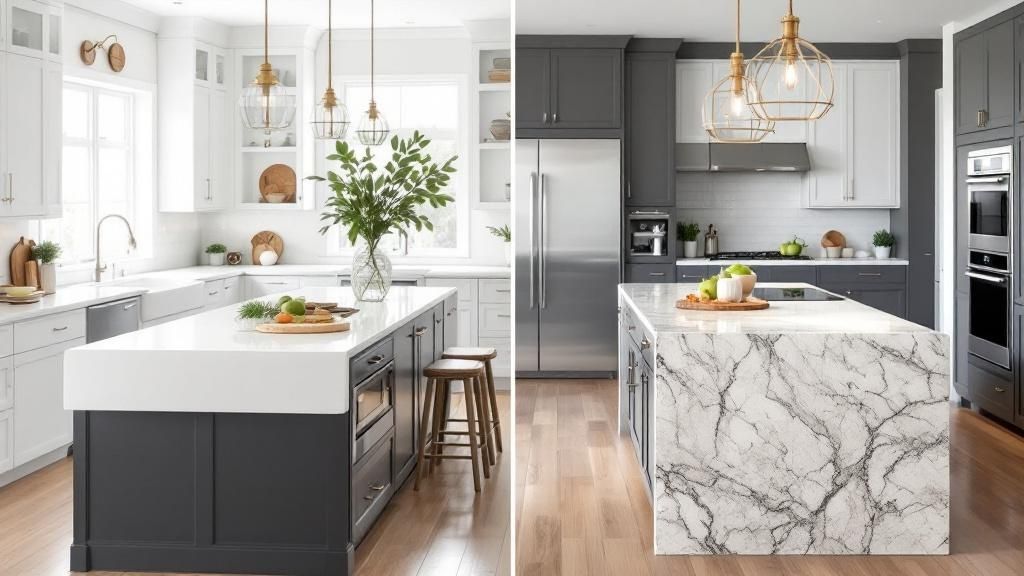
Let's be honest, your countertop is the visual anchor of your kitchen or bathroom. This is where the debate between granite and quartz really comes down to your personal taste. Granite offers one-of-a-kind, natural artistry, while quartz provides predictable beauty and a limitless range of styles.
If you’re a purist who loves the story behind a natural material, granite is for you. Each slab is a true geological masterpiece with rich, complex tones and dramatic veining that can never be perfectly duplicated. This unique character is perfect for creating a powerful focal point in a high-end space.
Predictability Meets Creative Control
On the other hand, quartz gives you total design control, a massive plus for many modern projects here in the Bay Area. Since it's an engineered product, quartz can be manufactured to hit incredibly precise aesthetic targets, ensuring consistency across a large project.
This precision manufacturing opens up a world of possibilities:
- Solid Colors: You can get flawless, uniform colors like pure white or sleek gray—looks that are simply impossible to find in natural stone.
- Realistic Mimicry: High-quality quartz slabs, like ‘Calacatta Laza,’ do an amazing job of recreating the delicate veining of luxury marble without the maintenance headaches.
- Modern Finishes: It’s easy to get countertops that look like concrete or other industrial materials, but with perfect consistency and far better performance.
The Market Reflects Both Tastes
While granite’s unique beauty keeps it firmly planted in the luxury design world, quartz is quickly gaining ground because it's so versatile. According to a 2023 market analysis, granite held the biggest piece of the global countertop market at 29.15%. However, the market's growth is increasingly pushed by demand for durable, low-maintenance materials like quartz.
Think about it this way: for a sleek, minimalist home in Palo Alto, a crisp white quartz countertop provides a clean, unbroken canvas. But for a rustic-luxe estate in Carmel Valley, the wild, organic beauty of a granite slab might be the perfect, show-stopping choice.
Breaking Down the Cost and Long-Term Value
When you're choosing a new countertop, the sticker price is just the beginning of the investment. While quartz and granite can seem close in their upfront costs, their long-term value tells two very different stories. The total cost of ownership over the years is where the question of is quartz better than granite moves from a style debate to a serious financial decision.
The Initial Investment
Both materials have a wide range of options that can fit different price points. The cost per square foot depends on factors like slab rarity, origin, and pattern complexity.
- Entry-Level Options: Common colors and patterns for both quartz and granite can start around $40-$60 per square foot.
- Mid-Range Choices: For more unique veining in granite or a specific designer pattern in quartz, expect to pay between $60-$100 per square foot.
- Premium & Luxury Slabs: The rarest granite and most intricately designed quartz slabs can easily go over $100+ per square foot, becoming the true focal point of a luxury kitchen.
Long-Term Value and Maintenance Costs
Here’s where the financial paths of quartz and granite really start to split. Granite has ongoing maintenance needs that bring costs quartz owners simply don't have to think about.
Because granite is a natural, porous stone, it needs to be sealed every one to three years to prevent staining. While a DIY job is inexpensive, hiring a professional in the Bay Area can run $100 to $300 each time, a recurring expense that adds up over the countertop's life.
In stark contrast, quartz is a zero-maintenance surface. Its non-porous nature is a permanent feature—no sealing, no special cleaners, and no surprise upkeep costs. Over a 10 or 20-year span, this makes it a much more predictable and often more budget-friendly choice.
Understanding the work involved is also smart. Getting a clear picture of the requirements for installing quartz countertops can help you appreciate why its "set it and forget it" nature is so highly valued.
Making the Right Choice for Your California Home
So, after laying out all the differences, how do you actually choose? The truth is, the right answer really boils down to your daily life and what you value most in your home's design. There isn't one "better" material—only the one that’s better for you.
For a busy Bay Area family that needs a bulletproof and hygienic surface, quartz is almost always the answer. Its non-porous nature and resistance to stains from spilled juice or coffee is a lifesaver in a hectic household. According to Houzz, this practical advantage is a huge reason quartz is the top pick for kitchen remodels, favored by 42% of homeowners.
Matching Stone to Lifestyle
On the other hand, what if you're designing a luxury kitchen around a show-stopping, one-of-a-kind centerpiece? This is where granite truly shines. The unmatched, organic beauty of a unique granite slab simply can't be replicated. Its rich, earthy patterns provide a sense of character and history that engineered stone just can't manufacture.
Situational Recommendation: If your top priority is effortless upkeep and a clean, consistent style for a modern home, go with quartz. If you’re after a unique, natural work of art and don't mind the simple task of periodic sealing, granite is your hands-down winner.
Ultimately, the final decision is best made in person. We encourage you to visit a Carmel Stone Imports showroom in Palo Alto, Carmel, or Sand City. There's just no substitute for feeling the cool, smooth texture of polished quartz or tracing the intricate veins of a granite slab with your own hands. You can also explore our detailed guide on quartz countertops in San Francisco to see how this versatile material is being used in modern Bay Area homes.
Frequently Asked Questions
1. Which countertop can handle the heat better?
Granite has a natural edge when it comes to heat. Formed by intense heat deep within the earth, it can typically handle a hot pan set directly on its surface. Quartz is heat resistant, but the resins used in its manufacturing can be damaged by sudden, extreme temperature changes, so using a trivet is always recommended.
2. Is quartz or granite a better choice for an outdoor kitchen in California?
For an outdoor project, granite is the hands-down winner. Its natural makeup is completely UV stable, meaning its colors won't fade or yellow in direct sun. The resins in quartz can be damaged by long-term UV exposure, making it unsuitable for outdoor use.
3. Which stone offers more unique, one-of-a-kind patterns?
If you're looking for true, natural artistry that can't be replicated, granite is your answer. Each slab is quarried from the earth and has a unique combination of mineral formations and veining. While high-end quartz offers stunning designs, the patterns are manufactured and repeated across slabs.
4. Do I need special cleaners for quartz and granite?
Quartz is incredibly easy to care for; a little mild soap and water are all you need. For granite, you should use a pH-neutral cleaner made specifically for natural stone to protect its sealant from breaking down.
5. How do I know which is better for my home's resale value?
Both quartz and granite are seen as premium upgrades that will boost your home's resale value. Quartz is incredibly popular with buyers who love a modern look and zero-maintenance. However, the timeless, luxurious feel of a beautiful granite slab remains a huge selling point, particularly in high-end or traditional homes.
Ready to see which material is the perfect fit for your home? The expert team at Carmel Stone Imports is here to guide you through our extensive collections of premium quartz and granite. Visit one of our showrooms or contact us today to start your design journey.