Direct Answer: Calacatta Gold is a pattern name, not a single material. It is sold as quarried Italian marble, as printed large-format porcelain, and as engineered stone slabs. Each behaves differently in a kitchen.
You saved a photo of a kitchen with a white countertop and warm gold veining. The caption said Calacatta Gold. You now have a name, and you are about to spend real money on it.
The problem is that those two words get printed on three completely different products: quarried Italian marble, large-format porcelain, and engineered stone slabs. A photo on a design site will not tell you which one you fell in love with.
Sorting that out before a fabricator gets involved is the difference between a smooth kitchen remodel and an expensive surprise. This guide covers how to tell the three apart, how the natural version varies slab to slab, and the short list of specs you need pinned down before any money moves.
Calacatta Gold Is a Pattern Name, Not a Material
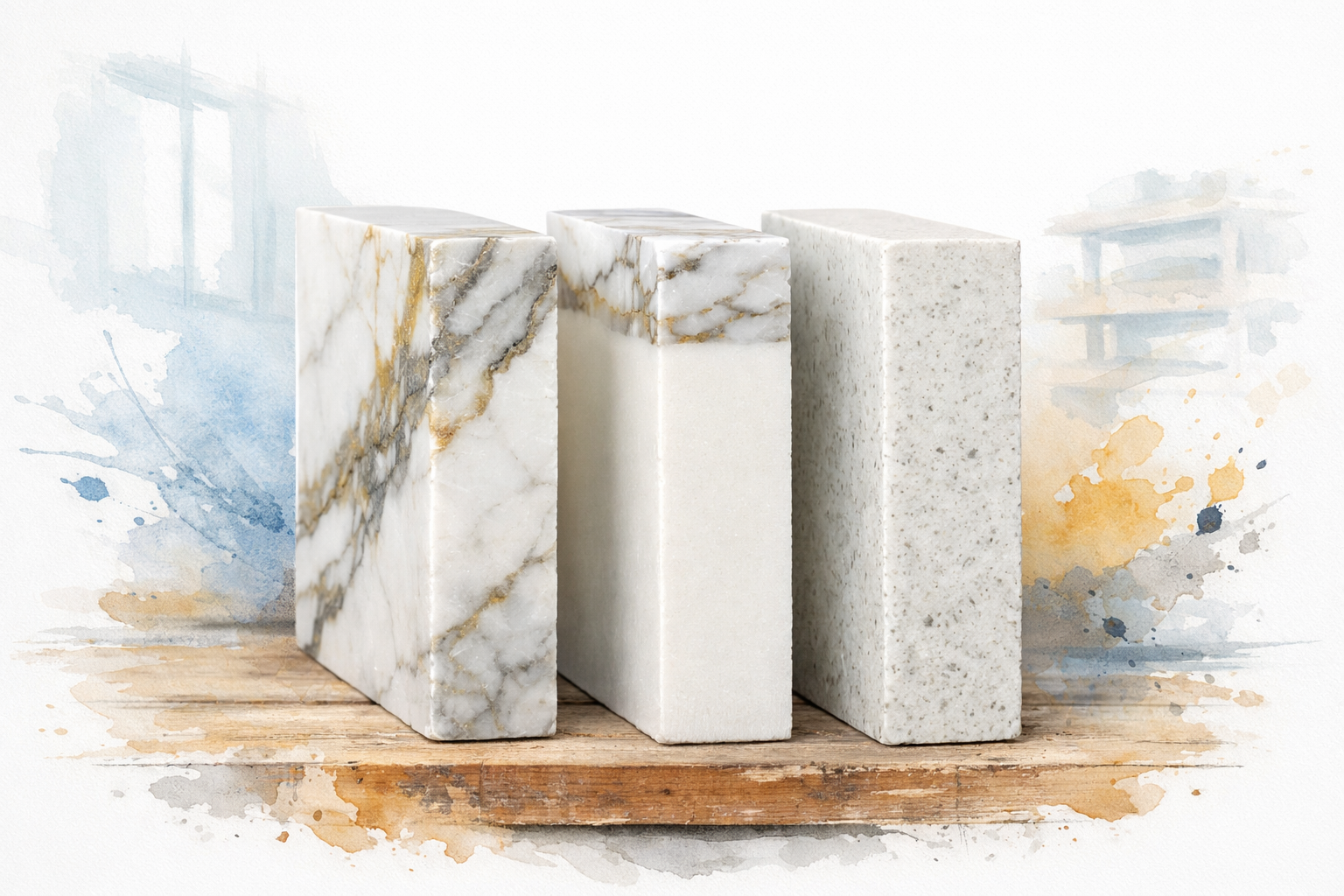
Nobody owns the name. A quarry in Tuscany can use it, a porcelain factory in Italy can use it, and a plant pressing engineered stone slabs can use it. All three are describing the same look: a white field with bold, warm gold veining.
We see this play out constantly in the questions that come through the website. In a single quarter, one visitor typed “Is Calacatta Gold in stock?” and another asked for “Calacatta Gold marble” specifically. A homeowner sourcing a San Francisco kitchen sent a form asking about a porcelain maker’s Calacatta Gold line in 12mm polished.
Three different material categories. One name.
Here is what that name can actually be:
- Natural marble, quarried in blocks and sawn into slabs, usually sold at 2cm or 3cm thickness
- Large-format porcelain, with the pattern applied to a printed surface layer on most products, sold in 6mm, 12mm, and 20mm
- Engineered stone, a pressed slab of mineral and resin with the pattern built in during manufacturing
If your inspiration image just says Calacatta Gold, you do not yet know which of those three you are looking at. Start there, not at the quote stage.
What Natural Calacatta Gold Actually Is, and Why the Photo Lies
Natural Calacatta Gold is a calcite marble from the Carrara region of Tuscany. The white field is recrystallized limestone. The veins are mineral impurities that worked their way through the stone over an enormous span of time, and the warm gold tone comes from iron-bearing minerals in those veins.
That matters because mineral content changes from block to block, and even from one end of a block to the other. Two slabs pulled from the same quarry, sold under the same name, can read as different stones in a room.
When you finally stand in front of two of them, look at three things:
- Vein width. Some Calacatta Gold runs in thin gold threads. Some runs in bands an inch wide that will dominate an island.
- How much warm tone sits against the white. A slab with heavy gold reads cream in a room with warm cabinets. A cooler one with gray-gold veins can read almost gray next to white oak.
- Where the veining lands. A gorgeous vein pattern is meaningless if it falls where your sink cutout goes.
You already suspect the picture is not the slab, and that instinct is right. The useful habit is to view the full slab in daylight rather than under showroom spots, and to ask for the piece to be pulled forward so you can see the whole face. If you want a deeper walkthrough, our guide on how to read a marble slab before you say yes covers what to look for vein by vein.
How Each Version Behaves in a Real Kitchen
This is where generic pros-and-cons lists fall apart, because the right answer depends on how you cook and how long you plan to stay.
Natural marble will etch. Calcite reacts to acid, so lemon juice, wine, or a cleaner that is not pH neutral will leave a dull mark where it sat. That is a patina question more than a damage question. Modern sealers and cleaners handle it far better than most people expect, and a stone restoration pro can bring an etched surface back, which is not true of a pressed slab.
So the honest verdict splits by household. A Pacific Grove homeowner who cooks most nights and likes the way old European marble ages will be fine with it. A Palo Alto owner updating a 1960s kitchen to sell next spring often does not want to explain etch marks to a buyer.
Porcelain carries its pattern on a printed surface layer on most products. That changes how an exposed edge or a mitered waterfall reads, and it raises the stakes on fabrication. Edge work and cutouts are the risk points, which is why your fabricator choice matters more with porcelain than it does with stone.
Engineered stone slabs are mineral and resin. They shrug off acid, but resin does not take direct heat the way stone does, so hot pans go on a trivet. Two bits of context worth knowing if you are weighing this version: the import safeguard measure that took effect August 15, 2026 applies to engineered quartz surface products and leaves quarried marble outside its scope, and fabrication of engineered stone in California is the subject of active Cal/OSHA emergency rulemaking. Our showroom team carries only crystalline silica-free quartz and can share product documentation on request.
Calacatta Gold: Three Versions Side by Side
Same name, same look from across a room, three different sets of rules once the material is in your kitchen.
| Version | How the pattern is made | Etching and heat | Common thickness |
|---|---|---|---|
| Natural marble | Mineral veining through the full body of the stone | Etches from acid, handles heat well, can be restored | 2cm or 3cm |
| Large-format porcelain | Printed surface layer on most products | Does not etch, handles heat, edges need careful fabrication | 6mm, 12mm, 20mm |
| Silica free engineered stone | Pattern built in during manufacturing | Does not etch, needs a trivet for hot pans | 2cm or 3cm |
Pin These Down Before Any Money Moves
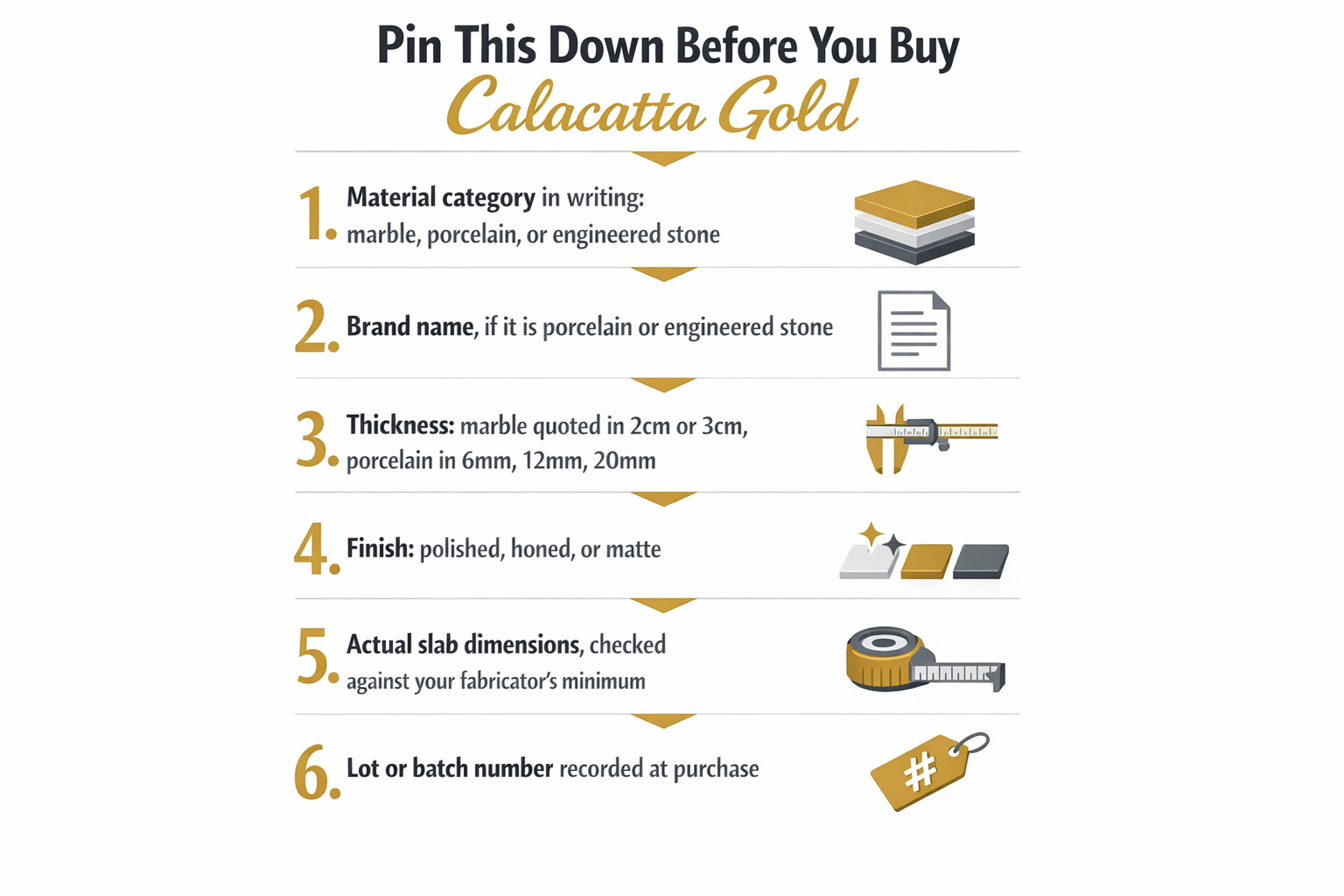
Six items turn a pattern name into an actual order. Missing any one of them is how quotes go sideways.
The Short List a Designer Can Paste Into an Email
If you are specifying for a client, this is the list. No hedging, no extra words.
- Material category, stated in writing
- Brand and product line, if porcelain or engineered stone
- Thickness, in the unit that material actually uses
- Finish
- Actual slab dimensions, not nominal
- Lot or batch number
Thickness is where this stone trips people most often. Porcelain commonly comes in 6mm, 12mm, and 20mm, while natural marble is quoted in 2cm and 3cm. Those are not interchangeable on a quote, and a 12mm porcelain priced against a 3cm marble is not a comparison. Our breakdown of 6mm, 12mm, or 20mm porcelain slab thickness walks through where each one belongs.
Slab size is the other quiet deal-breaker. Fabricators often have a minimum usable length, and 130 inches comes up regularly as the threshold for a run or an island. A slab you love that measures short of it may still work with a seam, but you want that conversation before the deposit, not after.
One more practical note: if your quote shows a SKU and no photo, ask what it refers to. Existing customers do this all the time, and a thirty second answer beats finding out at delivery.
If You Think You Will Want More of It in Two Years
Calacatta Gold is exactly the material people come back for. A bar area, a powder room, a second island, usually two or three years after the kitchen is done.
Containers arrive from different blocks. The name on the label stays the same. The veining does not.
We see the request often enough to be honest about it. One homeowner wrote in hunting a discontinued engineered slab already installed in their kitchen, listing the exact SKU, color, size, thickness, and finish. Another had bought a quartzite in Reno about five years earlier and wanted to match it for a new bar.
An exact match on a gold-veined marble years later is unlikely. What does work:
- Buy overage up front. One extra slab now costs less than a five year search later.
- Record the lot and SKU at purchase, and keep it with your project file, not in a text thread.
- Search across multiple warehouse locations, not one showroom floor, since inventory moves between buildings.
The version of success that actually exists is a deliberate complementary slab chosen in person, something that reads as an intentional pairing instead of a near miss. Mismatches read as mistakes. Contrast reads as design.
That is also the practical case for seeing material in person. Inventory here is imported directly and sits physically across three Northern California locations, with the Carmel showroom on Carmel Rancho Lane and the Sand City warehouse handling Central Coast projects, so a Calacatta Gold conversation can move from a name on a screen to two real slabs leaning in a rack the same day. Founder Robbie Robinson personally inspects the quarries and factories behind the collections, and roughly 500 containers a year come in through the Port of Oakland. As one customer put it in a review, “the people who work here guide you through the many options so that you are not overwhelmed, and you find something right for your project.”
Frequently Asked Questions About Calacatta Gold
Is Calacatta Gold marble too delicate for a kitchen with kids?
It depends on what bothers you. The stone is hard enough for daily use, but it is calcite, so acid will etch it where lemon juice or wine sits. Families who treat the surface as something that ages tend to love it. Families who want a counter that looks the same in year five as it did on install day usually land on porcelain or a silica free quartz slab instead.
How much does Calacatta Gold cost per square foot?
There is no single number, and anyone who gives you one without asking questions is guessing. Price moves with the material category, the block the slab came from, thickness, finish, and current import conditions. A marble slab with dramatic wide veining and a near-white field prices differently than a quieter one with the same name. Our team can confirm current pricing on specific slabs in stock.
Does the Calacatta Gold pattern go all the way through porcelain slabs?
On most porcelain products the pattern sits on a printed surface layer, which is why exposed edges, mitered waterfalls, and sink cutouts need careful handling. Some products offer a full-body look. Confirm it by brand and product line before you commit to a waterfall detail.
Can I see photos of actual slabs before driving out to the showroom?
Yes, and a lot of buyers do. Remote clients and out-of-area designers regularly ask for photos of the specific slabs on hand before making the trip. Photos are a good filter, but they are not a substitute for seeing a full slab in daylight, especially with a stone where the gold tone shifts this much.
Do you fabricate and install the countertops too?
No. This is a supplier and showroom business: slabs, tile, and outdoor stone. You work with your own fabricator or contractor for templating, cutting, and installation, and the team can share referrals if you need one.
Want to See Calacatta Gold in Person Before You Decide?
If you have a photo and a name but no idea which material you are actually looking at, standing in front of two real slabs clears it up faster than any catalog. The Carmel showroom on Carmel Rancho Lane serves Carmel-by-the-Sea, Monterey, Pacific Grove, and Pebble Beach, with additional locations in Palo Alto and Sand City. Slab selection appointments can be arranged at (650) 800-7840 or info@carmelimports.com, and the team will confirm what is currently on the floor.