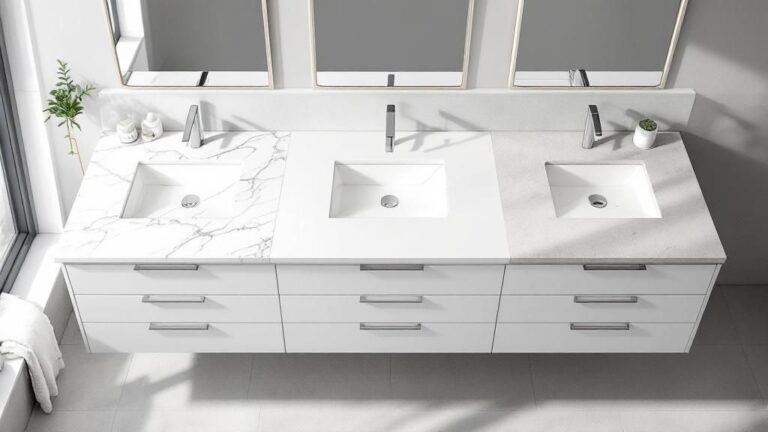
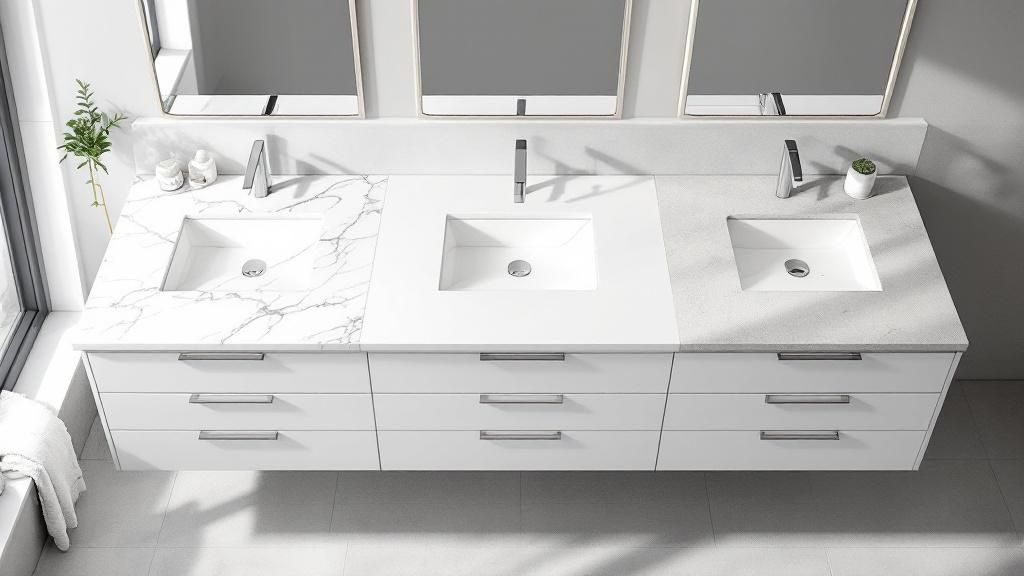
Your bathroom countertop isn't just a place to set your toothbrush; it's a daily touchpoint that pulls the entire room's design together. This guide explores the best bathroom vanity countertop materials, from luxurious natural stones like marble to workhorse engineered quartz, helping you find the perfect balance of style, durability, and maintenance for your home.
How to Choose the Perfect Bathroom Countertop
Picking the right material is about balancing four key things: durability, maintenance, personal style, and budget. This guide will demystify the process, showing you how different surfaces hold up in real-world settings—from a chaotic family bathroom in Palo Alto to a tranquil master suite in Monterey.
This decision puts you in a growing market. The global bathroom vanities market was valued at around USD 17.9 billion in 2024 and is expected to climb to USD 30.6 billion by 2033, according to Precedence Research. While wood is common for vanity cabinets, stone surfaces are a fast-growing segment for tops, prized for their premium look and long-lasting nature.
Navigating Your Top Material Options
To make your search easier, it helps to group the materials into a few main categories. Each one offers a unique mix of looks and performance that suits different lifestyles and design goals.
- Natural Stone: Think of materials like marble and granite, quarried from the earth. Every slab is a one-of-a-kind piece of natural art with unique veining and colors.
- Engineered Stone: Quartz is the star player here. It’s made by combining crushed natural quartz with resins, creating a non-porous, consistent, and low-maintenance surface.
- Porcelain Slabs: This is a high-tech option delivering amazing durability and design flexibility. It can mimic materials like marble or wood with photorealistic detail.
Take a look at this breakdown of the most popular choices. It gives you a clear visual starting point for where to focus your attention.
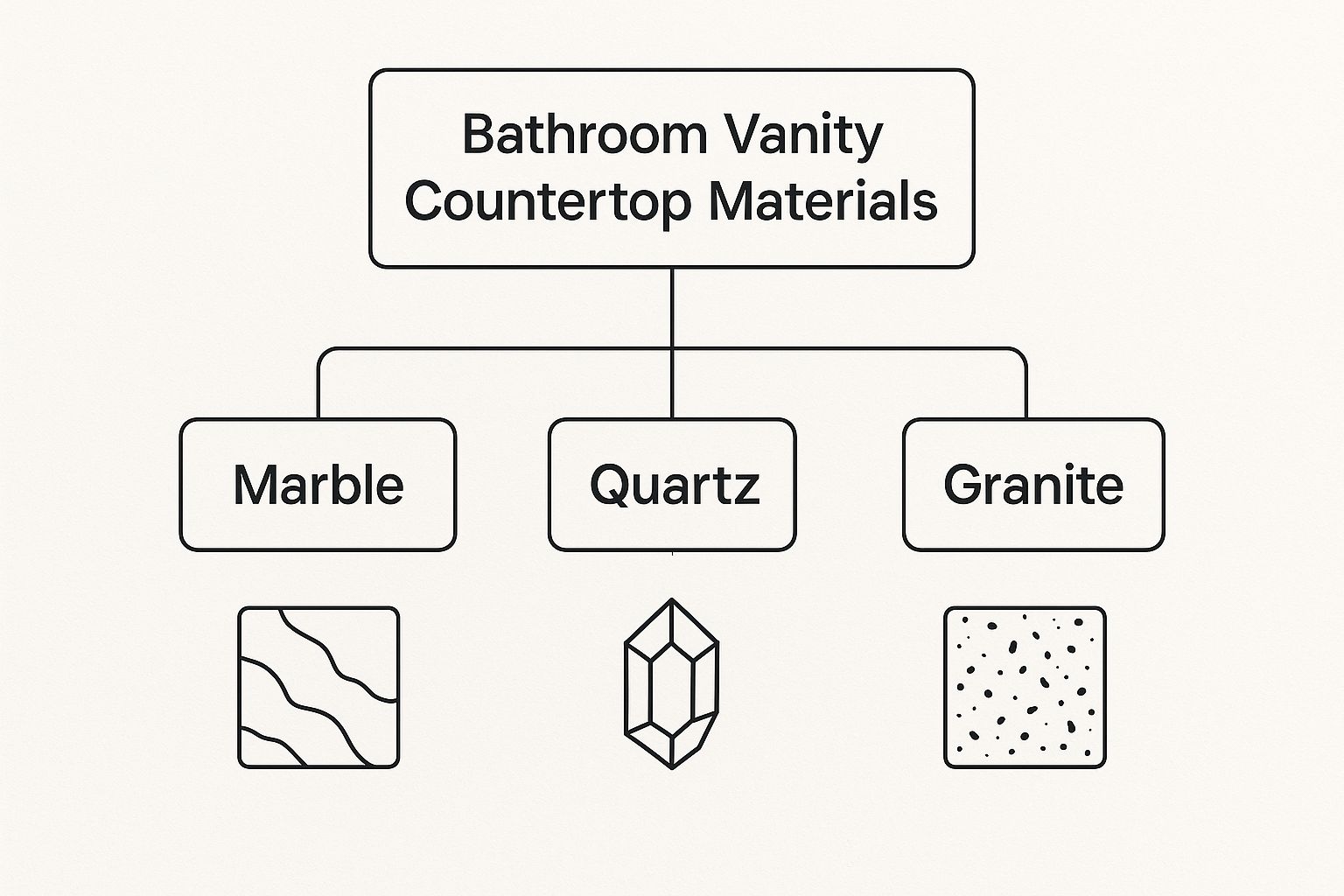
As you can see, marble, quartz, and granite are the big three that most homeowners and designers consider first. From there, each material opens up its own world of possibilities, which we'll dive into next.
Quick Comparison of Popular Vanity Countertop Materials
This table offers a snapshot of the most popular materials to help you make a quick initial assessment based on what matters most to you.
| Material | Durability | Maintenance Level | Typical Cost | Best For |
|---|---|---|---|---|
| Marble | Moderate to High | High | High | Luxurious, high-end aesthetics where elegance is the priority. |
| Quartz | Very High | Low | Mid to High | Busy households needing a durable, low-fuss, stylish surface. |
| Granite | High | Moderate | Mid to High | Those wanting unique natural patterns with excellent durability. |
| Porcelain | Very High | Low | High | Modern designs and achieving a specific look with high performance. |
| Solid Surface | Moderate | Low | Mid-range | Seamless looks, integrated sinks, and easy repairs. |
This table is a great starting point, but the "best" material is always the one that fits your specific project's needs and personal taste. Once you’ve landed on the perfect countertop, the next step is often the vanity installation. For solid guidance, you can find great resources on professional bathroom vanity assembly to ensure your beautiful new top has a flawless foundation.
The Unmatched Character of Natural Stone
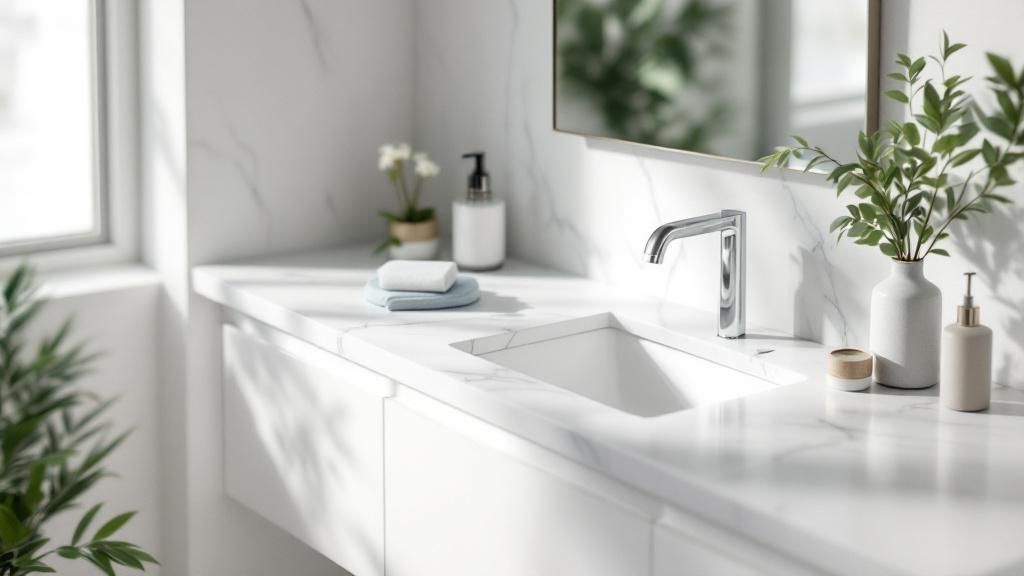
There’s just something about natural stone. It brings a story millions of years in the making right into your bathroom, with each slab of marble, granite, or quartzite being a unique piece of art quarried from the earth. This means your countertop will be completely one-of-a-kind.
Unlike factory-made materials, no two natural stone countertops are ever identical, giving your space an exclusive character you can't replicate. It’s no wonder that for homeowners who value timeless elegance, natural stone is almost always the first choice. Whether it’s the dramatic flair of marble or the steadfast strength of granite, these materials make a powerful statement.
The Timeless Allure of Marble
When you think of luxury in a bathroom, you’re probably thinking of marble. Its soft, luminous surface and distinctive, graceful veining can turn a simple master bath into a personal spa.
Picture the classic, bold veins of Calacatta or the subtle, feathery patterns of Carrara—each creates a different mood. But this beauty comes with responsibility. Marble is a porous, calcium-based stone, making it sensitive to acidic substances like certain cleaners, lotions, or colognes.
Marble requires diligent care. This means sealing it regularly (usually every 6-12 months) and wiping up spills right away. For many homeowners in places like Carmel, the unrivaled look is a worthy trade-off.
The Durable Beauty of Granite
Need a natural stone that can stand up to the chaos of a busy family bathroom? Granite is an outstanding choice. Formed deep within the earth, it’s one of the toughest natural materials, fantastic at resisting scratches and heat from styling tools.
Visually, granite is known for its granular, speckled look, and it comes in a huge spectrum of colors and patterns. From deep, shimmering blacks to warm, earthy browns and cool whites, there’s a granite slab for any design.
Like marble, granite is porous and needs to be sealed to ward off stains. The good news is that it’s generally less porous and a bit more forgiving. You’ll typically only need to seal it every 12 to 18 months, making it a practical-yet-beautiful choice among bathroom vanity countertop materials.
Quartzite: The Best of Both Worlds
Often confused with engineered quartz, quartzite is a natural metamorphic rock. It offers the stunning looks of marble with the rugged durability of granite, starting as sandstone and transformed by intense heat and pressure into an incredibly dense, hard stone.
This process gives quartzite its breathtaking appeal, often featuring the soft, sweeping veins that recall high-end marble. At the same time, its hardness makes it exceptionally resistant to scratches and etching—a level of resilience marble can't offer.
Because it is a natural product, quartzite still needs a good seal to protect it from stains. But for anyone who adores marble's aesthetic but needs a surface for the daily grind, quartzite is an ideal solution. If you're planning a larger project, our guide on how to purchase natural stone tile for home installation offers more valuable insights.
Engineered Quartz: Modern Style Meets Unbeatable Performance
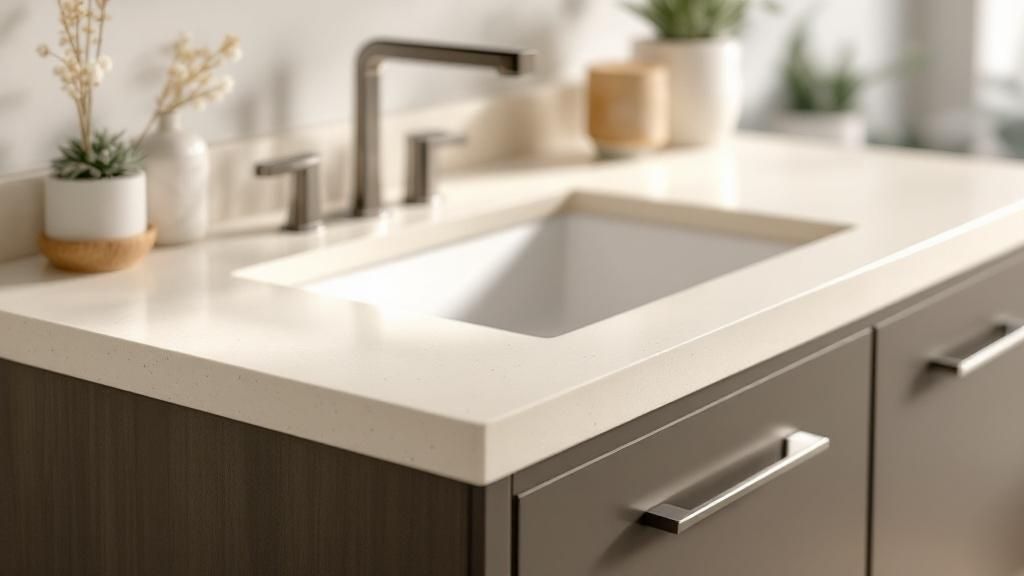
If you could engineer the perfect countertop—one with all the soul of natural stone but none of its vulnerabilities—you’d end up with quartz. It’s the ideal blend of nature and ingenuity, a go-to solution for homeowners who want stunning looks without high maintenance.
Manufacturers take over 90% crushed natural quartz crystals and fuse them with resins and pigments. This process creates an incredibly dense, non-porous slab that never needs sealing and can handle the daily grind of a busy bathroom without a problem.
Durability You Can Count On
The biggest draw for quartz is its sheer resilience. Being non-porous makes it one of the most hygienic and low-maintenance bathroom vanity countertop materials you can find. Unlike natural stones that can absorb spills, quartz provides a solid, impenetrable surface where germs have nowhere to go.
This toughness also makes it a champion against stains and scratches. Everyday bathroom products like toothpaste, lotions, and soaps won't leave their mark, making quartz a fantastic pick for high-traffic bathrooms, especially those used by kids or guests.
A Blank Canvas for Any Design
While its performance is legendary, the design potential of quartz is where it truly shines. The manufacturing process allows for an endless spectrum of colors, patterns, and finishes with a consistency that nature can't replicate.
Quartz can adapt to virtually any style you can dream up:
- Natural Stone Looks: Find quartz that convincingly mimics the dramatic veining of Calacatta marble or the earthy tones of granite.
- Sleek and Minimal: For a clean, modern Bay Area aesthetic, quartz comes in brilliant, solid whites and deep, uniform grays.
- Bold and Unique: Make a statement with quartz in vibrant blues, rich blacks, or other saturated colors that don't exist in nature.
This amazing range guarantees you'll find a quartz countertop that fits your vision. To learn more, you can explore the many benefits of quartz countertops.
Quartz gives designers and homeowners a level of control that is simply not possible with natural stone. You can select a sample in one of our Palo Alto or Carmel showrooms and be confident the installed slab will match perfectly.
This consistency is a huge plus when planning a project. To see how engineered options stack up against their natural cousins, our guide to engineered versus natural stone countertops is the perfect resource.
Porcelain Slabs: The Ultimate High-Tech Surface
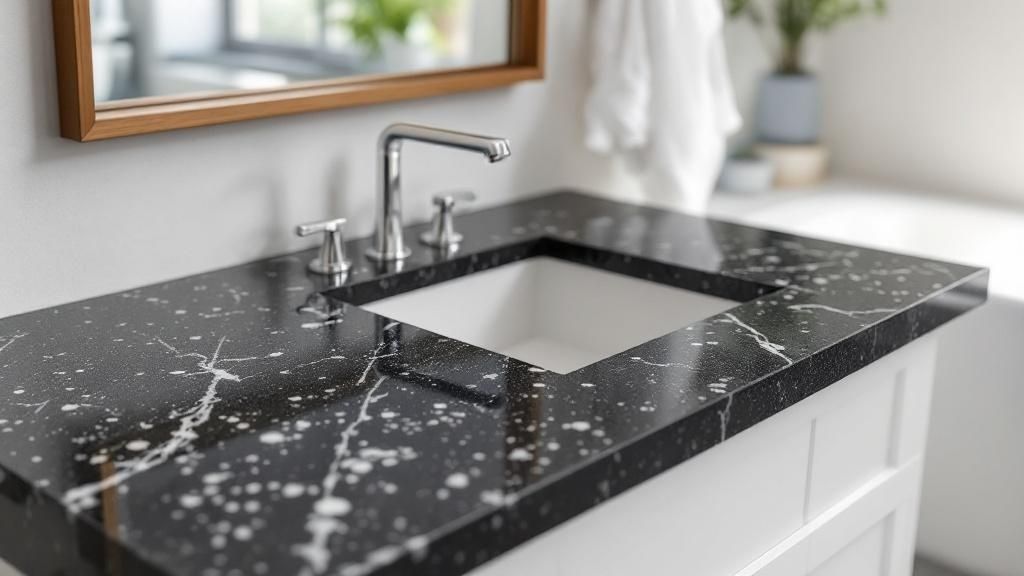
Porcelain slabs have emerged as a champion in modern bathroom design, offering a blend of cutting-edge technology and sophisticated style. Think bigger than traditional tile; we’re talking about large-format slabs that create a seamless, grout-free surface that’s as tough as it is beautiful.
Unlike natural stones, porcelain slabs are meticulously engineered. Clay, sand, and other natural minerals are fused under immense heat and pressure in a process called sintering. This creates a surface that is incredibly dense, virtually waterproof, and exceptionally resistant to everything a bathroom can throw at it.
Unbeatable Performance and Durability
The real standout feature of porcelain is that it's nearly indestructible. That high-heat manufacturing process makes it incredibly tough, so it stands up to daily life without breaking a sweat.
Porcelain’s non-porous nature gives it several key advantages:
- Stain-Proof: Spills from makeup, hair dye, or dark soaps wipe away completely without a trace.
- Scratch-Resistant: The material is actually harder than granite, making it extremely difficult to scratch with keys or razors.
- Heat-Resistant: You can set a hot curling iron or straightener directly on the surface without worry of scorching or burning.
- UV-Resistant: Perfect for bathrooms with lots of natural light, like in sunny Carmel or Monterey, its color won't fade or yellow.
Limitless Design Versatility
The design potential is what truly sets porcelain apart. The surface is a high-definition canvas, allowing for hyper-realistic patterns that can replicate almost any premium material without the maintenance headaches.
Imagine the sweeping veins of rare Italian marble without worrying about etching or staining. Or perhaps the warm feel of wood or the industrial look of concrete for a modern Bay Area home. Porcelain can deliver these looks with breathtaking accuracy.
Because porcelain is manufactured, it provides a level of design consistency that natural materials can't match. You get a predictable, flawless appearance across the entire slab, perfect for a clean, cohesive look.
The slim profile of many porcelain slabs also lends itself to sleek, contemporary designs. For a truly integrated look, you can use porcelain slabs for flooring and shower surrounds. Our guide on using porcelain slab bathroom walls shows how this creates a spa-like retreat.
A Practical Look at Cost and Long-Term Value
Choosing the right countertop involves understanding the full picture: the initial investment, long-term maintenance, and the value it adds to your home. A higher upfront cost doesn't automatically mean it's more expensive in the long run. The sweet spot is finding the balance between what you pay today and how it performs tomorrow.
Think of it like buying a car. A cheaper model might need constant, pricey tune-ups, while a pricier one may only need a simple wash to look fantastic. Bathroom countertops are no different.
Breaking Down the Initial Investment
The upfront cost is almost always calculated per square foot, and the range can be wide, depending on the material's quality, rarity, and origin.
Here’s a rough idea of what to expect:
- Premium Natural Stones (Marble, Quartzite): These beauties usually sit at the top, running from $100 to over $250 per square foot.
- Granite: A true workhorse, granite lands in the mid-to-high range, typically $95 to $225 per square foot.
- Engineered Quartz: This manufactured product offers a ton of options, generally from $105 to $185 per square foot.
- Porcelain Slabs: This high-tech option is a premium choice, with prices similar to or even higher than top-tier quartz. For a deeper dive, our article explaining why porcelain slab countertops are a great idea is packed with great info.
Analyzing Long-Term Maintenance Costs
This is where the true value of a material shines. A countertop with a lower initial cost that needs frequent upkeep can end up costing more over a decade than a premium option that asks for nothing.
The long-term cost equation is simple: Initial Price + (Annual Maintenance Cost x Years) + Repair Costs = Total Cost of Ownership. A material like quartz, with zero ongoing maintenance costs, dramatically reduces that long-term financial hit.
Natural stones like granite and marble need to be sealed periodically. You could DIY with a $20 kit or hire a pro for $100 to $300 every year or two. In contrast, engineered quartz and porcelain are non-porous and never need sealing, making them incredibly cost-effective over time.
Vanity Material Cost and Maintenance Breakdown
This table breaks down not just what you'll pay upfront, but what you can expect in terms of upkeep and overall value down the road.
| Material | Initial Cost (per sq. ft.) | Required Maintenance | Long-Term Value |
|---|---|---|---|
| Marble/Quartzite | $100 – $250+ | Periodic sealing required (every 1-3 years) to prevent staining. | High, adds significant luxury appeal, but requires commitment. |
| Granite | $95 – $225 | Periodic sealing required (every 1-3 years) to maintain stain resistance. | Strong, classic appeal that holds its value well. |
| Engineered Quartz | $105 – $185 | None. Non-porous surface requires no sealing, just routine cleaning. | Excellent, offers modern style with incredible durability and ease of care. |
| Porcelain | Varies (often high-end) | None. Non-porous and highly resistant to stains, scratches, and heat. | Very high, provides a sleek, modern look with unbeatable performance. |
Looking at this, you can see how a material like quartz or porcelain, while a significant initial investment, can pay for itself by eliminating ongoing maintenance expenses.
Factoring in Resale Value
Finally, don't forget resale value. In places like Palo Alto and Carmel, high-quality stone countertops—whether natural or engineered—are a major selling point.
Both natural stone and premium quartz signal a high-end, well-cared-for home to potential buyers. The best investment is a material that creates a beautiful, cohesive look that will feel both timeless and valuable for years to come.
Eco-Friendly Countertops For A Greener Home
For so many homeowners in California, a beautiful design isn't finished unless it's also a responsible one. This desire for sustainability has shaped the market for bathroom vanity countertop materials, pushing suppliers to find greener ways of doing business.
This isn't a niche interest. A recent Houzz survey found that nearly half of renovating homeowners (46%) prioritize integrating green or sustainable materials. This shows that homeowners in our communities, from Monterey to the Bay Area, are putting their money where their values are.
The Natural Longevity Of Stone
At first, quarrying massive blocks of stone might not sound "green," but its incredible lifespan tells a different story. A natural stone countertop is a "buy it for life" investment.
When you select a timeless material like granite or quartzite, you’re choosing a surface that can easily last for generations. This drastically cuts down on waste created by replacing lower-quality materials every few years. This longevity is a cornerstone of true sustainability. For more, our guide on selecting the right natural stone offers great perspective.
Innovations In Engineered Surfaces
The world of engineered stone has also made huge strides in sustainability. Top manufacturers of quartz and porcelain are putting eco-conscious processes into place that make a real difference.
Here are a few key green features to look for:
- Recycled Content: Many top quartz slabs now include pre-consumer and post-consumer recycled materials, like crushed glass and leftover stone from quarries.
- Water Conservation: Advanced factories now recycle up to 100% of the water they use for cutting and polishing in a closed-loop system.
- Healthier Air Certifications: Look for products with GREENGUARD Gold certification, which guarantees the material meets strict chemical emissions limits for better indoor air quality.
Choosing a countertop from a brand committed to these practices means you don't have to choose between performance and principles. You get a tough, beautiful surface that also supports a healthier planet.
By focusing on durable natural stone or certified engineered products, you create a bathroom that reflects your style and your commitment to the environment. For more ideas, you can explore various eco-friendly building materials to apply throughout your home.
Frequently Asked Questions
When you're choosing a new countertop for your bathroom, the questions start piling up. It's a big decision! Here are answers to some of the most common questions our clients in Palo Alto and Carmel ask.
What’s the most durable material for a high-traffic family bathroom?
For a busy bathroom, engineered quartz and porcelain are the top performers. Both are non-porous, meaning they are exceptionally resistant to stains, scratches, and bacteria. Their durability and low-maintenance nature make them an ideal, worry-free solution for families.
Can I put marble in a bathroom that gets used every day?
Yes, you absolutely can use marble in a primary bathroom. While it requires more care than engineered options, its timeless beauty is unmatched. To protect it, you must seal it regularly and wipe up spills from acidic products immediately to prevent etching and staining.
What is the main difference between quartz and quartzite?
This is a common point of confusion! Quartzite is a 100% natural metamorphic rock quarried from the earth that offers marble-like looks with granite-like durability. Engineered quartz is a man-made product, combining over 90% crushed natural quartz with resins, making it non-porous and maintenance-free.
How do I clean my new stone countertop?
For any stone surface, natural or engineered, use a soft cloth with a pH-neutral cleaner specifically formulated for stone. Avoid harsh, acidic, or abrasive cleaners like bleach or vinegar, as they can damage the sealant on natural stone or dull the finish on any surface.
Which bathroom vanity countertop material offers the best ROI?
Both natural stone and high-end engineered quartz offer an excellent return on investment. Buyers in markets like the Bay Area recognize these as premium features. The best choice is a material that creates a cohesive, high-end look that complements the bathroom’s design, as this delivers the strongest impression of value.
Ready to find the perfect surface for your bathroom? The experts at Carmel Stone Imports are here to guide you through our extensive collections of natural stone, quartz, and porcelain. Visit one of our showrooms or contact our team today to start your project.