

Direct Answer: Limestone tile is soft enough to etch from acids and scratch from grit, but it is not fragile. Match the finish to the room, seal it, and it can be restored later.
You saw a honed limestone floor somewhere and it stopped you. Warm, matte, quiet underfoot, the kind of surface that looks like it has always been there. Then someone told you limestone is too soft and you started second-guessing the whole thing.
That warning is half right, which is the worst kind of advice. Limestone does etch, and it does absorb, but the way it fails is predictable and mostly preventable. It also happens to be one of the few surfaces that can be brought back years later.
This guide covers three things that actually change the outcome: what softness means in daily use, how finish and application should drive your choice, and how coastal moisture on the Monterey Peninsula changes your sealing schedule. If you live anywhere between Carmel-by-the-Sea and the inland valleys, that last one matters more than you think.
What “Soft” Actually Means With Limestone Tile
Forget hardness charts for a second. Limestone is calcium carbonate, and calcium carbonate reacts with acid. That is the whole story behind most limestone complaints.
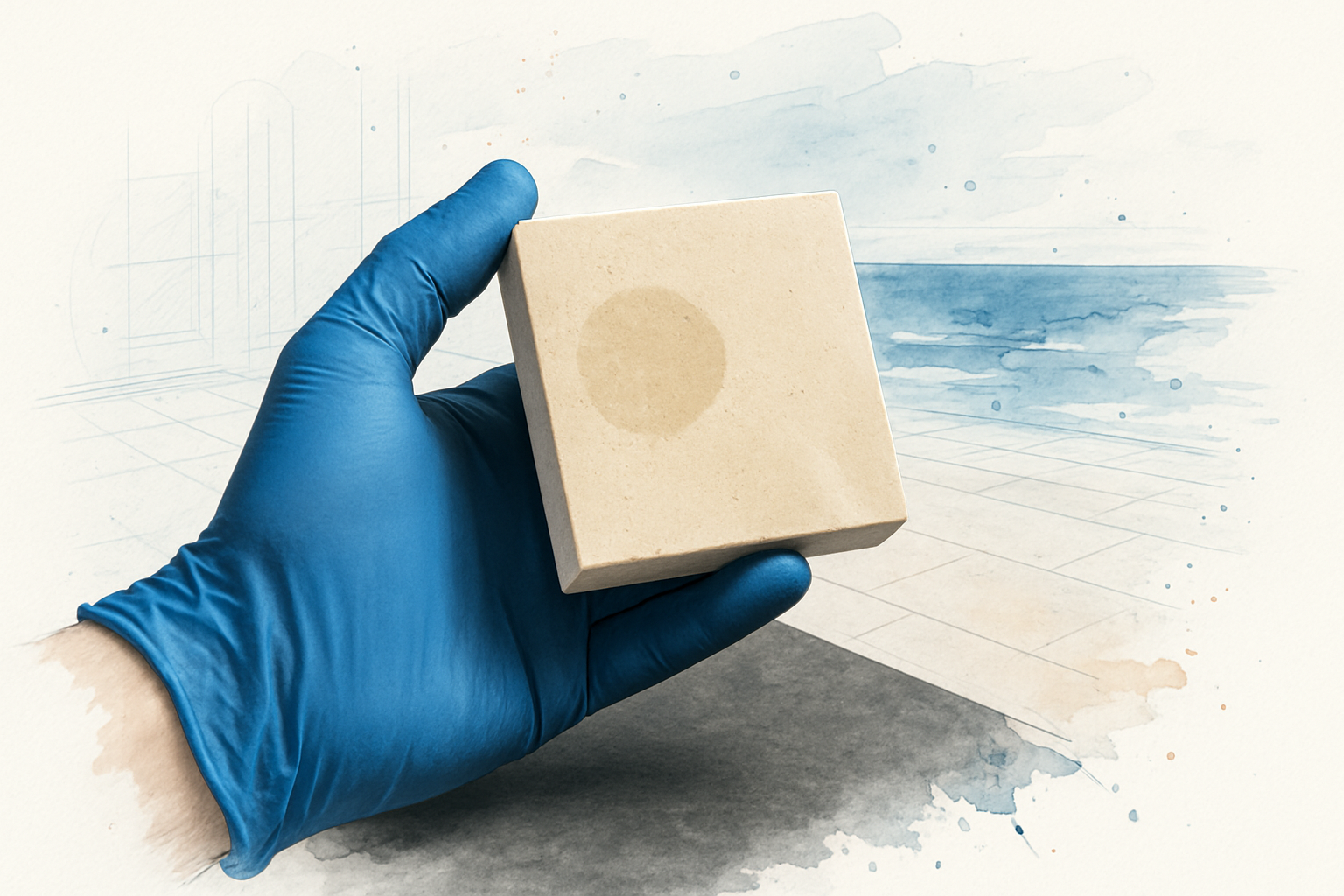
When acid touches the surface, it dissolves a microscopic layer and leaves a dull spot. That is etching, and it is not a stain. A stain is something soaking into the stone and darkening it from within. Two different problems, two different fixes.
The common acid sources in a real house:
- Lemon and lime juice, tomato, vinegar
- Wine, coffee, and some sodas
- Many all-purpose sprays that are not labeled stone-safe
- Tub and tile cleaners with citric or phosphoric acid
- Some “natural” vinegar-based cleaners people assume are gentle
Here is the distinction that clears up most of the confusion buyers walk in with: a sealer reduces absorption, but it does not stop etching. Impregnating sealers sit below the surface and slow liquids from soaking in. They do not put a shield over the stone. Acid still reaches the calcium carbonate.
This is the same chemistry that wears down limestone buildings and monuments over decades, which the USGS explains in its work on acid rain. On a bathroom floor the exposure is far lower, but the mechanism is identical.
Not Every Limestone Behaves the Same Way
“Limestone” is a category, not a spec. Some limestones are dense, tight, and hold up in traffic for decades. Others are chalky, open, and drink up water.
That range is wider than most homeowners realize, and it is the single most useful question to ask before anyone brings out color samples:
- Water absorption rate. Lower is better for wet rooms and exteriors. This is a measurable number, not an opinion.
- Density and abrasion resistance. Relevant for floors, especially floors near a door.
- Quarry and block origin. French, Turkish, Israeli, and Egyptian limestones behave differently from one another.
- Fossil content and veining. Heavy fossil pockets can mean soft spots that wear at a different rate.
A dense French limestone in a powder room is a completely different risk profile than a soft, absorbent stone on a kitchen floor. Our write-up on where Gascogne Beige limestone holds up and where it doesn’t walks through one specific stone in detail, and the same thinking applies to any limestone you are considering.
Start with performance numbers. Then talk about color. Doing it the other way around is how people fall in love with a stone that does not suit the room.
Where Limestone Tile Works, and Where the Finish Has to Change
The honest answer to “is limestone right for my house” changes by room. Finish matters as much as the stone itself.
Bathroom floors, shower walls, and powder rooms are limestone’s home turf. Low acid exposure, low grit, and the matte look is exactly what people want in those spaces. The catch on the Peninsula is drying time.
A honed limestone bathroom floor in Pacific Grove or Carmel-by-the-Sea may not fully dry between showers from October through March. Damp honed stone is slicker than damp textured stone. A tumbled or brushed surface gives you more grip and hides water spotting better, at the cost of holding a little more soap residue in the texture.
Kitchen floors and entryways are a different conversation:
- Kitchens bring acid to the floor by way of spills, not just counters
- Entries near gravel drives in Carmel Valley and Pebble Beach track in quartz-hard grit that scratches soft stone
- Both areas get cleaned more often, so cleaner chemistry becomes a real factor
Pick your finish for the wettest, dirtiest three months of the year, not for the day the tile is installed. And if you are running large-format limestone in a shower, the substrate and setting requirements tighten up considerably, which we cover in what large-format stone tile installs actually demand.
Limestone Tile by Application and Finish
A quick reference for matching room, risk, and surface texture. Confirm the specific stone’s absorption rate before committing to any of these.
| Application | Main Risk | Finish Worth Considering |
|---|---|---|
| Primary bath floor | Standing moisture, slow drying in fog belt | Tumbled or brushed for grip and texture |
| Shower walls | Soap residue, mineral spotting | Honed, sealed, with stone-safe cleaner only |
| Powder room floor | Low traffic, low risk | Honed works well here |
| Kitchen floor | Acid spills, dropped cookware, heavy cleaning | Textured finish on a denser limestone |
| Entry from gravel drive | Tracked-in grit abrading the surface | Brushed or tumbled, plus a real walk-off mat |
| Covered patio | Coastal damp, freeze is rare but moisture lingers | Low-absorption stone, textured finish |
The Water Drop Test: Is Your Sealer Still Working?
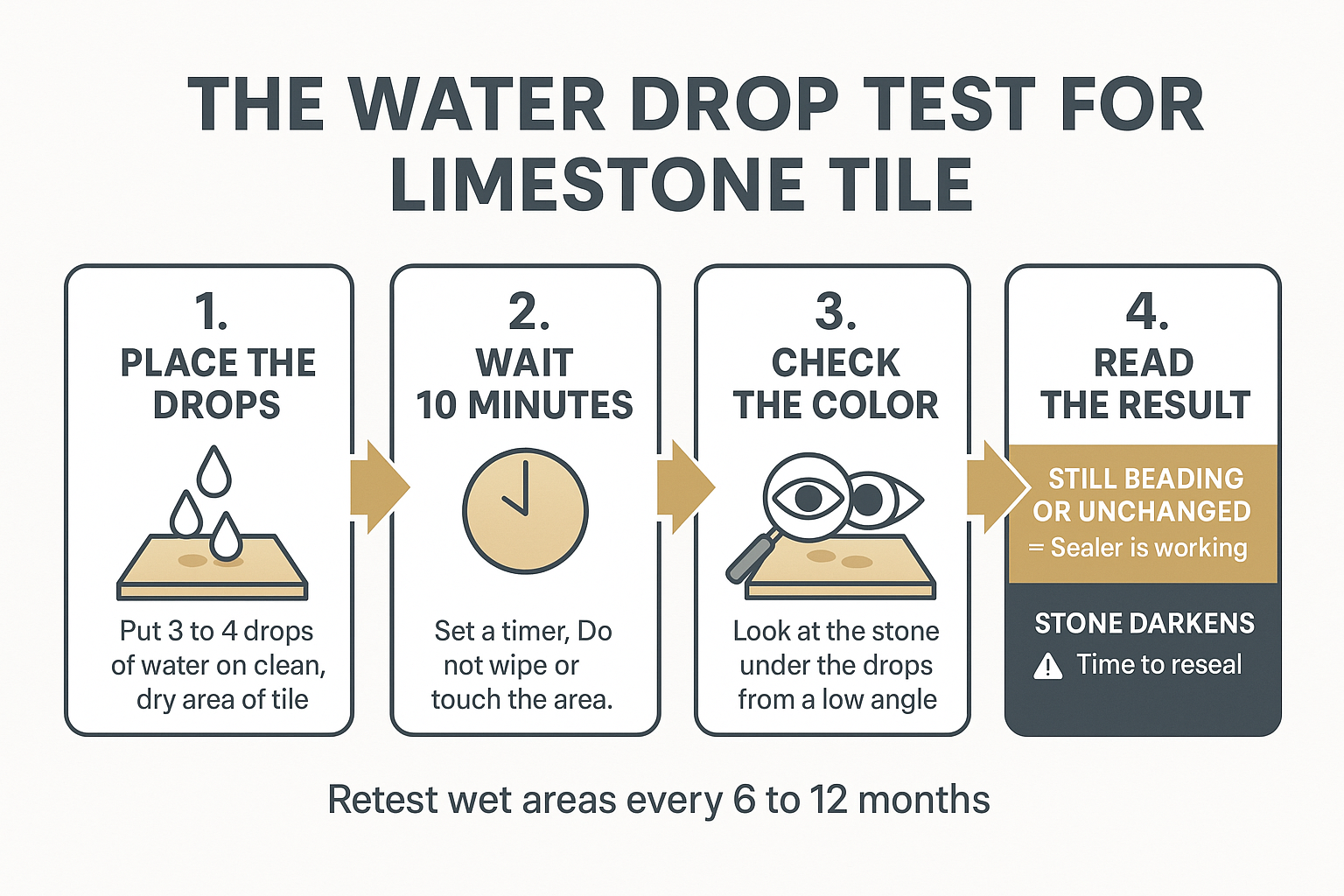
You do not need a pro to tell you when it is time to reseal. This takes two minutes and a glass of water.
Coastal Moisture Changes Your Sealing Schedule
A bathroom in the Carmel fog belt and a bathroom in Salinas are not the same environment, even if the tile came off the same pallet.
Stone that stays damp longer stays vulnerable longer. Marine layer mornings, a bathroom with one small window, and a shower used twice a day add up to a surface that rarely reaches bone dry between October and March.
Practical differences by location:
- Carmel-by-the-Sea, Pacific Grove, Pebble Beach: fog and slow drying. Expect to retest sealer more often, roughly every 6 to 12 months in wet rooms.
- Salinas, San Jose, inland valleys: faster drying, more heat, more UV on exterior surfaces. Interior wet rooms often hold sealer longer.
- Covered patios anywhere on the coast: treat these like wet rooms, not like dry exterior surfaces.
Sealer frequency is not a fixed calendar item. It depends on how much water hits the stone, how fast it leaves, what cleaner is being used, and how absorbent that particular limestone was to begin with.
Run the water drop test instead of guessing. If the stone darkens quickly, reseal. If it stays unchanged, check again in six months. The same approach applies to other calcium carbonate stones, which is why the conversation looks similar in travertine bathrooms on the coast.
The Part Most Limestone Articles Leave Out: It Can Be Fixed
Every discussion of limestone durability stops at the damage. Almost none of them mention that natural stone is a restorable material.
A honed limestone floor that has gone dull and traffic-worn over ten or fifteen years can be re-honed by a stone restoration specialist and brought back to a uniform surface. Etch marks can be polished out. Deep stains can often be drawn out with a poultice.
Manufactured surfaces do not work that way. Damage to a resin-based product is generally permanent because you cannot remove material and expose fresh stone underneath.
This is why limestone floors are still in service in European buildings that are centuries old. They were not protected from wear. They were maintained, and the surface was renewed when it needed it.
Modern impregnating sealers and pH-neutral cleaners also perform far better than the reputation limestone picked up twenty years ago. One professional cleaner recently asked about the right product for built-up grime on a limestone floor without damaging it. That question has a real answer, and it is not “replace the floor.”
Think of limestone as a surface with a maintenance cycle, not a surface with an expiration date.
Limestone Is a See-It-In-Person Material
Limestone shifts more than almost any other stone between showroom lighting and the room it ends up in. A warm cream under halogen can read gray in a north-facing bathroom on a foggy morning.
What actually helps before you commit:
- Take home samples and look at them in the room, at three different times of day
- Ask to see a full crate or several pieces, not one representative tile
- Look at the range, since fossil density and tone vary within a single lot
- Bring your cabinet door, paint chip, or plumbing finish to compare against the stone
One caller summed up the whole category when she said she wanted to come in and see it in person before committing. That is the right instinct with limestone.
Order your overage with the first order, too. Lots vary, and a second order six months later will not match the first, which we explain in detail in why your second tile order won’t match.
On cost, limestone pricing is driven by quarry, block quality, finish, and format rather than by any single number you can look up. A time-worn finish in a large format is a different conversation than a standard 12×12. Ask for a written quote on the specific stone and size you want.
Frequently Asked Questions About Limestone Tile
Will limestone tile etch if I just use it normally in a bathroom?
Rarely, if your cleaner is right. Bathrooms have very little acid exposure compared to kitchens. The most common cause of bathroom etching is the cleaning product, not the use. Switch to a pH-neutral, stone-safe cleaner and skip anything with vinegar, citrus, or bleach-based tub sprays.
How often do I need to reseal limestone tile in Carmel?
There is no fixed schedule. In a coastal bathroom that stays damp much of the winter, retesting every 6 to 12 months is reasonable. Inland homes often go longer. Use the water drop test rather than a calendar, because the stone will tell you before a schedule will.
Is limestone tile a bad idea for a kitchen floor?
Not automatically, but it raises the bar on stone selection. You want a denser limestone with low absorption and a textured finish, plus a realistic plan for wiping acidic spills promptly. A chalky, absorbent limestone in a busy kitchen is asking for trouble.
What is the difference between an etch and a stain?
An etch is a dull spot where acid dissolved a thin layer of the surface. A stain is discoloration from something soaking into the stone. Sealer helps with stains. It does nothing for etching. The fixes are different too, so identifying which one you have matters.
Should I choose honed or tumbled limestone for a shower floor?
Texture helps in wet areas. A tumbled or brushed surface offers more grip and disguises water spotting better than a smooth honed finish. Talk through slip resistance with your tile setter, since grout joint spacing and slope also affect how a shower floor performs.
Can limestone tile be restored after years of wear?
Yes. A stone restoration specialist can re-hone the surface, remove etch marks, and reseal. That is a meaningful advantage over engineered surfaces, which cannot be resurfaced the same way once they are damaged.
Seeing Limestone Tile in Person Before You Decide
Limestone is one of those materials where a take-home sample and a walk through live inventory answer more questions than any article can. The showrooms in Carmel and Palo Alto keep limestone tile on hand, along with samples you can look at in your own room light, and one homeowner recently wrote, “We are thrilled with our purchase of honed limestone tiles from Carmel Stone.”
Worth knowing up front: Carmel Stone Imports supplies material and does not fabricate, cut, or install, so setting, slope, and grout questions belong with your tile setter. For slab and tile selection appointments or availability on a specific limestone, call (650) 800-7840 or email info@carmelimports.com.