
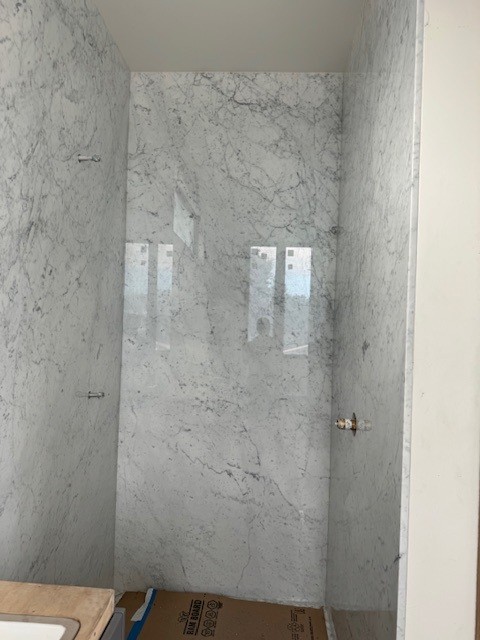
Direct Answer: Read a marble slab in person by checking how its veining runs, which lot it came from, how the finish behaves, and how it looks in your home’s actual light.
You found the marble online. You saved the photo, showed it to your designer, maybe even sent the name to your fabricator. Then you walked into a warehouse, stood in front of the actual slab, and something felt off.
That gap is normal, and it happens constantly on the Monterey Peninsula. A name like Calacatta, Arabescato, or Paonazzetto describes a family of stone, not one consistent product. The catalog image is not what you are buying. The slab in front of you is.
This guide walks through what to actually look at, in order, before you commit. Five checks, each one takes a few minutes, and together they prevent the thing nobody wants: a finished kitchen in Carmel, CA that looks nothing like the picture you fell in love with.
Step 1: Understand That the Name Is a Family, Not a Spec
Marble names come from regions, quarries, and historical trade language. They tell you roughly where a stone came from and roughly how it tends to look. They do not guarantee color, vein weight, or background tone.
Two slabs labeled the same name, pulled from the same quarry in Carrara, can read very differently in person. Between quarry blocks and production runs, the difference gets more pronounced.
What actually varies slab to slab:
- Background tone, from bright white to warm cream to soft gray
- Vein color, ranging from charcoal to gold to green undertones
- Vein density, from a few quiet lines to heavy movement across the whole face
- Vein direction, which is set by how the block was cut
- Crystal structure and translucency, which changes how light behaves on the surface
This is why so many callers say some version of the same thing: they saw it on the website but are not sure it is what they need. It is also why live inventory matters. Material moves through the Sand City warehouse and the Carmel Rancho Lane showroom on a rolling basis, so what is actually on the racks this month is not what was there last month.
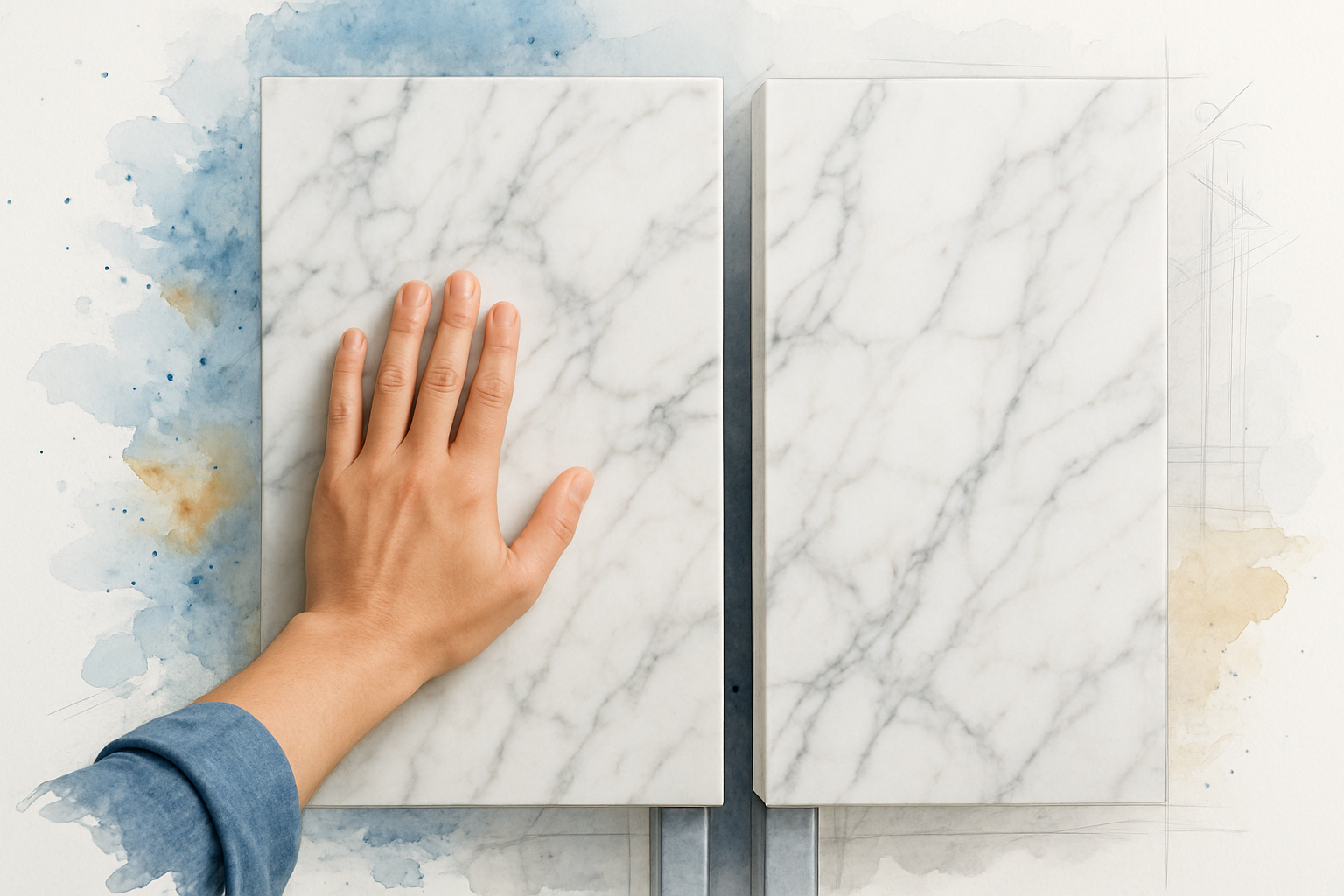
Step 2: Look at the Movement the Way It Will Actually Be Installed
Most slabs sit upright on racks, but plenty get viewed flat or at odd angles. That matters more than people expect.
A slab with strong diagonal veining reads one way lying horizontal and a completely different way standing vertical. A pattern that looks balanced on a countertop can look like it is sliding off the wall as a full height backsplash.
Ask the staff to stand the slab upright, or walk around and view it from the angle it will live at. Then do three things:
- Step back at least eight feet. Vein patterns resolve at room distance, not nose distance.
- Photograph the full slab straight on, not at an angle, so your fabricator sees true proportions.
- Mark roughly where your sink and cooktop cutouts land. A gorgeous vein cluster is wasted if it disappears under a farmhouse sink.
Light changes the read too. A slab under warm overhead warehouse light behaves differently than the same stone under the flat afternoon light you get in a Pacific Grove kitchen. This is one of the most common reasons a finished counter feels unfamiliar. For a deeper breakdown, veining, movement, and batch numbers covers how each one shifts the final look.
Step 3: Ask Which Lot the Slabs Belong To
This is the step buyers skip most often, and it causes the most trouble on larger projects.
Slabs cut from the same quarry block share a lot number (sometimes called a batch or bundle number). Those slabs sit in sequence and share color, vein direction, and background tone far more closely than slabs from a different block of the same material.
If your project needs more than one slab, lot matching is not optional:
- Bookmatched installations require two consecutive slabs from the same lot, opened like a book
- Sequenced runs across a long island plus perimeter counters need the whole set from one lot
- A countertop plus full height backsplash should come from the same lot or the seam line will read as a color break
One buyer contacted the showroom while coordinating multiple slabs with a fabricator and asked for exactly this: confirmation of lot numbers and slab dimensions before committing. That is the right question to ask.
Get three specifics in writing before you say yes: the lot number, the true dimensions of each slab, and how many slabs from that lot remain available. Lots run out, and once a block is gone, it is gone.
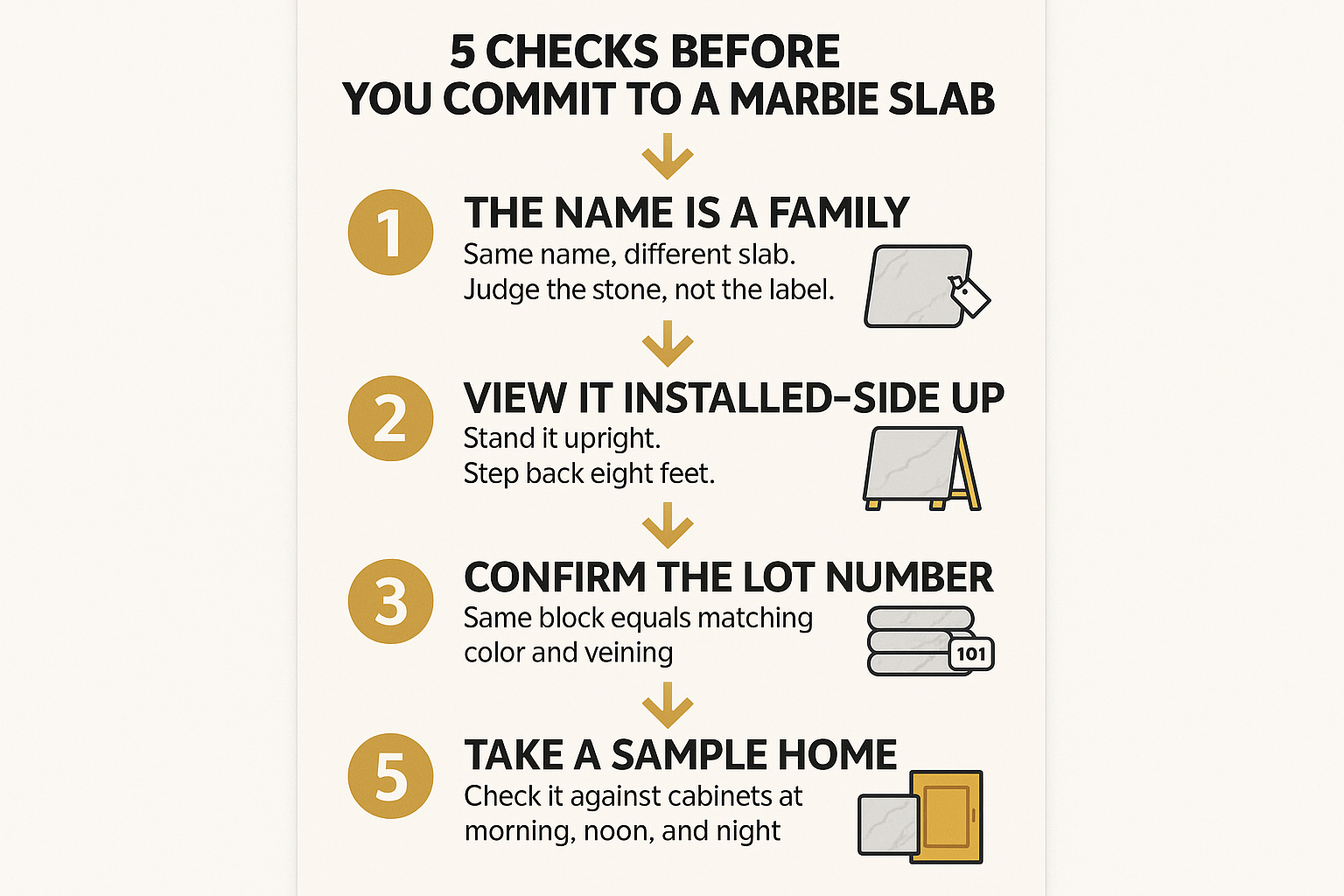
The Five Checks, In Order
Run through these in sequence during a slab selection appointment and you will catch the issues that show up later.
Finish Comparison: What Each One Actually Costs You in Upkeep
Finish is usually treated as a look decision. It is really a maintenance decision, because the same marble behaves differently depending on how the surface was processed.
| Finish | How It Reads | What to Expect Day to Day |
|---|---|---|
| Polished | Deeper color, sharper vein contrast, formal | Shows water marks and etching most visibly; every acidic spill leaves a dull spot until it is addressed |
| Honed | Softer, matte, quieter vein contrast | Hides minor surface marks well, but absorbs stains more readily if sealing is neglected |
| Leathered | Textured, low sheen, tactile | Sits between the two; hides fingerprints, but fine particles can settle into the texture and need regular cleaning |
Step 4: Treat the Finish as a Maintenance Decision
Marble is calcium carbonate, which means it reacts with acids. Lemon juice, wine, vinegar, and some household cleaners can etch the surface no matter how well it is sealed. Groups like the Natural Stone Institute publish care guidance that spells this out clearly.
Here is the part people underestimate: etching is not staining. Etching is a dull mark in the surface. Staining is discoloration soaking in from below. They have different causes and different fixes.
That is also the good news about natural stone. Modern sealers and cleaners resist both far better than they did fifteen years ago, and marble that does get damaged can generally be restored by a stone care professional. Engineered products do not repair the same way.
Pick your finish based on who lives in the house and how the kitchen gets used. A Carmel Valley family with two teenagers and a polished Calacatta island will have a different experience than a Pebble Beach couple using a honed slab in a powder room. The finish on your slab matters more than most buyers realize going in.
Step 5: Take a Sample Home Before You Finalize
Showroom lighting is generous. Warm overhead light flatters cooler toned marbles and softens gray veining. Your kitchen may not be so kind.
A slab that looks warm and creamy on the rack can read cooler and starker in a room with north facing windows or LED recessed cans. On the Monterey Peninsula, where morning fog can hold until midday and afternoon light comes in hard, this shift is significant.
So before you commit:
- Take a physical sample home. Samples are available for most materials.
- Hold it against your actual cabinet doors and flooring, not against a paint chip.
- Look at it three times in one day: morning, midday, and after dark under your own fixtures.
- Bring your cabinet door back to the showroom if you are still torn, and ask staff to pull comparison slabs.
That last step is worth doing. Reviewers regularly mention staff pulling out alternatives so they could see materials side by side, and one buyer described the process as “streamlined and genuinely enjoyable” instead of overwhelming. Seeing two candidates next to each other resolves the decision faster than staring at one slab for an hour. If you are weighing the trade offs, picking a slab in person versus online breaks down where the real risk sits.
Frequently Asked Questions About Marble Slab Selection
Can you hold a slab while I confirm with my fabricator?
Suppliers commonly offer a short, time-bound hold so you can coordinate measurements and templating. Ask about the hold policy while you are standing in front of the slab, not a week later. Holds are the single most useful tool for buyers who need square footage confirmed before committing.
Why do two slabs with the same marble name have different prices?
Pricing is driven by the specific block, the rarity of the coloring, slab thickness, finish, and the current supply from that quarry region. Costs move with shipping and quarry output too, so a firm number really has to come from the showroom for the exact slab you are looking at.
Do I need an appointment to look at slabs?
Walk-ins are welcome at the showrooms. That said, a scheduled slab selection appointment usually gets you more focused time with a design consultant, which matters if you are comparing several materials or coordinating a multi-slab project.
Does the supplier cut or install the stone?
No. This is a supplier and showroom business, so material selection and delivery coordination happen here, and fabrication and installation are handled by your own fabricator or contractor. Referrals to fabricators in the Monterey Peninsula and Bay Area are available if you need a name.
How many slabs should I buy for a kitchen?
Your fabricator determines that from templated measurements, not from a floor plan estimate. Many kitchens with an island plus perimeter counters land in the two to three slab range, but layout, seam placement, and whether you want a full height backsplash all change the count. Confirm the number before you reserve a lot.
Want to See the Slabs in Person?
Slabs move through the Carmel and Palo Alto showrooms on a rolling basis, and the Sand City warehouse holds inventory for Central Coast projects. If you would like to walk the racks, compare lots side by side, or take a sample home before you decide, the team at Carmel Stone Imports can set up a slab selection appointment. Reach them at (650) 800-7840 or info@carmelimports.com.