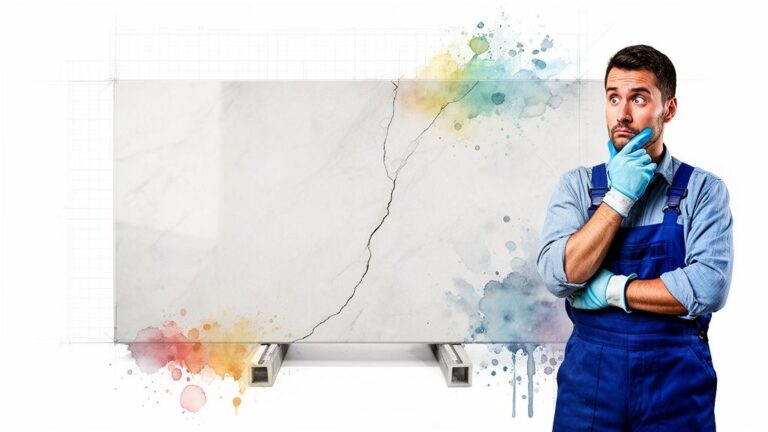
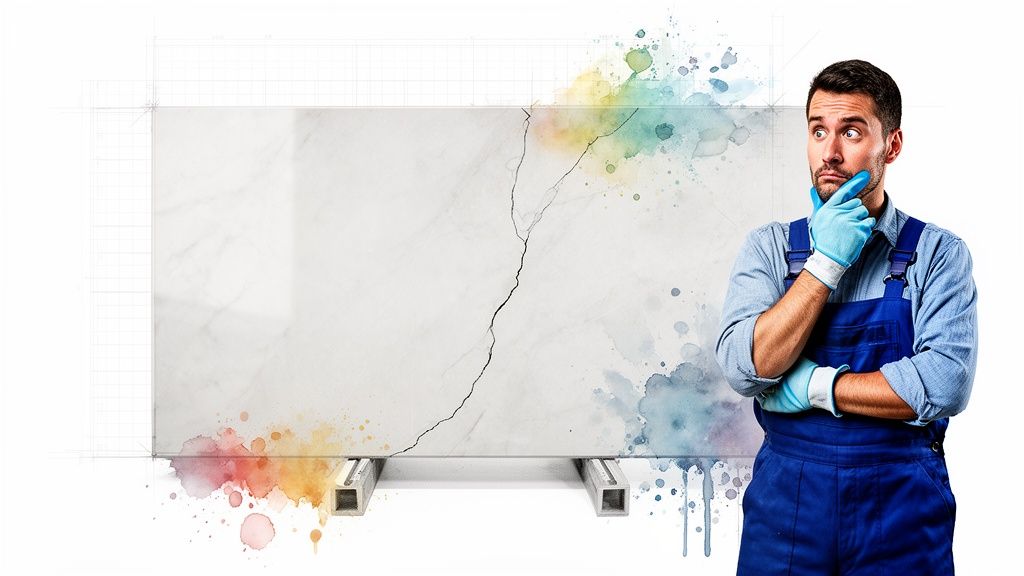
The biggest mistake contractors make with porcelain slabs is completely misjudging the total project cost. Many assume it's cheaper than natural stone, but then receive unexpectedly high quotes that seem out of sync with the material cost. This almost always leads to sticker shock for them and their clients.
The reality? That slab price is just the starting line. The real cost comes from the skilled labor and special equipment needed for a flawless result. This article breaks down what contractors get wrong about porcelain slab pricing and how to quote jobs with confidence.
Solving The Porcelain Pricing Puzzle
"Why is this porcelain quote so high?" It's a common question we hear from contractors across California. Many look at the raw material price, assume it will be cheaper than natural stone, and then get a bid that tells a totally different story.
The confusion is understandable. One Reddit user even shared a client's quote for over $56,000 for a porcelain project, sparking a big debate about where those costs came from. The answer isn't the material—it's the complexity. Porcelain’s popularity has surged, but a clear understanding of its cost drivers has not.
Breaking Down The Real Cost Drivers
A porcelain quote isn't just about the slab itself. It is a reflection of the true complexity of the job. Mitered edges, full-height backsplashes, and even just handling the large format slabs all demand time, precision, and skill.
Here’s what’s really driving the cost:
- Specialized Handling: These large slabs are surprisingly fragile during transport. You need specific A-frames and high-end suction cup systems to move them without a catastrophic crack.
- Precision Cuts: Getting clean, chip-free cuts for mitered edges or perfect openings for sinks demands waterjet cutters or special diamond blades.
- Skilled Labor: Not every shop has the experience—or the nerve—to work with porcelain. The pros who do it well are in high demand and command higher rates.
Before quoting a job, you need to manage all these moving parts. A great first step is to explore ways to reduce construction costs without ever compromising on quality.
This chart gives you a clear visual of how project costs break down. It shows that the material is just one piece of the pie.

The data makes it obvious: while the slab has its cost, specialized labor and equipment make up a huge chunk of the total investment.
Porcelain Project Cost Factors Beyond The Slab
Many contractors get caught off guard by expenses they did not expect. Here’s a quick comparison of where porcelain projects demand more investment compared to a standard quartz job.
| Cost Factor | Why It Impacts Porcelain More | Typical Contractor Misconception |
|---|---|---|
| Specialized Transport | Porcelain is brittle and prone to cracking during transit. It requires A-frames and suction lifts, not just manpower. | "We can just carry it in like any other slab." |
| Specialized Tools | Standard diamond blades will chip or crack porcelain. Waterjets or porcelain-specific blades are non-negotiable. | "My saw is good enough; it'll be fine." |
| Labor Expertise | It requires technicians trained in handling large, thin, and brittle material. A smaller pool of skilled labor means higher rates. | "Any experienced pro can handle this." |
| Surface Prep | The surface underneath must be perfectly flat (<1/8" over 10 ft). Any imperfection can cause stress cracks. | "A little extra adhesive will even things out." |
| Breakage/Waste Factor | The risk of a slab cracking is higher. Experienced shops build a higher waste factor into their quotes to account for this. | "We'll order just what we need to save on material." |
Before you source a slab for a project in the Bay Area or Monterey, talk to a supplier who understands the entire process. A partner like Carmel Stone Imports can give you a transparent breakdown of material versus labor costs. This helps you explain the true value to your clients with total confidence.
Why Porcelain Is Not Just 'Big Tile'
One of the most expensive mistakes a contractor can make is thinking a porcelain slab is just a bigger version of a standard tile. This thinking leads to cracked slabs and unhappy clients, especially in markets like Monterey and Palo Alto.
Think about the difference between a large sheet of glass and a thick wooden plank. Both are strong, but one can shatter from a sharp impact. Porcelain slabs share that glass-like quality. Their dense structure makes them tough for homeowners but unforgiving under the wrong kind of stress.
The Brittleness Factor
This brittleness is the key difference. A regular ceramic tile has some give. A quartz slab has resins that add flexibility. Porcelain has neither. It’s a pure, rigid material.
The biggest mistakes with porcelain often happen long before the slab gets to the job site. The entire process—from transport to final placement—must account for its glass-like nature.
Ignoring this is asking for trouble. Many in the industry will tell you that treating porcelain like quartz or natural stone is a leading cause of fractures. As leading stone experts explain, these materials cannot be handled the same way without a high risk of failure. You can explore their insights on porcelain slab installation failures to learn more.
This basic misunderstanding is what separates a profitable job from a financial disaster. It is not about one material being "stronger." It's about understanding the type of strength each one has and adapting your methods.
Key Material Differences to Respect
To avoid cracks and callbacks, you must stop thinking of porcelain as "big tile." It's a high-performance surface that needs to be treated differently.
- Composition: Porcelain is fired at much higher temperatures than ceramic tile. This process makes it far denser, less porous, and more brittle.
- Flexibility: Unlike engineered quartz, which contains resins that give it some bend, porcelain has almost no flex. Any tension from an uneven surface or improper handling can lead to a crack.
- Weight & Size: The combination of large size and heavy weight creates unique challenges. This isn't something you can just muscle into place.
Once you grasp these properties, it becomes clear why specialized handling is an absolute requirement. For a deeper dive, our advanced guide to choosing porcelain slabs offers more detail for Bay Area professionals.
The True Cost Of Moving Large Format Slabs
The journey from a supplier's warehouse to a Bay Area job site is where a porcelain project's budget can completely fall apart. The logistics are one of the most underestimated parts of what contractors get wrong about porcelain slab installation.
Moving these huge, heavy, yet brittle slabs is not a two-person job with a pickup truck. It's a high-stakes operation that demands precision, special gear, and a solid plan.

A Lesson Learned The Hard Way
We recently spoke with a Bay Area contractor who learned this lesson on a high-rise project. During the final lift into the unit, a slight twist and poor support caused a hairline crack to spread across the entire slab.
Just like that, his profit margin shattered along with the porcelain.
Logistics are not an afterthought. They are a critical project phase that demands its own budget, equipment, and skilled team. The cost of a broken slab almost always exceeds the cost of proper handling equipment.
This story is a powerful reminder that transport planning is not just about getting from point A to point B. It’s about making sure the slab arrives in perfect condition.
Partnering For A Successful Delivery
The key to avoiding these costly mistakes is to plan your logistics with care. Before you finalize a quote, your supplier should be part of this conversation.
An expert supplier like Carmel Stone Imports can provide essential guidance on:
- Required Equipment: We can advise on the right A-frames and lifting systems for the specific slab you've selected.
- Site Accessibility: We help you think through the delivery path, from our warehouse in Palo Alto or Carmel to the final placement on-site.
- Team Coordination: We offer insights on how many people are needed and the best practices for handling to prevent breakage.
To learn more about oversized porcelain, our guide on large format porcelain slabs is a great resource. By partnering with a knowledgeable supplier, you ensure every slab arrives intact.
How Edges And Finishes Drive Project Complexity

Here's another place contractors get into trouble: underestimating the skill, time, and precision needed for high-end finishes.
Quoting a mitered edge or a seamless waterfall island on a porcelain project is completely different than with natural stone. This misunderstanding is a frequent and costly part of what contractors get wrong about porcelain slab installation.
Why Premium Finishes Demand Premium Labor
Porcelain’s dense and brittle nature turns every cut into a high-stakes operation. Nailing a clean, chip-free mitered edge or a book-matched waterfall requires special diamond blades and a slow, careful hand.
One wrong move can compromise an entire slab.
This is high-risk work that justifies higher labor costs. In luxury markets like Palo Alto and Carmel, clients expect these design details. They are signatures of quality that demand true artistry.
Quoting sophisticated edge profiles on porcelain without accounting for the increased labor and risk is a direct path to losing your profit margin. The cost is in the experience required to execute it flawlessly.
It’s important to help clients understand what they’re paying for. They are investing in the specialized talent needed to deliver a perfect, seamless result.
Common High-Complexity Finishes
Certain design choices will dramatically increase the skill, time, and cost involved. When you create a quote for a porcelain job, be ready for these elements to impact your labor estimate.
- Mitered Edges: This technique creates the look of a solid, thick block of stone. It involves cutting two pieces at a perfect 45-degree angle so they meet seamlessly.
- Waterfall Islands: A popular design where the countertop material flows vertically down the sides. This often involves multiple mitered edges and perfect book-matching of any veining.
- Full-Height Backsplashes: Taking the same slab from the counter up to the cabinets makes a stunning visual statement. But it means making large, delicate cuts for outlets and fixtures.
To get a better handle on these requests, our guide on edge options for countertops is a great resource. Recognizing the complexity of these finishes from the start is key to creating an accurate quote.
Your Pre-Quote Action Plan
Before you quote or source porcelain slabs, consult with a supplier that understands slab size, edge treatments, and professional availability. Get a breakdown of material vs. labor costs so you can explain it clearly to clients and protect your margins.
The most common question contractors ask is: "Why is porcelain pricing all over the place?" They often assume it's cheaper than natural stone, only to receive high quotes that seem out of line with the material cost.
The Pricing Puzzle Solved
Recent insights show that porcelain’s surge in popularity has brought demand, but not understanding. A Reddit user reported a $56K quote, sparking debate. The reality is that porcelain requires skilled labor and special equipment for clean cuts and handling, which drives up the cost.
So, what does this mean for you? Pricing isn’t just about material—it’s about project complexity. Mitered edges, large-format handling, and fragile cuts all demand time and precision from skilled professionals.
Before quoting, partner with a supplier who truly understands the full scope of a porcelain project. This relationship is your best defense against unexpected costs and client sticker shock.
Your Pre-Quote Checklist
Before your next porcelain job, arm yourself with a checklist of essential questions for your supplier. This positions you as a knowledgeable expert.
Questions for Your Supplier:
- Slab Suitability: Is this specific slab rated for my client’s intended use (e.g., outdoor, high-traffic)?
- Handling Requirements: What will it take to move this slab? Does it need special A-frames or suction cups for transport?
- Professional Network: Do you have a list of trusted professionals in the Bay Area with a proven track record with this material?
- Cost Breakdown: Can you provide a clear breakdown of the material cost versus typical handling and finishing costs?
The first step is finding the right supplier. Our post about where to buy porcelain slabs is the perfect place to start.
Frequently Asked Questions
Here are some of the most common questions we hear from contractors about porcelain slabs.
Why does porcelain cost so much more than tile if it's a similar material?
While porcelain slabs and tiles are both ceramic-based, a slab is not just a "big tile." The real cost difference comes from the specialized manufacturing, handling, and finishing it requires. It’s the cost of that expertise and machinery—not the porcelain itself—that drives up the final project price.
Can porcelain slabs be used for outdoor projects in the Bay Area?
Absolutely. Porcelain is an outstanding choice for outdoor applications, especially in coastal California climates like Monterey. Its surface is non-porous, making it highly resistant to staining, and its colors won’t fade under intense sun. However, it must be specified and supported correctly for outdoor use to avoid damage.
Is porcelain more durable than natural stone like marble?
In some ways, yes. Porcelain is virtually non-porous, which makes it a fortress against stains and scratches. However, durability isn't just about surface hardness. A significant impact on a porcelain slab can cause a crack, which is a much bigger problem to fix than a chip in marble.
What is the biggest misconception about quoting porcelain jobs?
The single biggest mistake is quoting a porcelain job based only on the material's square-foot price. The real costs are in the logistics. You have to factor in specialized transport, high-risk finishing for features like mitered edges, and the small pool of skilled professionals qualified to handle these slabs.
How can I explain the high cost to my client without losing the bid?
Transparency is your best tool. Break your quote down so they can see the difference between material cost and the necessary expenses for specialized transport and expert labor. Frame it as an investment in a flawless result, which builds trust and wins jobs.
If you need help navigating porcelain slab selection or planning, Carmel Stone Imports offers consultative support at every step. Visit a showroom or talk with our team—we’ll make sure you quote with confidence. Learn more at Carmel Stone Imports.