
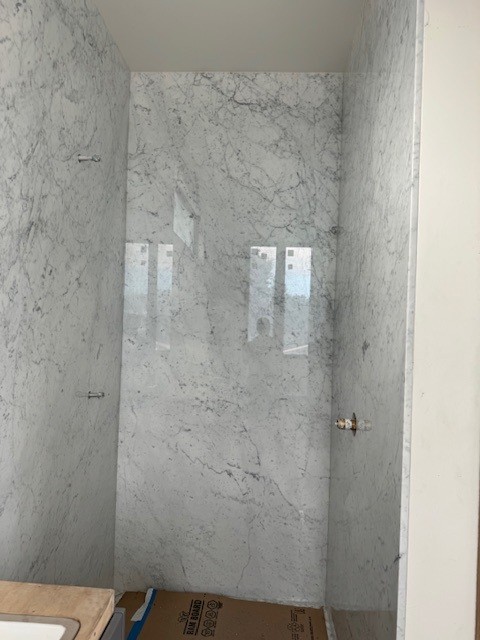
Direct Answer: A porcelain slab brand names the manufacturer, not the specific panel. You also need the collection, color name, finish, thickness, and panel size before two people can compare the same material.
Someone handed you a name. Maybe your designer wrote a producer on the spec sheet, maybe your contractor texted you a color like Calacatta Gold, and now you are calling showrooms trying to shop with it.
And you get different answers everywhere you call. One place says they have it, one says they have something close, one asks you three questions you cannot answer. That is not bad luck. A porcelain slab brand name, on its own, does not identify a single product.
This guide breaks down what a brand name on a porcelain spec actually pins down, what it leaves wide open, and the short list of details to write down before you shop. If you are remodeling in Carmel-by-the-Sea or anywhere on the Monterey Peninsula, it will also save you a drive.
What a Porcelain Slab Brand Name Actually Identifies
Think of a porcelain name as three layers stacked on top of each other. Most spec sheets show one layer clearly and leave the rest to be assumed.
- The producer. This is the factory. It tells you who pressed and fired the panel, what body they use, and what surface printing technology sits on top. It does not tell you which product.
- The collection or series. This is the line within that factory, and it sets the available colors, finishes, thicknesses, and panel sizes. Two collections from the same producer can behave very differently.
- The individual panel and its lot. Porcelain is produced in production runs. Panels from the same collection but different runs can shift slightly in background tone and gloss.
So when a visitor types a producer name into a chat box and asks if a showroom supplies it, the honest answer is always another question: which collection, which color, which finish, and what size panel.
That is not a runaround. It is the difference between a brand and a part number. A producer may publish dozens of collections and hundreds of color and finish combinations across them.
Worth knowing before you shop: a stone and tile showroom is a supplier. The cutting and installing is handled by your own fabricator, and who handles what in a remodel is a separate question from which brand you spec.

Why Two Panels Named Calacatta Gold Are Not the Same Product
Marble-look names are descriptions, not trademarks. Calacatta Gold, Statuario, and Bianco Carrara show up across many porcelain producers because they describe a look borrowed from natural quarries in Italy.
Two panels carrying the same name from different factories can differ in:
- Vein scale, meaning how thick and how far apart the veins run
- Background tone, from cool gray-white to warm cream
- Gloss level, since “polished” means different things at different factories
- Panel size, which changes where your seams land
This summer two requests came through from the same San Francisco kitchen project, each naming a polished gold-veined white porcelain from a different producer. Same look on paper. Not the same product.
If you are also weighing the natural version, the difference between Statuario and Bianco Carrara marble is a useful read, because the porcelain is printed to imitate one of them.
Write these six things down before you shop anything: producer, collection, color name, finish, thickness, and panel format. Showing up with only “Calacatta” is how two people end up comparing surfaces that were never the same material.
The Six Lines That Make a Porcelain Spec Usable
Here is what each line on the spec pins down, and what tends to go sideways when it is missing.
| Spec line | What it pins down | What goes wrong without it |
|---|---|---|
| Producer | The factory, the porcelain body, the printing technology | You get shown a lookalike from a different factory |
| Collection or series | Which colors, finishes, and sizes exist at all | You request a size the line was never produced in |
| Color name | The specific pattern within that collection | Vein scale and background tone come out different |
| Finish | Polished, matte, or textured surface | Gloss mismatch against cabinets, tile, and fixtures |
| Nominal thickness | Which strength criteria apply and how it fabricates | Your fabricator declines the panel or changes the edge detail |
| Panel format | Where seams land on an island or backsplash | Extra seams show up in the middle of the run |
The Three Layers of a Porcelain Slab Name
A quick visual of how a brand, a collection, and a single panel stack together.

Brand Reputation Is Not Technical Data
A well-known name tells you a factory has been around. It does not tell you how the panel performs in your shower, on your floor, or over your island.
The real answers sit in the manufacturer’s technical data sheet. In the United States, gauged porcelain tile panels and slabs are covered by ANSI A137.3, the standard listed by the Tile Council of North America, which sets minimum physical properties and grading procedures and groups strength criteria by declared nominal thickness.
That last part matters. A 6mm panel and a 20mm panel are not held to the same numbers, so “it is porcelain” is not a performance answer on its own. Our breakdown of 6mm, 12mm, and 20mm porcelain slab thickness covers where each one belongs.
When you ask for a data sheet, look for:
- Declared nominal thickness and the strength figures tied to it
- Surface finish and slip performance, which is the line that matters for any floor or wet area
- Panel sizes the collection is actually produced in, not sizes the factory offers elsewhere
One request this summer asked for pricing on a 12mm porcelain panel against a 2cm silica free quartz slab for a three wall alcove tub surround. Two different material categories, no performance data in hand for either. Pricing on porcelain swings with producer, thickness, finish, and whether the line is stocked or special order, so treat any number you see online as a starting point and ask a showroom to confirm the current figure for the exact panel.
Asking for a data sheet is a normal request. A line worth specifying will have one.
Availability Breaks More Brand-Spec’d Plans Than Looks Do
Stock was the single biggest question category in our August phone calls, right around a third of them. Several callers with jobs already underway ended the conversation the moment import timelines came up, since brand-spec’d porcelain often has to come across the water.
Import windows in this market are commonly quoted in the range of 90 to 120 days, though that varies by producer and shipment, and any supplier should confirm the current window for your specific line rather than guess.
The two sides of our region behave differently here:
- Palo Alto, Los Altos, and San Jose projects often run on a contractor’s calendar in housing stock built around the early 1960s. If demo is scheduled, ask what is physically on the floor in the same look before you lock a brand into the plan.
- Monterey Peninsula projects usually move slower, and a lot of owners here are making a once and done material choice. A slower timeline is the thing that buys you the option to order a specific collection and wait for it.
There is a second reason to see the real panels. Porcelain is printed, so the pattern repeats on a cycle that natural stone does not have.
On a 10 foot island or a full height backsplash running across two panels, that repeat can become visible once the material is up. Eleven of eighteen chat conversations this summer asked whether a named slab was in stock right now, and one homeowner sourcing two to three panels for a kitchen island asked outright for close-up photos and whether the material could be seen in person.
That instinct is correct. Asking for photos of the specific panels is reasonable, and what to confirm before approving a slab from photos covers the details photos tend to hide. Seeing what is actually in the rack is also the point of live inventory at a slab supplier.
What a House Collection Name Means
Some porcelain and stone lines carry a showroom’s own collection name instead of a household brand. People quietly wonder whether that means it is a lesser product.
It does not. A house collection is material developed with a factory to a specific color and finish, which is a different thing from a generic substitute.
Robbie Robinson, founder of Carmel Stone Imports, puts it plainly: “I go to inspect each quarry and factory, and teach them how to produce the colors and finishes we want in our collections.” Material from 12 countries arrives through the Port of Oakland and moves out to roughly 200 stone and tile showrooms across the western United States and the Midwest.
Judge a house collection the same way you judge a branded one: data sheet, finish, format, and the panel standing in front of you. As one customer put it after a bathroom project, “Brianna was super helpful in finding us great porcelain and stone tiles for our bathroom remodel.”
Frequently Asked Questions About Porcelain Slab Brands
Do showrooms carry every brand a designer might spec?
No showroom carries every producer, and brand lineups change as lines get added or discontinued. The better question to ask is which collections are stocked right now in the look, finish, and panel size you need. Call the showroom and ask what is physically on the floor before you drive over.
Is Calacatta Gold a brand?
No. It is a look name borrowed from Italian marble, and many porcelain producers sell a version of it. Two panels with that name from different factories can differ in vein scale, background tone, and gloss, so you need the producer and collection along with the color name.
Can I ask a supplier for the technical data sheet?
Yes, and you should. The data sheet is where the declared nominal thickness, strength figures, slip performance, and produced panel sizes live. It is a standard document for any line worth specifying, and the team can share product documentation.
How many panels should I look at before deciding?
Look at every panel going into the job, especially for an island or a full height backsplash. Porcelain pattern repeats, so two panels sitting next to each other can show the cycle. If you cannot get in, ask for close-up photos of the specific panels rather than catalog images.
Does the brand I pick change which fabricator I need?
It can. Large-format porcelain is less forgiving than natural stone at the edges and around cutouts, and not every shop runs the tooling for it. Confirm your fabricator works with the thickness and format you spec’d before the material is ordered.
Bringing a Porcelain Spec Sheet to a Showroom
If you have a producer and a collection written down and want to see how the actual panels read in person, the showrooms in Carmel, Palo Alto, and Sand City keep live inventory on the floor for exactly that. Bring the spec sheet, your cabinet door, and your panel dimensions, and the team can confirm what is in stock and share product documentation. Reach the team at (650) 800-7840 or info@carmelimports.com to arrange a slab selection appointment.